Page 452 of 656
AUTOMATIC TRANSMISSION (4 A/T) 7B1-43
On-Vehicle Service
Maintenance Service
Fluid level
LEVEL CHECK AT NORMAL OPERATING TEMPERATURE
1) Stop vehicle and place it level.
2) Apply parking brake and place chocks against wheels.
3) With selector at P position, start engine.
4) Warm up engine till fluid temperature reaches normal oper-
ating temperature (70 – 80 °C (158 – 176 °F)). As a guide to
check fluid temperature, warm up engine till engine coolant
temperature meter indicated around 1 unit above “C” point.
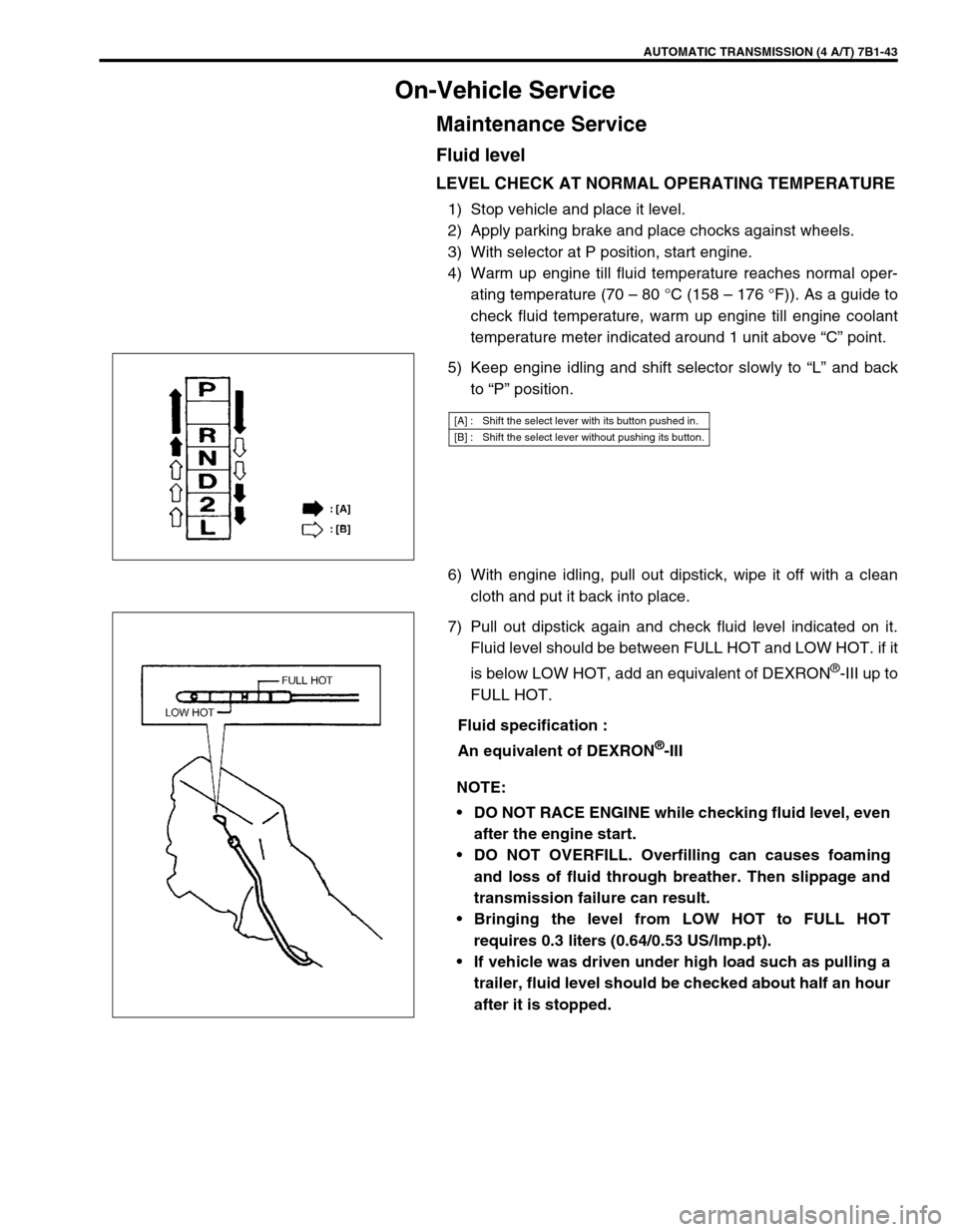
5) Keep engine idling and shift selector slowly to “L” and back
to “P” position.
6) With engine idling, pull out dipstick, wipe it off with a clean
cloth and put it back into place.
7) Pull out dipstick again and check fluid level indicated on it.
Fluid level should be between FULL HOT and LOW HOT. if it
is below LOW HOT, add an equivalent of DEXRON
®-III up to
FULL HOT.
Fluid specification :
An equivalent of DEXRON
®-III
[A] : Shift the select lever with its button pushed in.
[B] : Shift the select lever without pushing its button.
NOTE:
DO NOT RACE ENGINE while checking fluid level, even
after the engine start.
DO NOT OVERFILL. Overfilling can causes foaming
and loss of fluid through breather. Then slippage and
transmission failure can result.
Bringing the level from LOW HOT to FULL HOT
requires 0.3 liters (0.64/0.53 US/lmp.pt).
If vehicle was driven under high load such as pulling a
trailer, fluid level should be checked about half an hour
after it is stopped.
Page 486 of 656
DIFFERENTIAL (REAR) 7F-1
7F
SECTION 7F
DIFFERENTIAL (REAR)
CONTENTS
General Description ........................................ 7F-2
Diagnosis ......................................................... 7F-2
Diagnosis Table ............................................ 7F-2
On-Vehicle Service.......................................... 7F-3
Precaution for Maintenance Service ............. 7F-4
Differential Gear Oil Change ......................... 7F-4
Rear Differential Assembly ............................ 7F-5
Dismounting .............................................. 7F-5
Remounting ............................................... 7F-5
Unit Repair ....................................................... 7F-6Disassembling Unit ....................................... 7F-6
Component Inspection .................................. 7F-9
Sub-Assembly Adjustment and Reassembly 7F-9
Differential carrier .................................... 7F-10
Differential case ...................................... 7F-10
Differential side bearing .......................... 7F-12
Drive bevel pinion.................................... 7F-13
Assembling Unit .......................................... 7F-17
Tightening Torque Specification ................. 7F-20
Required Service Material ............................ 7F-20
Special Tool ................................................... 7F-21
Page 489 of 656
7F-4 DIFFERENTIAL (REAR)
Precaution for Maintenance Service
•When having driven through water, check immediately if
water has entered (if so, oil is cloudy). Water mixed oil must
be changed at once.
•Whenever vehicle is hoisted for any other service work than
oil change, also be sure to check for oil leakage and status of
breather hoses.
Differential Gear Oil Change
1) Before oil change or inspection, be sure to stop engine and
lift up vehicle horizontally.
2) Check oil level and existence of leakage. If leakage is found,
correct its cause.
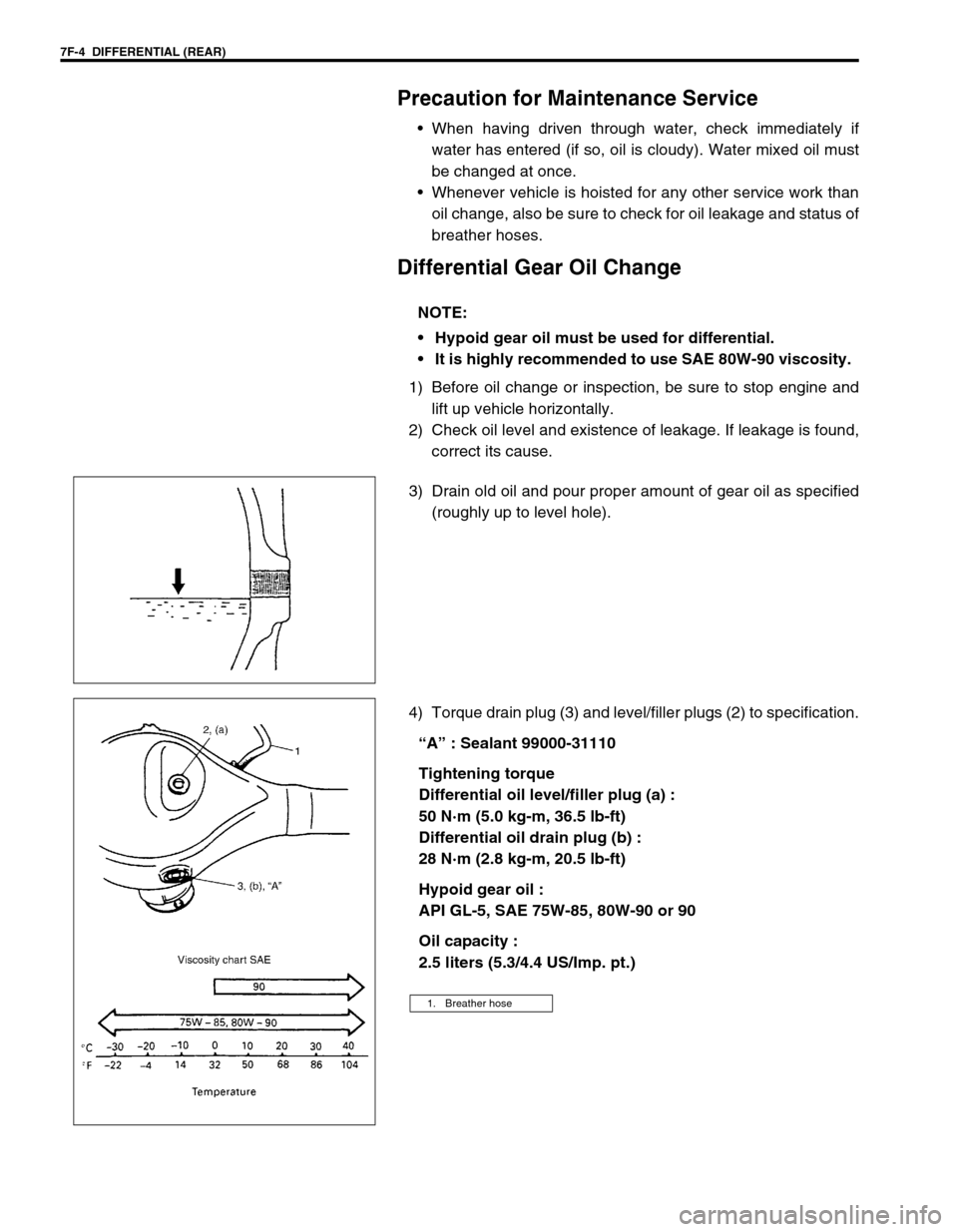
3) Drain old oil and pour proper amount of gear oil as specified
(roughly up to level hole).
4) Torque drain plug (3) and level/filler plugs (2) to specification.
“A” : Sealant 99000-31110
Tightening torque
Differential oil level/filler plug (a) :
50 N·m (5.0 kg-m, 36.5 lb-ft)
Differential oil drain plug (b) :
28 N·m (2.8 kg-m, 20.5 lb-ft)
Hypoid gear oil :
API GL-5, SAE 75W-85, 80W-90 or 90
Oil capacity :
2.5 liters (5.3/4.4 US/Imp. pt.) NOTE:
Hypoid gear oil must be used for differential.
It is highly recommended to use SAE 80W-90 viscosity.
1. Breather hose
Page:
< prev 1-8 9-16 17-24