1999 SUZUKI GRAND VITARA Switch light
[x] Cancel search: Switch lightPage 343 of 656
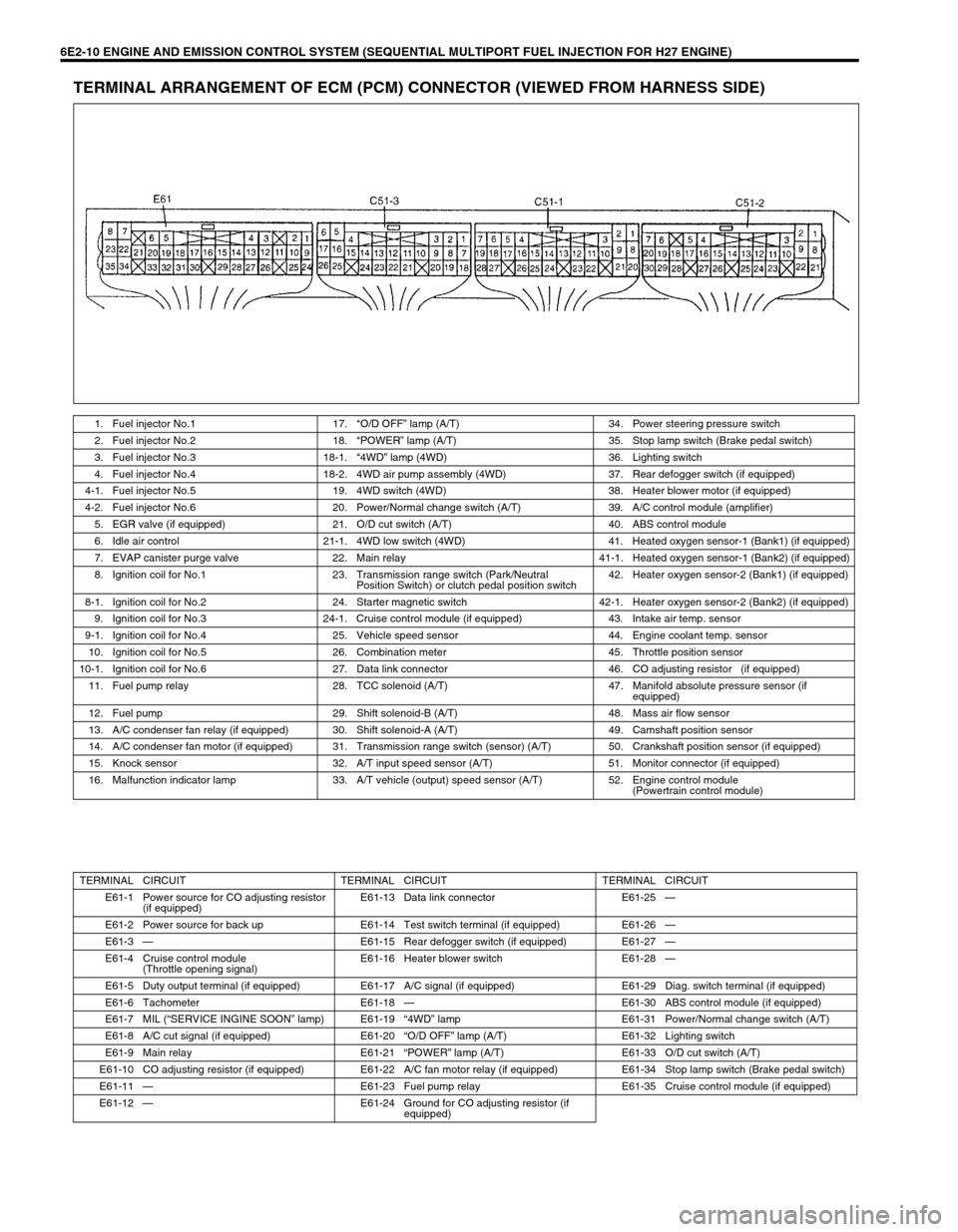
6E2-10 ENGINE AND EMISSION CONTROL SYSTEM (SEQUENTIAL MULTIPORT FUEL INJECTION FOR H27 ENGINE)
TERMINAL ARRANGEMENT OF ECM (PCM) CONNECTOR (VIEWED FROM HARNESS SIDE)
1. Fuel injector No.1 17.“O/D OFF” lamp (A/T) 34. Power steering pressure switch
2. Fuel injector No.2 18.“POWER” lamp (A/T) 35. Stop lamp switch (Brake pedal switch)
3. Fuel injector No.3 18-1.“4WD” lamp (4WD) 36. Lighting switch
4. Fuel injector No.4 18-2. 4WD air pump assembly (4WD) 37. Rear defogger switch (if equipped)
4-1. Fuel injector No.5 19. 4WD switch (4WD) 38. Heater blower motor (if equipped)
4-2. Fuel injector No.6 20. Power/Normal change switch (A/T) 39. A/C control module (amplifier)
5. EGR valve (if equipped) 21. O/D cut switch (A/T) 40. ABS control module
6. Idle air control 21-1. 4WD low switch (4WD) 41. Heated oxygen sensor-1 (Bank1) (if equipped)
7. EVAP canister purge valve 22. Main relay 41-1. Heated oxygen sensor-1 (Bank2) (if equipped)
8. Ignition coil for No.1 23. Transmission range switch (Park/Neutral
Position Switch) or clutch pedal position switch42. Heater oxygen sensor-2 (Bank1) (if equipped)
8-1. Ignition coil for No.2 24. Starter magnetic switch 42-1. Heater oxygen sensor-2 (Bank2) (if equipped)
9. Ignition coil for No.3 24-1. Cruise control module (if equipped) 43. Intake air temp. sensor
9-1. Ignition coil for No.4 25. Vehicle speed sensor 44. Engine coolant temp. sensor
10. Ignition coil for No.5 26. Combination meter 45. Throttle position sensor
10-1. Ignition coil for No.6 27. Data link connector 46. CO adjusting resistor (if equipped)
11. Fuel pump relay 28. TCC solenoid (A/T) 47. Manifold absolute pressure sensor (if
equipped)
12. Fuel pump 29. Shift solenoid-B (A/T) 48. Mass air flow sensor
13. A/C condenser fan relay (if equipped) 30. Shift solenoid-A (A/T) 49. Camshaft position sensor
14. A/C condenser fan motor (if equipped) 31. Transmission range switch (sensor) (A/T) 50. Crankshaft position sensor (if equipped)
15. Knock sensor 32. A/T input speed sensor (A/T) 51. Monitor connector (if equipped)
16. Malfunction indicator lamp 33. A/T vehicle (output) speed sensor (A/T) 52. Engine control module
(Powertrain control module)
TERMINAL CIRCUIT TERMINAL CIRCUIT TERMINAL CIRCUIT
E61-1 Power source for CO adjusting resistor
(if equipped)E61-13 Data link connector E61-25—
E61-2 Power source for back up E61-14 Test switch terminal (if equipped) E61-26—
E61-3—E61-15 Rear defogger switch (if equipped) E61-27—
E61-4 Cruise control module
(Throttle opening signal)E61-16 Heater blower switch E61-28—
E61-5 Duty output terminal (if equipped) E61-17 A/C signal (if equipped) E61-29 Diag. switch terminal (if equipped)
E61-6 Tachometer E61-18—E61-30 ABS control module (if equipped)
E61-7 MIL (“SERVICE INGINE SOON” lamp) E61-19“4WD” lamp E61-31 Power/Normal change switch (A/T)
E61-8 A/C cut signal (if equipped) E61-20“O/D OFF” lamp (A/T) E61-32 Lighting switch
E61-9 Main relay E61-21“POWER” lamp (A/T) E61-33 O/D cut switch (A/T)
E61-10 CO adjusting resistor (if equipped) E61-22 A/C fan motor relay (if equipped) E61-34 Stop lamp switch (Brake pedal switch)
E61-11—E61-23 Fuel pump relay E61-35 Cruise control module (if equipped)
E61-12—E61-24 Ground for CO adjusting resistor (if
equipped)
Page 345 of 656

6E2-12 ENGINE AND EMISSION CONTROL SYSTEM (SEQUENTIAL MULTIPORT FUEL INJECTION FOR H27 ENGINE)
Engine and Emission Control Input/Output Table
Diagnosis
Refer to Section 6-1.
Ignition coil with igniter
HO2S heater control
Input
Output Function
Main relay control
Fuel pump control
Injection control
Ignition control
MIL control Idle air control
EVAP purge control
EGR control
A/C control
A/C condensor fan
controlMain relay
Fuel pump relay
Injectors
MIL
EVAP canister purge
valve IAC valve
EGR valve (if equipped)
HO2S (if equipped)
A/C amplifier
(if equipped)
A/C condensor fan
relay (if equipped)
CMP sensor
MAF sensor
TP sensor
ECT sensor
IAT sensor
HO2S (sensor 1)(if equipped)
VSS
Blower fan switch
Rear defogger switch
PSP switch
Ignition switch
Starter switch
A/C amplifier (if equipped)
TR switch (A/T VEHICLE)
Light switch
Knock sensor
CO adjusting resistor (if equipped)
Test swich terminal (Vehicle with monitor connector)
Diag. swich terminal (Vehicle with monitor connector)
Brake switch (A/T VEHICLE)
ABS control module
Page 348 of 656
ENGINE AND EMISSION CONTROL SYSTEM (SEQUENTIAL MULTIPORT FUEL INJECTION FOR H27 ENGINE) 6E2-15
Idle Speed/Idle Air Control (IAC) Duty Inspec-
tion
Before idle speed/IAC duty check, make sure of the following.
•Lead wires and hoses of engine/emission control systems
are connected securely.
•Accelerator cable is adjusted.
•Ignition timing is within specification.
•All accessories (wipers, heater, lights, A/C, etc.) are out of
service.
•Air cleaner has been properly installed and is in good condi-
tion.
•ECM (PCM) does not detect any malfunction DTC.
After above items are all confirmed, check idle speed and IAC
duty as follows.
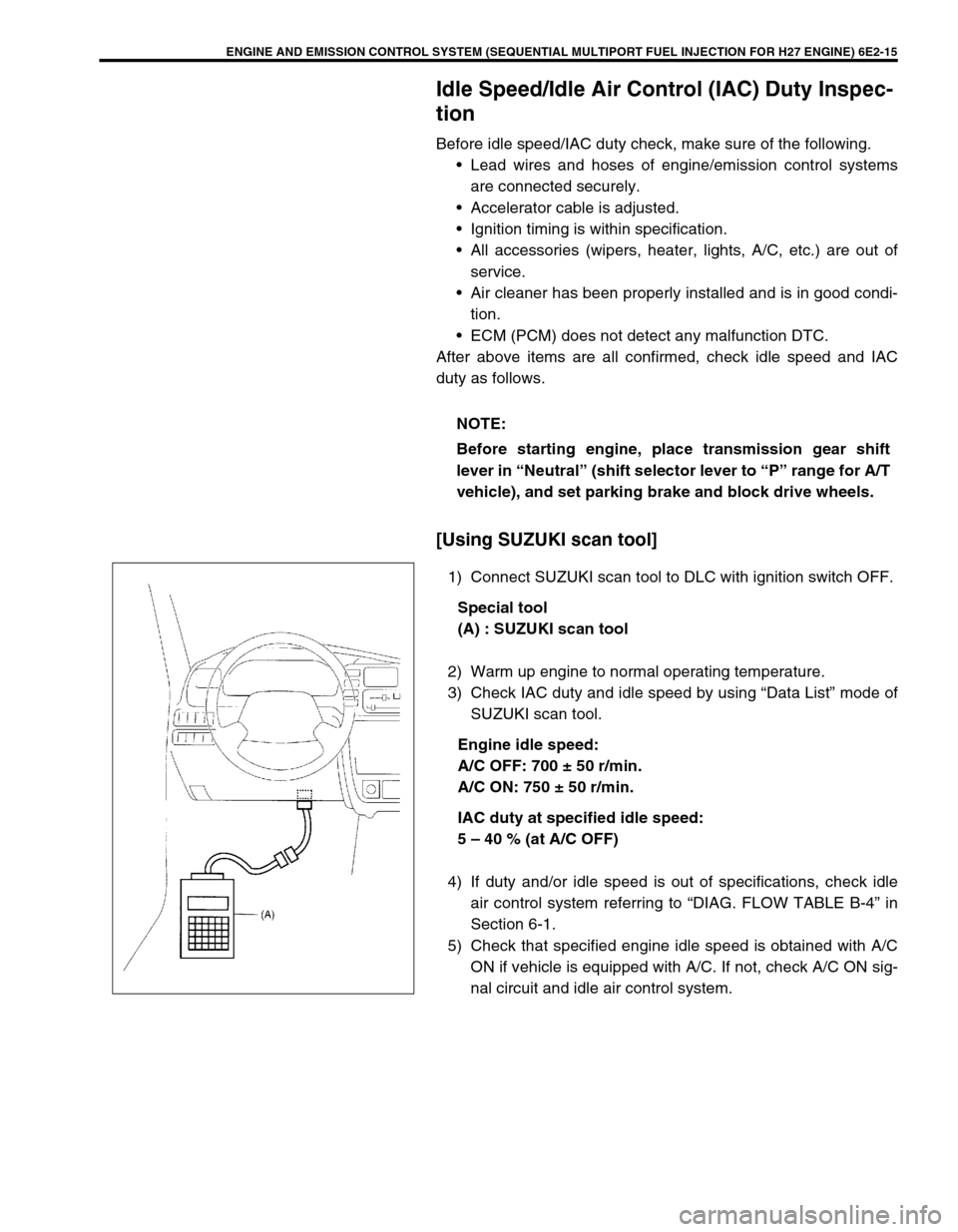
[Using SUZUKI scan tool]
1) Connect SUZUKI scan tool to DLC with ignition switch OFF.
Special tool
(A) : SUZUKI scan tool
2) Warm up engine to normal operating temperature.
3) Check IAC duty and idle speed by using “Data List” mode of
SUZUKI scan tool.
Engine idle speed:
A/C OFF: 700 ± 50 r/min.
A/C ON: 750 ± 50 r/min.
IAC duty at specified idle speed:
5 – 40 % (at A/C OFF)
4) If duty and/or idle speed is out of specifications, check idle
air control system referring to “DIAG. FLOW TABLE B-4” in
Section 6-1.
5) Check that specified engine idle speed is obtained with A/C
ON if vehicle is equipped with A/C. If not, check A/C ON sig-
nal circuit and idle air control system. NOTE:
Before starting engine, place transmission gear shift
lever in “Neutral” (shift selector lever to “P” range for A/T
vehicle), and set parking brake and block drive wheels.
Page 399 of 656

6H-2 CHARGING SYSTEM
General Description
Generator
WIRING CIRCUIT
B : Generator output (Battery terminal) L : Lamp terminal 5. Stator core 10. Rear end frame
D : Dummy terminal 1. Pulley 6. Field coil 11. Drive end frame
E : Ground 2. Pulley nut 7. Rectifier
F : Field coil terminal 3. Rotor fan 8. Brush
IG : Ignition terminal 4. Stator coil 9. Regulator
1. Generator with regulator assembly 3. Stator coil 5. Field coil (rotor coil) 7. Main switch
2. I.C. regulator 4. Diode 6. Charge indicator light 8. Battery
Page 410 of 656

AUTOMATIC TRANSMISSION (4 A/T) 7B1-1
7B1
SECTION 7B1
AUTOMATIC TRANSMISSION (4 A/T)
CONTENTS
General Description ......................................7B1-3
Electronic Shift Control System ................... 7B1-4
Automatic gear shift diagram................... 7B1-5
Diagnosis .......................................................7B1-7
On-Board Diagnostic System
(Vehicle without monitor connector) ............ 7B1-7
On-Board Diagnostic System
(Vehicle with monitor connector) ................. 7B1-8
Precaution in Diagnosing Trouble ............... 7B1-9
Automatic Transmission Diagnostic Flow
Table ......................................................... 7B1-10
Malfunction Indicator Lamp (MIL) Check... 7B1-13
“O/D OFF” Lamp Check ............................ 7B1-13
“POWER” Lamp Check ............................. 7B1-13
Diagnostic Trouble Code (DTC) Check ..... 7B1-13
Diagnostic Trouble Code Clearance ......... 7B1-13
Diagnostic Trouble Code Table ................. 7B1-14
Fail Safe Table .......................................... 7B1-14
Visual Inspection ....................................... 7B1-14
A/T Basic Check ........................................ 7B1-14
Trouble Diagnosis Table 1 ........................ 7B1-15
Trouble Diagnosis Table 2 ........................ 7B1-15
Trouble Diagnosis Table 3 ........................ 7B1-16
Scan Tool Data ......................................... 7B1-17
Inspection of PCM and Its Circuit .............. 7B1-17Wire Harness and Connectors .................. 7B1-17
Table A-1 : No TCC Lock-Up Occurs ........ 7B1-18
Table A-2 : No Gear Shift to O/D .............. 7B1-20
Table B-1 : “O/D OFF” Light Circuit Check
(“O/D OFF” Light Doesn’t Light at Ignition
Switch ON But Engine Starts Up) ............. 7B1-22
Table B-2 : “O/D OFF” Light Circuit Check
(“O/D OFF” Light Comes ON Steadily) ..... 7B1-23
Table B-3 : “POWER” Light Circuit Check
(“POWER” Light Doesn’t Light at Ignition
Switch ON But Engine Starts Up) ............. 7B1-24
Table B-4 : “POWER” Light Circuit Check
(“POWER” Light Comes ON Steadily) ...... 7B1-25
DTC P0705 (DTC NO.72) - Transmission
Range Sensor (Switch) Circuit Malfunction7B1-26
DTC P0715 (DTC NO.76) - Input/Turbine
Speed Sensor Circuit Malfunction............. 7B1-29
DTC P0720 (DTC NO.75) Output Speed
Sensor Circuit Malfunction ........................ 7B1-32
DTC P0743 (DTC NO.65/66) -
TCC (Lock-Up) Solenoid Electrical ........... 7B1-34
DTC P0753 (DTC NO.61/62)
Shift Solenoid-A (#1) Electrical
DTC P0758 (DTC NO.63/64)
Shift Solenoid-B (#2) Electrical ................. 7B1-36 WARNING:
For vehicles equipped with Supplemental Restraint (Air Bag) System:
Service on and around the air bag system components or wiring must be performed only by an
authorized SUZUKI dealer. Refer to “Air Bag System Components and Wiring Location View” under
“General Description” in air bag system section in order to confirm whether you are performing ser-
vice on or near the air bag system components or wiring. Please observe all WARNINGS and “Ser-
vice Precautions” under “On-Vehicle Service” in air bag system section before performing service
on or around the air bag system components or wiring. Failure to follow WARNINGS could result in
unintentional activation of the system or could render the system inoperative. Either of these two
conditions may result in severe injury.
Technical service work must be started at least 90 seconds after the ignition switch is turned to the
“LOCK” position and the negative cable is disconnected from the battery. Otherwise, the system
may be activated by reserve energy in the Sensing and Diagnostic Module (SDM).
NOTE:
For the descriptions (items) not found in this section, refer to the same section of the Service Manual
mentioned in FOREWORD of this manual.
Page 422 of 656
AUTOMATIC TRANSMISSION (4 A/T) 7B1-13
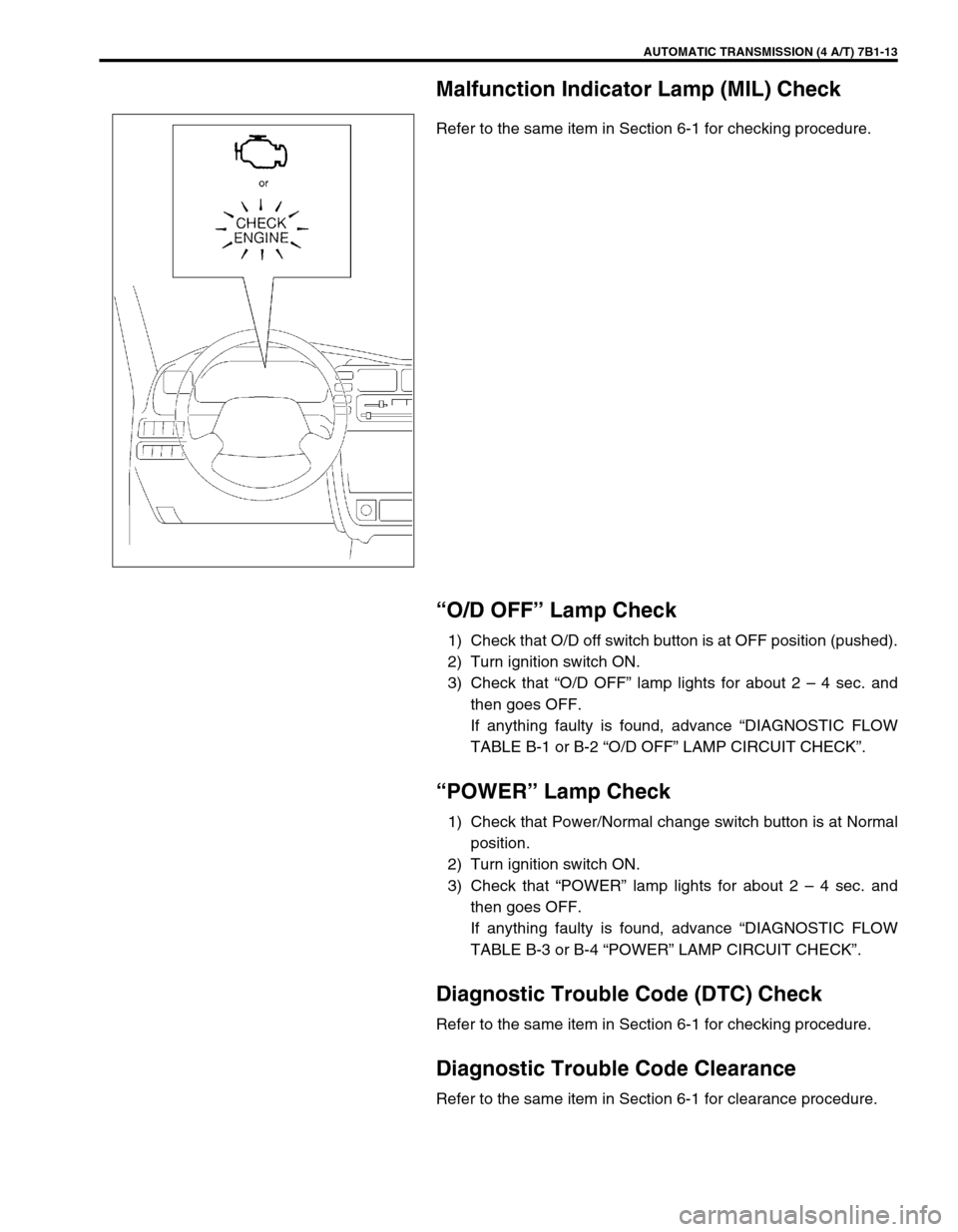
Malfunction Indicator Lamp (MIL) Check
Refer to the same item in Section 6-1 for checking procedure.
“O/D OFF” Lamp Check
1) Check that O/D off switch button is at OFF position (pushed).
2) Turn ignition switch ON.
3) Check that “O/D OFF” lamp lights for about 2 – 4 sec. and
then goes OFF.
If anything faulty is found, advance “DIAGNOSTIC FLOW
TABLE B-1 or B-2 “O/D OFF” LAMP CIRCUIT CHECK”.
“POWER” Lamp Check
1) Check that Power/Normal change switch button is at Normal
position.
2) Turn ignition switch ON.
3) Check that “POWER” lamp lights for about 2 – 4 sec. and
then goes OFF.
If anything faulty is found, advance “DIAGNOSTIC FLOW
TABLE B-3 or B-4 “POWER” LAMP CIRCUIT CHECK”.
Diagnostic Trouble Code (DTC) Check
Refer to the same item in Section 6-1 for checking procedure.
Diagnostic Trouble Code Clearance
Refer to the same item in Section 6-1 for clearance procedure.
Page 431 of 656
7B1-22 AUTOMATIC TRANSMISSION (4 A/T)
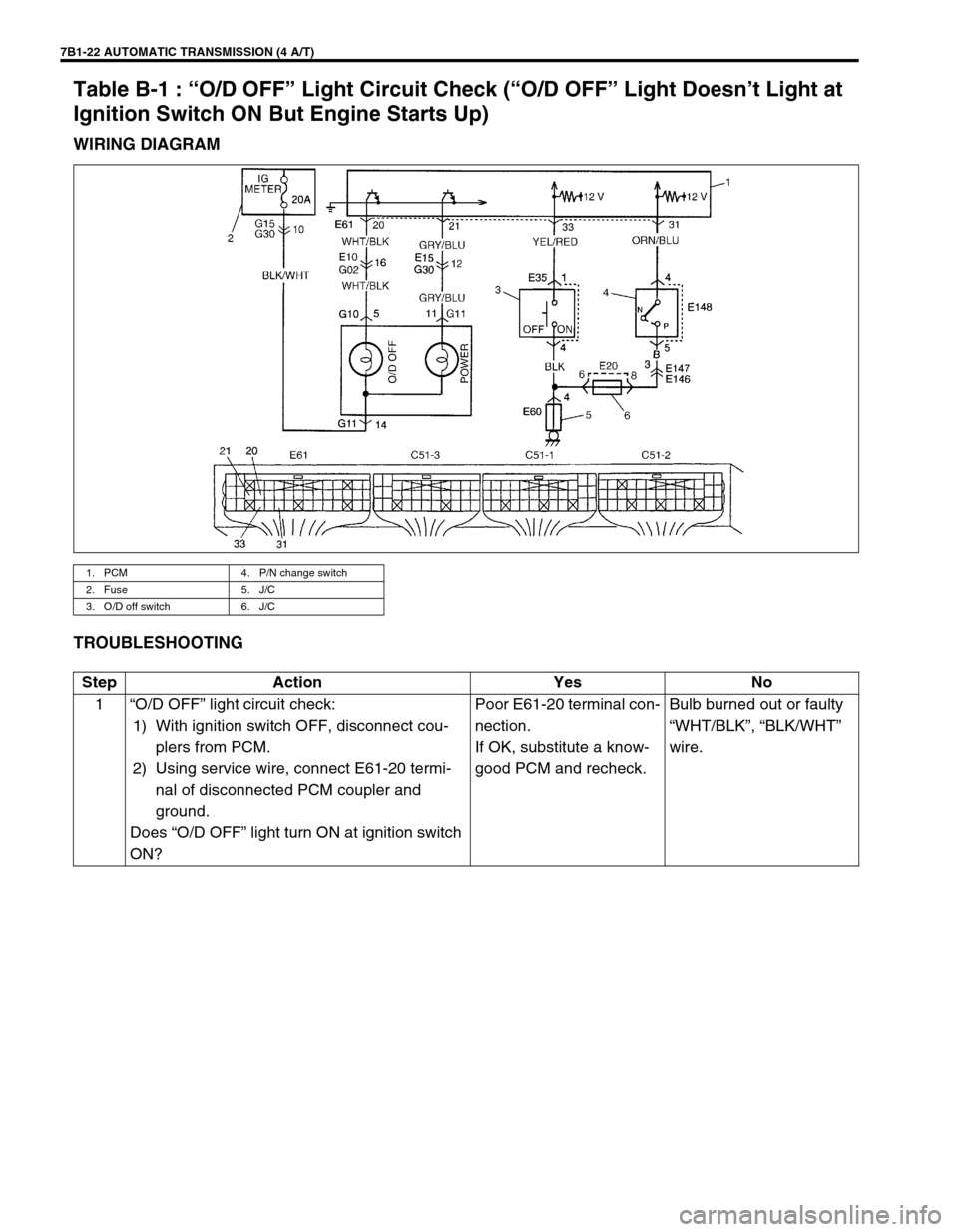
Table B-1 : “O/D OFF” Light Circuit Check (“O/D OFF” Light Doesn’t Light at
Ignition Switch ON But Engine Starts Up)
WIRING DIAGRAM
TROUBLESHOOTING
1. PCM 4. P/N change switch
2. Fuse 5. J/C
3. O/D off switch 6. J/C
Step Action Yes No
1“O/D OFF” light circuit check:
1) With ignition switch OFF, disconnect cou-
plers from PCM.
2) Using service wire, connect E61-20 termi-
nal of disconnected PCM coupler and
ground.
Does “O/D OFF” light turn ON at ignition switch
ON?Poor E61-20 terminal con-
nection.
If OK, substitute a know-
good PCM and recheck.Bulb burned out or faulty
“WHT/BLK”, “BLK/WHT”
wire.
Page 432 of 656
AUTOMATIC TRANSMISSION (4 A/T) 7B1-23
Table B-2 : “O/D OFF” Light Circuit Check (“O/D OFF” Light Comes ON
Steadily)
WIRING DIAGRAM
Refer to “TABLE B-1” in this section.
TROUBLESHOOTING
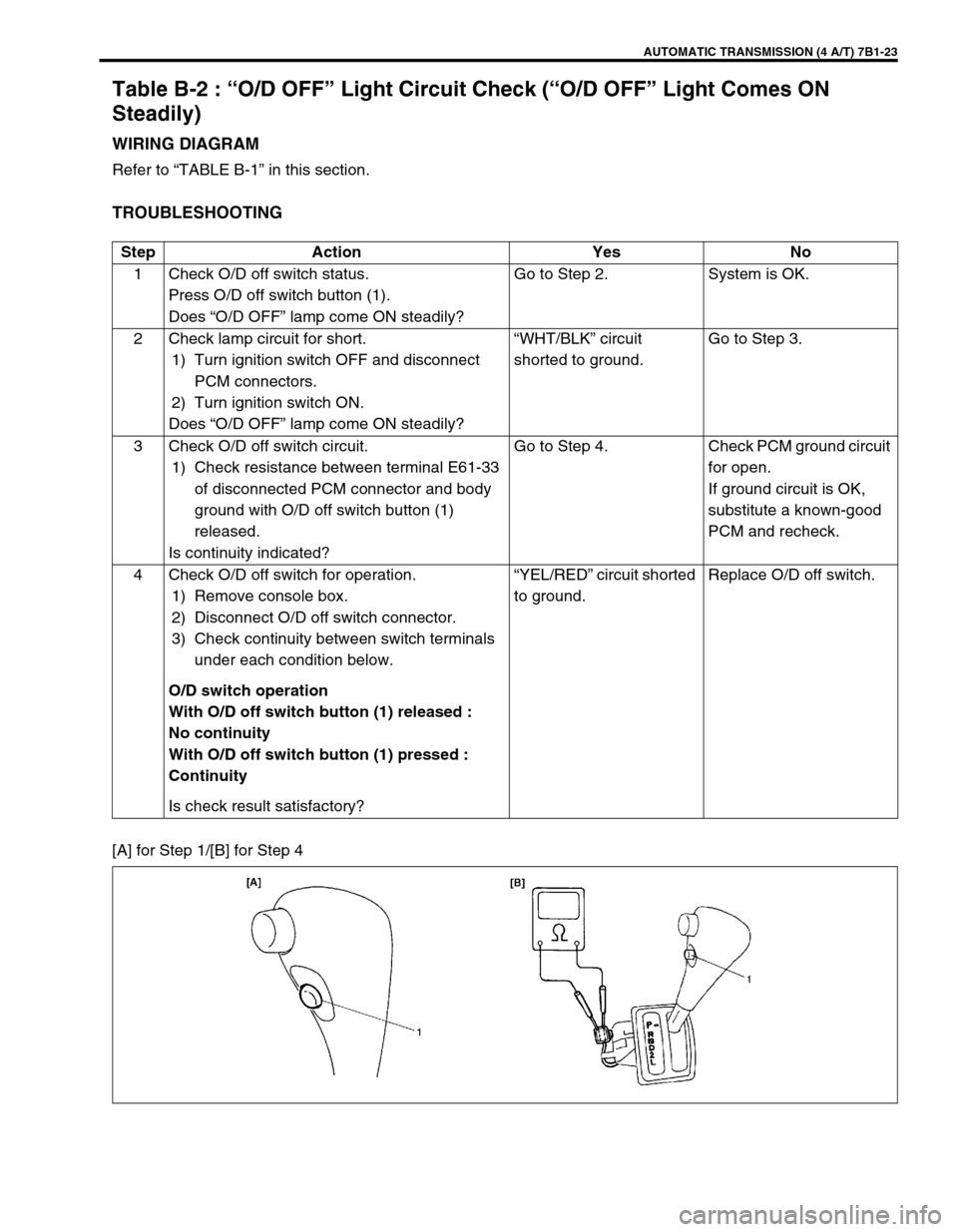
[A] for Step 1/[B] for Step 4Step Action Yes No
1 Check O/D off switch status.
Press O/D off switch button (1).
Does “O/D OFF” lamp come ON steadily?Go to Step 2. System is OK.
2 Check lamp circuit for short.
1) Turn ignition switch OFF and disconnect
PCM connectors.
2) Turn ignition switch ON.
Does “O/D OFF” lamp come ON steadily?“WHT/BLK” circuit
shorted to ground.Go to Step 3.
3 Check O/D off switch circuit.
1) Check resistance between terminal E61-33
of disconnected PCM connector and body
ground with O/D off switch button (1)
released.
Is continuity indicated?Go to Step 4. Check PCM ground circuit
for open.
If ground circuit is OK,
substitute a known-good
PCM and recheck.
4 Check O/D off switch for operation.
1) Remove console box.
2) Disconnect O/D off switch connector.
3) Check continuity between switch terminals
under each condition below.
O/D switch operation
With O/D off switch button (1) released :
No continuity
With O/D off switch button (1) pressed :
Continuity
Is check result satisfactory?“YEL/RED” circuit shorted
to ground.Replace O/D off switch.