Page 276 of 656

ENGINE GENERAL INFORMATION AND DIAGNOSIS (H27 ENGINE) 6-1-115
DTC P1510 Ecm Back-Up Power Supply Malfunction
WIRING DIAGRAM
CIRCUIT DESCRIPTION
Battery voltage is supplied to keep DTC memory, values that ECM has learned to control engine, etc. in ECM
even when ignition switch is turned OFF.
DTC DETECTING CONDITION AND TROUBLE AREA
DTC CONFIRMATION PROCEDURE
1) Connect scan tool to DLC with ignition switch OFF.
2) Turn ON ignition switch and clear DTC, pending DTC and freeze frame data by using scan tool and run
engine at idle speed for 1min.
3) Check DTC by using scan tool.
TROUBLESHOOTING
1. Main fuse box 3. ECM (PCM)
2. To DLC
DTC DETECTING CONDITION TROUBLE AREA
Back-up circuit voltage lower than specification is detected
while engine is running.•ECM (PCM) back-up circuit
•ECM (PCM)
NOTE:
Check to make sure that following condition is satisfied when using this “DTC CONFIRMATION PRO-
CEDURE”.
Intake air temp. : – 8°C (18°F) or higher
Engine coolant temp. : – 8 – 110°C (18 – 230°F)
Altitude (barometric pressure) : 2400 m, 8000 ft or less (560 mmHg (75 kPa) or more)
Step Action Yes No
1Was “ENGINE DIAG. FLOW TABLE” performed? Go to Step 2. Go to “ENGINE DIAG. FLOW
TABLE” in this section.
2 Battery voltage supply circuit check :
1) Remove ECM (PCM) cover.
2) While engine running, check voltage between E61-
2 and ground.
Is voltage 10 – 14 V?Poor E61-2 connection or
intermittent trouble.
Check for intermittent referring
to “INTERMITTENT AND
POOR CONNECTION” in
Section 0A.
If wire and connections are
OK, substitute a known-good
ECM (PCM) and recheck.“WHT” circuit open or short.
Page 277 of 656
6-1-116 ENGINE GENERAL INFORMATION AND DIAGNOSIS (H27 ENGINE)
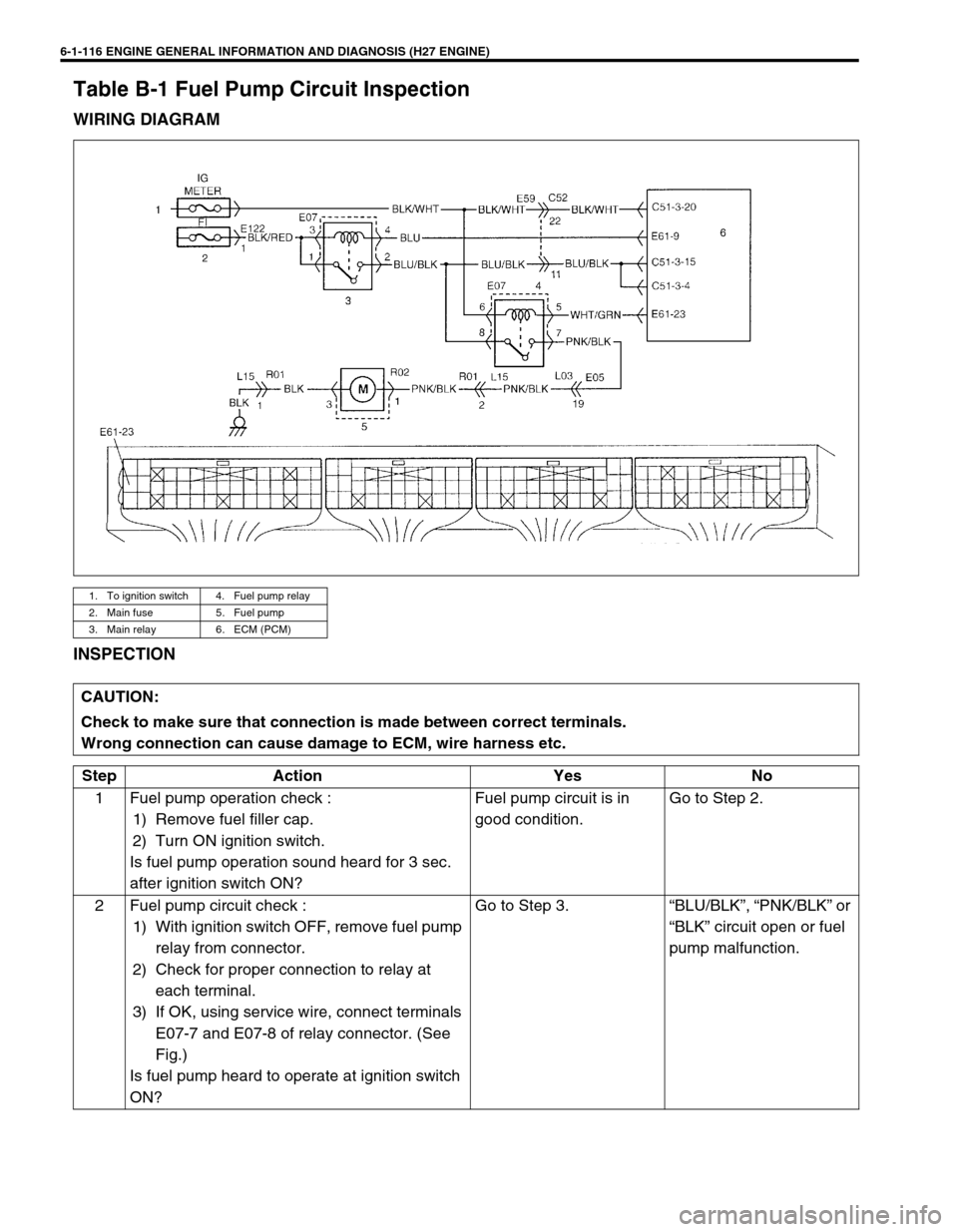
Table B-1 Fuel Pump Circuit Inspection
WIRING DIAGRAM
INSPECTION
1. To ignition switch 4. Fuel pump relay
2. Main fuse 5. Fuel pump
3. Main relay 6. ECM (PCM)
CAUTION:
Check to make sure that connection is made between correct terminals.
Wrong connection can cause damage to ECM, wire harness etc.
Step Action Yes No
1 Fuel pump operation check :
1) Remove fuel filler cap.
2) Turn ON ignition switch.
Is fuel pump operation sound heard for 3 sec.
after ignition switch ON?Fuel pump circuit is in
good condition.Go to Step 2.
2 Fuel pump circuit check :
1) With ignition switch OFF, remove fuel pump
relay from connector.
2) Check for proper connection to relay at
each terminal.
3) If OK, using service wire, connect terminals
E07-7 and E07-8 of relay connector. (See
Fig.)
Is fuel pump heard to operate at ignition switch
ON?Go to Step 3.“BLU/BLK”, “PNK/BLK” or
“BLK” circuit open or fuel
pump malfunction.
Page 278 of 656
ENGINE GENERAL INFORMATION AND DIAGNOSIS (H27 ENGINE) 6-1-117
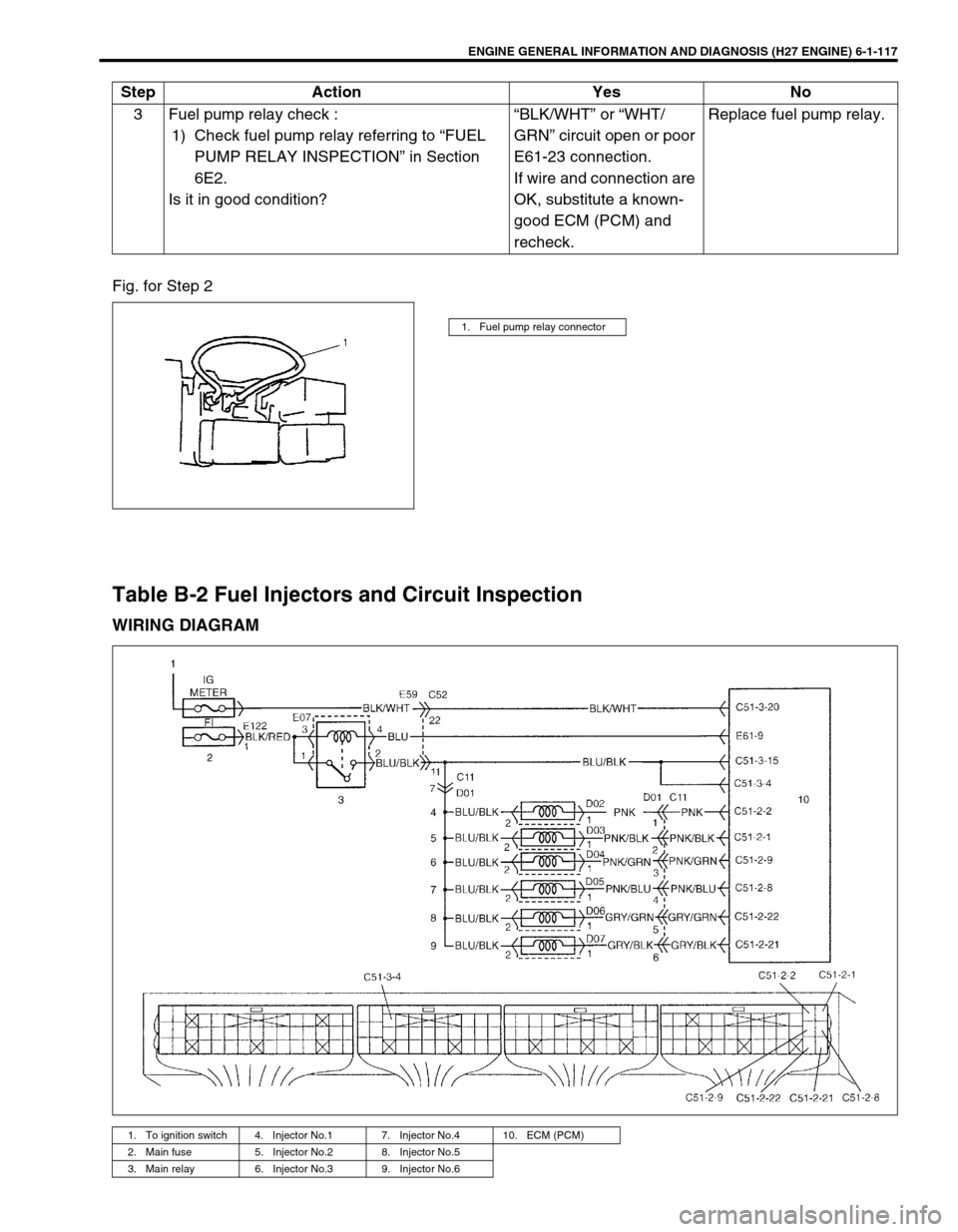
Fig. for Step 2
Table B-2 Fuel Injectors and Circuit Inspection
WIRING DIAGRAM
3 Fuel pump relay check :
1) Check fuel pump relay referring to “FUEL
PUMP RELAY INSPECTION” in Section
6E2.
Is it in good condition?“BLK/WHT” or “WHT/
GRN” circuit open or poor
E61-23 connection.
If wire and connection are
OK, substitute a known-
good ECM (PCM) and
recheck.Replace fuel pump relay. Step Action Yes No
1. Fuel pump relay connector
1. To ignition switch 4. Injector No.1 7. Injector No.4 10. ECM (PCM)
2. Main fuse 5. Injector No.2 8. Injector No.5
3. Main relay 6. Injector No.3 9. Injector No.6
Page 285 of 656

6-1-124 ENGINE GENERAL INFORMATION AND DIAGNOSIS (H27 ENGINE)
Table B-6 A/C Condenser Fan Motor Relay Control System Inspection (If
Equipped)
WIRING DIAGRAM
INSPECTION
1. To ignition switch 3. A/C fuse 5. A/C condenser fan motor
2. Main fuse 4. A/C condenser fan motor relay 6. ECM (PCM)
WARNING:
Keep hands, tools, and clothing away from A/C condenser fan to help prevent personal injury. This
fan is electric and can come on whether or not the engine is running. The fan can start automatically
in response to the ECT sensor with the ignition switch in the “ON” position.
Step Action Yes No
1 1) Check DTC referring to “DTC CHECK” in this sec-
tion.
Is there any malfunction DTC?Go to applicable DTC
Diag. Flow Table.Go to Step 2.
2 1) Check A/C condenser fan for operation.
A/C condenser fan should be operated under follow-
ing condition A or B only.
A : When engine is running and A/C is operating.
B : When engine coolant temp. is 113°C (235°F) or
more with ignition switch ON.
Is check result as specified?This system is in
good condition.Go to Step 3.
3 1) Remove ECM (PCM) cover.
2) Check voltage between E61-22 terminal of ECM
(PCM) connected coupler and ground.
Other than conditions A and B in Step 2 :
10 – 14 V
Under condition A or B in Step 2 :
0 – 1 V
Is check result as specified?Fuse blown, “RED”,
“RED/BLK” or “RED/
BLU” circuit open,
malfunction of con-
denser fan motor or
relay.“YEL/GRN” circuit
open, “YEL/BLU” cir-
cuit open or short, or
relay malfunction.
If above are OK, sub-
stitute a known-good
ECM (PCM) and
recheck.
Page 341 of 656

6E2-8 ENGINE AND EMISSION CONTROL SYSTEM (SEQUENTIAL MULTIPORT FUEL INJECTION FOR H27 ENGINE)
Electronic Control System
The electronic control system consists of 1) various sensors which detect the state of engine and driving condi-
tions, 2) ECM (PCM) which controls various devices according to the signals from the sensors and 3) various
controlled devices.
Functionally, it is divided into the following sub systems:
•Fuel injection control system
•Heated oxygen sensor heater control system (if equipped)
•Idle air control system
•Fuel pump control system
•Evaporative emission control system
•Ignition control system
•EGR system (if equipped)
Also, with A/T model, PCM controls A/T.
INFORMATION SENSORS CONTROLLED DEVICES OTHERS
1. IAT sensor a : A/C condenser fan motor relay (if equipped) A : Main fuse box
2. MAP sensor (if equipped) b : Ignition coil assemblies B : ECM (PCM)
3. Heated oxygen sensor (sensor 1) (if equipped) c : EVAP canister purge valve C : Data link connector
4. ECT sensor d : EGR valve (if equipped) D : Combination meter
5. TP sensor e : Idle air control valve E : Fuse box
6. MAF sensor f : Injectors F : EVAP canister
7. Camshaft position sensor (CMP sensor) g : Malfunction indicator lamp
8. ABS control module h : Fuel pump relay
9. Crankshaft position sensor (CKP sensor) (if equipped) i : Main relay
10. Power steering pressure switch (PSP switch) j : Oxygen sensor heater relay (if equipped)
11. CO adjusting resistor (if equipped)
12. Monitor connector (if equipped)
13. Transmission range switch (A/T)
14. Knock sensor
NOTE:
Above figure shows left-hand steering vehicle. For right-hand steering vehicle, parts with (*) are
installed at the side of symmetry.
Page 386 of 656
IGNITION SYSTEM (FOR H27 ENGINE) 6F2-3
System Wiring
NOTE:
For ECM (PCM) terminal assignment, refer to Section 6E2.
1. To ignition switch 8. Ignition coil assembly (For No.3 cylinder)
2.“IG COIL METER” fuse 9. Ignition coil assembly (For No.4 cylinder)
3. ECM (or PCM) 10. Spark plug
4. CMP sensor 11. Ignition coil assembly (For No.5 cylinder)
5. Noise suppressor 12. Ignition coil assembly (For No.6 cylinder)
6. Ignition coil assembly (For No.1 cylinder) 13. To main relay
7. Ignition coil assembly (For No.2 cylinder) 14. Sensed information
Page 387 of 656

6F2-4 IGNITION SYSTEM (FOR H27 ENGINE)
Diagnosis
Diagnostic Flow Table
Condition Possible Cause Correction
Engine cranks, but will
not start or hard to
start (No spark)Blown fuse for ignition coil assembly Replace.
Loose connection or disconnection of lead wire Connect securely.
Faulty spark plug (s) Replace.
Faulty ignition coil assembly (s) Replace.
Faulty CMP sensor Replace.
Faulty ECM (or PCM) Replace.
Maladjusted ignition timing Adjust.
Poor fuel economy or
engine performanceIncorrect ignition timing Adjust.
Faulty spark plug(s) Replace.
Faulty ignition coil assembly (s) Replace.
Faulty CMP sensor Replace.
Faulty ECM (or PCM) Replace.
Faulty knock sensor Replace.
Step Action Yes No
1Was “ENGINE DIAGNOSTIC FLOW TABLE” in
Section 6-1 performed?Go to Step 2. Go to “ENGINE DIAG-
NOSTIC FLOW TABLE” in
Section 6-1.
2 Ignition Spark Test
1) Check all spark plug for condition and type,
referring to “SPARK PLUG” in this section.
2) If OK, perform ignition spark test, referring
to “IGNITION SPARK CHECK” in this sec-
tion.
Is spark emitted from all spark plugs?Go to Step 8. Go to Step 3.
3 Diagnostic Trouble Code (DTC) Check
1) Check DTC stored in ECM (or PCM), refer-
ring to “DIAGNOSTIC TROUBLE CODE
(DTC) CHECK” in Section 6E2.
Is DTC stored?Go to applicable flow table
corresponding to that
code No. in Section 6E2.Go to Step 4.
4 Electrical Connection Check
1) Check ignition coil assemblies for electrical
connection.
Are they connected securely?Go to Step 5. Connect securely.
5 Ignition Coil Assembly Power Supply, Ground
and Trigger Signal Circuits Check
1) Check these circuits for open and short.
Are circuits in good condition?Go to Step 6. Repair or replace.
6 Ignition Coil Assembly Check
1) Substitute a known-good ignition coil
assembly and then repeat Step 2.
Is check result of Step 2 satisfactory?Malfunction of ignition coil
assembly.Go to Step 7.
Page 431 of 656
7B1-22 AUTOMATIC TRANSMISSION (4 A/T)
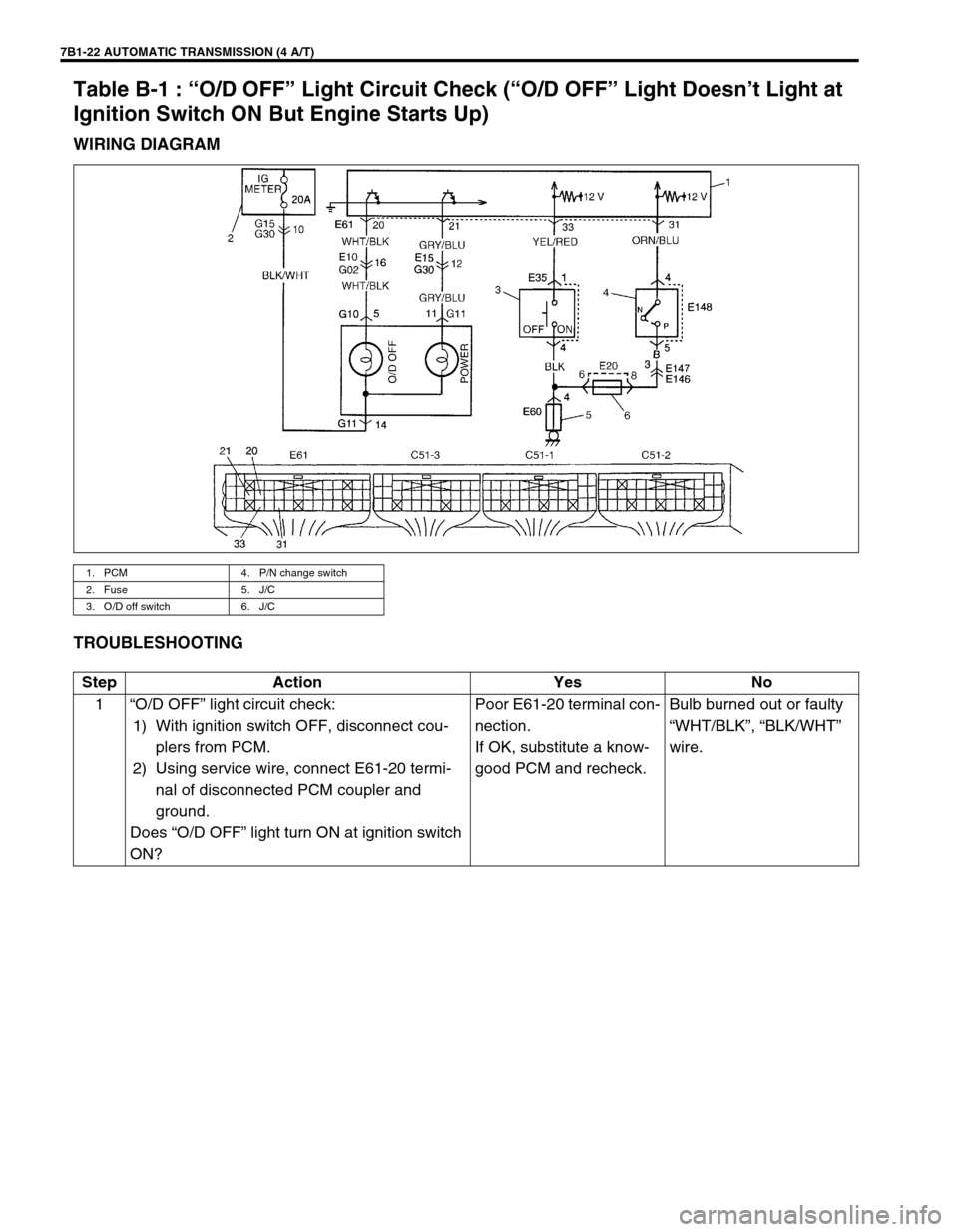
Table B-1 : “O/D OFF” Light Circuit Check (“O/D OFF” Light Doesn’t Light at
Ignition Switch ON But Engine Starts Up)
WIRING DIAGRAM
TROUBLESHOOTING
1. PCM 4. P/N change switch
2. Fuse 5. J/C
3. O/D off switch 6. J/C
Step Action Yes No
1“O/D OFF” light circuit check:
1) With ignition switch OFF, disconnect cou-
plers from PCM.
2) Using service wire, connect E61-20 termi-
nal of disconnected PCM coupler and
ground.
Does “O/D OFF” light turn ON at ignition switch
ON?Poor E61-20 terminal con-
nection.
If OK, substitute a know-
good PCM and recheck.Bulb burned out or faulty
“WHT/BLK”, “BLK/WHT”
wire.