1999 SUZUKI GRAND VITARA turn
[x] Cancel search: turnPage 51 of 656
1B-26 AIR CONDITIONING (OPTIONAL)
Never use heat for bending pipes. When bending a pipe, try to make its bending radius as slight as possible.
Keep internal parts of air conditioning free from moisture and dirt. When disconnecting any line from system,
install a blind plug or cap to the fitting immediately.
When tightening or loosening a fitting, use two wrenches, one for turning and the other for support.
Tighten flared nuts to specified torque.
Tightening torque
8 mm (0.31 in.) pipe : 13 N·m (1.3 kg-m, 9.5 lb-ft)
12.7 mm (0.5 in.) pipe : 22 N·m (2.2 kg-m, 16.0 lb-ft)
16 mm (0.63 in.) pipe : 33 N·m (3.3 kg-m, 24.0 lb-ft)
Route drain hose so that drained water does not make any contact to vehicle components.
Handling refrigerant HFC-134a (R-134a)
When handling refrigerant, always wear goggles to protect your eyes.
Avoid you direct contact to liquid refrigerant.
Do not heat refrigerant container higher than 40 °C (104 °F).
Do not discharge refrigerant into atmosphere.
Do not allow liquid refrigerant to touch bright metals. Refrigerant combined with moisture is corrosive and
will tarnish surfaces of bright metals including chrome.
After recovering refrigerant from system, the amount of compressor oil removed must be measured and the
same amount added to the system.
Refrigerant recovery
When discharging refrigerant out of A/C system, always recover it by using refrigerant recovery and recycling
equipment. Discharging refrigerant HFC-134a (R-134a) into atmosphere would cause adverse effect to environ-
ments.
Refrigerant charge
Charge a proper amount of refrigerant to A/C system according to charging procedure described in recovery,
evacuation and charging.NOTE:
When handling recovery and recycling equipment, be sure to follow the instruction manual for the
equipment.
CAUTION:
Do not perform an additional refrigerant charging to A/C system. This cause it to overcharge.
Page 72 of 656
POWER STEERING (P/S) SYSTEM 3B1-1
3B1
SECTION 3B1
POWER STEERING (P/S) SYSTEM
CONTENTS
General Description ......................................3B1-2
Power Steering (P/S) Pump ........................ 3B1-2
Diagnosis .......................................................3B1-2
Power Steering Pump Drive Belt ................. 3B1-2
Belt inspection ......................................... 3B1-2Belt tension check ................................... 3B1-2
Belt tension adjustment ........................... 3B1-2
Hydraulic Pressure in P/S Circuit ................ 3B1-3
Hydraulic pressure check ........................ 3B1-3 WARNING:
For vehicles equipped with Supplemental Restraint (Air Bag) System:
Service on and around the air bag system components or wiring must be performed only by an
authorized SUZUKI dealer. Refer to “Air Bag System Components and Wiring Location View” under
“General Description” in air bag system section in order to confirm whether you are performing ser-
vice on or near the air bag system components or wiring. Please observe all WARNINGS and “Ser-
vice Precautions” under “On-Vehicle Service” in air bag system section before performing service
on or around the air bag system components or wiring. Failure to follow WARNINGS could result in
unintentional activation of the system or could render the system inoperative. Either of these two
conditions may result in severe injury.
Technical service work must be started at least 90 seconds after the ignition switch is turned to the
“LOCK” position and the negative cable is disconnected from the battery. Otherwise, the system
may be activated by reserve energy in the Sensing and Diagnostic Module (SDM).
NOTE:
For the descriptions (items) not found in this section, refer to the same section of the Service Man-
ual mentioned in the FOREWORD of this manual.
Some parts in the Power Steering Gear Box cannot be disassembled or adjusted. For detailed infor-
mation, refer to the description of “POWER STEERING GEAR BOX ASSEMBLY”.
All steering gear fasteners are important attaching parts in that they could affect the performance of
vital parts and systems, and/or could result in major repair expense. They must be replaced with
one of the same part number or with an equivalent part if replacement becomes necessary. Do not
use a replacement part of lesser quality or substitute design. Torque values must be used as speci-
fied during reassembly to assure proper retention of these parts.
Page 73 of 656
3B1-2 POWER STEERING (P/S) SYSTEM
General Description
Power Steering (P/S) Pump
Power steering (P/S) pump specification :
The specification of this power steering pump is the same as the specification of the same section in the service
manual mentioned in this manual except for data of relieved pressure shown below.
Relieved pressure :
7850 kPa (78.5 kg/cm
2, 1116 psi)
Diagnosis
Power Steering Pump Drive Belt
Belt inspection
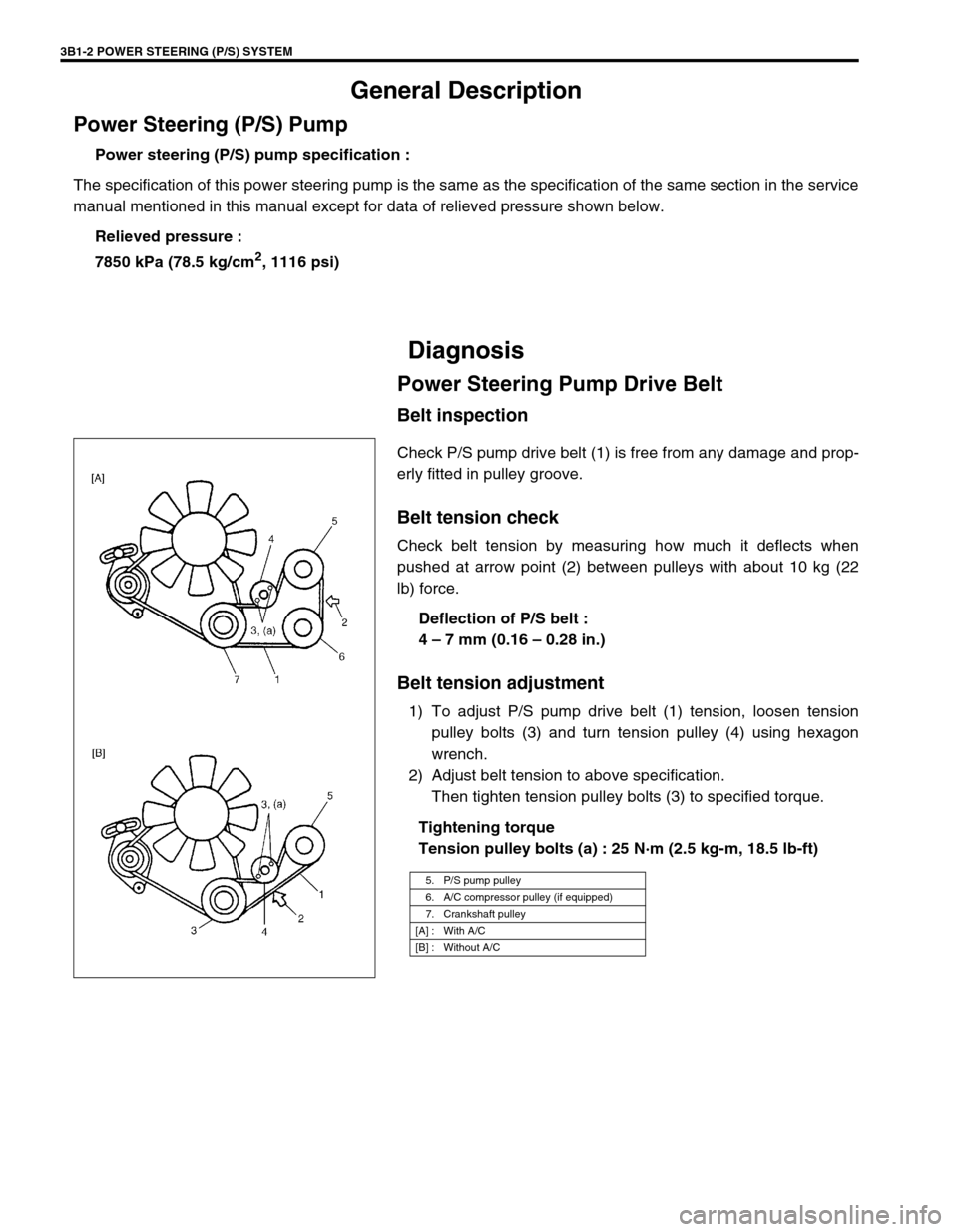
Check P/S pump drive belt (1) is free from any damage and prop-
erly fitted in pulley groove.
Belt tension check
Check belt tension by measuring how much it deflects when
pushed at arrow point (2) between pulleys with about 10 kg (22
lb) force.
Deflection of P/S belt :
4 – 7 mm (0.16 – 0.28 in.)
Belt tension adjustment
1) To adjust P/S pump drive belt (1) tension, loosen tension
pulley bolts (3) and turn tension pulley (4) using hexagon
wrench.
2) Adjust belt tension to above specification.
Then tighten tension pulley bolts (3) to specified torque.
Tightening torque
Tension pulley bolts (a) : 25 N·m (2.5 kg-m, 18.5 lb-ft)
5. P/S pump pulley
6. A/C compressor pulley (if equipped)
7. Crankshaft pulley
[A] : With A/C
[B] : Without A/C
Page 74 of 656
POWER STEERING (P/S) SYSTEM 3B1-3
Hydraulic Pressure in P/S Circuit
Hydraulic pressure check
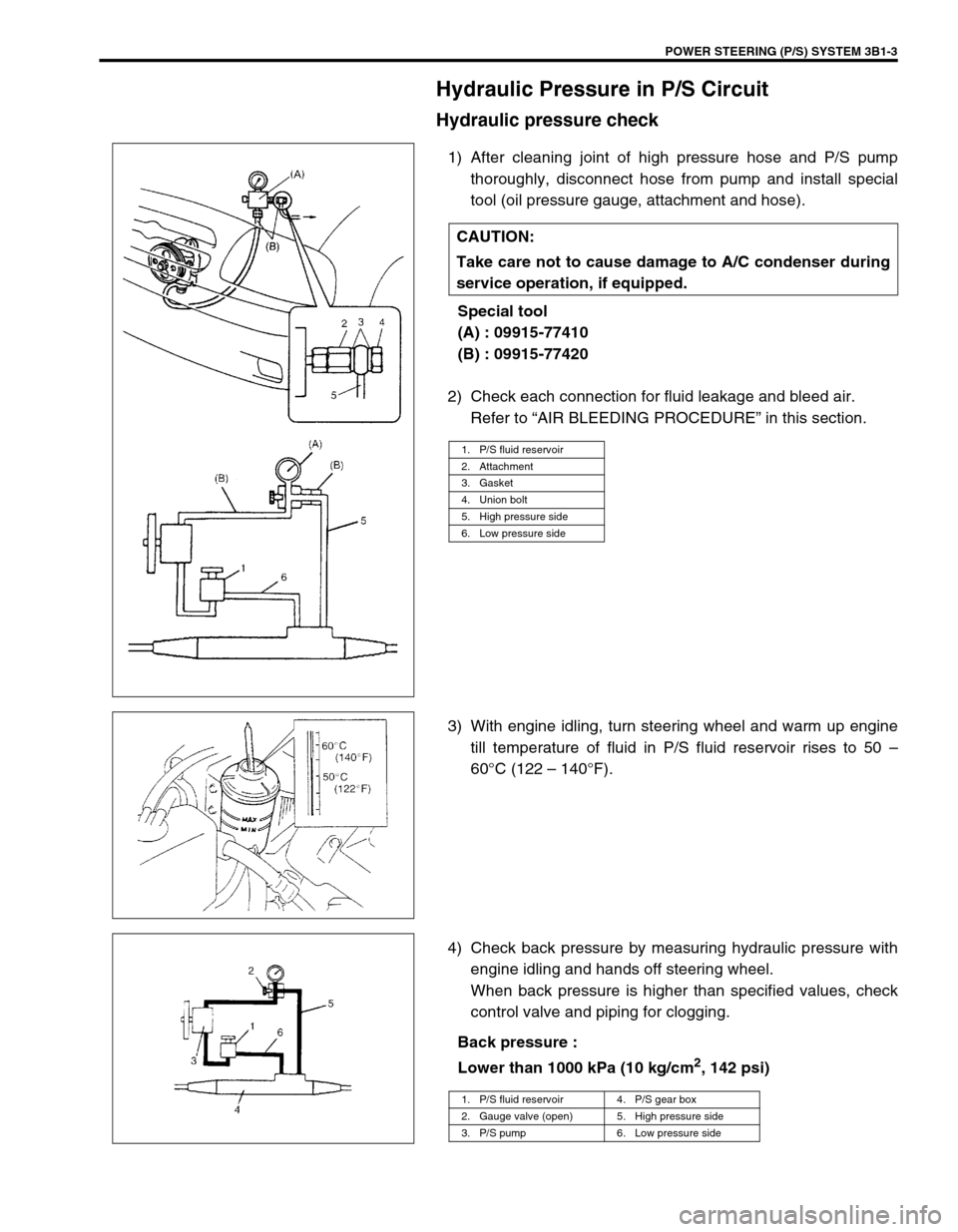
1) After cleaning joint of high pressure hose and P/S pump
thoroughly, disconnect hose from pump and install special
tool (oil pressure gauge, attachment and hose).
Special tool
(A) : 09915-77410
(B) : 09915-77420
2) Check each connection for fluid leakage and bleed air.
Refer to “AIR BLEEDING PROCEDURE” in this section.
3) With engine idling, turn steering wheel and warm up engine
till temperature of fluid in P/S fluid reservoir rises to 50 –
60°C (122 – 140°F).
4) Check back pressure by measuring hydraulic pressure with
engine idling and hands off steering wheel.
When back pressure is higher than specified values, check
control valve and piping for clogging.
Back pressure :
Lower than 1000 kPa (10 kg/cm
2, 142 psi) CAUTION:
Take care not to cause damage to A/C condenser during
service operation, if equipped.
1. P/S fluid reservoir
2. Attachment
3. Gasket
4. Union bolt
5. High pressure side
6. Low pressure side
1. P/S fluid reservoir 4. P/S gear box
2. Gauge valve (open) 5. High pressure side
3. P/S pump 6. Low pressure side
Page 75 of 656
3B1-4 POWER STEERING (P/S) SYSTEM
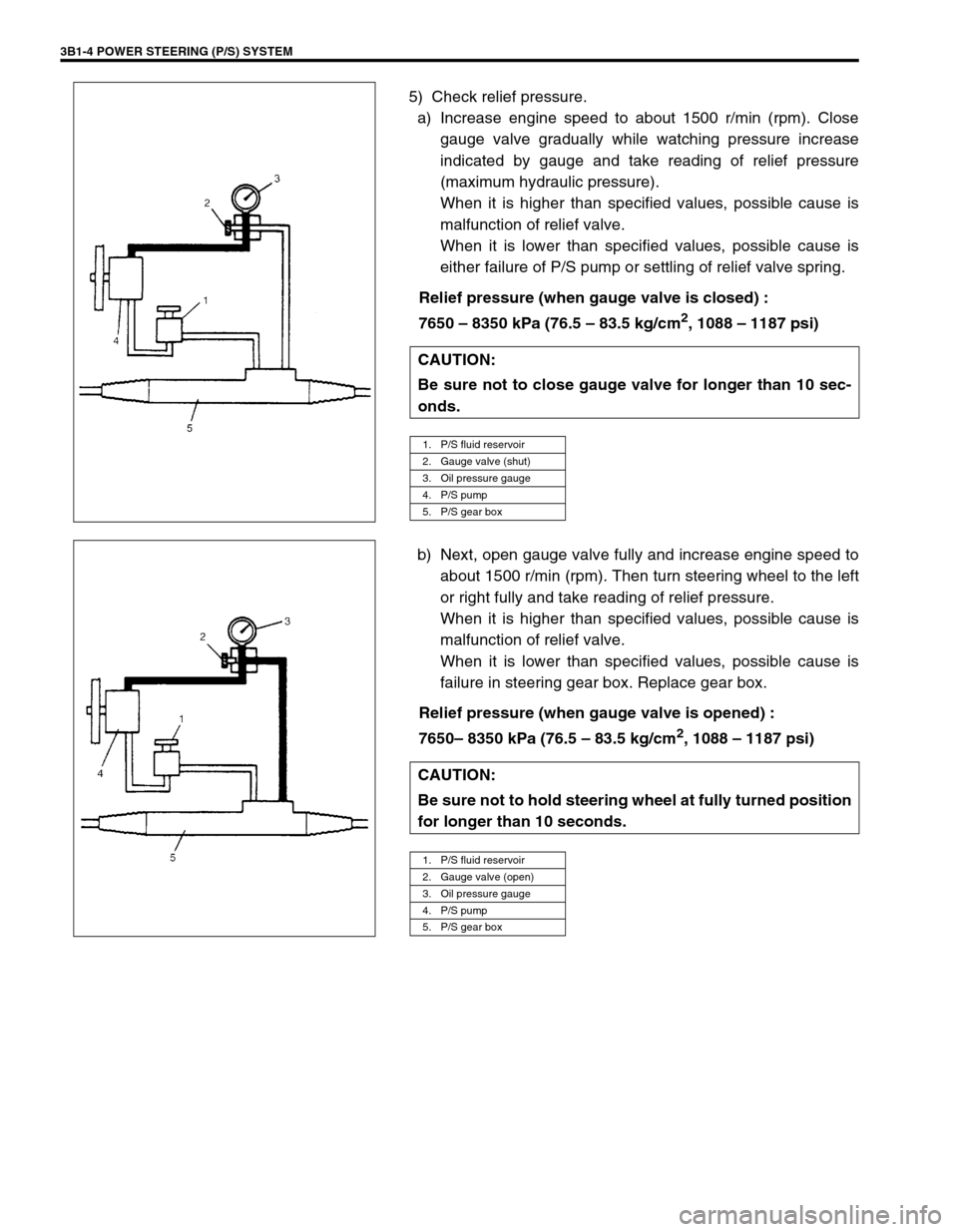
5) Check relief pressure.
a) Increase engine speed to about 1500 r/min (rpm). Close
gauge valve gradually while watching pressure increase
indicated by gauge and take reading of relief pressure
(maximum hydraulic pressure).
When it is higher than specified values, possible cause is
malfunction of relief valve.
When it is lower than specified values, possible cause is
either failure of P/S pump or settling of relief valve spring.
Relief pressure (when gauge valve is closed) :
7650 – 8350 kPa (76.5 – 83.5 kg/cm
2, 1088 – 1187 psi)
b) Next, open gauge valve fully and increase engine speed to
about 1500 r/min (rpm). Then turn steering wheel to the left
or right fully and take reading of relief pressure.
When it is higher than specified values, possible cause is
malfunction of relief valve.
When it is lower than specified values, possible cause is
failure in steering gear box. Replace gear box.
Relief pressure (when gauge valve is opened) :
7650– 8350 kPa (76.5 – 83.5 kg/cm
2, 1088 – 1187 psi) CAUTION:
Be sure not to close gauge valve for longer than 10 sec-
onds.
1. P/S fluid reservoir
2. Gauge valve (shut)
3. Oil pressure gauge
4. P/S pump
5. P/S gear box
CAUTION:
Be sure not to hold steering wheel at fully turned position
for longer than 10 seconds.
1. P/S fluid reservoir
2. Gauge valve (open)
3. Oil pressure gauge
4. P/S pump
5. P/S gear box
Page 79 of 656
3C1-4 AIR BAG STEERING WHEEL AND COLUMN
Steering Column
REMOVAL
1) Disconnect negative (–) cable at battery.
2) Disable air bag system. Refer to “DISABLING AIR BAG SYSTEM” under “SERVICE PRECAUTIONS” in
Section 10B.
3) Remove steering wheel and contact coil and combination switch assembly, if necessary. Refer to “STEER-
ING WHEEL” and “CONTACT COIL AND COMBINATION SWITCH ASSEMBLY” in this section.
Perform the following procedure if not removing steering wheel and/or combination switch.
a) Turn steering wheel so that vehicle’s front tires are at straight-ahead position.
b) Turn ignition switch to “LOCK” position and remove key.
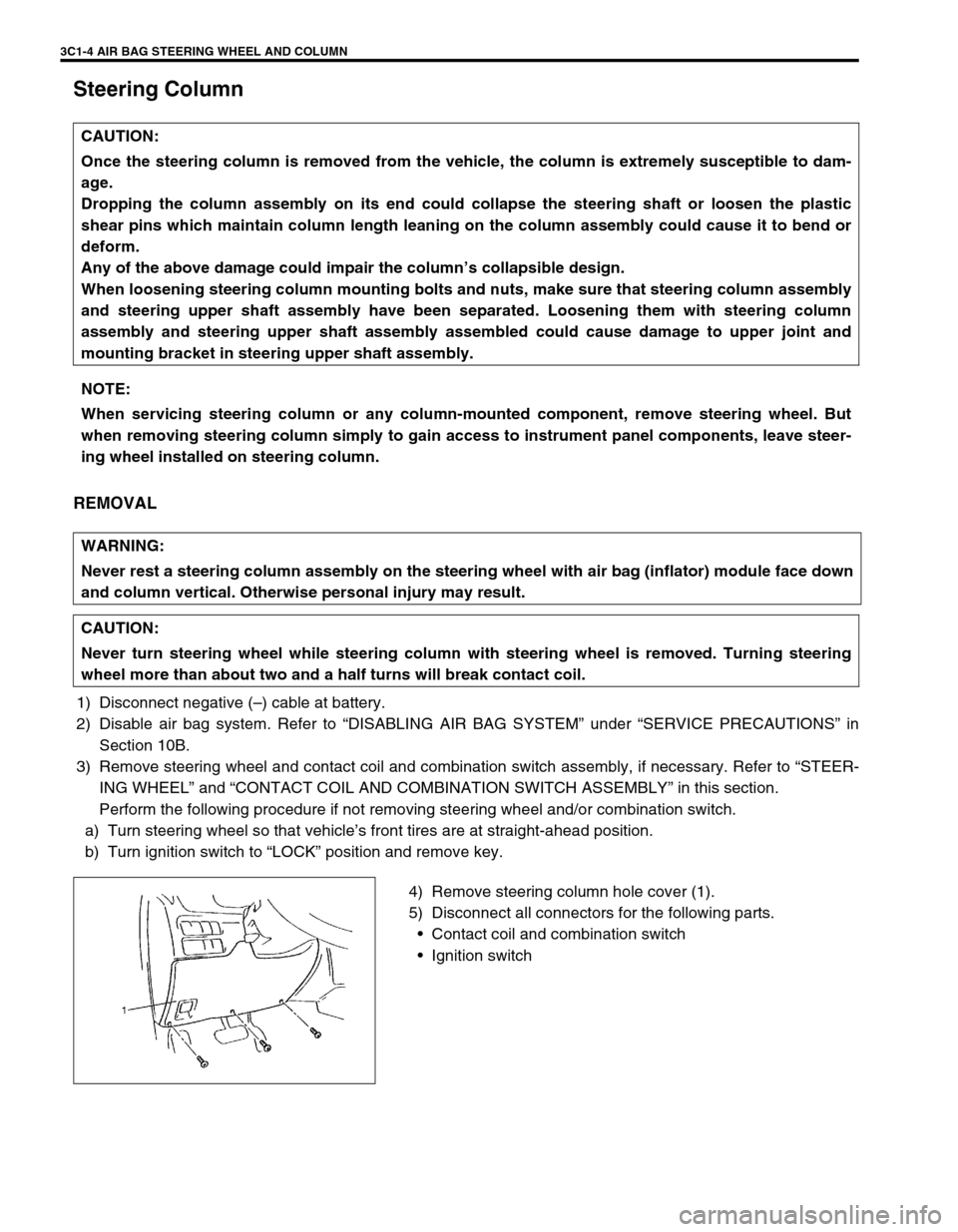
4) Remove steering column hole cover (1).
5) Disconnect all connectors for the following parts.
Contact coil and combination switch
Ignition switch CAUTION:
Once the steering column is removed from the vehicle, the column is extremely susceptible to dam-
age.
Dropping the column assembly on its end could collapse the steering shaft or loosen the plastic
shear pins which maintain column length leaning on the column assembly could cause it to bend or
deform.
Any of the above damage could impair the column’s collapsible design.
When loosening steering column mounting bolts and nuts, make sure that steering column assembly
and steering upper shaft assembly have been separated. Loosening them with steering column
assembly and steering upper shaft assembly assembled could cause damage to upper joint and
mounting bracket in steering upper shaft assembly.
NOTE:
When servicing steering column or any column-mounted component, remove steering wheel. But
when removing steering column simply to gain access to instrument panel components, leave steer-
ing wheel installed on steering column.
WARNING:
Never rest a steering column assembly on the steering wheel with air bag (inflator) module face down
and column vertical. Otherwise personal injury may result.
CAUTION:
Never turn steering wheel while steering column with steering wheel is removed. Turning steering
wheel more than about two and a half turns will break contact coil.
Page 82 of 656
AIR BAG STEERING WHEEL AND COLUMN 3C1-7
Steering Upper Shaft Assembly
REMOVAL
1) Turn steering wheel so that vehicle’s front tires are at
straight-ahead position.
2) Turn ignition switch to “LOCK” position and remove key.
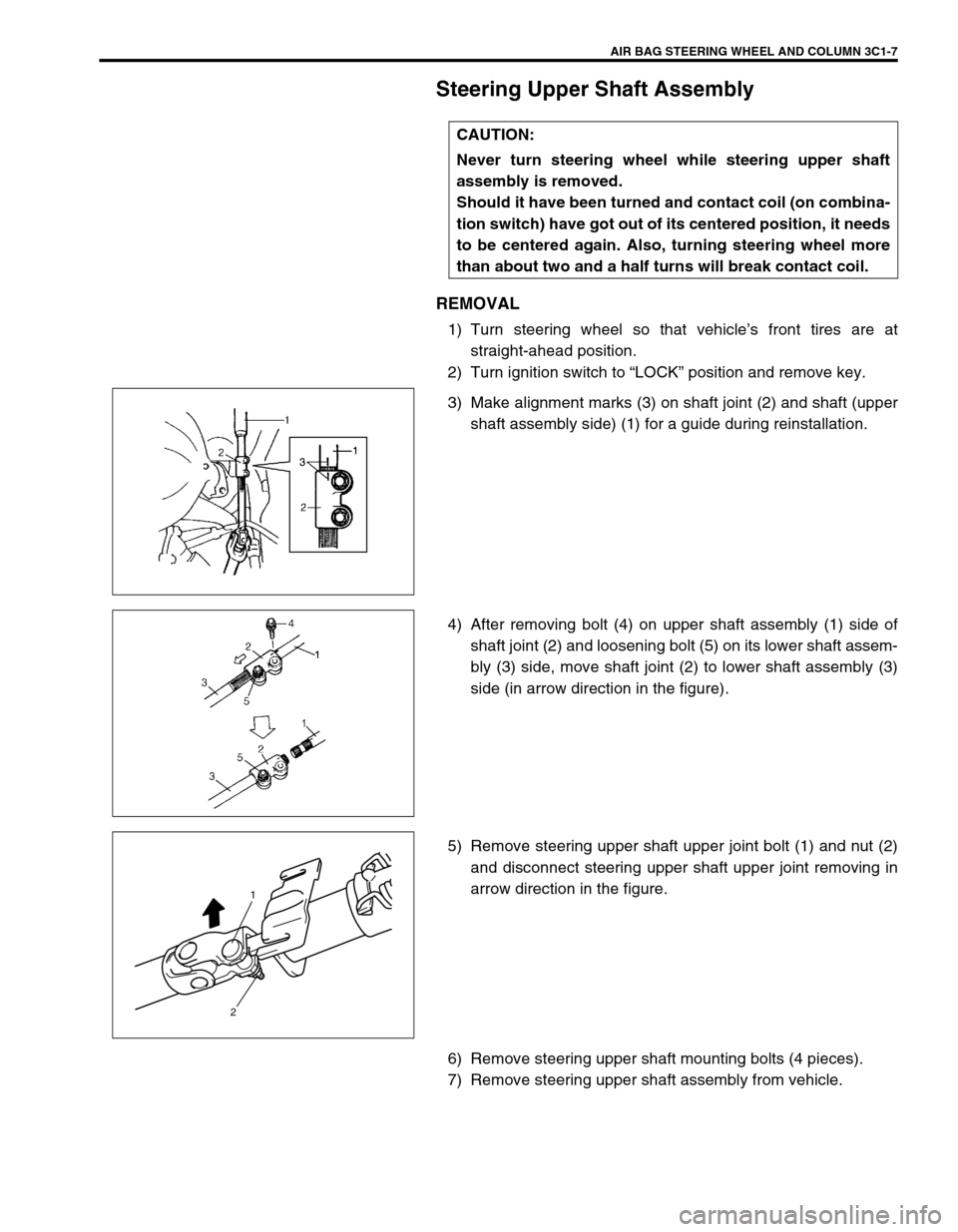
3) Make alignment marks (3) on shaft joint (2) and shaft (upper
shaft assembly side) (1) for a guide during reinstallation.
4) After removing bolt (4) on upper shaft assembly (1) side of
shaft joint (2) and loosening bolt (5) on its lower shaft assem-
bly (3) side, move shaft joint (2) to lower shaft assembly (3)
side (in arrow direction in the figure).
5) Remove steering upper shaft upper joint bolt (1) and nut (2)
and disconnect steering upper shaft upper joint removing in
arrow direction in the figure.
6) Remove steering upper shaft mounting bolts (4 pieces).
7) Remove steering upper shaft assembly from vehicle.CAUTION:
Never turn steering wheel while steering upper shaft
assembly is removed.
Should it have been turned and contact coil (on combina-
tion switch) have got out of its centered position, it needs
to be centered again. Also, turning steering wheel more
than about two and a half turns will break contact coil.
1
2
Page 84 of 656
AIR BAG STEERING WHEEL AND COLUMN 3C1-9
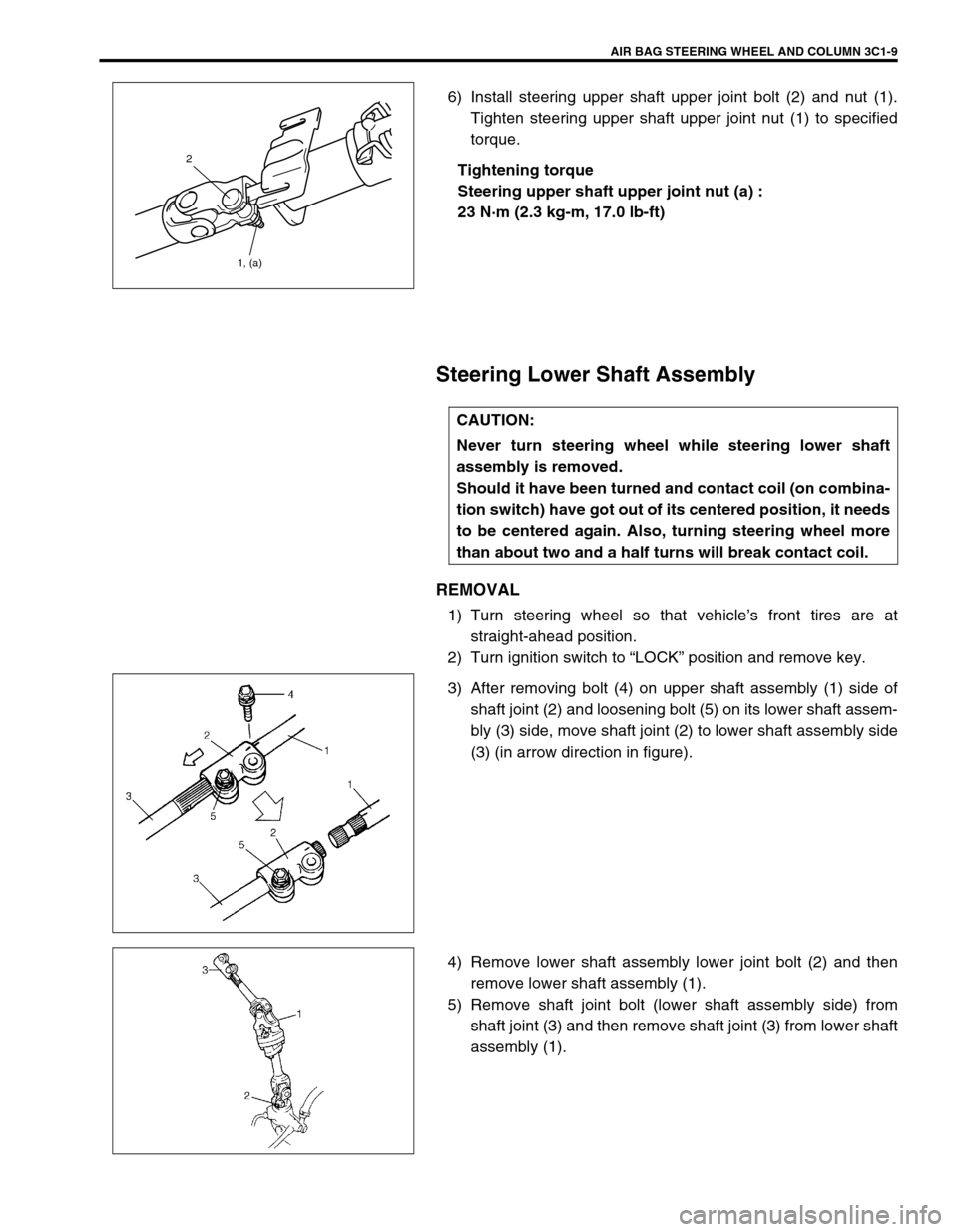
6) Install steering upper shaft upper joint bolt (2) and nut (1).
Tighten steering upper shaft upper joint nut (1) to specified
torque.
Tightening torque
Steering upper shaft upper joint nut (a) :
23 N·m (2.3 kg-m, 17.0 lb-ft)
Steering Lower Shaft Assembly
REMOVAL
1) Turn steering wheel so that vehicle’s front tires are at
straight-ahead position.
2) Turn ignition switch to “LOCK” position and remove key.
3) After removing bolt (4) on upper shaft assembly (1) side of
shaft joint (2) and loosening bolt (5) on its lower shaft assem-
bly (3) side, move shaft joint (2) to lower shaft assembly side
(3) (in arrow direction in figure).
4) Remove lower shaft assembly lower joint bolt (2) and then
remove lower shaft assembly (1).
5) Remove shaft joint bolt (lower shaft assembly side) from
shaft joint (3) and then remove shaft joint (3) from lower shaft
assembly (1).
1, (a) 2
CAUTION:
Never turn steering wheel while steering lower shaft
assembly is removed.
Should it have been turned and contact coil (on combina-
tion switch) have got out of its centered position, it needs
to be centered again. Also, turning steering wheel more
than about two and a half turns will break contact coil.