Page 204 of 656
ENGINE GENERAL INFORMATION AND DIAGNOSIS (H27 ENGINE) 6-1-43
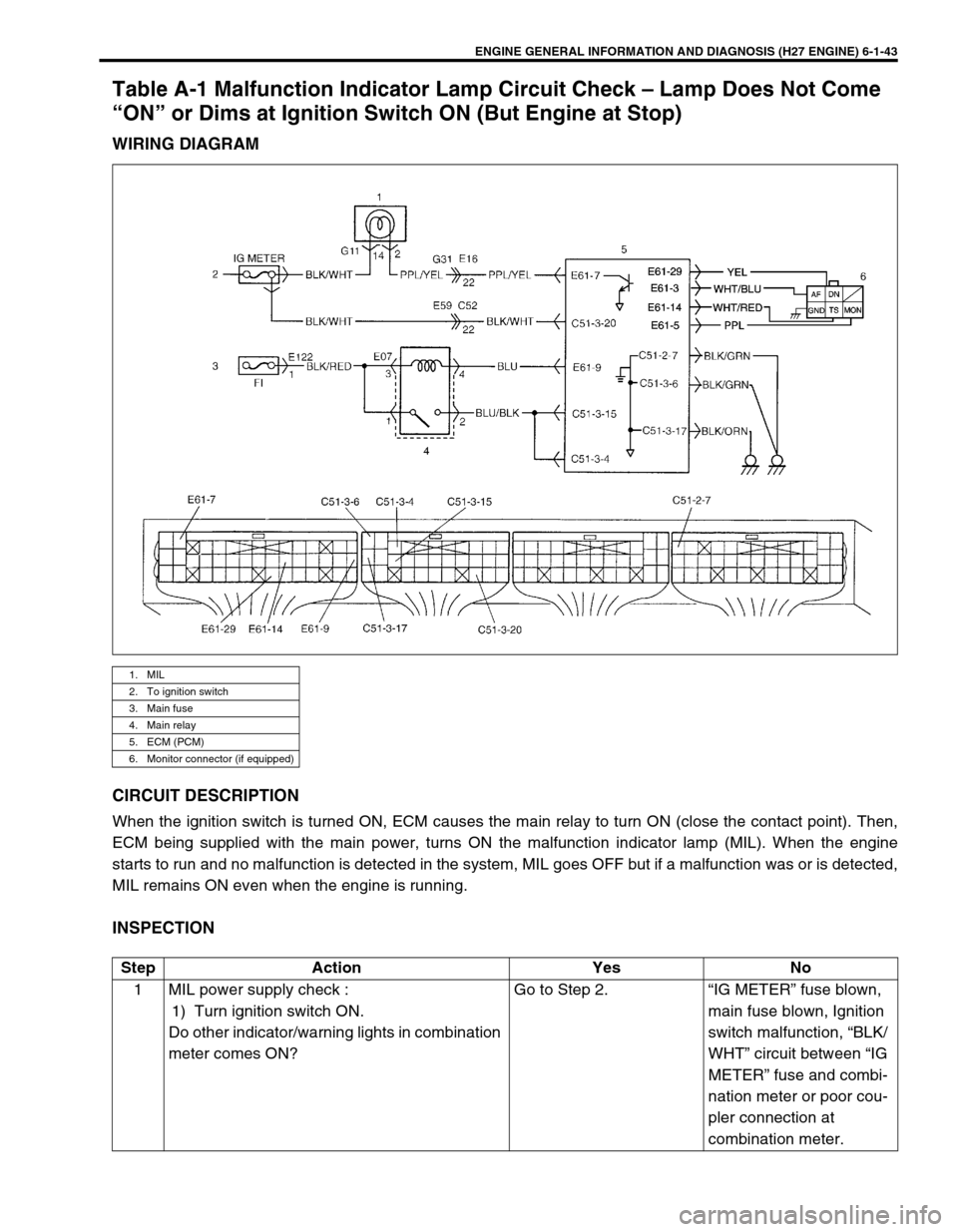
Table A-1 Malfunction Indicator Lamp Circuit Check – Lamp Does Not Come
“ON” or Dims at Ignition Switch ON (But Engine at Stop)
WIRING DIAGRAM
CIRCUIT DESCRIPTION
When the ignition switch is turned ON, ECM causes the main relay to turn ON (close the contact point). Then,
ECM being supplied with the main power, turns ON the malfunction indicator lamp (MIL). When the engine
starts to run and no malfunction is detected in the system, MIL goes OFF but if a malfunction was or is detected,
MIL remains ON even when the engine is running.
INSPECTION
1. MIL
2. To ignition switch
3. Main fuse
4. Main relay
5. ECM (PCM)
6. Monitor connector (if equipped)
Step Action Yes No
1 MIL power supply check :
1) Turn ignition switch ON.
Do other indicator/warning lights in combination
meter comes ON?Go to Step 2. “IG METER” fuse blown,
main fuse blown, Ignition
switch malfunction, “BLK/
WHT” circuit between “IG
METER” fuse and combi-
nation meter or poor cou-
pler connection at
combination meter.
Page 207 of 656
6-1-46 ENGINE GENERAL INFORMATION AND DIAGNOSIS (H27 ENGINE)
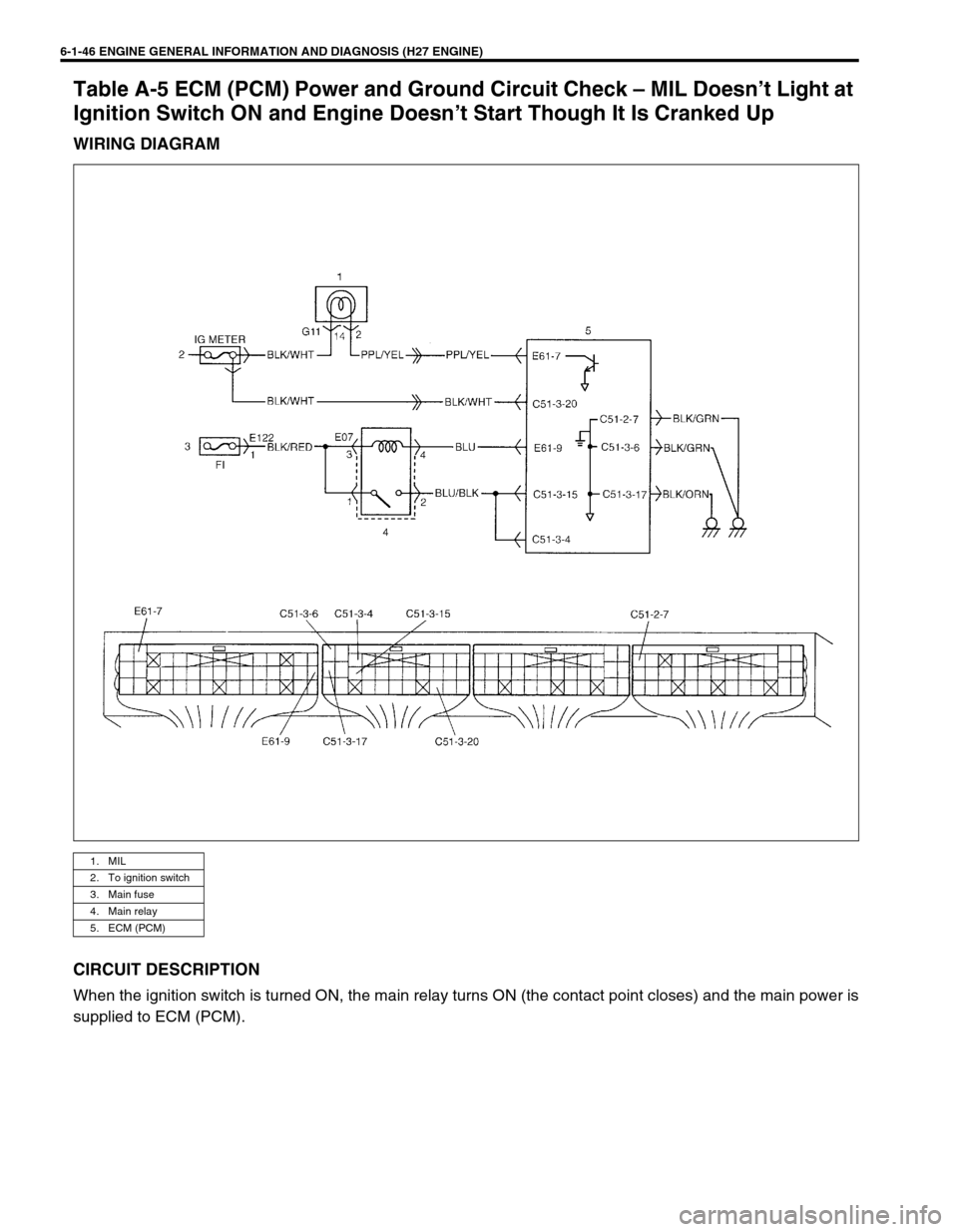
Table A-5 ECM (PCM) Power and Ground Circuit Check – MIL Doesn’t Light at
Ignition Switch ON and Engine Doesn’t Start Though It Is Cranked Up
WIRING DIAGRAM
CIRCUIT DESCRIPTION
When the ignition switch is turned ON, the main relay turns ON (the contact point closes) and the main power is
supplied to ECM (PCM).
1. MIL
2. To ignition switch
3. Main fuse
4. Main relay
5. ECM (PCM)
Page 282 of 656
ENGINE GENERAL INFORMATION AND DIAGNOSIS (H27 ENGINE) 6-1-121
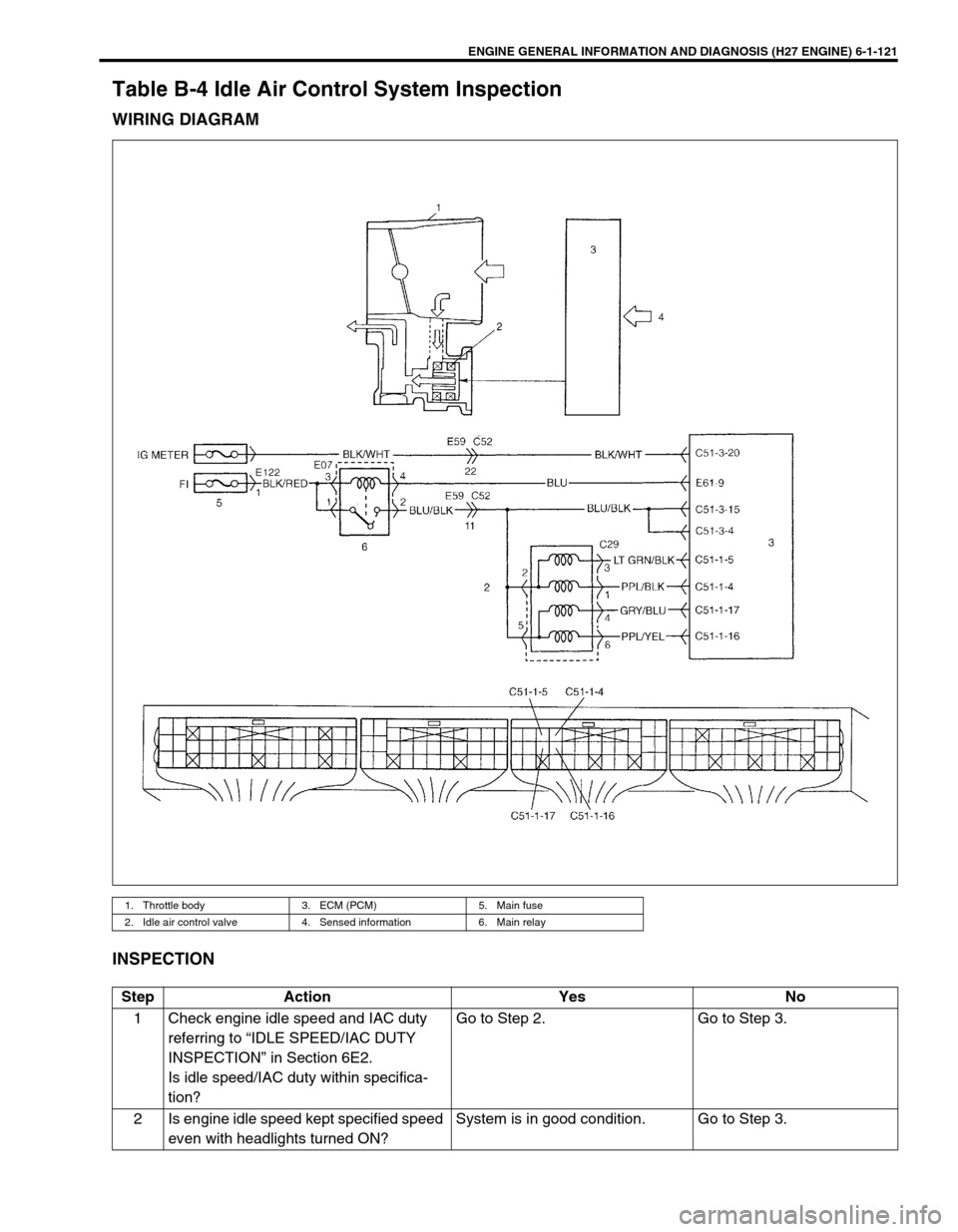
Table B-4 Idle Air Control System Inspection
WIRING DIAGRAM
INSPECTION
1. Throttle body 3. ECM (PCM) 5. Main fuse
2. Idle air control valve 4. Sensed information 6. Main relay
Step Action Yes No
1 Check engine idle speed and IAC duty
referring to “IDLE SPEED/IAC DUTY
INSPECTION” in Section 6E2.
Is idle speed/IAC duty within specifica-
tion?Go to Step 2. Go to Step 3.
2 Is engine idle speed kept specified speed
even with headlights turned ON?System is in good condition. Go to Step 3.
Page 348 of 656
ENGINE AND EMISSION CONTROL SYSTEM (SEQUENTIAL MULTIPORT FUEL INJECTION FOR H27 ENGINE) 6E2-15
Idle Speed/Idle Air Control (IAC) Duty Inspec-
tion
Before idle speed/IAC duty check, make sure of the following.
•Lead wires and hoses of engine/emission control systems
are connected securely.
•Accelerator cable is adjusted.
•Ignition timing is within specification.
•All accessories (wipers, heater, lights, A/C, etc.) are out of
service.
•Air cleaner has been properly installed and is in good condi-
tion.
•ECM (PCM) does not detect any malfunction DTC.
After above items are all confirmed, check idle speed and IAC
duty as follows.
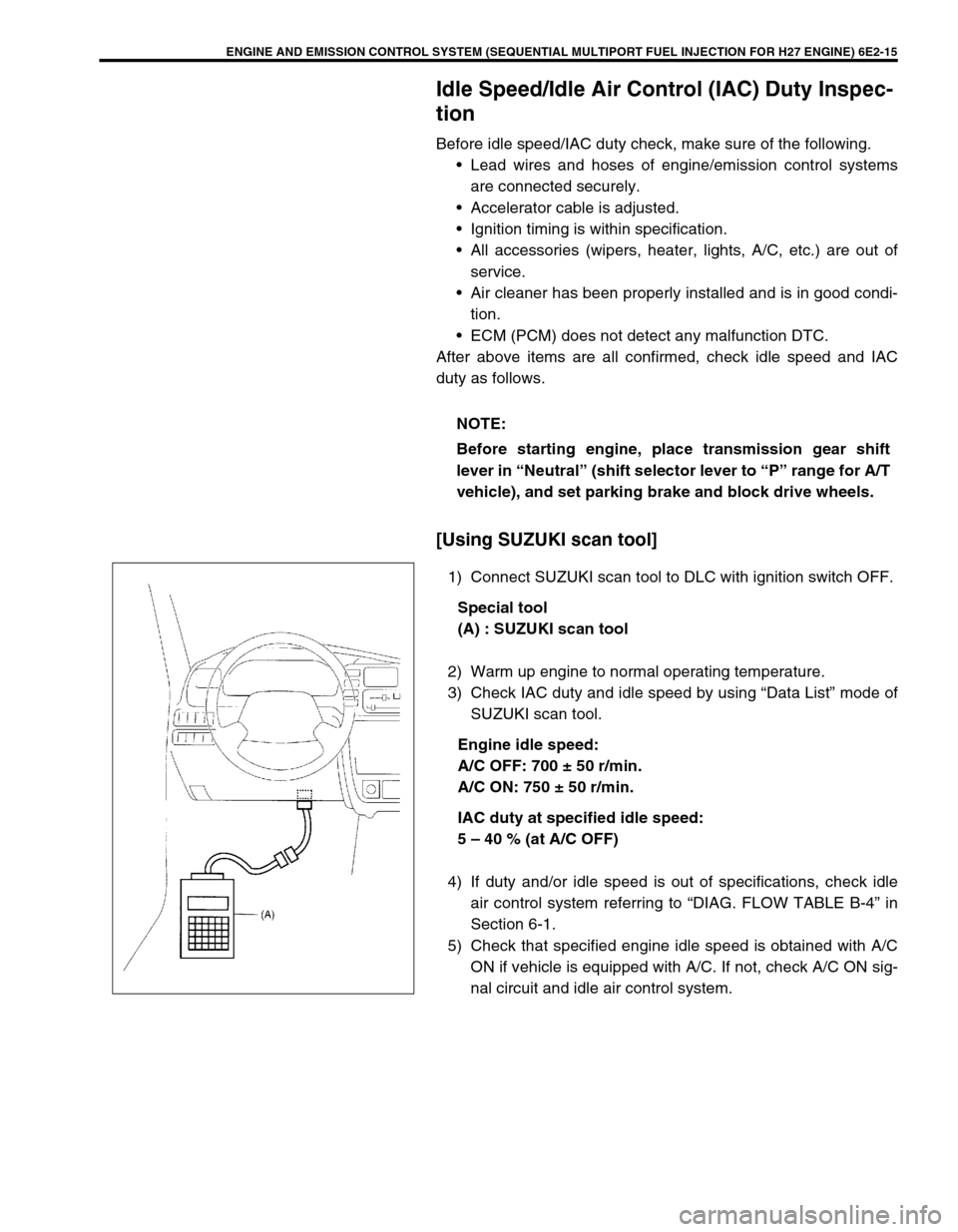
[Using SUZUKI scan tool]
1) Connect SUZUKI scan tool to DLC with ignition switch OFF.
Special tool
(A) : SUZUKI scan tool
2) Warm up engine to normal operating temperature.
3) Check IAC duty and idle speed by using “Data List” mode of
SUZUKI scan tool.
Engine idle speed:
A/C OFF: 700 ± 50 r/min.
A/C ON: 750 ± 50 r/min.
IAC duty at specified idle speed:
5 – 40 % (at A/C OFF)
4) If duty and/or idle speed is out of specifications, check idle
air control system referring to “DIAG. FLOW TABLE B-4” in
Section 6-1.
5) Check that specified engine idle speed is obtained with A/C
ON if vehicle is equipped with A/C. If not, check A/C ON sig-
nal circuit and idle air control system. NOTE:
Before starting engine, place transmission gear shift
lever in “Neutral” (shift selector lever to “P” range for A/T
vehicle), and set parking brake and block drive wheels.
Page 390 of 656

IGNITION SYSTEM (FOR H27 ENGINE) 6F2-7
5) Set timing light to ignition harness for No.1 cylinder.
6) Using timing light, check that timing observed from viewpoint
is within specification.
Initial ignition timing of viewpoint
(when it is fixed by SUZUKI scan tool) :
5 ± 1° BTDC
Ignition order :
1-6-5-4-3-2
Special tool
(A) : 09930-76420
7) If ignition timing is out of specification, loosen flange bolt,
adjust timing by turning CMP sensor (1) while engine is run-
ning, and then tighten bolt (2).
Tightening torque
CMP sensor bolt (a) : 15 N·m (1.5 kg-m, 11.0 lb-ft)
8) After tightening bolt (2), recheck that ignition timing is within
specification.
9) After checking and/or adjusting, end fixed spark mode of
SUZUKI scan tool.
10) With engine idling (closed throttle position and vehicle
stopped), check that ignition timing is about BTDC 12-16°
(shown in the figure). Also, check that increasing engine
speed advances ignition timing.
If above check results are not satisfactory, check input sig-
nals related to this system.
1. Timing mark on crankshaft pulley
NOTE:
In this state, ignition timing may vary more or less of ini-
tial ignition timing but it is nothing abnormal.
1. Timing mark on crankshaft pulley
Page 410 of 656

AUTOMATIC TRANSMISSION (4 A/T) 7B1-1
7B1
SECTION 7B1
AUTOMATIC TRANSMISSION (4 A/T)
CONTENTS
General Description ......................................7B1-3
Electronic Shift Control System ................... 7B1-4
Automatic gear shift diagram................... 7B1-5
Diagnosis .......................................................7B1-7
On-Board Diagnostic System
(Vehicle without monitor connector) ............ 7B1-7
On-Board Diagnostic System
(Vehicle with monitor connector) ................. 7B1-8
Precaution in Diagnosing Trouble ............... 7B1-9
Automatic Transmission Diagnostic Flow
Table ......................................................... 7B1-10
Malfunction Indicator Lamp (MIL) Check... 7B1-13
“O/D OFF” Lamp Check ............................ 7B1-13
“POWER” Lamp Check ............................. 7B1-13
Diagnostic Trouble Code (DTC) Check ..... 7B1-13
Diagnostic Trouble Code Clearance ......... 7B1-13
Diagnostic Trouble Code Table ................. 7B1-14
Fail Safe Table .......................................... 7B1-14
Visual Inspection ....................................... 7B1-14
A/T Basic Check ........................................ 7B1-14
Trouble Diagnosis Table 1 ........................ 7B1-15
Trouble Diagnosis Table 2 ........................ 7B1-15
Trouble Diagnosis Table 3 ........................ 7B1-16
Scan Tool Data ......................................... 7B1-17
Inspection of PCM and Its Circuit .............. 7B1-17Wire Harness and Connectors .................. 7B1-17
Table A-1 : No TCC Lock-Up Occurs ........ 7B1-18
Table A-2 : No Gear Shift to O/D .............. 7B1-20
Table B-1 : “O/D OFF” Light Circuit Check
(“O/D OFF” Light Doesn’t Light at Ignition
Switch ON But Engine Starts Up) ............. 7B1-22
Table B-2 : “O/D OFF” Light Circuit Check
(“O/D OFF” Light Comes ON Steadily) ..... 7B1-23
Table B-3 : “POWER” Light Circuit Check
(“POWER” Light Doesn’t Light at Ignition
Switch ON But Engine Starts Up) ............. 7B1-24
Table B-4 : “POWER” Light Circuit Check
(“POWER” Light Comes ON Steadily) ...... 7B1-25
DTC P0705 (DTC NO.72) - Transmission
Range Sensor (Switch) Circuit Malfunction7B1-26
DTC P0715 (DTC NO.76) - Input/Turbine
Speed Sensor Circuit Malfunction............. 7B1-29
DTC P0720 (DTC NO.75) Output Speed
Sensor Circuit Malfunction ........................ 7B1-32
DTC P0743 (DTC NO.65/66) -
TCC (Lock-Up) Solenoid Electrical ........... 7B1-34
DTC P0753 (DTC NO.61/62)
Shift Solenoid-A (#1) Electrical
DTC P0758 (DTC NO.63/64)
Shift Solenoid-B (#2) Electrical ................. 7B1-36 WARNING:
For vehicles equipped with Supplemental Restraint (Air Bag) System:
Service on and around the air bag system components or wiring must be performed only by an
authorized SUZUKI dealer. Refer to “Air Bag System Components and Wiring Location View” under
“General Description” in air bag system section in order to confirm whether you are performing ser-
vice on or near the air bag system components or wiring. Please observe all WARNINGS and “Ser-
vice Precautions” under “On-Vehicle Service” in air bag system section before performing service
on or around the air bag system components or wiring. Failure to follow WARNINGS could result in
unintentional activation of the system or could render the system inoperative. Either of these two
conditions may result in severe injury.
Technical service work must be started at least 90 seconds after the ignition switch is turned to the
“LOCK” position and the negative cable is disconnected from the battery. Otherwise, the system
may be activated by reserve energy in the Sensing and Diagnostic Module (SDM).
NOTE:
For the descriptions (items) not found in this section, refer to the same section of the Service Manual
mentioned in FOREWORD of this manual.
Page 431 of 656
7B1-22 AUTOMATIC TRANSMISSION (4 A/T)
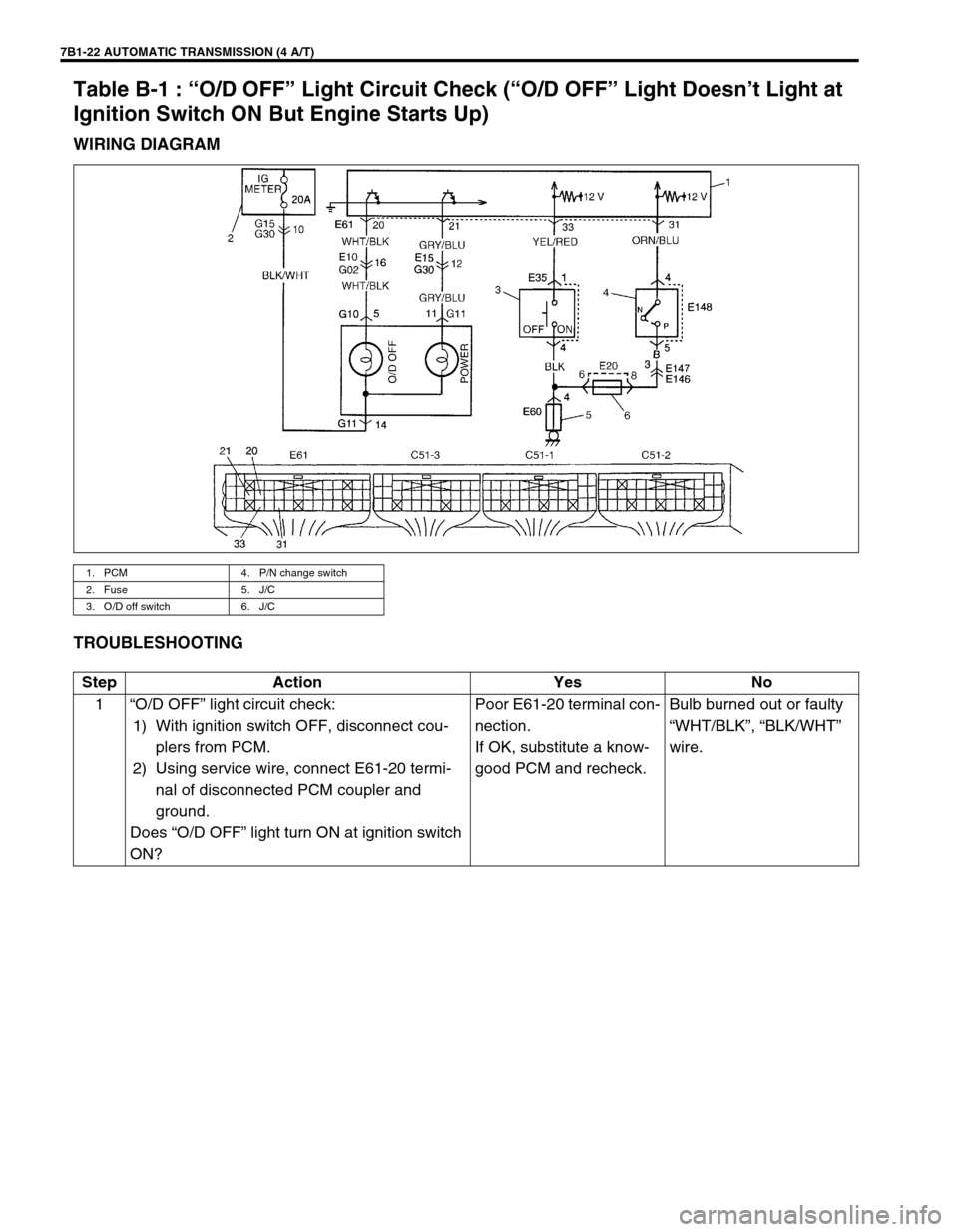
Table B-1 : “O/D OFF” Light Circuit Check (“O/D OFF” Light Doesn’t Light at
Ignition Switch ON But Engine Starts Up)
WIRING DIAGRAM
TROUBLESHOOTING
1. PCM 4. P/N change switch
2. Fuse 5. J/C
3. O/D off switch 6. J/C
Step Action Yes No
1“O/D OFF” light circuit check:
1) With ignition switch OFF, disconnect cou-
plers from PCM.
2) Using service wire, connect E61-20 termi-
nal of disconnected PCM coupler and
ground.
Does “O/D OFF” light turn ON at ignition switch
ON?Poor E61-20 terminal con-
nection.
If OK, substitute a know-
good PCM and recheck.Bulb burned out or faulty
“WHT/BLK”, “BLK/WHT”
wire.
Page 433 of 656
7B1-24 AUTOMATIC TRANSMISSION (4 A/T)
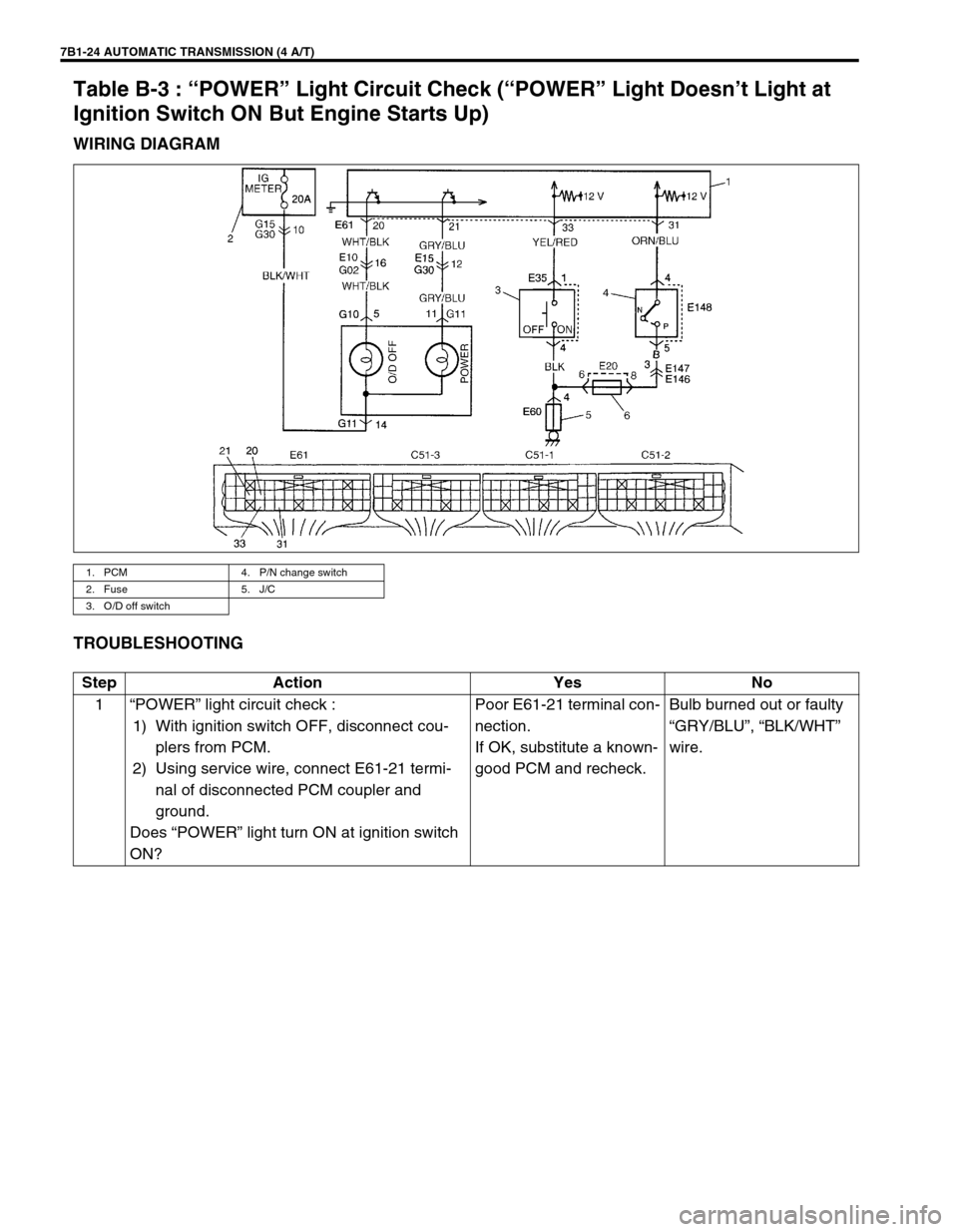
Table B-3 : “POWER” Light Circuit Check (“POWER” Light Doesn’t Light at
Ignition Switch ON But Engine Starts Up)
WIRING DIAGRAM
TROUBLESHOOTING
1. PCM 4. P/N change switch
2. Fuse 5. J/C
3. O/D off switch
Step Action Yes No
1“POWER” light circuit check :
1) With ignition switch OFF, disconnect cou-
plers from PCM.
2) Using service wire, connect E61-21 termi-
nal of disconnected PCM coupler and
ground.
Does “POWER” light turn ON at ignition switch
ON?Poor E61-21 terminal con-
nection.
If OK, substitute a known-
good PCM and recheck.Bulb burned out or faulty
“GRY/BLU”, “BLK/WHT”
wire.