1999 SUZUKI GRAND VITARA Pcm
[x] Cancel search: PcmPage 168 of 656
ENGINE GENERAL INFORMATION AND DIAGNOSIS (H27 ENGINE) 6-1-7
WARM-UP CYCLE
A warm-up cycle means sufficient vehicle operation such that the
coolant temperature has risen by at least 22°C (40°F) from
engine starting and reaches a minimum temperature of 70 °C
(160 °F).
DRIVING CYCLE
A “Driving Cycle” consists of engine startup, driving mode where
a malfunction would be detected if present and engine shutoff.
2 DRIVING CYCLE DETECTION LOGIC
The malfunction detected in the first driving cycle is stored in
ECM (PCM) memory (in the form of pending DTC) but the mal-
function indicator lamp does not light at this time. It lights up at the
second detection of same malfunction also in the next driving
cycle.
PENDING DTC
Pending DTC means a DTC detected and stored temporarily at 1
driving cycle of the DTC which is detected in the 2 driving cycle
detection logic.
FREEZE FRAME DATA
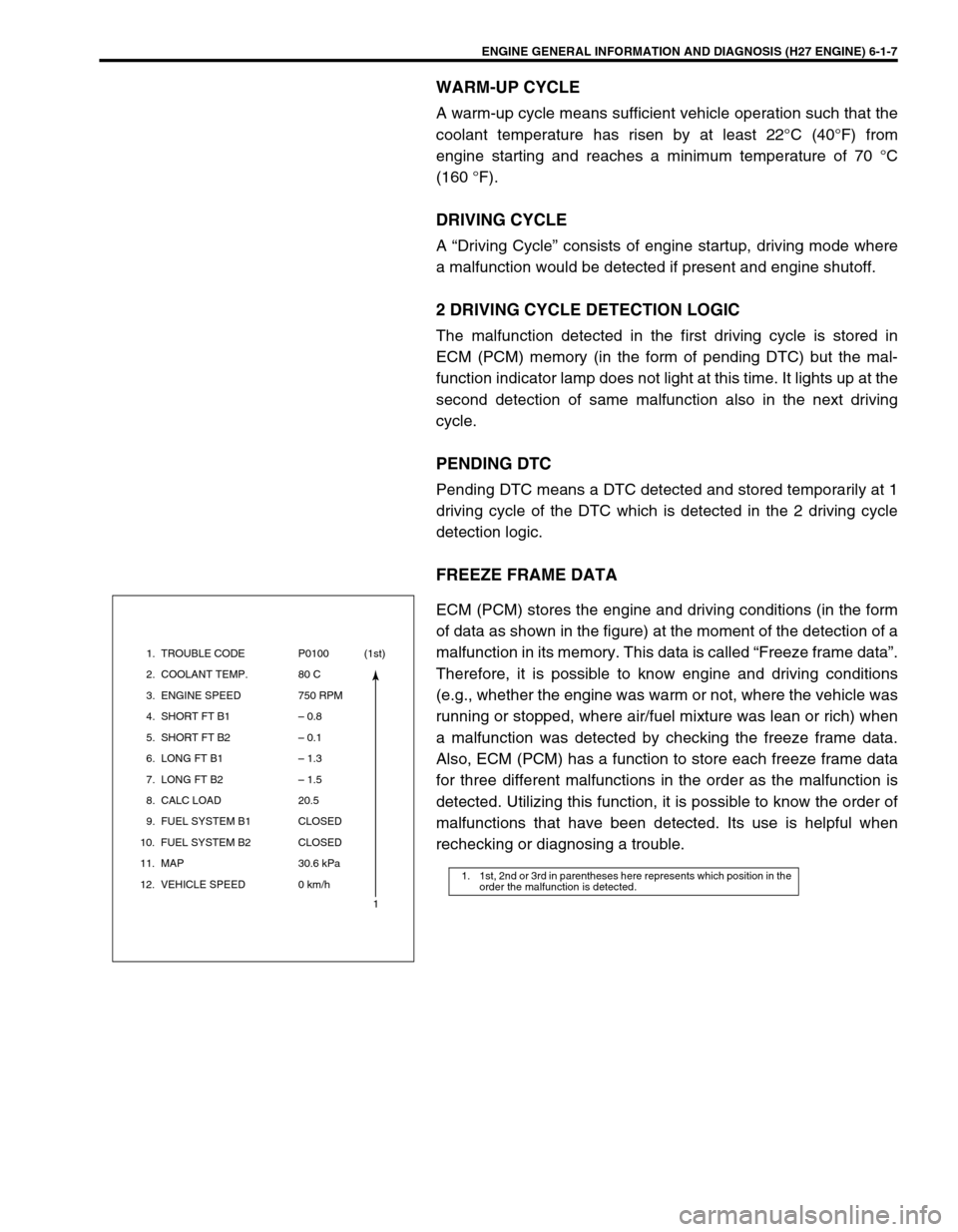
ECM (PCM) stores the engine and driving conditions (in the form
of data as shown in the figure) at the moment of the detection of a
malfunction in its memory. This data is called “Freeze frame data”.
Therefore, it is possible to know engine and driving conditions
(e.g., whether the engine was warm or not, where the vehicle was
running or stopped, where air/fuel mixture was lean or rich) when
a malfunction was detected by checking the freeze frame data.
Also, ECM (PCM) has a function to store each freeze frame data
for three different malfunctions in the order as the malfunction is
detected. Utilizing this function, it is possible to know the order of
malfunctions that have been detected. Its use is helpful when
rechecking or diagnosing a trouble.
1. 1st, 2nd or 3rd in parentheses here represents which position in the
order the malfunction is detected.
1. TROUBLE CODE
2. COOLANT TEMP.
3. ENGINE SPEED
4. SHORT FT B1
5. SHORT FT B2
6. LONG FT B1
7. LONG FT B2
8. CALC LOAD
9. FUEL SYSTEM B1
10. FUEL SYSTEM B2
11. MAP
12. VEHICLE SPEEDP0100
80 C
750 RPM
– 0.8
– 0.1
– 1.3
– 1.5
20.5
CLOSED
CLOSED
30.6 kPa
0 km/h(1st)
1
Page 169 of 656
6-1-8 ENGINE GENERAL INFORMATION AND DIAGNOSIS (H27 ENGINE)
Priority of Freeze Frame Data
ECM (PCM) has 4 frames where the freeze frame data can be stored. The first frame stores the freeze frame
data of the malfunction which was detected first. However, the freeze frame data stored in this frame is updated
according to the priority described below. (If malfunction as described in the upper square “1” below is detected
while the freeze frame data in the lower square “2” has been stored, the freeze frame data “2” will be updated by
the freeze frame data “1”.)
In the 2nd through the 4th frames, the freeze frame data of each malfunction is stored in the order as the mal-
function is detected. These data are not updated regardless of the priority.
Shown in the table below are examples of how freeze frame data are stored when two or more malfunctions are
detected.
Freeze Frame Data Clearance
The freeze frame data is cleared at the same time as clearance of DTC.
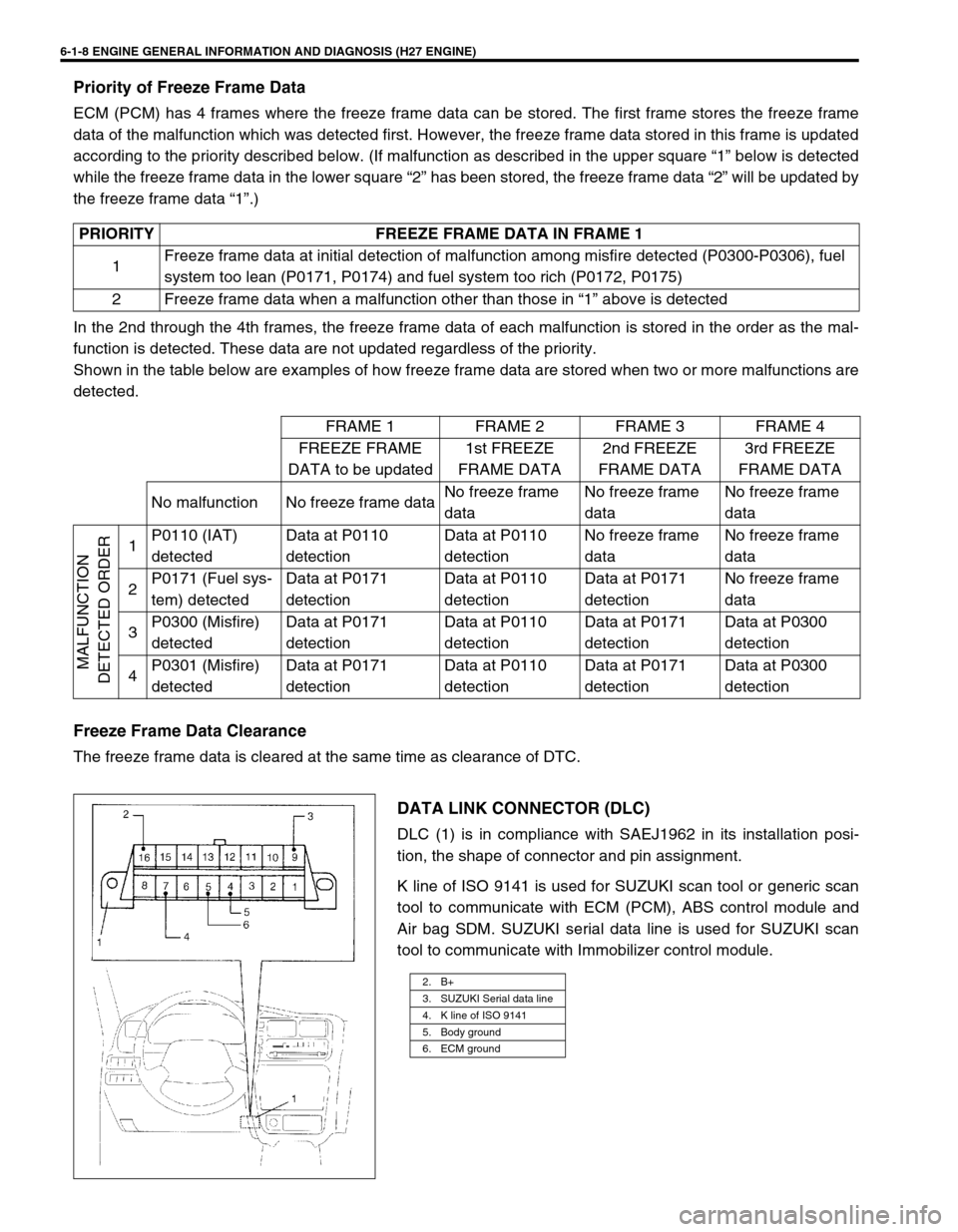
DATA LINK CONNECTOR (DLC)
DLC (1) is in compliance with SAEJ1962 in its installation posi-
tion, the shape of connector and pin assignment.
K line of ISO 9141 is used for SUZUKI scan tool or generic scan
tool to communicate with ECM (PCM), ABS control module and
Air bag SDM. SUZUKI serial data line is used for SUZUKI scan
tool to communicate with Immobilizer control module. PRIORITY FREEZE FRAME DATA IN FRAME 1
1Freeze frame data at initial detection of malfunction among misfire detected (P0300-P0306), fuel
system too lean (P0171, P0174) and fuel system too rich (P0172, P0175)
2 Freeze frame data when a malfunction other than those in “1” above is detected
FRAME 1 FRAME 2 FRAME 3 FRAME 4
FREEZE FRAME
DATA to be updated1st FREEZE
FRAME DATA2nd FREEZE
FRAME DATA3rd FREEZE
FRAME DATA
No malfunction No freeze frame dataNo freeze frame
dataNo freeze frame
dataNo freeze frame
data
MALFUNCTION
DETECTED ORDER
1P0110 (IAT)
detectedData at P0110
detectionData at P0110
detectionNo freeze frame
dataNo freeze frame
data
2P0171 (Fuel sys-
tem) detectedData at P0171
detectionData at P0110
detectionData at P0171
detectionNo freeze frame
data
3P0300 (Misfire)
detectedData at P0171
detectionData at P0110
detectionData at P0171
detectionData at P0300
detection
4P0301 (Misfire)
detectedData at P0171
detectionData at P0110
detectionData at P0171
detectionData at P0300
detection
2. B+
3. SUZUKI Serial data line
4. K line of ISO 9141
5. Body ground
6. ECM ground
Page 171 of 656

6-1-10 ENGINE GENERAL INFORMATION AND DIAGNOSIS (H27 ENGINE)
DATA LINK CONNECTOR (DLC)
DLC (1) is in compliance with SAEJ1962 in its installation posi-
tion, the shape of connector and pin assignment.
K line of ISO 9141 is used for SUZUKI scan tool to communicate
with ECM (PCM), ABS control module and air bag SDM. SUZUKI
serial data line is used for SUZUKI scan tool to communicate with
Immobilizer control module.
Precaution in Diagnosing Trouble
• Don’t disconnect couplers from ECM (PCM), battery cable from battery, ECM (PCM) ground wire harness
from engine or main fuse before confirming diagnostic information (DTC, freeze frame data, etc.) stored in
ECM (PCM) memory. Such disconnection will erase memorized information in ECM (PCM) memory.
• Diagnostic information stored in ECM (PCM) memory can be cleared as well as checked by using SUZUKI
scan tool or generic scan tool. Before using scan tool, read its Operator’s (Instruction) Manual carefully to
have good understanding as to what functions are available and how to use it.
• Priorities for diagnosing troubles (Vehicle without monitor connector)
If two or more diagnostic trouble codes (DTCs) are stored, proceed to the flow table of the DTC which was
detected earliest in the order and follow the instruction in that table.
If no instructions are given, troubleshoot diagnostic trouble codes according to the following priorities.
– Diagnostic trouble codes (DTCs) other than DTC P0171/P0172/P0174/P0175 (Fuel system too lean/too
rich), DTC P0300/P0301/P0302/P0303/P0304/P0305/P0306 (Misfire detected) and DTC P0400 (EGR
flow malfunction)
– DTC P0171/P0172/P0174/P0175 (Fuel system too lean/too rich) and DTC P0400 (EGR flow malfunction)
– DTC P0300/P0301/P0302/P0303/P0304/P0305/P0306 (Misfire detected)
• Be sure to read “PRECAUTIONS FOR ELECTRICAL CIRCUIT SERVICE” in Section 0A before inspection
and observe what is written there.
• ECM (PCM) Replacement
When substituting a known-good ECM (PCM), check for following conditions. Neglecting this check may
cause damage to a known-good ECM (PCM).
– Resistance value of all relays, actuators is as specified respectively.
– MAF sensor, MAP sensor and TP sensor are in good condition and none of power circuits of these sen-
sors is shorted to ground.
2. B+
3. SUZUKI Serial data line
4. K line of ISO 9141
5. Body ground
6. ECM ground
Page 176 of 656

ENGINE GENERAL INFORMATION AND DIAGNOSIS (H27 ENGINE) 6-1-15
STEP 9. TROUBLESHOOTING FOR DTC
Based on the DTC indicated in Step 6 or 7 and referring to the applicable DTC diag. flow table in this section,
locate the cause of the trouble, namely in a sensor, switch, wire harness, connector, actuator, ECM (PCM) or
other part and repair or replace faulty parts.
STEP 10. CHECK FOR INTERMITTENT PROBLEM
Check parts where an intermittent trouble is easy to occur (e.g., wire harness, connector, etc.), referring to
“INTERMITTENT AND POOR CONNECTION” in Section 0A and related circuit of DTC recorded in step 2.
STEP 11. FINAL CONFIRMATION TEST
Confirm that the problem symptom has gone and the engine is free from any abnormal conditions. If what has
been repaired is related to the DTC, clear the DTC once, perform DTC confirmation procedure and confirm that
no malfunction DTC (a normal code) is indicated.
Page 177 of 656
6-1-16 ENGINE GENERAL INFORMATION AND DIAGNOSIS (H27 ENGINE)
Malfunction Indicator Lamp (MIL) Check
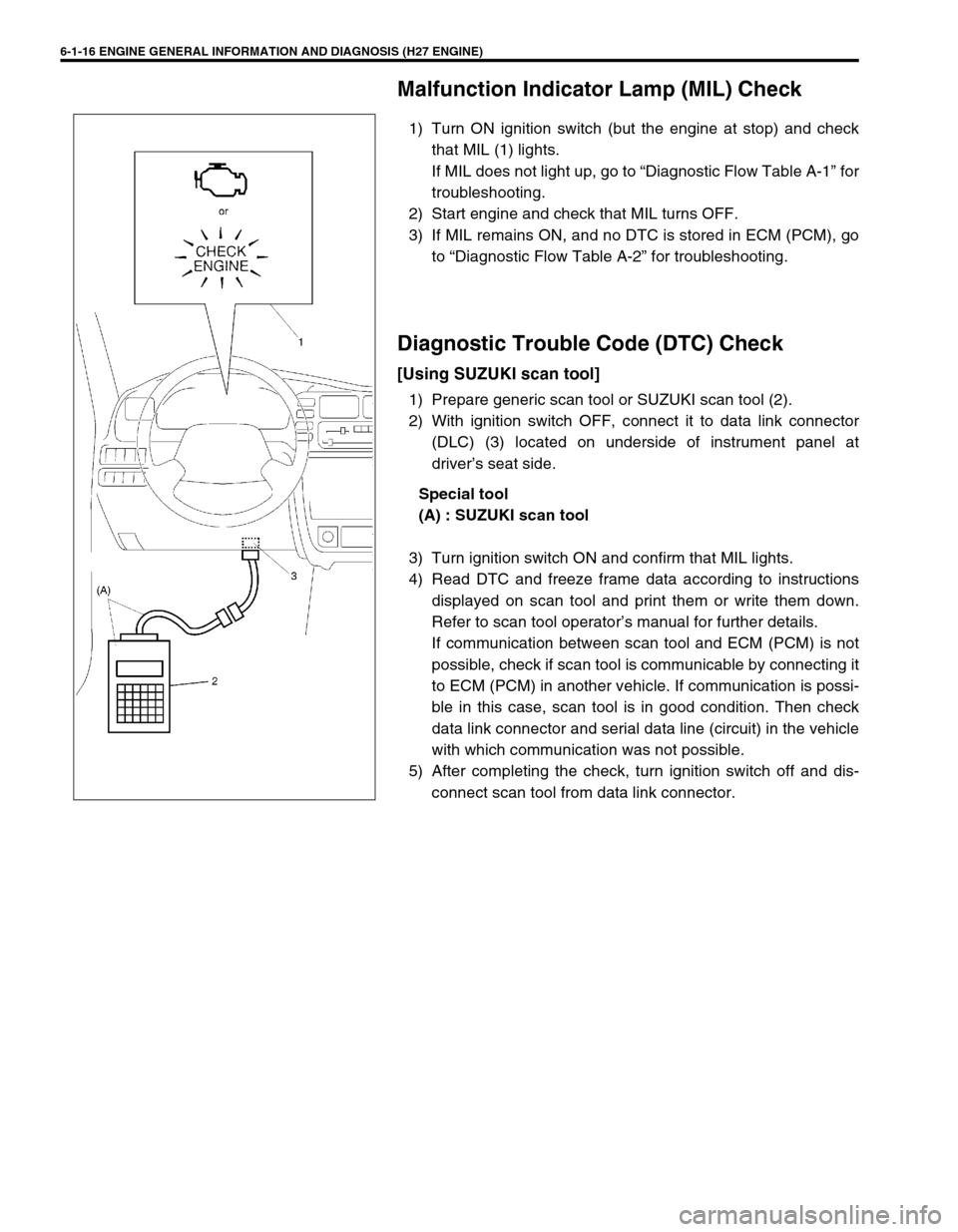
1) Turn ON ignition switch (but the engine at stop) and check
that MIL (1) lights.
If MIL does not light up, go to “Diagnostic Flow Table A-1” for
troubleshooting.
2) Start engine and check that MIL turns OFF.
3) If MIL remains ON, and no DTC is stored in ECM (PCM), go
to “Diagnostic Flow Table A-2” for troubleshooting.
Diagnostic Trouble Code (DTC) Check
[Using SUZUKI scan tool]
1) Prepare generic scan tool or SUZUKI scan tool (2).
2) With ignition switch OFF, connect it to data link connector
(DLC) (3) located on underside of instrument panel at
driver’s seat side.
Special tool
(A) : SUZUKI scan tool
3) Turn ignition switch ON and confirm that MIL lights.
4) Read DTC and freeze frame data according to instructions
displayed on scan tool and print them or write them down.
Refer to scan tool operator’s manual for further details.
If communication between scan tool and ECM (PCM) is not
possible, check if scan tool is communicable by connecting it
to ECM (PCM) in another vehicle. If communication is possi-
ble in this case, scan tool is in good condition. Then check
data link connector and serial data line (circuit) in the vehicle
with which communication was not possible.
5) After completing the check, turn ignition switch off and dis-
connect scan tool from data link connector.
Page 178 of 656
![SUZUKI GRAND VITARA 1999 2.G Owners Manual ENGINE GENERAL INFORMATION AND DIAGNOSIS (H27 ENGINE) 6-1-17
[Without Using SUZUKI Scan Tool] (Vehicle with Monitor
Connector)
1) Check malfunction indicator lamp referring to “Malfunction
Indicato](/manual-img/20/7583/w960_7583-177.png "SUZUKI GRAND VITARA 1999 2.G Owners Manual ENGINE GENERAL INFORMATION AND DIAGNOSIS (H27 ENGINE) 6-1-17
[Without Using SUZUKI Scan Tool] (Vehicle with Monitor
Connector)
1) Check malfunction indicator lamp referring to “Malfunction
Indicato")
ENGINE GENERAL INFORMATION AND DIAGNOSIS (H27 ENGINE) 6-1-17
[Without Using SUZUKI Scan Tool] (Vehicle with Monitor
Connector)
1) Check malfunction indicator lamp referring to “Malfunction
Indicator Lamp Check” in this section.
2) With the ignition switch OFF position, disconnect SUZUKI
scan tool if connected and using service wire (4), connect
diagnosis switch terminal (1) to ground terminal (2) in moni-
tor connector (3).
3) With the ignition switch ON position and leaving engine OFF,
read DTC from flashing pattern of malfunction indicator
lamp. Refer to “Diagnostic Trouble Code Table”.
If lamp remains ON, go to “Diagnostic Flow Table A-4”.
4) After completing the check, turn the ignition switch OFF posi-
tion and disconnect service wire from monitor coupler.
Diagnostic Trouble Code (DTC) Clearance
[Using scan tool]
1) With ignition switch OFF, connect generic scan tool or
SUZUKI scan tool to data link connector (DLC).
2) Turn ignition switch ON.
3) Erase DTC according to instructions displayed on scan tool.
Freeze frame data is cleared with the DTC. Refer to scan tool
operator’s manual for further details.
4) After completing the clearance, turn ignition switch off and
disconnect scan tool from data link connector. NOTE:
If abnormality or malfunction lies in two or more areas,
malfunction indicator lamp indicates applicable codes
three times each.
And flashing of these codes is repeated as long as
diagnosis terminal is grounded and ignition switch is
held at ON position.
Take a note of diagnostic trouble code indicated first.
NOTE:
DTC and freeze frame data stored in ECM (PCM) memory
are also cleared in following cases. Be careful not to
clear them before keeping their record.
When power to ECM (PCM) is cut off (by disconnecting
battery cable, removing fuse or disconnecting ECM
(PCM) connectors)
When the same malfunction (DTC) is not detected
again during 40 engine warm-up cycles (refer to
“WARM-UP CYCLE” of “ON-BOARD DIAGNOSTIC SYS-
TEM” in this section) (Vehicle without monitor connec-
tor)
Page 182 of 656

ENGINE GENERAL INFORMATION AND DIAGNOSIS (H27 ENGINE) 6-1-21
For A/T system (Refer to Section 7B1 for diagnosis)
P0505Idle air control system mal-
functionDifference between desired idle speed
and actual idle speed continues to
exceed specified value for longer than
specified time.2 driving
cyclesNot
applicable
P0601
(No.71)Internal control module mem-
ory check sum errorData write error (or check sum error)
when written into ECM1 driving
cycle1 driving
cycle
P1408Manifold absolute pressure
sensor circuit malfunctionManifold absolute pressure sensor
output voltage is higher or lower than
specified value (or sensor circuit
shorted to ground or open).2 driving
cyclesNot
applicable
P1450Barometric pressure sensor
circuit malfunctionBarometric pressure is lower or higher
than specification.1 driving
cycleNot
applicable
P1451Barometric pressure sensor
performance problemDifference between intake manifold
pressure and barometric pressure is
larger than specification.2 driving
cyclesNot
applicable
P1500Engine starter signal circuit
malfunctionEngine starts with no starter signal or
signal input during long period after
start.2 driving
cyclesNot
applicable
P1510ECM back-up power supply
malfunctionNo back-up power after starting
engine.1 driving
cycleNot
applicable DTC NO. DETECTED ITEMDETECTING CONDITION
(DTC will set when detecting : )MIL
(vehicle
without
monitor
connector)MIL
(vehicle
with
monitor
connector)
DTC NO. DETECTED ITEMDETECTING CONDITION
(DTC will set when detecting : )MIL
(vehicle
without
monitor
connector)MIL
(vehicle
with
monitor
connector)
P0705
(No.72)Transmission range switch cir-
cuit malfunctionMultiple signals inputted simulta-
neously or P, R, N, D, 2 or L range sig-
nal not inputted while running at
60km/h or more.2 driving
cyclesNot
applicable
P0715
(No.76)Input speed sensor circuit
malfunctionInput speed sensor signal is lower
than specification while running.2 driving
cyclesNot
applicable
P0720
(No.75)Output speed sensor circuit
malfunctionOutput speed sensor signal not input-
ted while VSS signal being inputted.2 driving
cyclesNot
applicable
P0741TCC (lock-up) solenoid perfor-
mance or stuck offActual TCC operation does not agree
with ON/OFF control from PCM to
TCC.2 driving
cyclesNot
applicable
P0743
(No.65)
(No.66)TCC (lock-up) solenoid electri-
calMonitor signal OFF is detected when
TCC control solenoid is ON or monitor
signal ON is detected when it is OFF.1 driving
cycleNot
applicable
P0751Shift solenoid A (#1) perfor-
mance or stuck offGear change control from PCM to A/T
does not agree with actual gear posi-
tion of A/T.2 driving
cyclesNot
applicable
Page 183 of 656

6-1-22 ENGINE GENERAL INFORMATION AND DIAGNOSIS (H27 ENGINE)
For immobilizer control system (Refer to Section 8G for diagnosis)
P0753
(No.61)
(No.62)Shift solenoid A (#1) electricalMonitor signal OFF is detected when
shift solenoid A (#1) is ON or monitor
signal ON is detected when it is OFF.1 driving
cycleNot
applicable
P0756Shift solenoid B (#2) perfor-
mance or stuck offGear change control from PCM to A/T
does not agree with actual gear posi-
tion of A/T.2 driving
cyclesNot
applicable
P0758
(No.63)
(No.64)Shift solenoid B (#2) electricalMonitor signal OFF is detected when
shift solenoid B (#2) is ON or monitor
signal ON is detected when it is OFF.1 driving
cycleNot
applicable
P18754WD low switch circuit mal-
functionDifference between vehicle speed
detected by VSS and vehicle speed
detected by output speed sensor and
compensated by 4WD low switch is
larger than specification.2 driving
cyclesNot
applicable DTC NO. DETECTED ITEMDETECTING CONDITION
(DTC will set when detecting : )MIL
(vehicle
without
monitor
connector)MIL
(vehicle
with
monitor
connector)
DTC NO. DETECTED ITEMDETECTING CONDITION
(DTC will set when detecting : )MIL
(vehicle
without
monitor
connector)MIL
(vehicle
with
monitor
connector)
P1620
(No.84)ECU code not registered
Refer to Section 8G P1621
(No.83)NO ECU code transmitted
from Immobilizer Control Mod-
ule
P1622
(No.82)Fault ECM
P1623
(No.81)ECU code not matched
NOTE:
DTC NO. with (*) is detected only vehicle without monitor connector.
DTC No. with (**) is detected only vehicle with monitor connector.
For ( ) marked No. in DTC column, it is used for vehicle with monitor connector.
DTC No.12 appears when none of the other codes is identified.