8E-16 CRUISE CONTROL SYSTEM
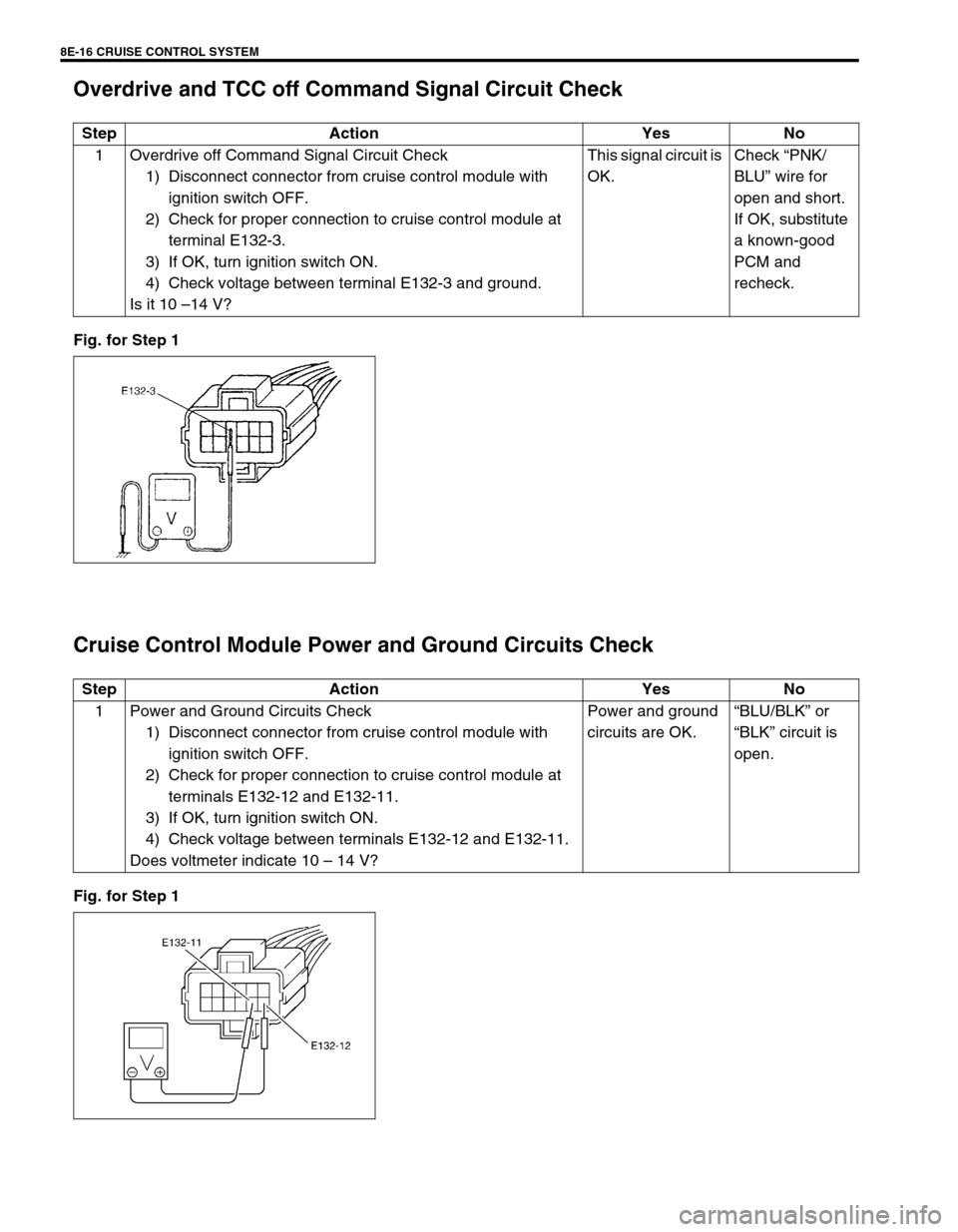
Overdrive and TCC off Command Signal Circuit Check
Fig. for Step 1
Cruise Control Module Power and Ground Circuits Check
Fig. for Step 1Step Action Yes No
1 Overdrive off Command Signal Circuit Check
1) Disconnect connector from cruise control module with
ignition switch OFF.
2) Check for proper connection to cruise control module at
terminal E132-3.
3) If OK, turn ignition switch ON.
4) Check voltage between terminal E132-3 and ground.
Is it 10 –14 V?This signal circuit is
OK.Check “PNK/
BLU” wire for
open and short.
If OK, substitute
a known-good
PCM and
recheck.
Step Action Yes No
1 Power and Ground Circuits Check
1) Disconnect connector from cruise control module with
ignition switch OFF.
2) Check for proper connection to cruise control module at
terminals E132-12 and E132-11.
3) If OK, turn ignition switch ON.
4) Check voltage between terminals E132-12 and E132-11.
Does voltmeter indicate 10 – 14 V?Power and ground
circuits are OK.“BLU/BLK” or
“BLK” circuit is
open.
CRUISE CONTROL SYSTEM 8E-17
Cruise Control Module and Its Circuit Inspection
VOLTAGE CHECK
Check for input or output voltage of control module (voltage between each circuit and body ground) with cruise
control module connector connected.CAUTION:
Cruise control module can not be checked by itself. It is strictly prohibited to connect voltmeter or
ohmmeter to cruise control module with coupler disconnected from it.
CIRCUIT NORMAL
VOLTAGECONDITION
Vehicle speed sensor Indicator deflection
repeated between
0 – 1 V and 3 – 5 VIgnition switch ON and cruise main switch ON. Vehicle
hoisted and rear left tire turned slowly with rear right
tire locked.
Stop lamp switch 0 – 2 V Brake pedal released.
10 – 14 V Brake pedal depressed.
Overdrive and TCC off signal
(4 A/T only) 10 – 14 V Ignition switch ON.
CRUISE indicator light 10 – 14 V Ignition switch ON.
Ground––
Brake pedal position switch
(in stop lamp switch) 10 – 14 V Ignition switch ON and brake pedal released.
0 V Ignition switch ON and brake pedal depressed.
Throttle valve opening signal
from PCM (4A/T only)Ignition switch ON.
Voltage varies as specified by graph in “THROTTLE VALVE OPENING SIG-
NAL CIRCUIT CHECK” in this section.
Cruise main switch 7 – 9V Ignition switch ON and cruise main switch released.
3 – 5 V Ignition switch ON and cruise main switch pressed.
CANCEL switch 0 – 1 V Ignition switch ON and CANCEL switch pressed.
COAST SET switch 1 – 2 V Ignition switch ON and COAST SET switch rotated.
RESUME ACCEL switch 2.5 – 4 V Ignition switch ON and RESUME ACCEL switch
rotated.
Clutch pedal position switch
(M/T only)10 – 14 V Ignition switch ON and clutch pedal released.
0 – 1 V Ignition switch ON and clutch pedal depressed fully.
Transmission range switch
(Park/Neutral position switch)
(A/T only)0 V Ignition switch ON and selector lever in “P” or “N”
range.
10 – 14 V Ignition switch ON and selector lever in “R”, “D”, “2” or
“L” range.
Cruise main switch indicator
lamp0 – 1 V Ignition switch ON.
10 – 14 V Ignition switch ON and after input main switch ON sig-
nal.
10B-78 AIR BAG SYSTEM
WARNING:
Be sure to use the specified digital multimeter. Otherwise, air bag deployment or personal injury may
result.
NOTE:
“A” : This kit includes the following items and substitutes for the Tech-2 kit.
1. Storage case, 2. Operator’s manual, 3. Tech 1A, 4. DLC cable, 5. Test lead/probe, 6. Power source
cable, 7. DLC cable adapter, 8. Self-test adapter
“B” : Digital multimeter specification : The maximum test current is 10 mA or less at the minimum
range of resistance measurement.
“C” : This kit includes the following items and substitutes for the Tech-1A kit.
1. Tech 2, 2. PCMCIA card, 3. DLC cable, 4. SAE 16/19 adapter, 5. Cigarette cable, 6. DLC loopback
adapter, 7. Battery power cable, 8. RS232 cable, 9. RS232 adapter, 10. RS232 loopback connector,
11. Storage case, 12. Power supply