1999 SUZUKI BALENO speedometer
[x] Cancel search: speedometerPage 18 of 65

60G-74E
INSTRUMENT PANEL
INSTRUMENT PANEL
Instrument Panel 5-1
Instrument Cluster 5-2
Warning and Indicator Lights 5-3
Speedometer/Odometer/Tripmeter (if equipped) 5-5
Tachometer (if equipped) 5-6
Fuel Gauge 5-6
Temperature Gauge 5-6
Hazard Warning Switch 5-7
Rear Window Defroster Switch (if equipped) 5-7
Cigarette Lighter (if equipped) 5-7
Ashtray 5-8
Glove Box 5-8
Heating System (if equipped) 5-9
System Operating Instructions 5-10
Air Conditioning System (if equipped) 5-13
System Operating Instructions 5-13
37
INSTRUMENT PANEL
60G-74E
INSTRUMENT PANEL
1. Instrument cluster
2. Ignition switch
3. Lighting switch/Turn signal and
dimmer switch
4. Windscreen wiper and washer
switch
5. Hazard warning switch
6. Rear window defroster switch
(if equipped)
7. Other switches (if equipped)
8. Heater control panel
9. Audio system (if equipped)
10. Cigarette lighter (if equipped)
11. Ashtray
12. Bonnet release
13. Center ventilator
14. Side ventilator
15. Side defroster
16. Glove box
17. Fuse box
18. Cup holder (if equipped)
5-1
38
Page 19 of 65

60G-74E
INSTRUMENT PANEL
INSTRUMENT CLUSTER
© Speedometer
® Odometer
© Trip meter (if equipped)
© Trip meter reset knob
© Tachometer (if equipped)
© Fuel gauge
® Temperature gauge
© Warning and indicator lights
60G-05-002
39
5-2
INSTRUMENT PANEL
60G-74E
WARNING AND INDICATOR LIGHTS
70F-07-070
Brake fluid level warning/Parking Brake
Indicator light
This light operates under three conditions:
1) when the ignition switch is turned to the
"START' position, 2) when the fluid in the brake
fluid reservoir falls below the specified level
or 3) when the parking brake is not fully
released and the ignition switch is in the "ON"
position. The light should go out after starting
the engine and fully releasing the parking
brake, if the fluid in the brake fluid reservoir is
adequate. If the light does not go off or comes
on whilst you are driving, it may mean that
there is something wrong with the vehicle's
braking system. If this happens, you should:
1) Pull off the road and stop carefully.
Remember that stopping distance may
be longer, you may have to push
harder on the pedal, and the pedal
may go down farther than normal.
2) Test the brakes by carefully starting and
stopping at the side of the road.
3) If you determine that it is safe, drive
carefully at low speed to the nearest dealer
for repairs.
Have the vehicle towed to the nearest
dealer for repairs.
or
4)
If any of the following conditions occur,
you should Immediately ask your
MARUTI dealer to inspect the brake
system.
• If the brake fluid level warning light
does not go out after the engine has
been started and the parking brake
has been fully released.
• If the brake fluid level warning light
does not come on when the ignition
switch is turned to the "START"
position.
• If the brake fluid level warning light
comes on at any time during vehicle
operation.
NOTE:
Because the disc brake system is self
adjusting, the fluid level will drop as the brake
pads become worn.
Replenishing the brake fluid reservoir is
considered normal periodic maintenance.
70F-03-039
Oil Pressure Light
This light comes on when the ignition switch
is turned on, and goes out when the engine
is started. The light will come on and remain
on if there is insufficient oil pressure. If the
light comes on when driving, pull off the
road as soon as you can and stop the
engine. Check the oil level and add oil if
necessary (see pages 9-8 and 9-9). If there
is enough oil, the lubrication system should
be inspected by your MARUTI dealer before
you drive the vehicle again.
5-3
40
Page 20 of 65

60G-74E
INSTRUMENT PANEL
60G-09-002
CAUTION
If you operate the engine with this
light on, severe engine damage can
result.
Do not rely on the Oil Pressure Light
to indicate the need to add oil. Be
sure to periodically check the engine
oil level (see pages 9-8 and 9-9).
70F-03-009
Charging Light
This light comes on when the ignition switch
is turned on, and goes out when the engine is
started. The light will come on and remain on
if there is something wrong with the battery
charging system. If the light comes on when
the engine is running, the charging system
should be inspected immediately by your
MARUTI dealer.
CAUTION
Do not continue driving long with the
charging light ON as this will drain the
battery 'dead'.
72F-05-027
"Malfunction Indicator" Light
Your vehicle has a computer-controlled
emission control system. A "Malfunction
Indicator" light is provided on the instrument
panel to indicate when it is necessary to have
the emission control system serviced. The
"Malfunction Indicator" light comes on when
the ignition switch is turned to "ON" and goes
out when the engine is started.
If the "Malfunction Indicator" light comes on
when the engine is running, there is a problem
with the emission control system. Take the
vehicle to your MARUTI dealer to have the
problem corrected.
CAUTION
Continuing to drive the vehicle when
the "Malfunction Indicator" light is on
can cause permanent damage to the
vehicle's emission control system, and
can affect fuel economy and
driveability.
5-4
INSTRUMENT PANEL
60G-74E
70F-03-042
Turn Signal Indicators
When you turn on the left or right turn signals,
the corresponding green arrow on the
instrument panel will flash along with the
respective turn signal lights. When you turn
on the hazard warning switch, both arrows will
flash along with all of the turn signal lights.
70F-03-043
Main Beam (High Beam) Indicator Light
This indicator comes on when headlight main
beams (high beams) are turned on.
SPEEDOMETER/ODOMETER/
TRIPMETER (if equipped)
60G-05-003
© Speedometer
© Odometer
(D Trip meter
© Trip meter reset knob
The speedometer indicates vehicle speed in
km/h.The odometer records the total distance
the vehicle has been driven. The tripmeter can
be used to measure the distance travelled on
short trips or between fuel stops. You can reset
the tripmeter to zero by pushing the reset
knob.
CAUTION
Keep track of your odometer reading
and check the maintenance schedule
regularly for required services.
Increased wear or damage to certain
parts can result from failure to perform
required services at the proper mileage
intervals and your warranty rights may
be affected.
5-5
42
41
Page 37 of 65
60G-74E
DRIVING TIPS AND SAFE DRIVING
Snow Chains
If you must use snow chains to increase tyre
traction, observe the following precautions:
• Choose a safe place away from traffic to
install the chains.
• When installing the chains carefully follow
the manufacturer's instructions.
• Install the chains on the front tyres.
• With the chains on, drive only at slow and
moderate speeds.
• If Your Vehicle Gets Stuck
If your vehicle gets stuck in snow, mud, or
sand, follow the directions below:
1) Change back and forth between first gear
and reverse. This will create a rocking
motion which may give you enough
momentum to free the vehicle. Press
gently on the accelerator to keep wheel
spin to a minimum. Remove your foot from
the accelerator while changing gear.
Do not race the engine. Excessive wheel
spin will cause the tyres to dig deeper,
making it more difficult to free the vehicle.
2) If your vehicle remains stuck after a few
minutes of rocking, get another vehicle to
pull you out.
Do not allow anyone to stand near the
vehicle when you are rocking it, and do
not spin the wheels faster than an
indicated 40 km/h on the speedometer.
Personal injury and/or vehicle damage
may result from spinning the wheels
too fast.
CAUTION
Do not continue rocking the vehicle for
more than a few minutes. Prolonged
rocking can cause engine overheating
or transmission damage.
DRIVING ON WET ROADS
CAUTION
When driving on wet roads, avoid driv-
ing through large amount of standing
water on the road. Large amount of
water entering the engine compart-
ment may cause damage to the engine
and or electrical components.
If stuck in deep water, do not start till
water level drops.
Water Is incompressible substance,
water inside engine is harmful to
the engine."
Make sure your tyres are in good
condition and always maintain the
specified tyre pressure. Refer to
"TYRES" in the "INSPECTION AND
MAINTENANCE" section for details.
Do not use tyres other than those
specified by MARUTI. never use
different sizes or types of tyres on
the front and rear wheels. For
information regarding the specified
tyres, refer to ^"SPECIFICATIONS"
section.
Never use oversized tyres or special
shock absorbers and springs to
raise (jack up) your vehicle.This will
change the handling characteristics.
After driving through water, test the
brakes while driving at a slow speed
to see if they have maintained their
normal effectiveness. If the brakes
are less effective than normal, dry
them by repeatedly applying the
brakes while driving slowly until the
brakes have regained their normal
effectiveness.
75
8-2
DRIVING TIPS AND SAFE DRIVING
60G-74E
DO'S AND DON'TS FOR SAFE
DRIVING
Exercise care in handling your vehicle. Be
conscious of not only your own safety but also
the safety of others on the road, and thus enjoy
the best and most comfortable driving
experience.
This section contains basic rules for safe
driving. Read it carefully for good
understanding of the content so that you can
enjoy safe and pleasant driving in your Maruti
vehicle.
72F-08-001
Starting
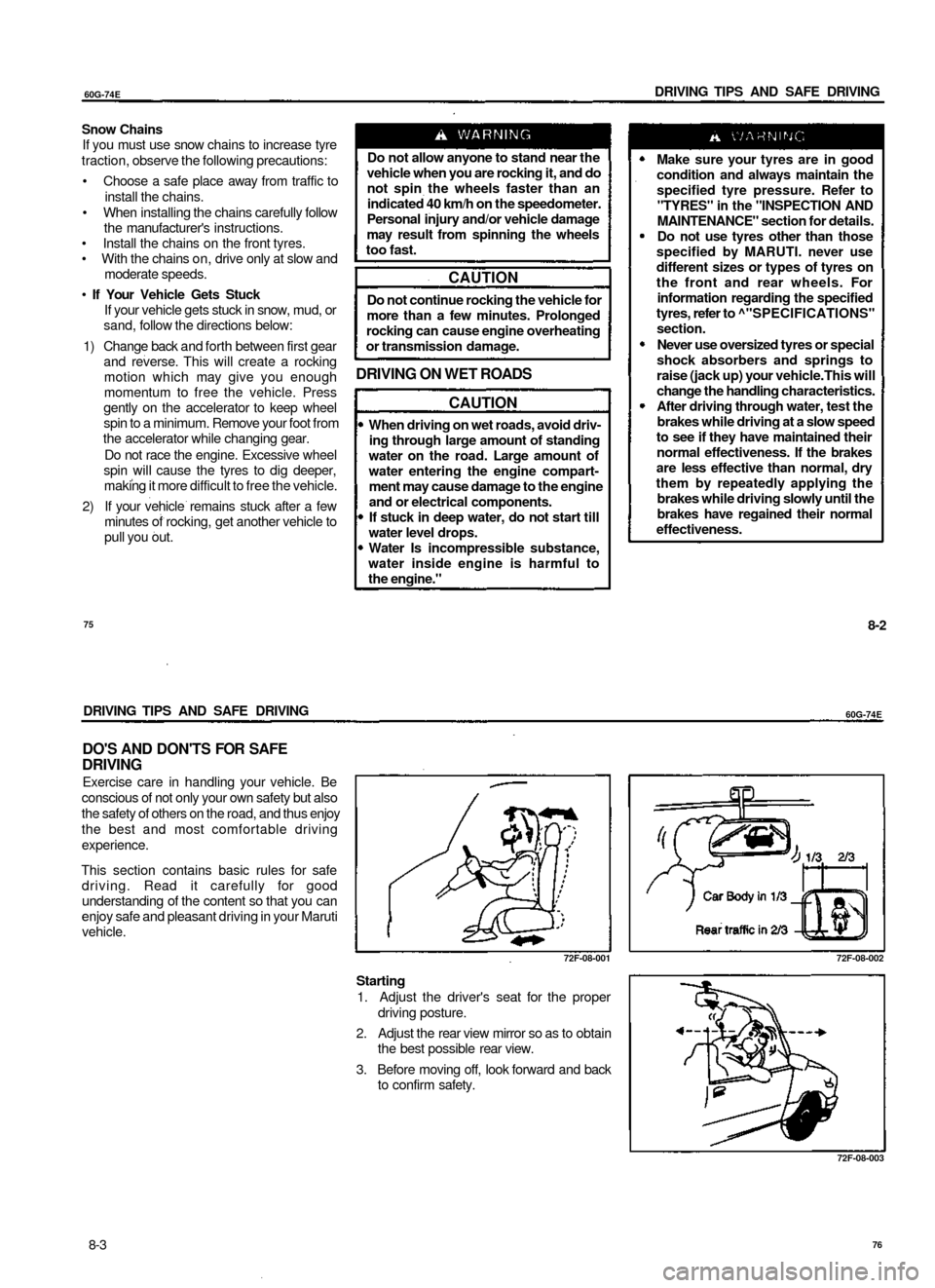
1. Adjust the driver's seat for the proper
driving posture.
2. Adjust the rear view mirror so as to obtain
the best possible rear view.
3. Before moving off, look forward and back
to confirm safety.
72F-08-002
72F-08-003
8-3
76
Page 44 of 65

60G-74E
INSPECTION AND MAINTENANCE
Interval: This Interval should be judged
by odometer reading or months,
whichever comes first.
km (x 1,000)
months
ROAD TEST
1. Operation of Brakes, Gear shifting & speedometer
2. Body and Chassis noise
AIR CONDITIONER (if equipped)
1. Check belt tension
2. Check Receiver Drier bubbles.
3. Tighten compressor mounting bolts
4. Check all hose joints, tighten if necessary
5. Check functioning of Recirc flap .*
6. Clean condenser with low pressure water
7. Check belt for frayed edges, change if necessary
8. Check all mounting bolts
FREE
1
1
I
I
I
I
—
I
I
_
-
-
INSPECTIONS
5
6
I
I
I
I
T
I
I
C
I
I
10
12
I
I
I
I
T
I
I
C
I
I
PERIODIC
20
24
I
I
I
I
T
I
I
C
I
I
30
36
I
I
I
I
T
I
I
C
I
I
MAINTENANCE
40
48
I
I
I
I
T
I
I
C
I
I
50
60
I
I
I
I
T
I
I
C
I
I
SERVICE
60
72
I
I
I
I
T
I
I
C
I
I
AT,
70
84
I
I
I
I
T
I
I
C
I
I
COST
80
96
I
I
I
I
T
I
I
C
I
I
The rear shock absorbers are filled with
high pressure gas. Never attempt to
disassemble it or throw it into a fire.
Avoid storing it near a heater or heating
device. When scrapping the absorber,
the gas must be released from the
absorber safely. Ask your dealer for
assistance.
89
9-6
INSPECTION AND MAINTENANCE
60G-74E
All maintenance should be carried
out with the Ignition switch in the
"OFF" position and the car parked
securely on the level ground unless
otherwise specified.
If you are In any way unsure of your
ability to undertake a task, then do
not start it but contact your Maruti
dealer to perform the work for you.
ENGINE OIL AND FILTER
Specified oil
Be sure that the engine oil you use comes
under the API classification of SF, SG or SH.
Select the appropriate oil viscosity according
to the above chart.
9-7
90
70F-07-004E
Page 51 of 65
60G-74E
INSPECTION AND MAINTENANCE
Hitting curbs and running over rocks
can damage tyres and affect wheel
alignment. Be sure to have tyres and
wheel alignment checked periodically
by your MARUTI dealer.
4) Check for loose wheel nuts.
5) Check that there are no nails, stones, or
other objects sticking into the tyres.
Your MARUTI is equipped with tyres
which are all the same type and size.
This is important to ensure proper
steering and handling of the vehicle.
Never mix tyres of different size or type
on the four wheels of your vehicle. The
size and type of tyres used should be
only those approved by MARUTI as
standard or optional equipment for
your vehicle.
Replacing the wheels and tyres
equipped on your vehicle with certain
combinations of aftermarket wheels
and tyres can significantly change the
steering and handling characteristics
of your vehicle. Therefore, use only
those wheel and tyre combinations
approved by MARUTI as standard or
optional equipment for your vehicle.
CAUTION
Replacing the original tyres with tyres
of a different size may result in false
speedometer or odometer readings.
60G-09-019E
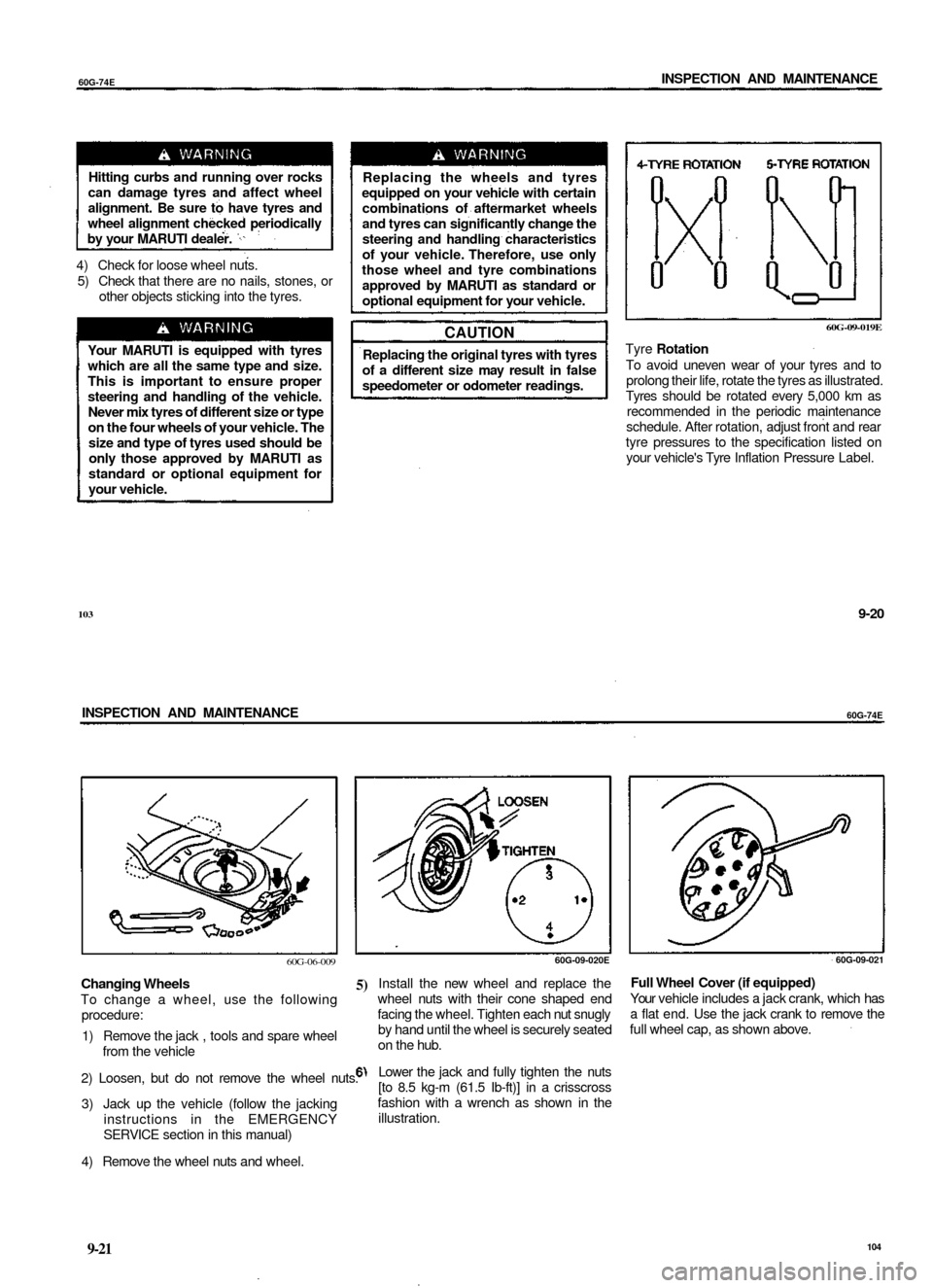
Tyre Rotation
To avoid uneven wear of your tyres and to
prolong their life, rotate the tyres as illustrated.
Tyres should be rotated every 5,000 km as
recommended in the periodic maintenance
schedule. After rotation, adjust front and rear
tyre pressures to the specification listed on
your vehicle's Tyre Inflation Pressure Label.
103
9-20
INSPECTION AND MAINTENANCE
60G-74E
60G-06-009
5)
Changing Wheels
To change a wheel, use the following
procedure:
1) Remove the jack , tools and spare wheel
from the vehicle
2) Loosen, but do not remove the wheel nuts. '
3) Jack up the vehicle (follow the jacking
instructions in the EMERGENCY
SERVICE section in this manual)
4) Remove the wheel nuts and wheel.
60G-09-020E
Install the new wheel and replace the
wheel nuts with their cone shaped end
facing the wheel. Tighten each nut snugly
by hand until the wheel is securely seated
on the hub.
Lower the jack and fully tighten the nuts
[to 8.5 kg-m (61.5 Ib-ft)] in a crisscross
fashion with a wrench as shown in the
illustration.
60G-09-021
Full Wheel Cover (if equipped)
Your vehicle includes a jack crank, which has
a flat end. Use the jack crank to remove the
full wheel cap, as shown above.
9-21
104