1999 SUZUKI BALENO power
[x] Cancel search: powerPage 43 of 65
60G-74E
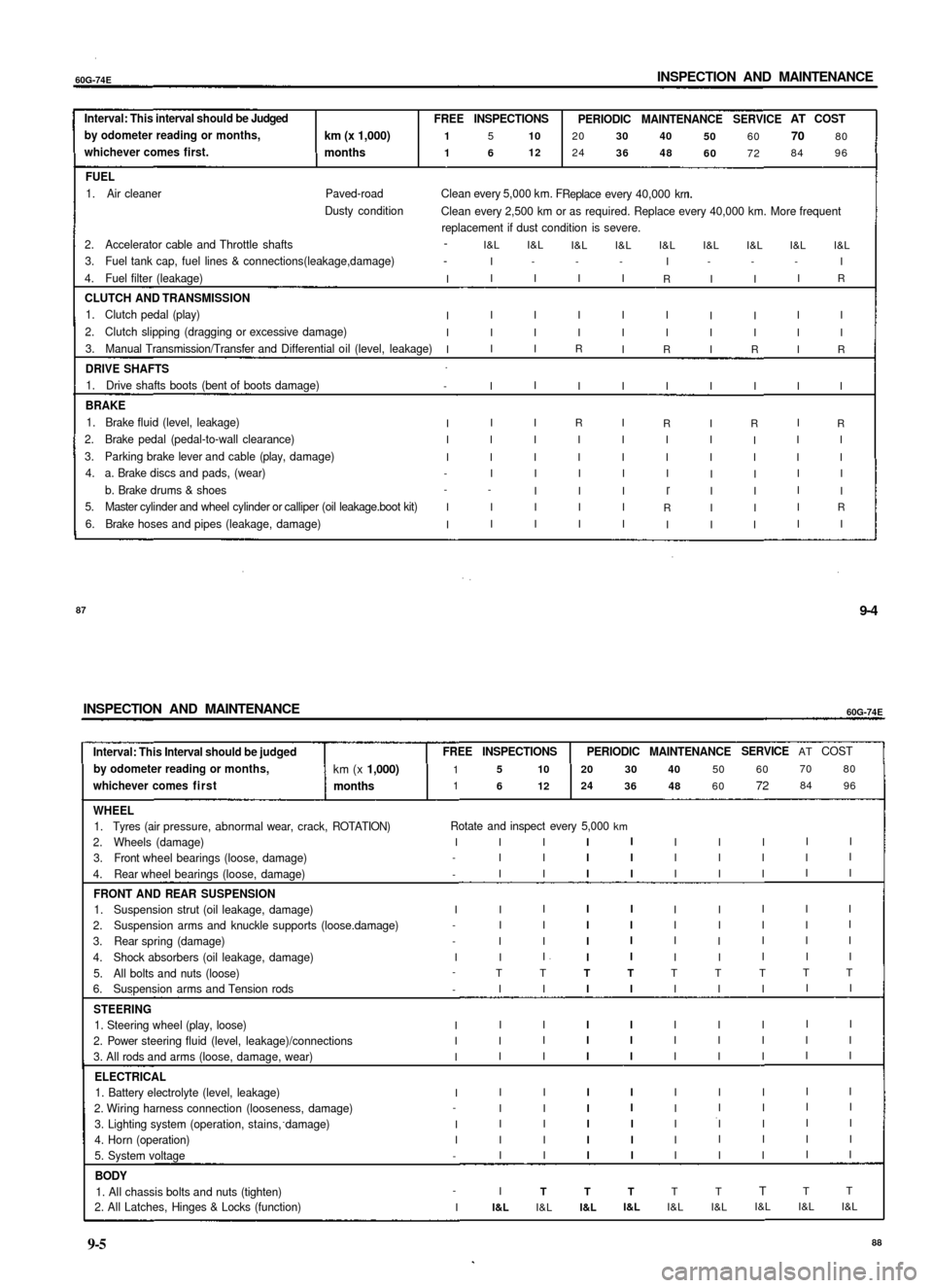
INSPECTION AND MAINTENANCE
Interval: This interval should be Judged
by odometer reading or months,
whichever comes first.
km (x 1,000)
months
FUEL
1. Air cleaner Paved-road
Dusty condition
2. Accelerator cable and Throttle shafts
3. Fuel tank cap, fuel lines & connections(leakage,damage)
4. Fuel filter (leakage)
CLUTCH AND TRANSMISSION
1. Clutch pedal (play)
2. Clutch slipping (dragging or excessive damage)
3. Manual Transmission/Transfer and Differential oil (level, leakage)
DRIVE SHAFTS
1. Drive shafts boots (bent of boots damage)
BRAKE
1. Brake fluid (level, leakage)
2. Brake pedal (pedal-to-wall clearance)
3. Parking brake lever and cable (play, damage)
4. a. Brake discs and pads, (wear)
b. Brake drums & shoes
5. Master cylinder and wheel cylinder or calliper (oil leakage.boot kit)
6. Brake hoses and pipes (leakage, damage)
FREE
1
1
INSPECTIONS
5
6
10
12
Clean every 5,000 km. F
PERIODIC MAINTENANCE
20
24
30
36
40
48
Replace every 40,000 krr
50
60
SERVICE
60
72
AT
70
84
COST
80
96
Clean every 2,500 km or as required. Replace every 40,000 km. More frequent
replacement if dust condition is severe.
-
-
I
I
I
I
-
I
I
I
-
-
I
I
I&L
I
I
I
I
I
I
I
I
I
I
-
I
I
I&L
-
I
I
I
I
I
I
I
I
I
I
I
I
I&L
-
I
I
I
R
I
R
I
I
I
I
I
I
I&L
-
I
I
I
I
I
I
I
I
I
I
I
I
I&L
I
R
I
I
R
I
R
I
I
I
I
R
I
I&L
-
I
I
I
I
I
I
I
I
I
I
I
I
I&L
-
I
I
I
R
I
R
I
I
I
I
I
I
I&L
-
I
I
I
I
I
I
I
I
I
I
I
I
I&L
I
R
I
I
R
I
R
I
I
I
I
R
I
87
9-4
INSPECTION AND MAINTENANCE
60G-74E
Interval: This Interval should be judged
by odometer reading or months,
whichever comes first
km (x 1,000)
months
WHEEL
1. Tyres (air pressure, abnormal wear, crack, ROTATION)
2. Wheels (damage)
3. Front wheel bearings (loose, damage)
4. Rear wheel bearings (loose, damage)
FRONT AND REAR SUSPENSION
1. Suspension strut (oil leakage, damage)
2. Suspension arms and knuckle supports (loose.damage)
3. Rear spring (damage)
4. Shock absorbers (oil leakage, damage)
5. All bolts and nuts (loose)
6. Suspension arms and Tension rods
STEERING
1. Steering wheel (play, loose)
2. Power steering fluid (level, leakage)/connections
3. All rods and arms (loose, damage, wear)
ELECTRICAL
1. Battery electrolyte (level, leakage)
2. Wiring harness connection (looseness, damage)
3. Lighting system (operation, stains, damage)
4. Horn (operation)
5. System voltage
BODY
1. All chassis bolts and nuts (tighten)
2. All Latches, Hinges & Locks (function)
FREE
1
1
INSPECTIONS
5
6
Rotate and
I
-
-
I
-
-
I
-
-
I
I
I
I
-
I
I
-
-
I
I
I
I
I
I
I
I
T
I
I
I
I
I
I
I
I
I
I
I&L
10
12
PERIODIC
20
24
inspect every 5,000
I
I
I
I
I
I
I
T
I
I
I
I
I
I
I
I
I
T
I&L
I
I
I
I
I
I
I
T
I
I
I
I
I
I
I
I
I
T
I&L
30
36
km
I
I
I
I
I
I
I
T
I
I
I
I
I
I
I
I
I
T
I&L
MAINTENANCE
40
48
I
I
I
I
I
I
I
T
I
I
I
I
I
I
I
I
I
T
I&L
50
60
I
I
I
I
I
I
I
T
I
I
I
I
I
I
I
I
I
T
I&L
SERVICE
60
72
I
I
I
I
I
I
I
T
I
I
I
I
I
I
I
I
I
T
I&L
AT
70
84
I
I
I
I
I
I
I
T
I
I
I
I
I
I
I
I
I
T
I&L
COST
80
96
I
I
I
I
I
I
I
T
I
I
I
I
I
I
I
I
I
T
I&L
9-5
88
Page 47 of 65

60G-74E
INSPECTION AND MAINTENANCE
CAUTION
When adding or replacing coolant,
use a high quality ethylene glycol
antifreeze and anticorrosion (Non-
Amine type) diluted with distilled
water. If the lowest ambient
temperature in your area is expected
to be -15°C (5°F) or above, make the
antifreeze concentration of the
mixture you use at least 30% but no
more than 50%. If -16°C (3°F) or
below, make the concentration at
least 50%. If the 50% concentration
does not provide adequate
protection against freezing, follow
the instructions on the antifreeze
container to obtain the desired
freezing point.
When putting the cap on the
reservoir tank, line up the arrow on
the cap and the arrow on the tank,
or coolant can leak out.
70F-07-019E
Coolant Replacement
1) When the engine is cool, remove the
radiator cap by turning it slowly to the left
until a "stop" is felt. Do not press down
while turning the cap. Wait until any
pressure is released, then press down on
the cap and continue turning it
anticlockwise.
60G-09-039E
It is dangerous to remove the radiator
cap when the water temperature is
high, because scalding fluid and steam
may be blown out under pressure. Watt
until the coolant temperature has
lowered before removing the cap.
2) Remove the reservoir tank cap. Remove
the reservoir by lifting it up, and drain the
reservoir completely by pouring the
coolant in to a suitable container.
95
9-12
INSPECTION AND MAINTENANCE
60G-74E
WINDSCREEN WASHER FLUID
AIR CLEANER
60G-09-008
3) Loosen the drain plug attached to the
lower part of the radiator and drain the
coolant into a suitable container.
4) Tighten the drain plug on the radiator, fill
the radiator with coolant and install the
radiator cap.
5) Refit the reservoir and fill it with the correct
coolant to the "FULL" line. Refit the
reservoir tank cap, ensuring the arrows are
correctly aligned.
CAUTION
The coolant must be replaced with the
vehicle on level ground.
63B-09-001
Check that there is washer fluid in the tank.
Refill it if necessary. Use a good quality
windscreen washer fluid, diluted with water as
necessary.
Do not use "antifreeze" solution in the
windscreen washer reservoir.This can
severely impair visibility when sprayed
on the windscreen, and can also
damage your vehicle's paint.
CAUTION
Damage may result if the washer motor
is operated whilst the fluid or fluid
nozzles are frozen or with no fluid in
the washer tank.
6OG-09-009
If the air cleaner is clogged with dust, there
will be greater intake resistance, resulting in
decreased power output and increased fuel
consumption.
Take out the air cleaner element after
unhooking the clamps shown in the illustration.
Blow off dust on air cleaner element by
compressed air. If the air cleaner element
appears to be dirty, replace it with a new one.
9-13
96
Page 50 of 65

60G-74E
INSPECTION AND MAINTENANCE
POWER STEERING (if equipped)
CLUTCH PEDAL
60G-09-017
Check the steering box case, vane pump and
hose connections for leaks or damage.
Power steering fluid
Check the fluid level by looking at the reservoir
in the engine compartment when the fluid is
cold (about room temperature).
Check that the fluid level is between the
"UPPER" and "LOWER" lines. If the fluid level
is near the "LOWER" line, fill it up to the
"UPPER" line with an automatic transmission
fluid equivalent to DEXRON»-IIE or
DEXRON'-III. Do not overfill.
63B-09-00SE
Power steering belt
The tension of the belt should be such that
there is a deflection of 8-10mm (0.31 -0.39 in.)
when you press your thumb midway between
the pulleys.
The belt should also be examined to ensure
that it is not damaged. If necessary, have the
belt adjusted or replaced by your MARUTI
dealer.
70F-07-034
Measure the clutch pedal piay by moving the
clutch pedal with your hand and measuring
the distance it moves until you feel slight
resistance. The play in the clutch pedal should
be between 15-20 mm (0.6 - 0.8 in). If the
play is more or less than the above, or clutch
dragging is felt with the pedal fully depressed,
have the clutch inspected by your MARUTI
dealer.
101
9-18
INSPECTION AND MAINTENANCE
60G-74E
TYRES
60G-09-018
The front and rear tyre pressure specifications
for your vehicle are listed on the Tyre Inflation
Pressure Label and in the "SPECIFICATIONS"
section at the end of this book. Both the front
and rear tyres should have the specified tyre
pressure.
Tyre Inspection
Inspect your vehicle's tyres periodically by
performing the following checks:
1) Measure the air pressure with a tyre
gauge. Adjust the pressure if necessary.
Air pressures should be checked
when the tyres are cold or you may
get inaccurate readings.
Check the inflation pressure from
time to time while inflating the tyre
gradually, until the specified
pressure is obtained.
Never underinf late or overinf late the
tyres.
Underinflation can cause unusual
handling characteristics or can
cause the rim to slip on the tyre
bead, resulting in an accident or
damage to the tyre or rim.
Overinflation can cause the tyre to
burst, resulting in personal injury.
Overinflation can also cause
unusual handling characteristics
which may result In an accident.
70F-07-037E
2) Check that the depth of the tread groove
is more than 1.6 mm (0.06 in). To help you
check this, the tyres have moulded in tread
wear indicators in the grooves. When the
indicators appear on the tread surface, the
remaining depth of the tread is 1.6 mm
(0.06 in) or less and the tyre should be
replaced.
3) Check for abnormal wear, cracks and
damage. Any tyres with cracks or other
damage should be replaced. If any tyres
show abnormal wear, have them inspected
by your MARUTI dealer.
9-19
102