1999 SUBARU LEGACY ESP
[x] Cancel search: ESPPage 874 of 1456
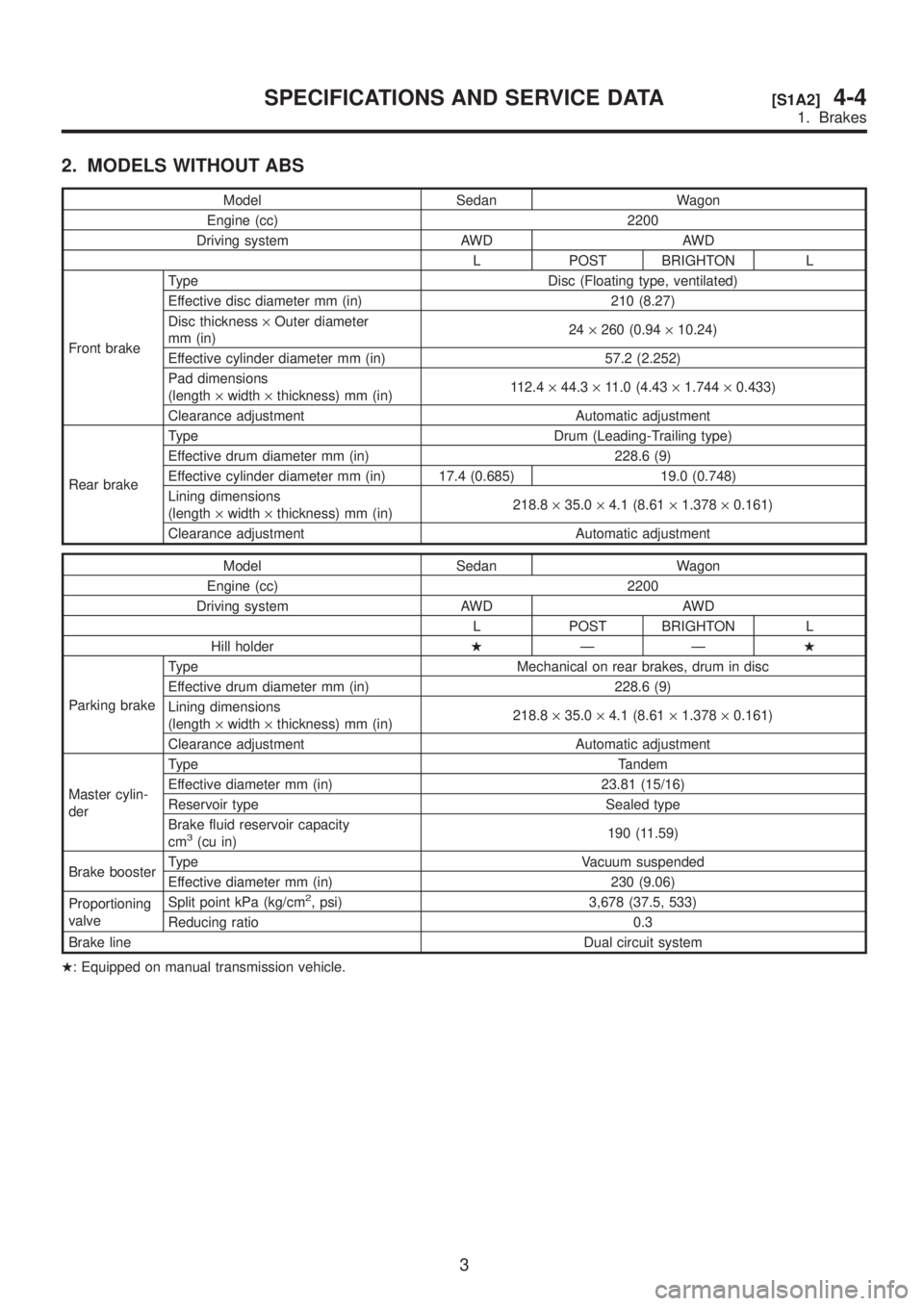
2. MODELS WITHOUT ABS
Model Sedan Wagon
Engine (cc) 2200
Driving system AWD AWD
L POST BRIGHTON L
Front brakeType Disc (Floating type, ventilated)
Effective disc diameter mm (in) 210 (8.27)
Disc thickness´Outer diameter
mm (in)24´260 (0.94´10.24)
Effective cylinder diameter mm (in) 57.2 (2.252)
Pad dimensions
(length´width´thickness) mm (in)112.4´44.3´11.0 (4.43´1.744´0.433)
Clearance adjustment Automatic adjustment
Rear brakeType Drum (Leading-Trailing type)
Effective drum diameter mm (in) 228.6 (9)
Effective cylinder diameter mm (in) 17.4 (0.685) 19.0 (0.748)
Lining dimensions
(length´width´thickness) mm (in)218.8´35.0´4.1 (8.61´1.378´0.161)
Clearance adjustment Automatic adjustment
Model Sedan Wagon
Engine (cc) 2200
Driving system AWD AWD
L POST BRIGHTON L
Hill holderHÐÐH
Parking brakeType Mechanical on rear brakes, drum in disc
Effective drum diameter mm (in) 228.6 (9)
Lining dimensions
(length´width´thickness) mm (in)218.8´35.0´4.1 (8.61´1.378´0.161)
Clearance adjustment Automatic adjustment
Master cylin-
derType Tandem
Effective diameter mm (in) 23.81 (15/16)
Reservoir type Sealed type
Brake fluid reservoir capacity
cm
3(cu in)190 (11.59)
Brake boosterType Vacuum suspended
Effective diameter mm (in) 230 (9.06)
Proportioning
valveSplit point kPa (kg/cm
2, psi) 3,678 (37.5, 533)
Reducing ratio 0.3
Brake lineDual circuit system
H: Equipped on manual transmission vehicle.
3
[S1A2]4-4SPECIFICATIONS AND SERVICE DATA
1. Brakes
Page 875 of 1456
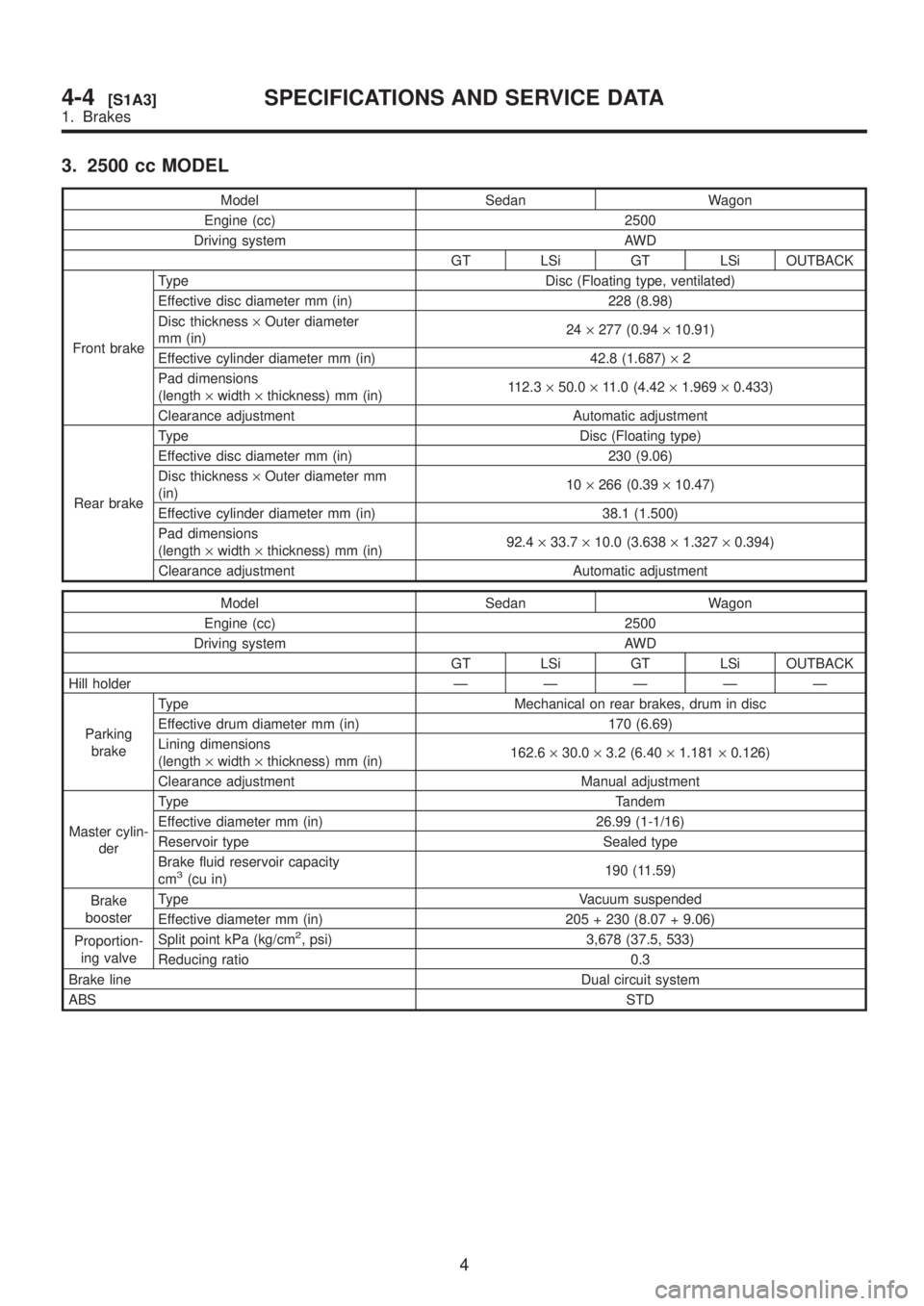
3. 2500 cc MODEL
Model Sedan Wagon
Engine (cc) 2500
Driving system AWD
GT LSi GT LSi OUTBACK
Front brakeType Disc (Floating type, ventilated)
Effective disc diameter mm (in) 228 (8.98)
Disc thickness´Outer diameter
mm (in)24´277 (0.94´10.91)
Effective cylinder diameter mm (in) 42.8 (1.687)´2
Pad dimensions
(length´width´thickness) mm (in)112.3´50.0´11.0 (4.42´1.969´0.433)
Clearance adjustment Automatic adjustment
Rear brakeType Disc (Floating type)
Effective disc diameter mm (in) 230 (9.06)
Disc thickness´Outer diameter mm
(in)10´266 (0.39´10.47)
Effective cylinder diameter mm (in) 38.1 (1.500)
Pad dimensions
(length´width´thickness) mm (in)92.4´33.7´10.0 (3.638´1.327´0.394)
Clearance adjustment Automatic adjustment
Model Sedan Wagon
Engine (cc) 2500
Driving system AWD
GT LSi GT LSi OUTBACK
Hill holderÐÐÐÐÐ
Parking
brakeType Mechanical on rear brakes, drum in disc
Effective drum diameter mm (in) 170 (6.69)
Lining dimensions
(length´width´thickness) mm (in)162.6´30.0´3.2 (6.40´1.181´0.126)
Clearance adjustment Manual adjustment
Master cylin-
derType Tandem
Effective diameter mm (in) 26.99 (1-1/16)
Reservoir type Sealed type
Brake fluid reservoir capacity
cm
3(cu in)190 (11.59)
Brake
boosterType Vacuum suspended
Effective diameter mm (in) 205 + 230 (8.07 + 9.06)
Proportion-
ing valveSplit point kPa (kg/cm
2, psi) 3,678 (37.5, 533)
Reducing ratio 0.3
Brake lineDual circuit system
ABSSTD
4
4-4[S1A3]SPECIFICATIONS AND SERVICE DATA
1. Brakes
Page 1189 of 1456
B: TEST
1. MAGNETIC SWITCH
CAUTION:
IThe following magnetic switch tests should
be performed with specified voltage applied.
IEach test should be conducted within 3 to 5
seconds. Power to be furnished should be one-
half the rated voltage.
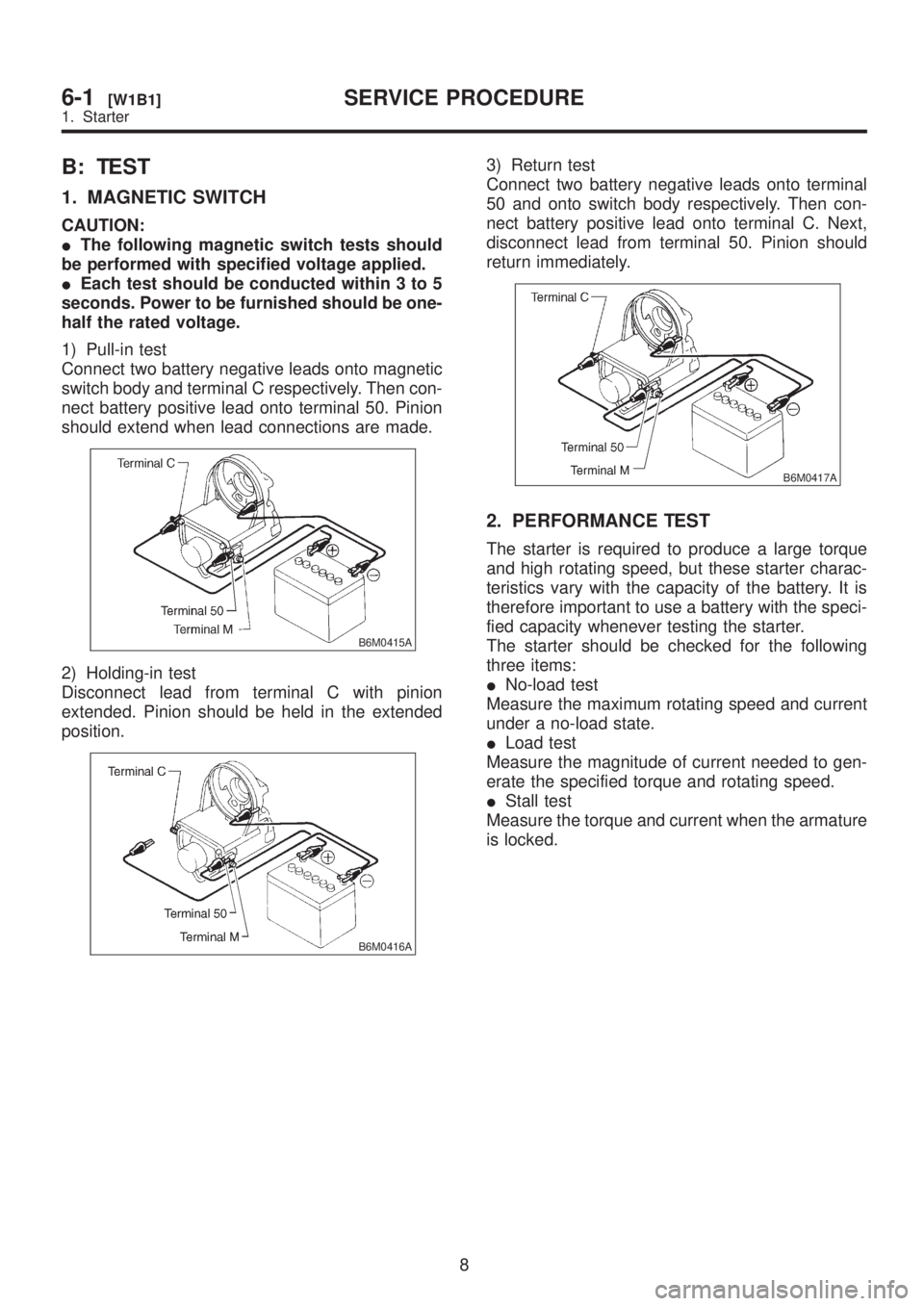
1) Pull-in test
Connect two battery negative leads onto magnetic
switch body and terminal C respectively. Then con-
nect battery positive lead onto terminal 50. Pinion
should extend when lead connections are made.
B6M0415A
2) Holding-in test
Disconnect lead from terminal C with pinion
extended. Pinion should be held in the extended
position.
B6M0416A
3) Return test
Connect two battery negative leads onto terminal
50 and onto switch body respectively. Then con-
nect battery positive lead onto terminal C. Next,
disconnect lead from terminal 50. Pinion should
return immediately.
B6M0417A
2. PERFORMANCE TEST
The starter is required to produce a large torque
and high rotating speed, but these starter charac-
teristics vary with the capacity of the battery. It is
therefore important to use a battery with the speci-
fied capacity whenever testing the starter.
The starter should be checked for the following
three items:
INo-load test
Measure the maximum rotating speed and current
under a no-load state.
ILoad test
Measure the magnitude of current needed to gen-
erate the specified torque and rotating speed.
IStall test
Measure the torque and current when the armature
is locked.
8
6-1[W1B1]SERVICE PROCEDURE
1. Starter
Page 1227 of 1456
1. Precaution
IBefore disassembling or reassembling parts,
always disconnect battery ground cable. When
repairing radio, control modules, etc. which are
provided with memory functions, record
memory contents before disconnecting battery
ground cable. Otherwise, these contents are
cancelled upon disconnection.
IReassemble parts in reverse order of disas-
sembly procedure unless otherwise indicated.
IAdjust parts to specifications contained in
this manual if so designated.
IConnect connectors and hoses securely dur-
ing reassembly.
IAfter reassembly, ensure functional parts
operate smoothly.
CAUTION:
IAirbag system wiring harness is routed near
the electrical parts and switch.
IAll Airbag system wiring harness and con-
nectors are colored yellow. Do not use electri-
cal test equipment on these circuits.
IBe careful not to damage Airbag system wir-
ing harness when servicing the ignition key
cylinder.
2. Battery
A: REMOVAL AND INSTALLATION
1. BATTERY
1) Disconnect the positive (+) terminal after dis-
connecting the negative (þ) terminal of battery.
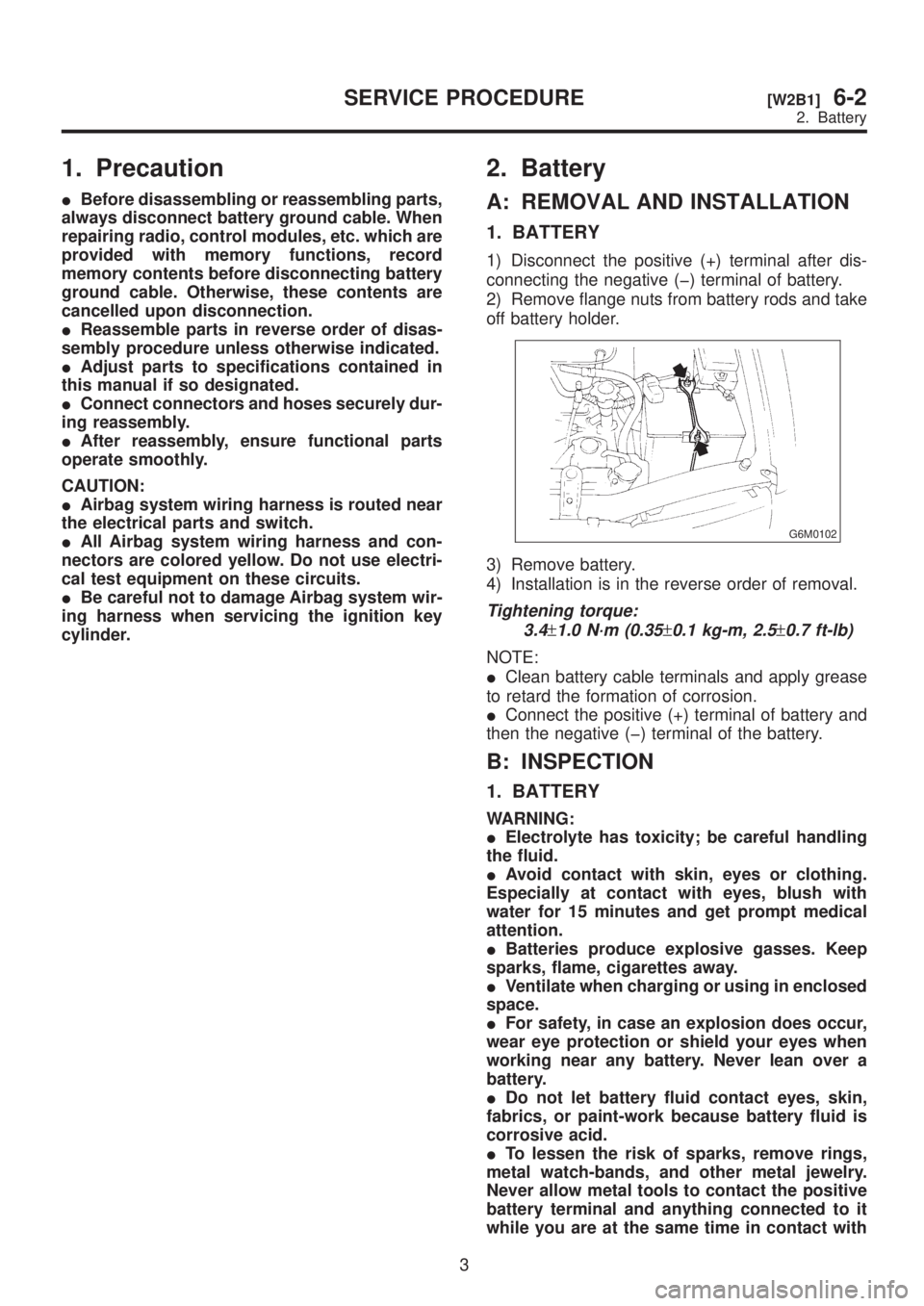
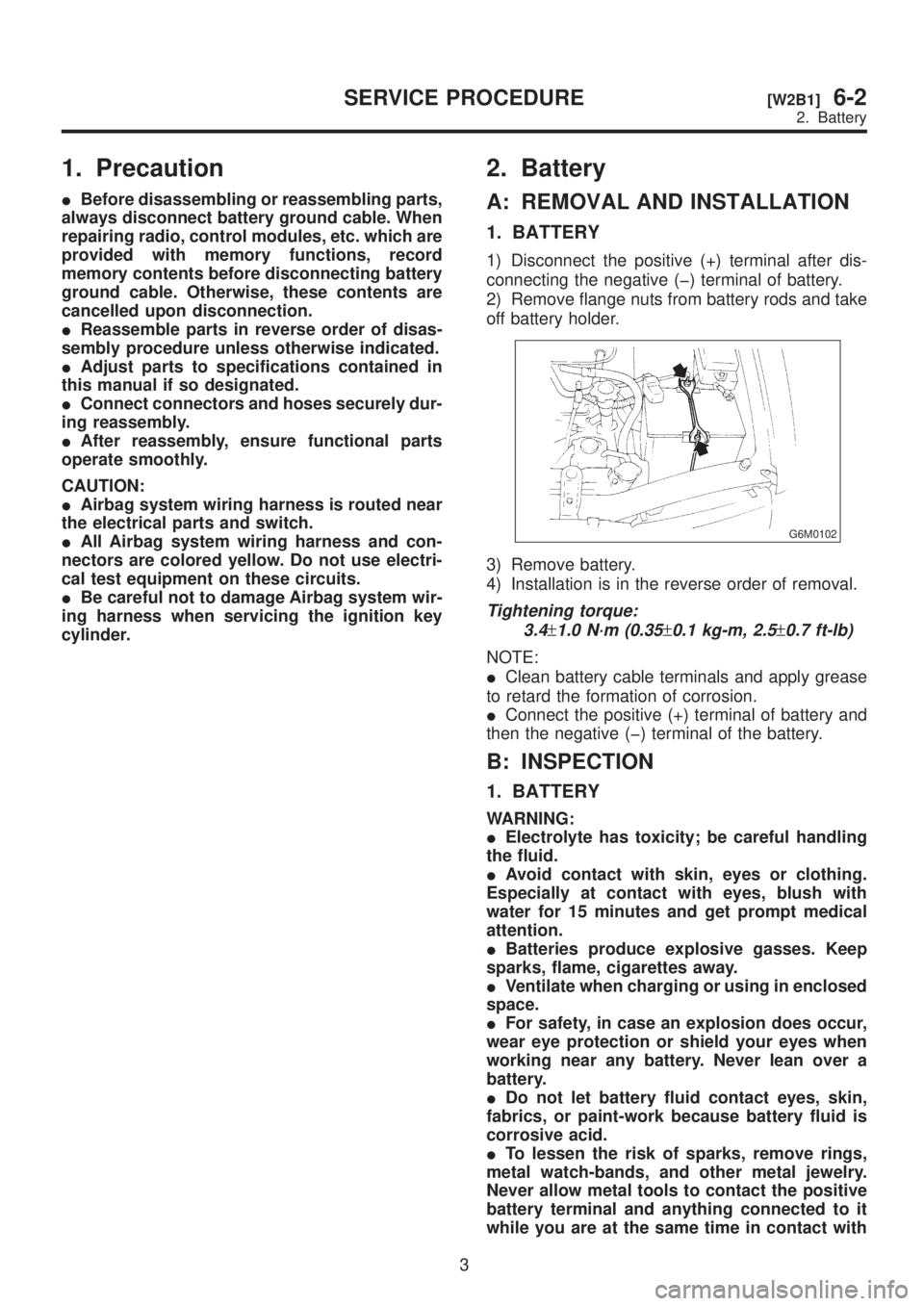
2) Remove flange nuts from battery rods and take
off battery holder.
G6M0102
3) Remove battery.
4) Installation is in the reverse order of removal.
Tightening torque:
3.4
±1.0 N´m (0.35±0.1 kg-m, 2.5±0.7 ft-lb)
NOTE:
IClean battery cable terminals and apply grease
to retard the formation of corrosion.
IConnect the positive (+) terminal of battery and
then the negative (þ) terminal of the battery.
B: INSPECTION
1. BATTERY
WARNING:
IElectrolyte has toxicity; be careful handling
the fluid.
IAvoid contact with skin, eyes or clothing.
Especially at contact with eyes, blush with
water for 15 minutes and get prompt medical
attention.
IBatteries produce explosive gasses. Keep
sparks, flame, cigarettes away.
IVentilate when charging or using in enclosed
space.
IFor safety, in case an explosion does occur,
wear eye protection or shield your eyes when
working near any battery. Never lean over a
battery.
IDo not let battery fluid contact eyes, skin,
fabrics, or paint-work because battery fluid is
corrosive acid.
ITo lessen the risk of sparks, remove rings,
metal watch-bands, and other metal jewelry.
Never allow metal tools to contact the positive
battery terminal and anything connected to it
while you are at the same time in contact with
3
[W2B1]6-2SERVICE PROCEDURE
2. Battery
Page 1228 of 1456
1. Precaution
IBefore disassembling or reassembling parts,
always disconnect battery ground cable. When
repairing radio, control modules, etc. which are
provided with memory functions, record
memory contents before disconnecting battery
ground cable. Otherwise, these contents are
cancelled upon disconnection.
IReassemble parts in reverse order of disas-
sembly procedure unless otherwise indicated.
IAdjust parts to specifications contained in
this manual if so designated.
IConnect connectors and hoses securely dur-
ing reassembly.
IAfter reassembly, ensure functional parts
operate smoothly.
CAUTION:
IAirbag system wiring harness is routed near
the electrical parts and switch.
IAll Airbag system wiring harness and con-
nectors are colored yellow. Do not use electri-
cal test equipment on these circuits.
IBe careful not to damage Airbag system wir-
ing harness when servicing the ignition key
cylinder.
2. Battery
A: REMOVAL AND INSTALLATION
1. BATTERY
1) Disconnect the positive (+) terminal after dis-
connecting the negative (þ) terminal of battery.
2) Remove flange nuts from battery rods and take
off battery holder.
G6M0102
3) Remove battery.
4) Installation is in the reverse order of removal.
Tightening torque:
3.4
±1.0 N´m (0.35±0.1 kg-m, 2.5±0.7 ft-lb)
NOTE:
IClean battery cable terminals and apply grease
to retard the formation of corrosion.
IConnect the positive (+) terminal of battery and
then the negative (þ) terminal of the battery.
B: INSPECTION
1. BATTERY
WARNING:
IElectrolyte has toxicity; be careful handling
the fluid.
IAvoid contact with skin, eyes or clothing.
Especially at contact with eyes, blush with
water for 15 minutes and get prompt medical
attention.
IBatteries produce explosive gasses. Keep
sparks, flame, cigarettes away.
IVentilate when charging or using in enclosed
space.
IFor safety, in case an explosion does occur,
wear eye protection or shield your eyes when
working near any battery. Never lean over a
battery.
IDo not let battery fluid contact eyes, skin,
fabrics, or paint-work because battery fluid is
corrosive acid.
ITo lessen the risk of sparks, remove rings,
metal watch-bands, and other metal jewelry.
Never allow metal tools to contact the positive
battery terminal and anything connected to it
while you are at the same time in contact with
3
[W2B1]6-2SERVICE PROCEDURE
2. Battery
Page 1233 of 1456
D: INSPECTION
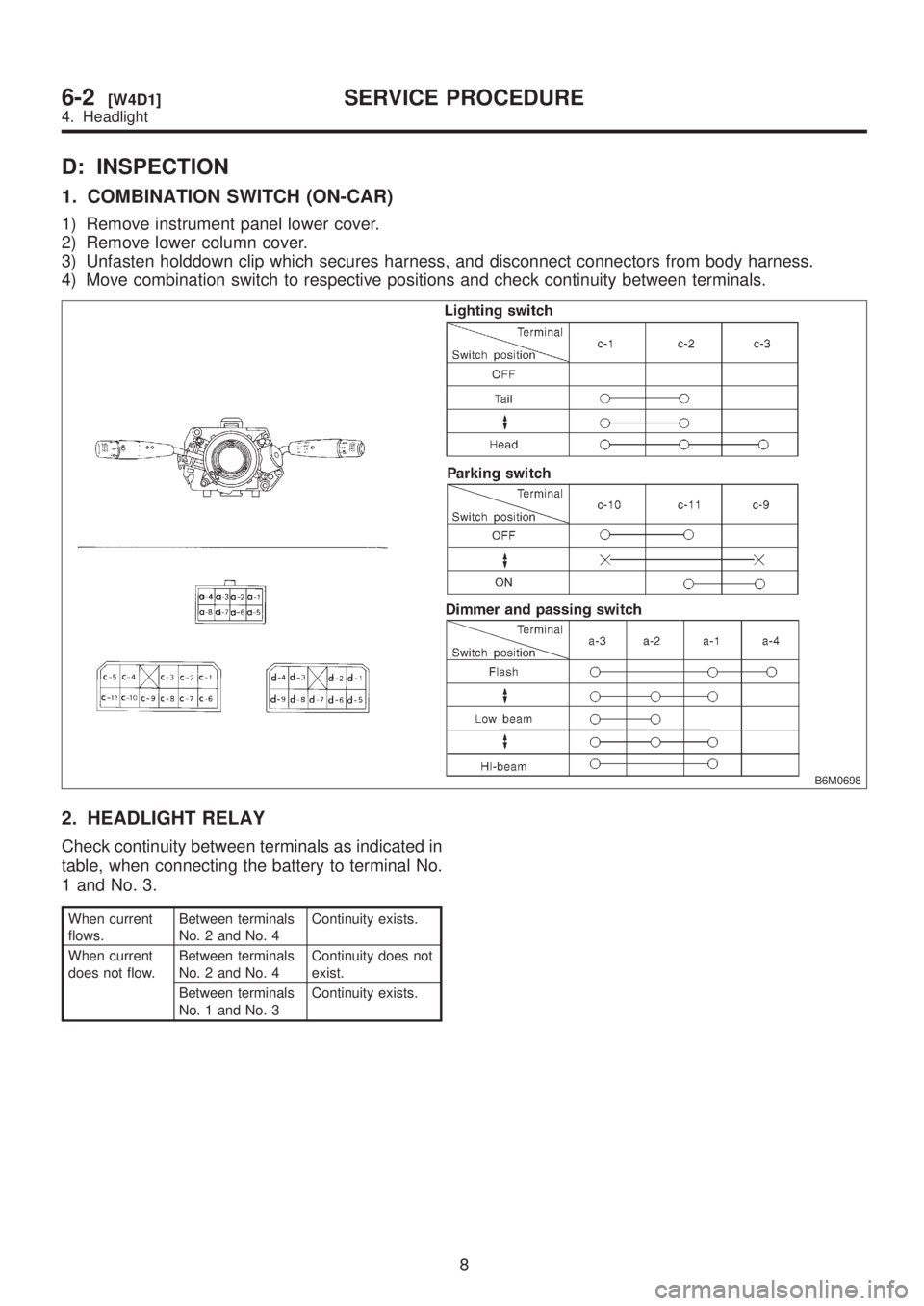
1. COMBINATION SWITCH (ON-CAR)
1) Remove instrument panel lower cover.
2) Remove lower column cover.
3) Unfasten holddown clip which secures harness, and disconnect connectors from body harness.
4) Move combination switch to respective positions and check continuity between terminals.
B6M0698
2. HEADLIGHT RELAY
Check continuity between terminals as indicated in
table, when connecting the battery to terminal No.
1 and No. 3.
When current
flows.Between terminals
No. 2 and No. 4Continuity exists.
When current
does not flow.Between terminals
No. 2 and No. 4Continuity does not
exist.
Between terminals
No. 1 and No. 3Continuity exists.
8
6-2[W4D1]SERVICE PROCEDURE
4. Headlight
Page 1240 of 1456
![SUBARU LEGACY 1999 Service Repair Manual 7. Turn Signal and Hazard
Warning Light
A: REMOVAL AND INSTALLATION
1. FRONT TURN SIGNAL LIGHT
Remove and install front turn signal light. <Ref. to
6-2 [W4B2].>
NOTE:
The front turn signal light is un](/manual-img/17/57435/w960_57435-1239.png "SUBARU LEGACY 1999 Service Repair Manual 7. Turn Signal and Hazard
Warning Light
A: REMOVAL AND INSTALLATION
1. FRONT TURN SIGNAL LIGHT
Remove and install front turn signal light. <Ref. to
6-2 [W4B2].>
NOTE:
The front turn signal light is un")
7. Turn Signal and Hazard
Warning Light
A: REMOVAL AND INSTALLATION
1. FRONT TURN SIGNAL LIGHT
Remove and install front turn signal light.
NOTE:
The front turn signal light is united with headlight
assembly.
2. REAR COMBINATION LIGHT
Remove and install rear combination light.
3. COMBINATION SWITCH
Remove and install combination switch.
4. HAZARD SWITCH
1) Remove center panel from instrument panel.
2) Disconnect connector of hazard switch from
body harness.
3) Remove hazard switch from center panel.
B6M0063
4) Installation is in the reverse order of removal.
5. TURN SIGNAL AND HAZARD UNIT
1) Remove instrument panel lower cover.
2) Remove engine hood opener lever bracket.
3) Disconnect connector of turn signal and hazard
unit.4) Remove screw, and then remove turn signal
and hazard unit from bracket.
B6M0343A
5) Installation is in the reverse order of removal.
B: DISASSEMBLY AND ASSEMBLY
1. COMBINATION SWITCH
Disassemble and assemble combination switch.
C: INSPECTION
1. COMBINATION SWITCH (ON-CAR)
1) Remove instrument panel lower cover.
2) Remove lower column cover.
3) Unfasten holddown clip which secures harness,
and disconnect connectors from body harness.
4) Move combination switch to respective posi-
tions and check continuity between terminals.
B6M0702
14
6-2[W7A1]SERVICE PROCEDURE
7. Turn Signal and Hazard Warning Light
Page 1284 of 1456
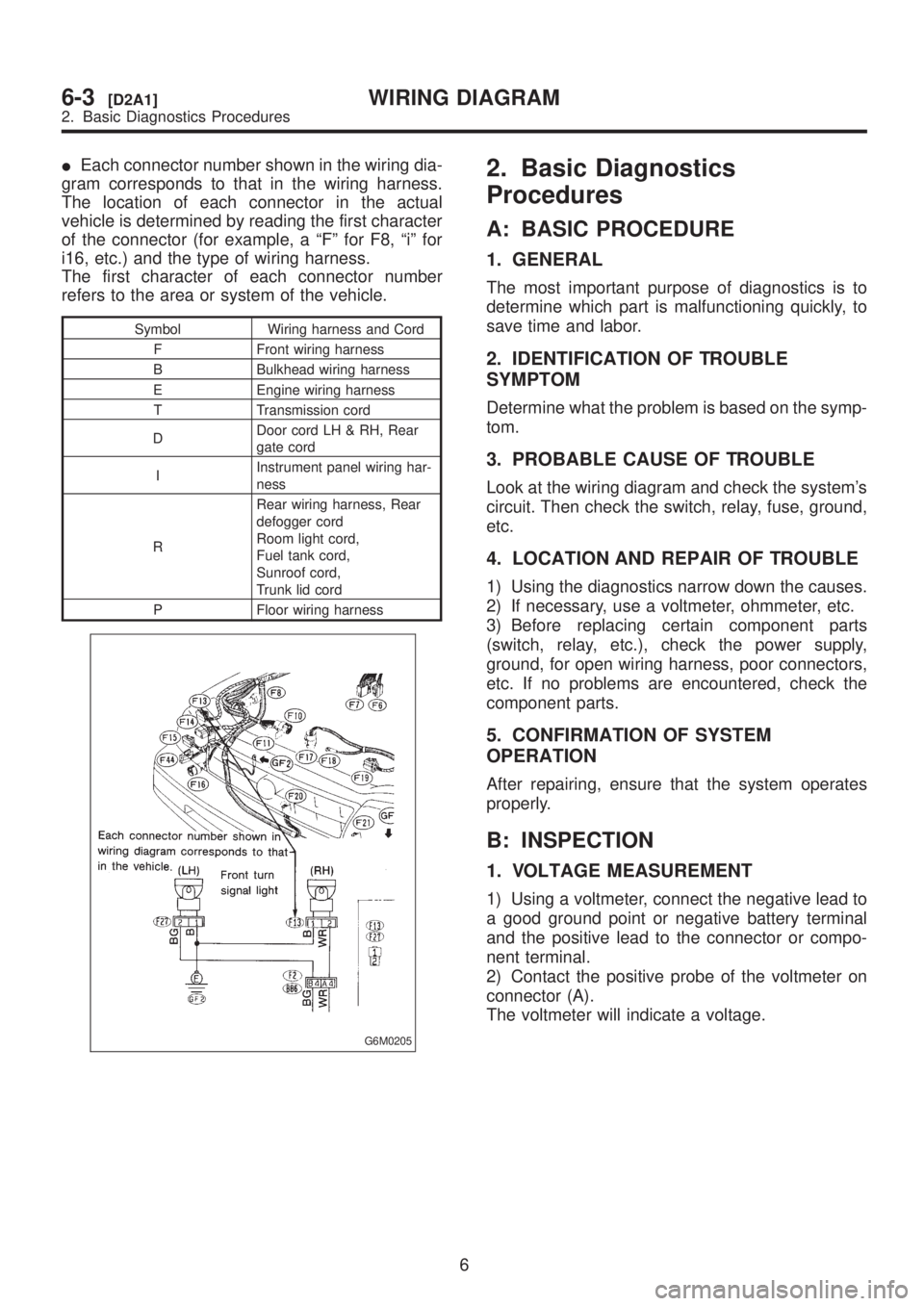
IEach connector number shown in the wiring dia-
gram corresponds to that in the wiring harness.
The location of each connector in the actual
vehicle is determined by reading the first character
of the connector (for example, a ªFº for F8, ªiº for
i16, etc.) and the type of wiring harness.
The first character of each connector number
refers to the area or system of the vehicle.
Symbol Wiring harness and Cord
F Front wiring harness
B Bulkhead wiring harness
E Engine wiring harness
T Transmission cord
DDoor cord LH & RH, Rear
gate cord
IInstrument panel wiring har-
ness
RRear wiring harness, Rear
defogger cord
Room light cord,
Fuel tank cord,
Sunroof cord,
Trunk lid cord
P Floor wiring harness
G6M0205
2. Basic Diagnostics
Procedures
A: BASIC PROCEDURE
1. GENERAL
The most important purpose of diagnostics is to
determine which part is malfunctioning quickly, to
save time and labor.
2. IDENTIFICATION OF TROUBLE
SYMPTOM
Determine what the problem is based on the symp-
tom.
3. PROBABLE CAUSE OF TROUBLE
Look at the wiring diagram and check the system's
circuit. Then check the switch, relay, fuse, ground,
etc.
4. LOCATION AND REPAIR OF TROUBLE
1) Using the diagnostics narrow down the causes.
2) If necessary, use a voltmeter, ohmmeter, etc.
3) Before replacing certain component parts
(switch, relay, etc.), check the power supply,
ground, for open wiring harness, poor connectors,
etc. If no problems are encountered, check the
component parts.
5. CONFIRMATION OF SYSTEM
OPERATION
After repairing, ensure that the system operates
properly.
B: INSPECTION
1. VOLTAGE MEASUREMENT
1) Using a voltmeter, connect the negative lead to
a good ground point or negative battery terminal
and the positive lead to the connector or compo-
nent terminal.
2) Contact the positive probe of the voltmeter on
connector (A).
The voltmeter will indicate a voltage.
6
6-3[D2A1]WIRING DIAGRAM
2. Basic Diagnostics Procedures