1999 NISSAN SENTRA fuel
[x] Cancel search: fuelPage 198 of 223
FUEL RECOMMENDATION
Your vehicle is designed to operate on
unleaded gasoline with an octane rating
of at least 87 AKI (Anti-Knock Index)
(Research octane number 91).
CAUTION
cUsing a fuel other than that specified
could adversely affect the emission
control devices and systems, and
could also affect the warranty cover-
age.
cUnder no circumstances should a
leaded gasoline be used, since this
will damage the three way catalyst.
Reformulated Gasoline
Some fuel suppliers are now producing re-
formulated gasolines. These gasolines are
specially designed to reduce vehicle emis-
sions. NISSAN supports efforts towards
cleaner air and suggests that you use refor-
mulated gasoline when available.
Gasoline containing oxygenates
Some fuel suppliers sell gasoline containing
oxygenates such as ethanol, MTBE andmethanol with or without advertising their
presence. NISSAN does not recommend
the use of fuels of which the oxygenate
content and the fuel compatibility for your
NISSAN cannot be readily determined. If in
doubt, ask your service station manager.
If you use oxygenate-blend gasoline, please
take the following precautions as the usage
of such fuels may cause vehicle performance
problems and/or fuel system damage.
cThe fuel should be unleaded and
have an octane rating no lower than
that recommended for unleaded
gasoline.
cIf an oxygenate-blend other than a
methanol blend is used, it should
contain no more than 10% oxygenate.
(MTBE may, however, be added up to
15%.)
cIf a methanol blend is used, it should
contain no more than 5% methanol
(methyl alcohol, wood alcohol). It
should also contain a suitable
amount of appropriate cosolvents
and corrosion inhibitors. If not prop-
erly formulated with appropriate co-
solvents and corrosion inhibitors,such methanol blends may cause
fuel system damage and/or vehicle
performance problems. At this time,
sufficient data is not available to en-
sure that all methanol blends are suit-
able for use in NISSAN vehicles.
If any driveability problems such as engine
stalling and hard hot-starting are experi-
enced after using oxygenate-blend fuels,
immediately change to a non-oxygenate
fuel or a fuel with a low blend of MTBE.
Take care not to spill gasoline during
refueling. Gasoline containing oxygen-
ates can cause paint damage.
After Market Fuel Additives
NISSAN does not recommend the use of
any fuel additives (i.e., fuel injector cleaners,
octane boosters, intake valve deposit re-
movers, etc.) which are sold commercially.
Many of these additives intended for gum,
varnish or deposit removal may contain ac-
tive solvents or similar ingredients that can
be harmful to the fuel system and engine.
Octane rating tips
In most parts of North America, you should
use unleaded gasoline with an octane rating
Technical and consumer information
10-3
ZX
Page 199 of 223
of at least 87 AKI (Anti-Knock Index). How-
ever, you may use unleaded gasoline with
an octane rating as low as 85 AKI (Anti-
Knock Index) in high altitude areas (over
4,000 ft [1,219 m]) such as: Colorado, Mon-
tana, New Mexico, Utah, Wyoming, north-
eastern Nevada, southern Idaho, western
South Dakota, western Nebraska, and the
part of Texas which is directly south of New
Mexico.
Using unleaded gasoline with an octane
rating lower than stated above can cause
persistent, heavy ``spark knock.'' (``Spark
knock'' is a metallic rapping noise.) If
severe, this can lead to engine damage. If
you detect a persistent heavy spark
knock even when using gasoline of the
stated octane rating, or if you hear steady
spark knock while holding a steady
speed on level roads, have an authorized
NISSAN dealer correct the condition.
Failure to correct the condition is misuse
of the vehicle, for which NISSAN is not
responsible.
Incorrect ignition timing may result in spark
knock, after-run and/or overheating, which
may cause excessive fuel consumption or
engine damage. If any of the above symp-toms are encountered, have your vehicle
checked at an authorized NISSAN dealer or
other competent service facility.
However, now and then you may notice
light spark knock for a short time while
accelerating or driving up hills. This is
not a cause for concern, because you
get the greatest fuel benefit when there
is light spark knock for a short time
under heavy engine load.
10-4Technical and consumer information
ZX
Page 200 of 223
ENGINE OIL AND OIL FILTER
RECOMMENDATION
Selecting the correct oil
It is essential to choose engine oil with the
correct quality and viscosity to ensure sat-
isfactory engine life and performance. NIS-
SAN recommends the use of a low friction
oil (energy conserving oil) in order to im-
prove fuel economy and conserve energy.
Oils which do not have the specified quality
label should not be used as they could
cause engine damage.
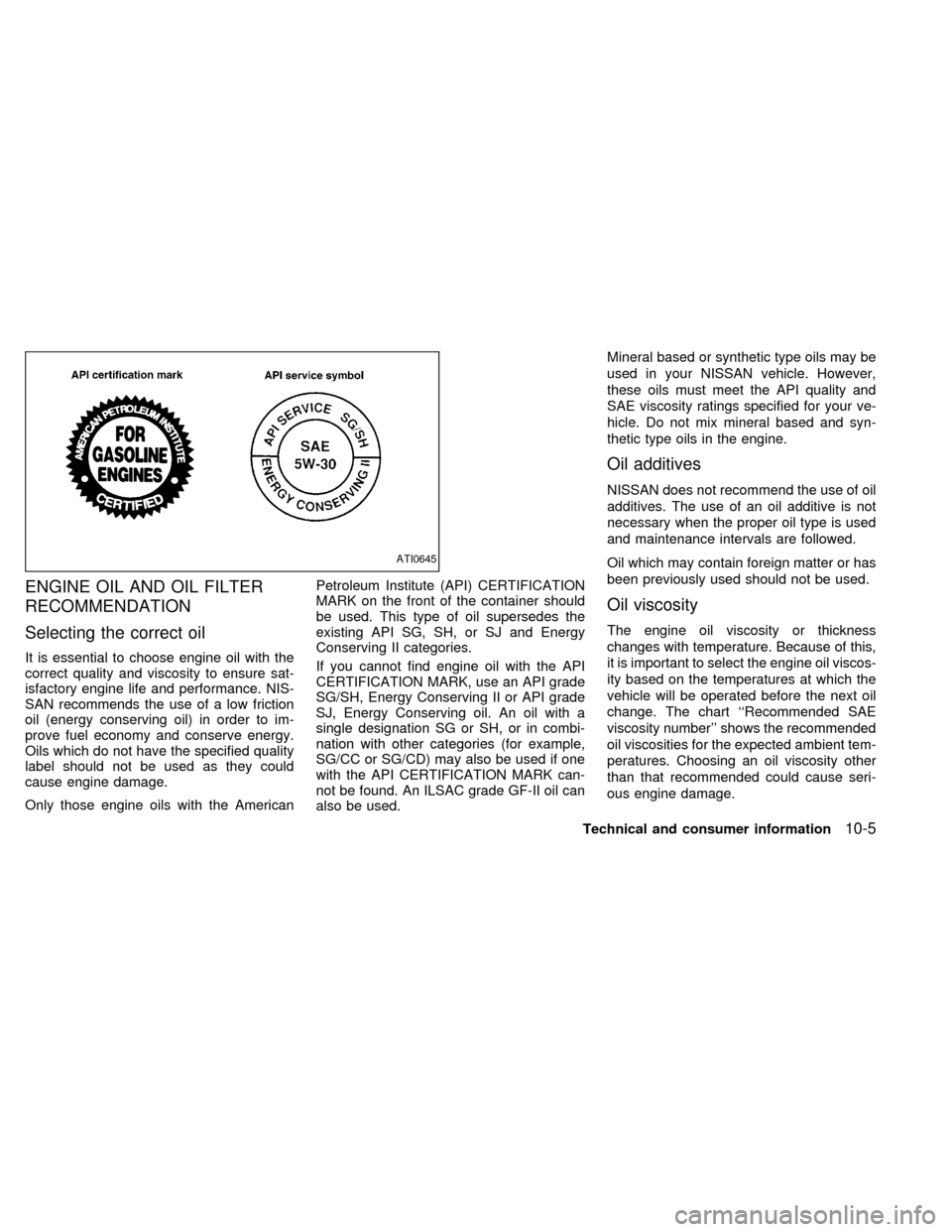
Only those engine oils with the AmericanPetroleum Institute (API) CERTIFICATION
MARK on the front of the container should
be used. This type of oil supersedes the
existing API SG, SH, or SJ and Energy
Conserving II categories.
If you cannot find engine oil with the API
CERTIFICATION MARK, use an API grade
SG/SH, Energy Conserving II or API grade
SJ, Energy Conserving oil. An oil with a
single designation SG or SH, or in combi-
nation with other categories (for example,
SG/CC or SG/CD) may also be used if one
with the API CERTIFICATION MARK can-
not be found. An ILSAC grade GF-II oil can
also be used.Mineral based or synthetic type oils may be
used in your NISSAN vehicle. However,
these oils must meet the API quality and
SAE viscosity ratings specified for your ve-
hicle. Do not mix mineral based and syn-
thetic type oils in the engine.
Oil additives
NISSAN does not recommend the use of oil
additives. The use of an oil additive is not
necessary when the proper oil type is used
and maintenance intervals are followed.
Oil which may contain foreign matter or has
been previously used should not be used.
Oil viscosity
The engine oil viscosity or thickness
changes with temperature. Because of this,
it is important to select the engine oil viscos-
ity based on the temperatures at which the
vehicle will be operated before the next oil
change. The chart ``Recommended SAE
viscosity number'' shows the recommended
oil viscosities for the expected ambient tem-
peratures. Choosing an oil viscosity other
than that recommended could cause seri-
ous engine damage.
ATI0645
Technical and consumer information10-5
ZX
Page 205 of 223
When planning to travel in another coun-
try,you should first find out if the fuel avail-
able is suitable for your vehicle's engine.
Using fuel with too low an octane/cetane
rating may cause engine damage. All gaso-
line vehicles must be operated with un-
leaded gasoline. Therefore, avoid taking
your vehicle to areas where appropriate fuel
is not available.
When transferring the registration of
your vehicle to another country, state,
province or district,it may be necessary to
modify the vehicle to meet local laws and
regulations.
The laws and regulations for motor vehicle
emission control and safety standards vary
according to the country, state, province or
district. Therefore, vehicle specifications
may differ.
When any vehicle is to be taken into
another country, state, province or dis-
trict and registered, its modifications,
transportation, and registration are the
responsibility of the user. NISSAN is not
responsible for any inconvenience that
may result.
VEHICLE IDENTIFICATION
NUMBER (VIN) PLATE
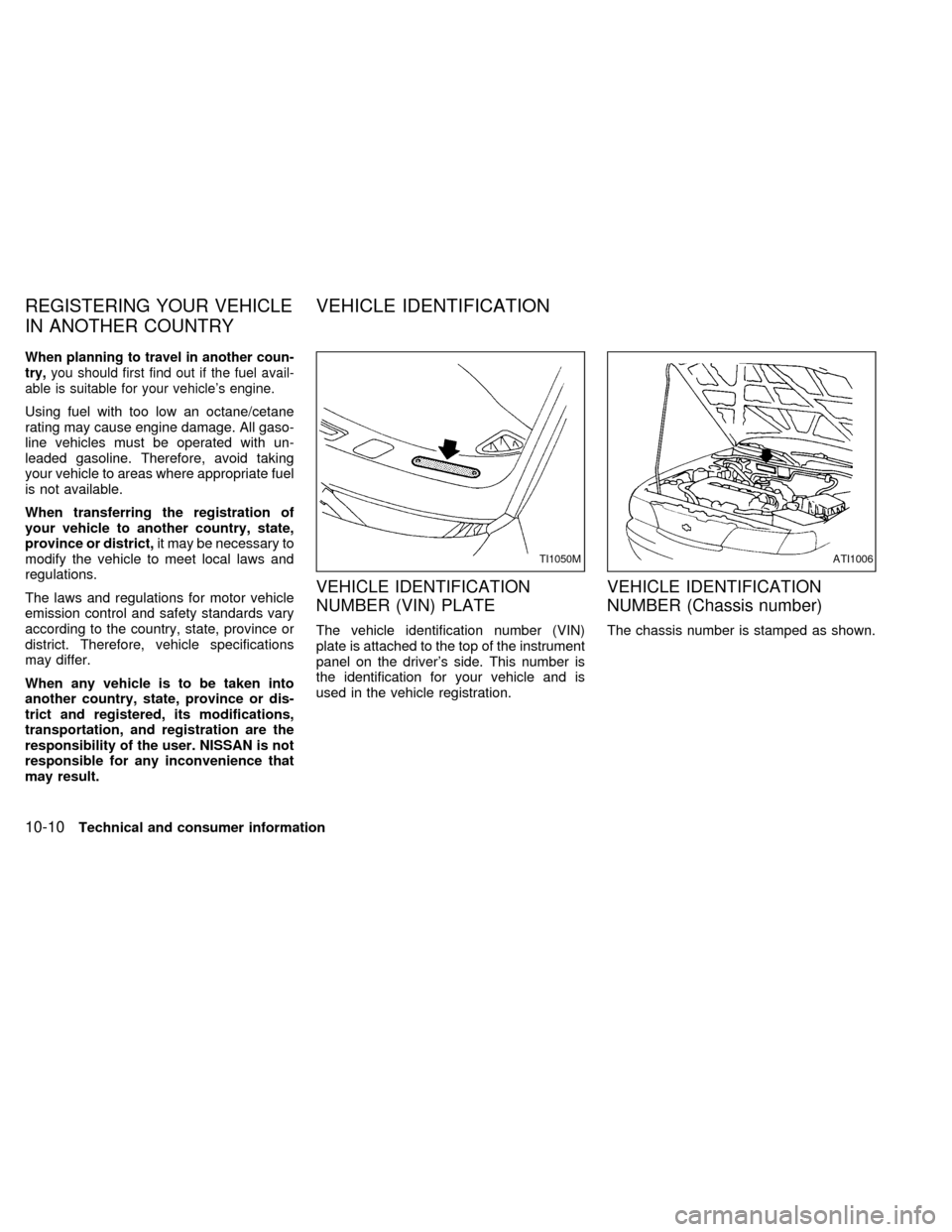
The vehicle identification number (VIN)
plate is attached to the top of the instrument
panel on the driver's side. This number is
the identification for your vehicle and is
used in the vehicle registration.
VEHICLE IDENTIFICATION
NUMBER (Chassis number)
The chassis number is stamped as shown.
TI1050MATI1006
REGISTERING YOUR VEHICLE
IN ANOTHER COUNTRYVEHICLE IDENTIFICATION
10-10Technical and consumer information
ZX
Page 212 of 223
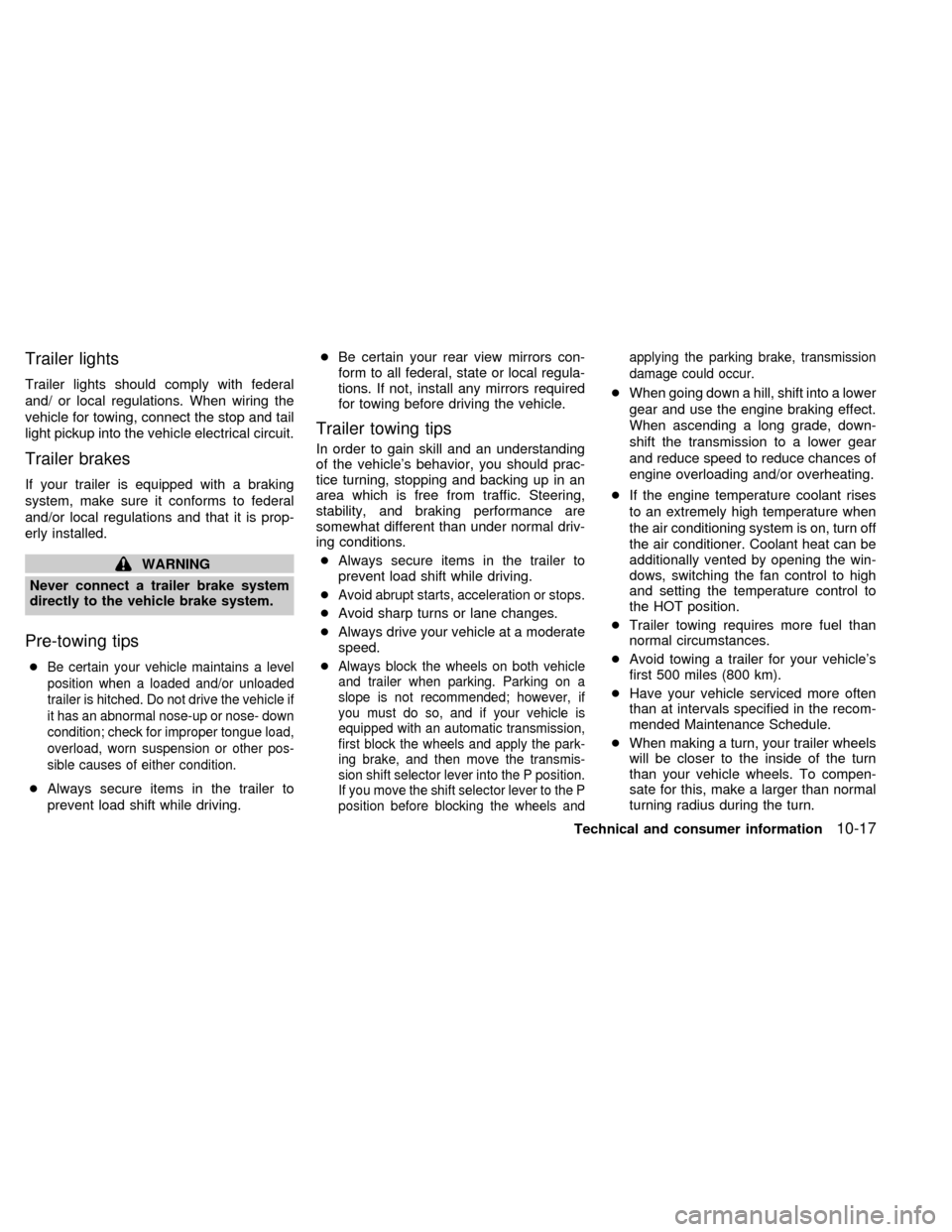
Trailer lights
Trailer lights should comply with federal
and/ or local regulations. When wiring the
vehicle for towing, connect the stop and tail
light pickup into the vehicle electrical circuit.
Trailer brakes
If your trailer is equipped with a braking
system, make sure it conforms to federal
and/or local regulations and that it is prop-
erly installed.
WARNING
Never connect a trailer brake system
directly to the vehicle brake system.
Pre-towing tips
cBe certain your vehicle maintains a level
position when a loaded and/or unloaded
trailer is hitched. Do not drive the vehicle if
it has an abnormal nose-up or nose- down
condition; check for improper tongue load,
overload, worn suspension or other pos-
sible causes of either condition.
cAlways secure items in the trailer to
prevent load shift while driving.cBe certain your rear view mirrors con-
form to all federal, state or local regula-
tions. If not, install any mirrors required
for towing before driving the vehicle.
Trailer towing tips
In order to gain skill and an understanding
of the vehicle's behavior, you should prac-
tice turning, stopping and backing up in an
area which is free from traffic. Steering,
stability, and braking performance are
somewhat different than under normal driv-
ing conditions.
cAlways secure items in the trailer to
prevent load shift while driving.
c
Avoid abrupt starts, acceleration or stops.
cAvoid sharp turns or lane changes.
cAlways drive your vehicle at a moderate
speed.
c
Always block the wheels on both vehicle
and trailer when parking. Parking on a
slope is not recommended; however, if
you must do so, and if your vehicle is
equipped with an automatic transmission,
first block the wheels and apply the park-
ing brake, and then move the transmis-
sion shift selector lever into the P position.
If you move the shift selector lever to the P
position before blocking the wheels andapplying the parking brake, transmission
damage could occur.
cWhen going down a hill, shift into a lower
gear and use the engine braking effect.
When ascending a long grade, down-
shift the transmission to a lower gear
and reduce speed to reduce chances of
engine overloading and/or overheating.
cIf the engine temperature coolant rises
to an extremely high temperature when
the air conditioning system is on, turn off
the air conditioner. Coolant heat can be
additionally vented by opening the win-
dows, switching the fan control to high
and setting the temperature control to
the HOT position.
cTrailer towing requires more fuel than
normal circumstances.
cAvoid towing a trailer for your vehicle's
first 500 miles (800 km).
cHave your vehicle serviced more often
than at intervals specified in the recom-
mended Maintenance Schedule.
cWhen making a turn, your trailer wheels
will be closer to the inside of the turn
than your vehicle wheels. To compen-
sate for this, make a larger than normal
turning radius during the turn.
Technical and consumer information
10-17
ZX
Page 218 of 223
11 Index
A
Air bag (See supplemental restraint
system) ........................................................ 1-6
Air bag warning light .......................... 1-11, 2-6
Air cleaner housing filter ............................ 8-19
Air conditioner
Air conditioner operation ........................ 4-5
Air conditioner specification label ....... 10-12
Air conditioner system refrigerant and
lubrication recommendations ................ 10-7
Heater and air conditioner controls ........ 4-3
Servicing air conditioner ......................... 4-9
Air flow charts .............................................. 4-6
Alarm system (See theft warning) ............... 2-9
Anchor point locations ............................... 1-31
Anti-lock brake system (ABS).................... 5-18
Anti-lock brake warning light ....................... 2-7
Ashtray (See cigarette lighter and
ashtray) ...................................................... 2-14
Audio system
AM-FM radio with cassette player ........ 4-10
AM-FM radio with cassette player and
compact disc player.............................. 4-20
AM-FM radio with compact disc (CD)
player .................................................... 4-15Automatic
Automatic power window switch .......... 2-17
Automatic transmission fluid (ATF) ...... 8-11
Driving with automatic transmission ....... 5-6
Transmission selector lever lock
release .................................................... 5-5
B
Battery........................................................ 8-15
Battery
Charge warning light .............................. 2-5
Before starting the engine ........................... 5-5
Belts (See drive belts) ............................... 8-17
Brake
Anti-lock brake system (ABS) .............. 5-18
Brake booster ....................................... 8-23
Brake fluid............................................. 8-14
Brake light (See stop light) ................... 8-27
Brake pedal .......................................... 8-22
Brake system ........................................ 5-17
Brake warning light ................................. 2-7
Brake wear indicators ................... 2-8, 8-23
Parking brake check ............................. 8-22
Parking brake operation ....................... 5-12
Break-in schedule ...................................... 5-15
Bulb check/instrument panel ....................... 2-5C
Capacities and recommended fuel/
lubricants.................................................... 10-2
Cargo (See vehicle loading
information) .............................................. 10-13
Cassette player (See audio system) ......... 4-10
CB radio or car phone ............................... 4-27
Check engine indicator light
(See malfunction indicator light) .................. 2-8
Child restraints ................................. 1-15, 1-21
Child safety rear door lock .......................... 3-8
Cigarette lighter (accessory) and
ashtray ....................................................... 2-14
Cleaning exterior and interior ...................... 7-2
Clock ....................................... 4-11, 4-16, 4-21
Clutch
Clutch pedal.......................................... 8-24
Cold weather driving .................................. 5-19
Controls
Heater and air conditioner controls ........ 4-3
Coolant
Capacities and recommended fuel/
lubricants .............................................. 10-2
Changing engine coolant........................ 8-6
Checking engine coolant level ............... 8-5
Engine coolant temperature gauge ........ 2-3
ZX
Page 219 of 223
Corrosion protection .................................... 7-5
Cruise control............................................. 5-13
Cup holder ................................................. 2-15
D
Daytime running light system
(Canada only) ............................................ 2-12
Defogger switch
Rear window defogger switch .............. 2-11
Dimensions and weights............................ 10-9
Door ajar warning light ................................ 2-6
Door locks .................................................... 3-2
Drive belts .................................................. 8-17
Driving
Cold weather driving............................. 5-19
Driving with automatic transmission ....... 5-6
Driving with manual transmission ........... 5-9
Precautions when starting and driving ... 5-2
E
Economy - fuel........................................... 5-15
Emission control information label........... 10-12
Emission control system warranty ........... 10-19
Engine
Before starting the engine ...................... 5-5
Capacities and recommended fuel/
lubricants .............................................. 10-2
Changing engine coolant........................ 8-6
Changing engine oil................................ 8-9Changing engine oil filter...................... 8-10
Checking engine coolant level ............... 8-5
Checking engine oil level ....................... 8-8
Engine compartment check locations ... 8-3,
8-4
Engine coolant temperature gauge ........ 2-3
Engine cooling system ........................... 8-5
Engine oil ................................................ 8-8
Engine oil and oil filter
recommendation ................................... 10-5
Engine oil pressure warning light ........... 2-5
Engine oil viscosity ............................... 10-5
Engine serial number ......................... 10-11
Engine specifications ............................ 10-8
Starting the engine ............................... 5-11
Exhaust gas (Carbon monoxide) ................. 5-2
F
Flashers (See hazard warning flasher
switch) ........................................................ 2-14
Flat tire ......................................................... 6-2
Floor mat positioning aid ............................. 7-4
Fluid
Automatic transmission fluid (ATF) ...... 8-11
Brake fluid............................................. 8-14
Capacities and recommended fuel/
lubricants .............................................. 10-2
Engine coolant ........................................ 8-5
Engine oil ................................................ 8-8
Power steering fluid .............................. 8-13
Window washer fluid ............................ 8-14F.M.V.S.S. certification label ................... 10-11
Front fog light switch ................................. 2-13
Front seats ................................................... 1-2
Fuel
Capacities and recommended fuel/
lubricants .............................................. 10-2
Fuel economy ....................................... 5-15
Fuel filler cap ........................................ 3-12
Fuel filler lid lock opener lever ............. 3-12
Fuel gauge.............................................. 2-4
Fuel octane rating................................. 10-3
Fuel recommendation ........................... 10-3
Fuses ......................................................... 8-24
Fusible links ............................................... 8-24
G
Gauge
Engine coolant temperature gauge ........ 2-3
Fuel gauge.............................................. 2-4
Speedometer .......................................... 2-3
Tachometer............................................. 2-3
Trip odometer ......................................... 2-3
General maintenance .................................. 9-2
Glove box................................................... 3-10
H
Hazard warning flasher switch .................. 2-14
Head restraints ............................................ 1-4
Headlight aiming adjustment ..................... 8-27
11-2
ZX
Page 220 of 223
Headlight and turn signal switch ............... 2-12
Headlights .................................................. 8-26
Heater
Heater and air conditioner controls ........ 4-3
Heater operation ..................................... 4-4
Hood release ............................................... 3-9
I
Ignition switch .............................................. 5-4
Increasing fuel economy............................ 5-15
Indicator lights and chimes (See warning/
indicator lights and chimes) ......................... 2-5
Inside mirror ............................................... 3-15
Instrument brightness control .................... 2-13
Interior light ................................................ 2-18
J
Jump starting ............................................... 6-8
K
Key ............................................................... 3-2
Keyless entry system (See multi-remote
control system) ............................................ 3-4L
Labels
Air conditioner specification label ....... 10-12
Emission control information label...... 10-12
Engine serial number ......................... 10-11
F.M.V.S.S. certification label .............. 10-11
Vehicle identification number (VIN)
plate .................................................... 10-10
Warning labels (for SRS) ..................... 1-11
License plate
Installing the license plate .................. 10-13
Light
Air bag warning light ..................... 1-11, 2-6
Brake light (See stop light) ................... 8-27
Bulb check/instrument panel .................. 2-5
Charge warning light .............................. 2-5
Front fog light switch ............................ 2-13
Headlight aiming adjustment ................ 8-27
Headlight and turn signal switch .......... 2-12
Headlights ............................................. 8-26
Interior light ........................................... 2-18
Light bulbs ............................................ 8-26
Trunk light ............................................. 2-19
Warning/indicator lights and chimes ...... 2-5
Lock
Child safety rear door lock ..................... 3-8
Door locks............................................... 3-2
Fuel filler lid lock opener lever ............. 3-12
Trunk lid lock opener lever ................... 3-10Luggage (See vehicle loading
information) .............................................. 10-13
M
Maintenance
General maintenance ............................. 9-2
Inside the vehicle.................................... 9-3
Maintenance precautions ....................... 8-2
Outside the vehicle ................................. 9-2
Periodic maintenance schedules ............ 9-5
Seat belt maintenance.......................... 1-21
Under the hood and vehicle ................... 9-4
Malfunction indicator lamp (MIL) ................. 2-8
Manual windows ........................................ 2-16
Meters and gauges ...................................... 2-2
Mirror
Inside mirror.......................................... 3-15
Outside mirror control ........................... 3-14
Vanity mirror ......................................... 3-15
Multi-remote control system ........................ 3-4
O
Octane rating (See fuel octane rating) ...... 10-3
Oil
Capacities and recommended fuel/
lubricants .............................................. 10-2
Changing engine oil................................ 8-9
Changing engine oil filter...................... 8-10
Checking engine oil level ....................... 8-8
11-3
ZX