1999 NISSAN PATHFINDER transmission
[x] Cancel search: transmissionPage 189 of 274
as this may cause serious and expen-
sive damage to the transmission.
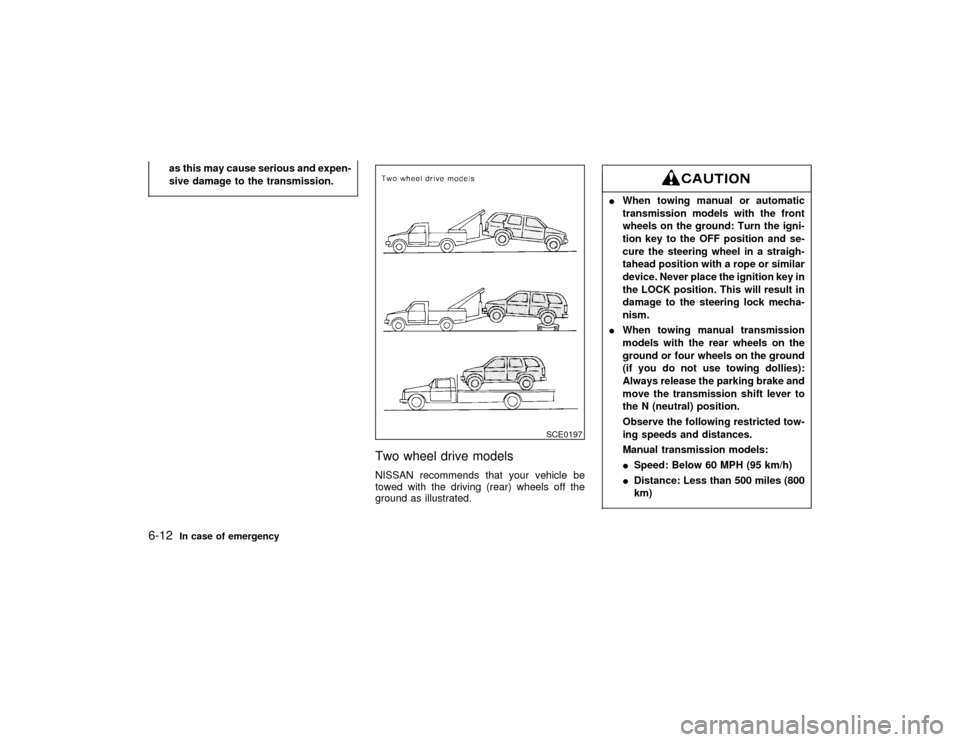
Two wheel drive modelsNISSAN recommends that your vehicle be
towed with the driving (rear) wheels off the
ground as illustrated.
IWhen towing manual or automatic
transmission models with the front
wheels on the ground: Turn the igni-
tion key to the OFF position and se-
cure the steering wheel in a straigh-
tahead position with a rope or similar
device. Never place the ignition key in
the LOCK position. This will result in
damage to the steering lock mecha-
nism.
IWhen towing manual transmission
models with the rear wheels on the
ground or four wheels on the ground
(if you do not use towing dollies):
Always release the parking brake and
move the transmission shift lever to
the N (neutral) position.
Observe the following restricted tow-
ing speeds and distances.
Manual transmission models:
ISpeed: Below 60 MPH (95 km/h)
IDistance: Less than 500 miles (800
km)
SCE0197
6-12
In case of emergency
Z
01.1.22/R50-D/V5
X
Page 190 of 274
If the speed or distance must necessarily be
greater, remove the propeller shaft beforehand
to prevent damage to the transmission.
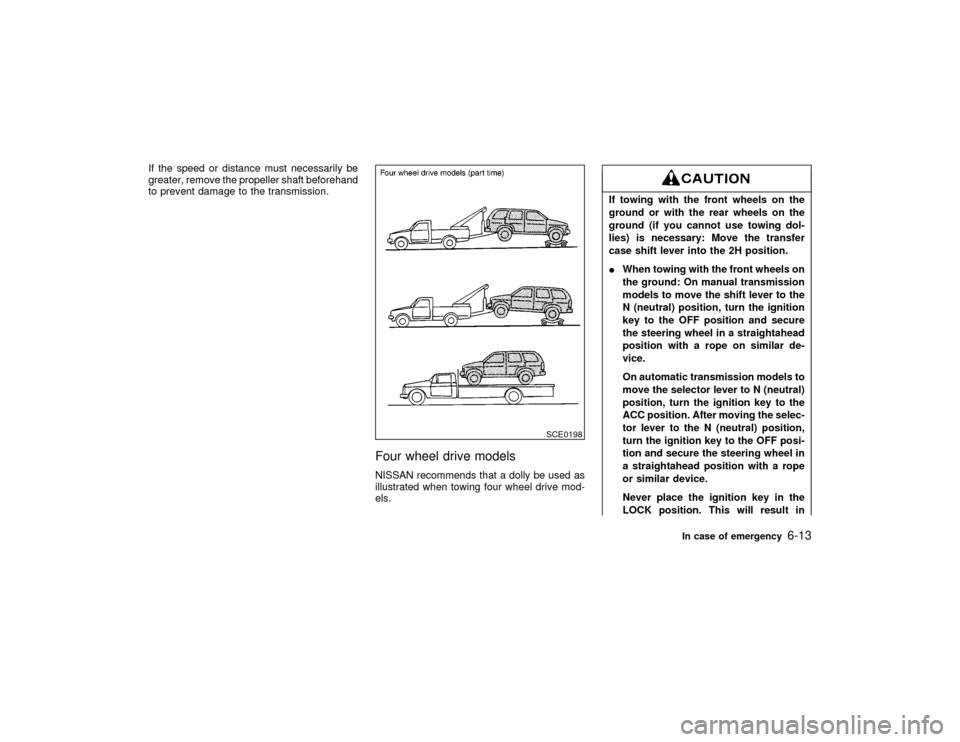
Four wheel drive modelsNISSAN recommends that a dolly be used as
illustrated when towing four wheel drive mod-
els.
If towing with the front wheels on the
ground or with the rear wheels on the
ground (if you cannot use towing dol-
lies) is necessary: Move the transfer
case shift lever into the 2H position.
IWhen towing with the front wheels on
the ground: On manual transmission
models to move the shift lever to the
N (neutral) position, turn the ignition
key to the OFF position and secure
the steering wheel in a straightahead
position with a rope on similar de-
vice.
On automatic transmission models to
move the selector lever to N (neutral)
position, turn the ignition key to the
ACC position. After moving the selec-
tor lever to the N (neutral) position,
turn the ignition key to the OFF posi-
tion and secure the steering wheel in
a straightahead position with a rope
or similar device.
Never place the ignition key in the
LOCK position. This will result in
SCE0198
In case of emergency
6-13
Z
01.1.22/R50-D/V5
X
Page 191 of 274
damage to the steering lock mecha-
nism.
IWhen towing manual transmission
models with the rear wheels on the
ground or four wheels on the ground:
Always release the parking brake and
move the transmission shift lever to
the N (neutral) position.
Observe the following restricted tow-
ing speeds and distances.
Manual transmission models:
ISpeed: Below 60 MPH (95 km/h)
IDistance: Less than 500 miles (800
km)
If the speed or distance must necessarily be
greater, remove the front and rear propeller
shafts beforehand to prevent damage to the
transmission.
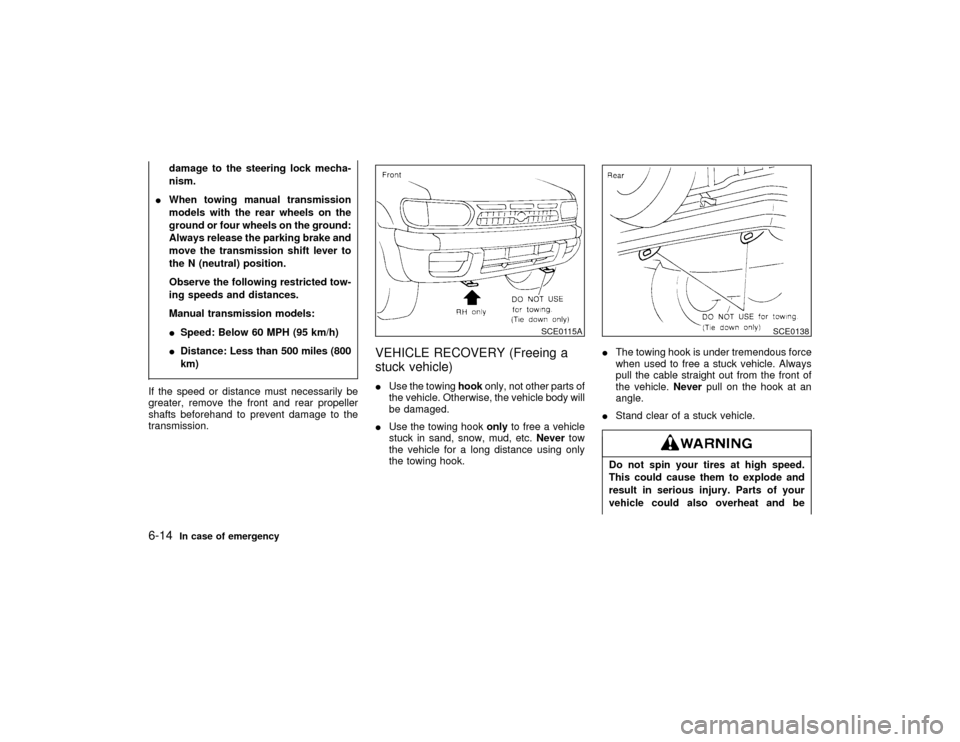
VEHICLE RECOVERY (Freeing a
stuck vehicle)IUse the towinghookonly, not other parts of
the vehicle. Otherwise, the vehicle body will
be damaged.
IUse the towing hookonlyto free a vehicle
stuck in sand, snow, mud, etc.Nevertow
the vehicle for a long distance using only
the towing hook.IThe towing hook is under tremendous force
when used to free a stuck vehicle. Always
pull the cable straight out from the front of
the vehicle.Neverpull on the hook at an
angle.
IStand clear of a stuck vehicle.
Do not spin your tires at high speed.
This could cause them to explode and
result in serious injury. Parts of your
vehicle could also overheat and be
SCE0115A
SCE0138
6-14
In case of emergency
Z
01.1.22/R50-D/V5
X
Page 200 of 274
8 Do-it-yourselfMaintenance precautions .......................................... 8-2
Engine compartment check locations ....................... 8-3
Engine cooling system .............................................. 8-4
Checking engine coolant level .................................. 8-4
Changing engine coolant .......................................... 8-5
Engine oil .................................................................. 8-7
Checking engine oil level .......................................... 8-7
Changing engine oil .................................................. 8-8
Changing engine oil filter .......................................... 8-9
Automatic transmission fluid ..................................... 8-9
Temperature conditions for checking ...................... 8-10
Power steering fluid ................................................ 8-11
Brake and clutch fluid ............................................. 8-11
Brake fluid ............................................................... 8-11
Clutch fluid .............................................................. 8-12
Window washer fluid ............................................... 8-12
Window washer fluid reservoir ................................ 8-12
Battery ..................................................................... 8-13
Jump starting........................................................... 8-14
Drive belts ............................................................... 8-14
Spark plugs ............................................................. 8-15
Replacing spark plugs ............................................. 8-15Air cleaner ............................................................... 8-16
Windshield wiper blades ......................................... 8-17
Cleaning .................................................................. 8-17
Replacement ........................................................... 8-17
Parking brake and brake pedal ............................... 8-18
Checking parking brake .......................................... 8-18
Checking brake pedal ............................................. 8-19
Brake booster .......................................................... 8-19
Clutch pedal ............................................................ 8-20
Checking clutch pedal ............................................. 8-20
Fuses....................................................................... 8-20
Engine compartment ............................................... 8-20
Passenger compartment ......................................... 8-21
Lights ....................................................................... 8-22
Headlights ............................................................... 8-23
Tires and wheels ..................................................... 8-26
Tire pressure ........................................................... 8-26
Types of tires .......................................................... 8-27
Tire chains............................................................... 8-28
Changing tires and wheels...................................... 8-28
Clutch housing drain ................................... 8-31
Z
01.1.22/R50-D/V5
X
Page 201 of 274
When performing any inspection or mainte-
nance work on your vehicle, always take care
to prevent serious accidental injury to yourself
or damage to the vehicle. The following are
general precautions which should be closely
observed.IPark the vehicle on a level surface,
apply the parking brake securely and
block the wheels to prevent the ve-
hicle from moving. For a manual
transmission, move the shift lever to
Neutral. For an automatic transmis-
sion, move the selector lever to P
(Park).
IBe sure the ignition key is in the OFF
or LOCK position when performing
any replacement or repair.
IIf you must work with the engine
running, keep your hands, clothing,
hair and tools away from moving fans
and fan belts.
IIt is advisable to remove necktie and
any jewelry, such as rings, watches,
etc. before working on your vehicle.IAlways wear eye protection when-
ever you work on your vehicle.
IIf you must run the engine in an
enclosed space such as a garage, be
sure there is proper ventilation for
exhaust gases.
INever get under the vehicle while it is
supported only by a jack. If it is nec-
essary to work under the vehicle,
support it with safety stands.
IKeep smoking materials, flame and
sparks away from fuel and battery.
IThe fuel filter or fuel lines should be
serviced by a NISSAN dealer because
the fuel lines are under high pressure
even when the engine is off.
IDo not work under the engine hood
while it is hot. Always turn off the
engine and wait until it cools down.
INever connect or disconnect either
the battery or any transistorized com-ponent connector while the ignition
key is on.
IAvoid direct contact with used engine
oil. Improperly disposed motor oil and/
or other vehicle fluids can hurt the
environment. Always conform to lo-
cal regulations for disposal of vehicle
fluid.
This ª8. Do-it-yourselfº section gives instruc-
tions regarding only those items which are
relatively easy for an owner to perform.
You should be aware that incomplete or im-
proper servicing may result in operating diffi-
culties or excessive emissions, and could af-
fect your warranty coverage.If in doubt about
any servicing, have it done by your NISSAN
dealer.
MAINTENANCE PRECAUTIONS8-2
Do-it-yourself
Z
01.1.22/R50-D/V5
X
Page 208 of 274

CHANGING ENGINE OIL FILTER1. Park the vehicle on a level surface and
apply the parking brake.
2. Turn the engine off.
3. Loosen the oil filter with an oil filter wrench.
(A specialcap-typewrench will assist with
oil filter removal on models with the V6
engine. This tool can be purchased from
your NISSAN dealer.) Then remove the oil
filter by turning it by hand.
Be careful not to burn yourself, as the
engine oil may be hot.4. Wipe the engine oil filter mounting surface
with a clean rag.
Be sure to remove any old rubber gasket
remaining on the mounting surface of the
engine.
5. Coat the rubber gasket on the new filter
with engine oil.
6. Screw in the oil filter until a slight resistance
is felt, then tighten an additional 2/3 turn.
7. Start the engine and check for leakage
around the oil filter. Correct as required.
8. Turn the engine off and wait several min-
utes. Check the oil level. Add engine oil if
necessary.
IWhen engine is running, keep hands,
jewelry, and clothing away from any
moving parts such as fan and drive
belt.
IAutomatic transmission fluid is poi-
sonous and should be stored care-
fully in marked containers out of the
reach of children.
SDI0417
SDI0488
AUTOMATIC TRANSMISSION
FLUID
Do-it-yourself
8-9
Z
01.1.22/R50-D/V5
X
Page 209 of 274

TEMPERATURE CONDITIONS
FOR CHECKINGThe fluid level should be checked using the
HOT range (L & H marks) on the dipstick at
fluid temperatures between 122 and 176ÉF (50
and 80ÉC) after the vehicle has been driven
approximately 5 minutes in urban areas after
the engine is warmed up. The level can be
checked at fluid temperatures between 86 and
122ÉF (30 and 50ÉC) using the COLD range on
the dipstick for reference, after the engine is
warmed up but before driving. However, the
fluid level must be rechecked using the HOT
range.
1. Park the vehicle on a level surface and set
the parking brake.
2. Start the engine and then move the selector
lever through each gear range, ending in P.
3. Check the fluid level with the engine idling.
If the vehicle has been driven for a long
time at high speeds, or in city traffic in hot
weather, or if it is being used to pull a
trailer, the fluid level cannot be read accu-
rately. You should wait until the fluid has
cooled down (about 30 minutes).
4. Remove the dipstick and wipe it clean with
lint-free paper.5. Re-insert the dipstick into the charging pipe
as far as it will go.
6. Remove the dipstick and note the reading.
If the level is on the low side of either range,
add fluid to the charging pipe.
IDo not overfill.
IUSE ONLY Nissan Matic D (Continen-
tal U.S. and Alaska) or Genuine
Nissan Automatic Transmission
Fluid (Canada). Dexron
TM
III/
Mercon
TM
or equivalent may also be
used. Outside the continental United
States and Alaska contact a NISSAN
dealer for more information regarding
suitable fluids, including recom-
mended brand(s) of Dexron
TM
III/
Mercon
TM
or Dexron
TM
IIE/Mercon
TM
Automatic Transmission Fluid.
SDI0386A
8-10
Do-it-yourself
Z
01.1.22/R50-D/V5
X
Page 229 of 274
could cause early tire wear, possibly
degraded vehicle handling character-
istics and/or interference with the
brake discs/drums. Such interference
can lead to decreased braking effi-
ciency and/or early brake pad/shoe
wear.
IDo not install a deformed wheel or
tire even if it has been repaired. Such
wheels or tires could have structural
damage and could fail without warn-
ing.
IThe use of retread tire is not rec-
ommended.
Four wheel drive modelsAlways use tires of the same size, brand,
construction (bias, bias-belted or ra-
dial), and tread pattern on all four
wheels. A spare tire of the same size,
brand, construction and tread pattern
must also be used. Failure to do so may
result in a circumference difference be-
tween tires on the front and rear axleswhich will cause excessive tire wear and
may damage the transmission, transfer
case and differential gears.
If excessive tire wear is found, it is recom-
mended that all four tires be replaced with tires
of the same size, brand, construction and
tread pattern. The tire pressure and wheel
alignment should also be checked and cor-
rected as necessary. Contact your NISSAN
dealer.Wheel balanceUnbalanced wheels may affect vehicle han-
dling and tire life. Even with regular use,
wheels can get out of balance. Therefore, they
should be balanced as required.
Wheel balance service should be performed
with the wheels off the vehicle. Spin balancing
the rear wheels on the vehicle could lead to
transmission damage.Care of wheelsIWash the wheels when washing the vehicle
to maintain their appearance.
IClean the inner side of the wheels when the
wheel is changed or the underside of the
vehicle is washed.IDo not use abrasive cleaners when wash-
ing the wheels.
IInspect wheel rims regularly for dents or
corrosion. This may cause loss of pressure
or damage the tire bead.
IWe recommend that the road wheels be
waxed to protect against road salt in areas
where it is used during winter.
8-30
Do-it-yourself
Z
01.1.22/R50-D/V5
X