1999 MERCEDES-BENZ C-CLASS fuel
[x] Cancel search: fuelPage 89 of 122

Tire Inflation Pressure
A table (see fuel filler flap) lists the tire inflation pressures specified for Mercedes-Benz recommended tires as well as
for the varying operating conditions.
Important !
Tire pressure changes by approx. 1.5 psi (0.1 bar) per 18°F (10°C) of air temperature change. Keep this in mind
when checking tire pressure inside a garage - especially in the winter.
Example:
If garage temperature = approx. +68°F (+20°C) and ambient te mperature = approx. +32°F (0°C) then the adjusted air
pressure = specified air pressure +3 psi (+0.2 bar).
Tire pressures listed for light loads are minimum values o ffering high driving comfort. Increased inflation pressures for
heavy loads produce favorable handling characteristics with lighter loads arid are perfectly permissible. The ride of
the vehicle, however, will become somewhat harder.
Tire temperature and pressure increase with the vehicle speed. Tire pressure should therefore only be corrected on
cold tires. Correct tire pressure in warm tires only if pressure has dropped below the pressure listed in the table and
the respective operating conditions are taken into consideration.
An underinflated tire due to a slow leak (e.g. due to a
nail in the tire) may cause damage such as tread separation, bulging etc.. Regular tire pressure checks (including the
spare tire) at intervals of no more than 14 days are therefore essential. If a tire constantly loses air, it should be
inspected for damage.
Warning !
Do not overinflate tires. Overinfiating tires can result in sudden deflation (blowout) because they are more
likely to become punctured or damaged by road debris, potholes etc.. Follow recommended inflation
pressures.
Do not overload the tires by exceeding the specified vehicle capacity weight (as indicated by the label on the
driver's door latch post). Overloading the tires can overheat them, possibly causing a blowout.
ProCarManuals.com
Page 99 of 122

Cleaning and Care of the Vehicle
Warning !
Many cleaning products can be hazardous. Some are poisonous, others are flammable.
Always follow the instructions on the particular container. Always open your car's doors or
windows when cleaning the inside. Never use fluids or solvents that are not designed for
cleaning your car.
In operation, your vehicle is subjected to varying external influences which, if gone unchecked, can
attack the paintwork as well as the underbody and cause lasting damage.
Such damage is caused not only by extreme and varying climatic conditions, but also by air
pollution, road salt, tar, gravel and stone chipping. Grease and oil, fuel, coolant, brake fluid, bird
droppings, insects, tree resins etc. should be removed immediately to avoid paint damage. Frequent
washing reduces and/or eliminates the aggr essiveness and potency of the above adverse
influences.
More frequent washings are necessary to deal with unfavorable conditions; for example, near the
ocean, in industrial areas (smoke, exhaust emissions), or during winter operation.
You should check your vehicle from time to time for stone chipping or other damage. Any damage
should be repaired as soon as possible to prevent the start of corrosion. In doing so, do not neglect
the underside of the car. A prerequisite for a t horough check is a washing of the underbody followed
by a thorough inspection. Damage d areas need to be reundercoated.
Your vehicle has been treated at the factory with a wax-base rustproofing in the body cavities which
will last for the lifetime of t he vehicle. Post-production treatment is neither necessary nor
recommended by Mercedes-Be nz because of the possibility of incompatibility between materials
used in the production proc ess and others applied later.
We have selected car care products and compiled recommendations which are specially matched to
our vehicles and which always reflect the late st technology. You can obtain Mercedes- Benz
approved car care products at your authorized Mercedes-Benz dealer.
Scratches, corrosive deposits, corrosion or damage due to negligent or incorrect care cannot always
be removed or repaired with the car care products recommended here. In such cases it is best to
seek aid at your authorized Mercedes-Benz dealer. The following topics deal with the cleaning and
care of your vehicle and give important "how-to" in formation as well as references to Mercedes-Benz
approved car care products. Additional information can be found in the booklet titled "Car Care".
Engine Cleaning
Prior to cleaning the engine compartment make sure to protect electrical components and
connectors from the intrusion of water and cleaning agents.
Corrosion protection, such as MB Anticorrosion Wax should be applied to the engine compartment
after every engine cleaning. Before applying, all control linkage bushings and joints should be
lubricated. The poly-V-belt and all pulleys should be protected from any wax.
Car Washing
Do not use hot water or wash your car in direct sunlight. Use only a mild car wash detergent, such
as Mercedes-Benz approved Car Shampoo.
Thoroughly spray the car with a diffused jet of wa ter. Direct only a very weak spray towards the
ventilation intake. Use plenty of water an d rinse the sponge and chamois frequently.
Rinse with clear water and thoroughly wipe dry with a chamois. Do not allow cleaning agents to dry
on the finish. If the vehicle has been run through an automatic car wash - in particular one of the
older installations - rewipe the recessed sections in the taillamps (designed to prevent soiling) if
necessary. No solvents (fuels, thi nners etc.) must be used. In the winter, thoroughly remove all
traces of road salt as soon as possible.
When washing the underbody, do not forget to clean the inner sides of the wheels.
Tar Stains
Quickly remove tar stains before they dry and beco me more difficult to remove. A tar remover is
recommended.
Window Cleaning
Use a window cleaning solution on all glass surfac es. An automotive glass cleaner is recommended.
ProCarManuals.com
Page 106 of 122
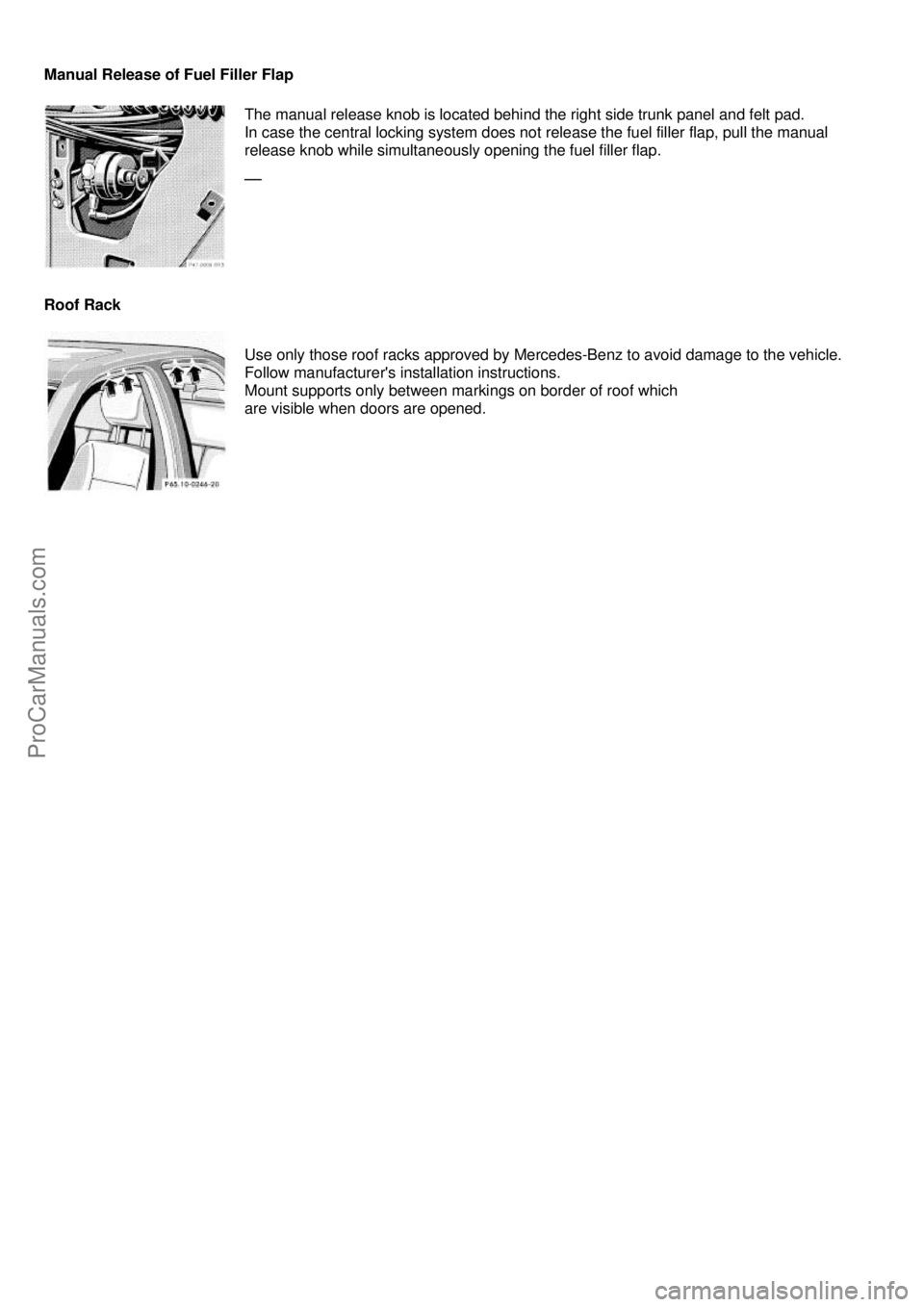
Manual Release of Fuel Filler Flap
The manual release knob is located behind the right side trunk panel and felt pad.
In case the central locking system does not release the fuel filler flap, pull the manual
release knob while simultaneously opening the fuel filler flap.
Roof Rack
Use only those roof racks appr oved by Mercedes-Benz to avoid damage to the vehicle.
Follow manufacturer's installation instructions.
Mount supports only between markings on border of roof which
are visible when doors are opened.
ProCarManuals.com
Page 114 of 122

Fuels, Coolants, Lubricants etc. - Capacities
Vehicle components and their respective lubricants must match Therefore use only brands tested and
recommended by us. Please refer to the Factory Approv ed Service Products pamphlet, or inquire at your
authorized Mercedes-Benz dealer.
Model Capacity Fuels, coolan ts,
lubricants etc
Engine with
oil filter C 230 6.5 US qt (6.2 l)
C 280 8.5US qt 8.0 l)
C 43 AMG 7.9US qt 7.5 l)
Recommended
engine oils
Automatic transmission C 230 7.9 US qt (7.5 l)
C 280 7.9 US qt (7.5 l)
C 43 AMG 9.9 US qt (9.4 l)
Automatic
transmissio
n fluid
Rear axle C 230
C 280 1.2 US qt (1.1 l)
C 43 AMG 1.4 US qt(1.3 l)
Hypoid gear oil SAL
90, 85 W 90
Power steering approx 1.1 US qt (1.0 l)
MB Power steering
fluid
Front wheel hubs
approx. 2.1 oz (60 g) each High temperature
roller bearing grease
Accelerator
control linkage
Hydraulic fluid
Brake system approx. 0.5 US qt (0.5 I) MB Brake fluid (DOT
4)
Windshield washer
and headlamp
cleaning system
approx. 5.3 US qt (5.0 I)
MB Windshield
washe
r
concentrate "S"
1
Cooling system C 220 approx. 10.0 US qt (9.5 I
C 280
C 36 AMG
approx. 10.6 US qt 10.0 I)
approx. 11.8 US qt (11.2 I
MB
Anticorrosion/antifreez
Fuel tank including
a reserve of
approx. 16.4 US gal (62.0 I)
approx. 2.1 US gal (8.0 I)
Premium unleaded
gasoline:
Posted O
c
tane 91
(Avg. of 96 RON/86
MON)
Air conditioner system
R-134a refrigerant
and special
lubricant (Never R-12)
Use MB Windshield Washer Concentrate "S" and water for temperatures above freezing or MB Windshield Washer
Con c
entrate "S" and commercially available premixed windsh ield washer solvent/antifreeze for temperatures below
freezing. Follow suggested mixing ratios, see Windshield/Headlamp Washer System in Index.
ProCarManuals.com
Page 116 of 122

Premium Unleaded Gasoline
Caution !
To maintain the engine's durability and performance, premium unleaded gasoline must be used. If premium unleaded
is not available and low octane fuel is used, follow these precautions:
• have the fuel tank filled only partially with unleaded regular and fill up with premium unleaded as soon as possible,
• avoid full throttle driving and abrupt acceleration,
• do not exceed an engine speed of 3000 rpm, if the vehicle is loaded with a light load such as two
persons and no luggage,
• do not exceed 2/3 of maximum accelerator pedal positi on, if the vehicle is fully loaded or operating
in mountainous terrain.
Fuel Requirements
Use only Premium unleaded meeting ASTM standard D 439: The octane number (posted at the pump) must be 91
min.
It is an average of both the Research (R) octane number an d the Motor (M) octane number: [(R+M)/2]. This is also
known as ANTI-KNOCK INDEX. Unleaded gasoline containing oxygenates such as Ethanol, I PA, IBA and TBA can
be used provided the ratio of any one of these oxygenates to gasoline does not exceed 10%, MTBE not to exceed
15%. The ratio of Methanol to gasoline must not exceed 3% plus additional components. Using mixtures of Ethanol
and Methanol is not allowed. Gasohol, which contains 10% Ethanol and 90% unleaded gasoline, can be used. These
blends must also meet all other fuel requirements such as resistance to spark knock, boiling range, vapor pressure
etc..
Gasoline Additives
A major concern among engine manufacturers is carbon build up caused by gasoline. Mercedes- Benz recommends
the use of only quality gasoline containing additives that prevent the build up of carbon deposits. After an extended
period of using fuels without such additives, carbon deposit s can build up especially on the intake valves and in the
combustion area, leading to engine performance problems such as:
• warm-up hesitation,
• unstable idle,
• knocking/pinging,
• misfire,
• power loss.
Do not blend other specific fuel additives with fuel. They only result in unnecessary cost, and may be harmful to the
engine operation. Damage or malfunctions resulting from poor fuel quality or from blending specific fuel additives are
not covered by the Mercedes-Benz Limited Warranty.
ProCarManuals.com
Page 122 of 122

Check Regularly and Before a Long Trip
The engine compartment of model C 230 is illustrated.
1. Fuel Supply
Open flap by pushing near front (arrow). Turn fuel cap
to the left and hold on to it until possible pressure in tank
has been released, then remove cap.
Failure to remove slowly could result in personal injury.
2. Tire Inflation Pressure
Check at least every two weeks.
For details see Index.
3. Coolant Level
See Adding coolant in Index.
4. Windshield Washer System,
Headlamp Cleaning System
For refilling reservoir see Index.
5. Engine Oil Level
See Index.
6. Brake Fluid
See Index.
Vehicle Lighting: Check function and cleanliness.
For replacement of light bulbs, see Index.
ProCarManuals.com