Page 156 of 216
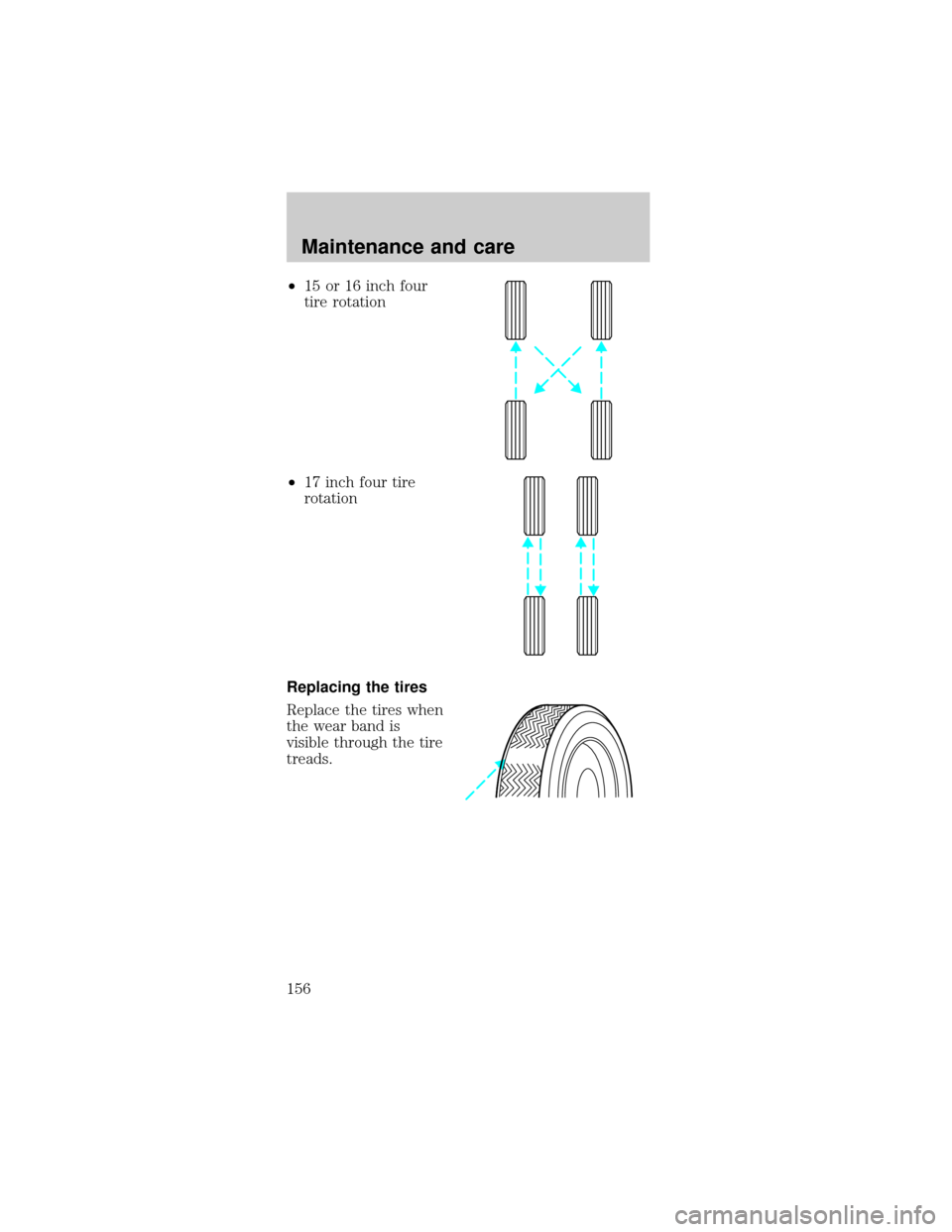
²15 or 16 inch four
tire rotation
²17 inch four tire
rotation
Replacing the tires
Replace the tires when
the wear band is
visible through the tire
treads.
Maintenance and care
156
Page 157 of 216
When replacing full size tires, never mix
radial bias-belted, or bias-type tires. Use
only the tire sizes that are listed on the
Certification Label. Make sure that all tires are the
same size, speed rating, and load-carrying capacity.
Use only the tire combinations recommended on
the label. If you do not follow these precautions,
your vehicle may not drive properly and safely.
Make sure that all replacement tires are of
the same size, type, load-carrying capacity
and tread design (e.g., ªAll Terrainº, etc.), as
originally offered by Ford.
Failure to follow these precautions may
adversely affect the handling of the vehicle
and make it easier for the driver to lose control
and roll over.
Tires that are larger or smaller than your vehicle's
original tires may also affect the accuracy of your
speedometer.
SNOW TIRES AND CHAINS
Driving too fast for conditions creates the
possibility of loss of vehicle control. Driving
at very high speeds for extended periods of time
may result in damage to vehicle components.
Snow tires must be the same size and grade
as the tires you currently have on your
vehicle.
Maintenance and care
157
Page 158 of 216
The tires on your vehicle have all weather treads to
provide traction in rain and snow. However, in some
climates, you may need to use snow tires and
chains. Use chains on the tires only in an emergency
or if the law requires them.
Follow these guidelines when using snow tires and
chains:
²Chains may damage aluminum wheels.
²Use only Cable Type chains with size P225/55R16
or 245/45ZR17 tires. Use of SAE Class S chains
may damage vehicle.
²SAE Class S chains may be used on P205/65R15
tires.
²Install chains securely, verifying that the chains do
not touch any wiring, brake lines or fuel lines.
²Drive cautiously. If you hear the chains rub or
bang against your vehicle, stop and re-tighten the
chains. If this does not work, remove the chains
to prevent damage to your vehicle.
²If possible, avoid fully loading your vehicle.
²Remove the tire chains when they are no longer
needed. Do not use tire chains on dry roads.
²The suspension insulation and bumpers will help
prevent vehicle damage. Do not remove these
components from your vehicle when using snow
tires and chains.
WHAT YOU SHOULD KNOW ABOUT
AUTOMOTIVE FUELS
Important safety precautions
Do not overfill the fuel tank. The pressure in
an overfilled tank may cause leakage and
lead to fuel spray and fire.
Maintenance and care
158
Page 167 of 216

²Combine errands and minimize stop-and-go
driving.
Maintenance
²Keep tires properly inflated and use only
recommended size.
²Operating a vehicle with the wheels out of
alignment will reduce fuel economy.
²Use recommended engine oil. Refer toLubricant
Specifications.
²Perform all regularly scheduled maintenance
items. Follow the recommended maintenance
schedule and owner maintenance checks found in
your vehicle Scheduled Maintenance Guide.
Conditions
²Heavily loading a vehicle or towing a trailer may
reduce fuel economy at any speed.
²Carrying unnecessary weight may reduce fuel
economy (approximately 2 km/h [1 mpg] is lost
for every 180 kg [400 lb] of weight carried).
²Adding certain accessories to your vehicle (for
example bug deflectors, rollover/light bars,
running boards, ski/luggage racks) may reduce
fuel economy.
²Using fuel blended with alcohol may lower fuel
economy.
²Fuel economy may decrease with lower
temperatures during the first 12±16 km (8±10
miles) of driving.
²Driving on flat terrain offers improved fuel
economy as compared to driving on hilly terrain.
²Transmissions give their best fuel economy when
operated in the top cruise gear and with steady
pressure on the gas pedal.
²Close windows for high speed driving.
Maintenance and care
167
Page 211 of 216

Power distribution box
(see Fuses) ............. 117
Power door locks ...... 51
Power steering .......... 96
fluid, checking
and adding ............ 144
fluid, refill
capacity ................. 183
fluid,
specifications . 185,188
Radio .......................... 21
Relays ...................... 113
Remote entry
system ................... 56,58
illuminated entry .... 58
locking/unlocking
doors ........................ 57
opening the trunk ... 58
panic alarm ............. 58
replacement/
additional
transmitters ............. 59
replacing the
batteries .................. 59
Roadside
emergencies ......... 60,62
Safety belts (see
Safety restraints) ...... 11
68,69,70,71,72
Safety Compliance
Certification Label .. 190
Safety defects,
reporting .................. 206
Safety restraints ... 68,69
70,71,72
cleaning the safety
belts .................. 73,181
extension
assembly .................. 72
for adults .. 69,70,71,72
for children ........ 79,80warning light and
chime .......... 7,11,72,73
Safety seats
for children ................ 81
Seat belts (see Safety
restraints) .................. 68
Seats .......................... 64
child safety seats .... 81
cleaning ................. 180
Seats-easy access/
easyout feature ......... 67
Servicing your
vehicle ...................... 130
Spark plugs,
specifications .... 182,188
Special notice .............. 3
Specification chart,
lubricants .......... 185,188
Speed control ............ 46
Speedometer ............. 13
Starting your
vehicle .............. 87,88,90
jump starting ........ 123
preparing to start
your vehicle ....... 60,62
Steering wheel
tilting ....................... 46
Tachometer ............... 14
Tilt steering wheel .... 46
Tires .... 119,153,154,155
changing ......... 119,120
checking the
pressure ................. 155
replacing ................ 156
rotating .................. 155
snow tires
and chains ............. 157
tire grades ............. 154
treadwear .............. 154
Towing
trailer towing ........ 108
wrecker .................. 128
Index
211