Page 121 of 216
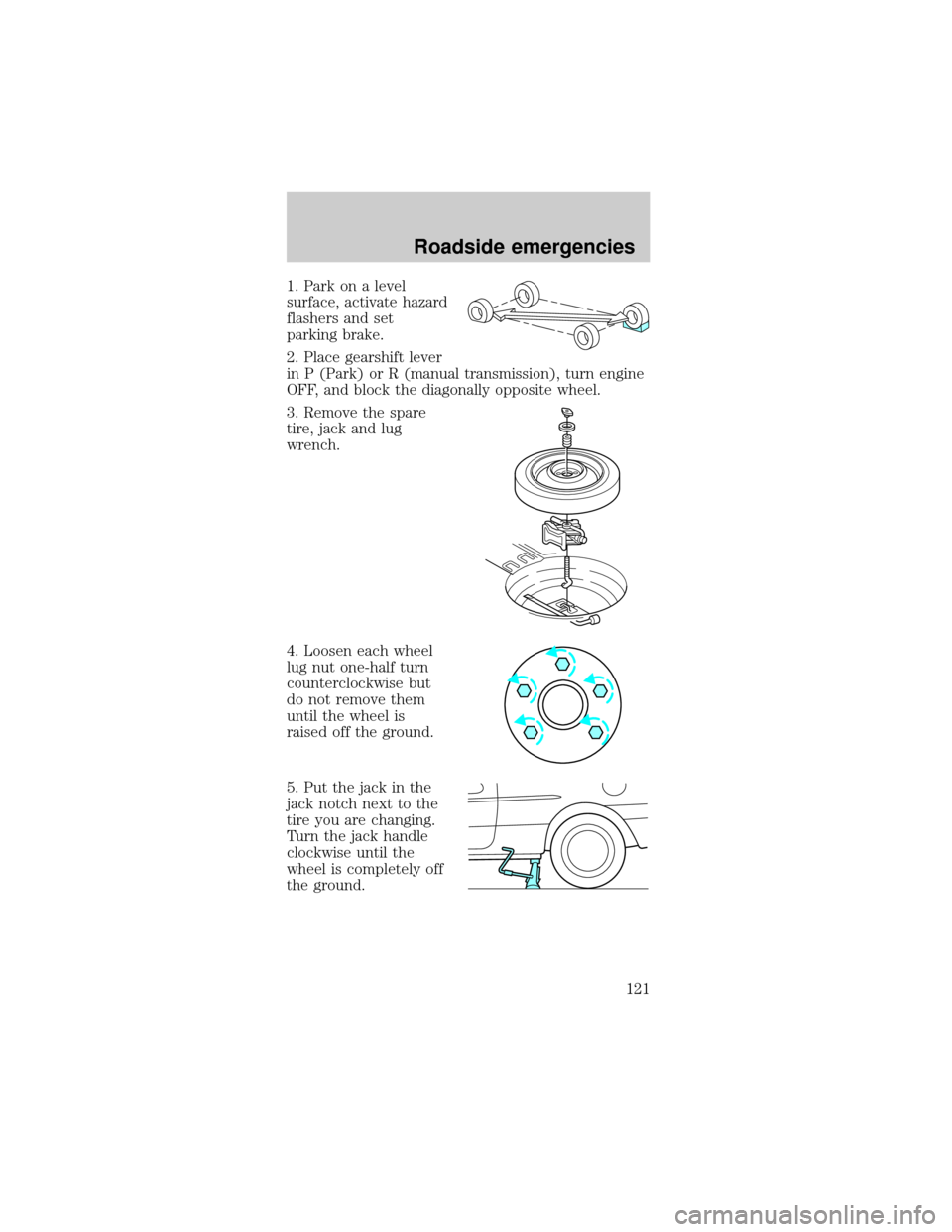
1. Park on a level
surface, activate hazard
flashers and set
parking brake.
2. Place gearshift lever
in P (Park) or R (manual transmission), turn engine
OFF, and block the diagonally opposite wheel.
3. Remove the spare
tire, jack and lug
wrench.
4. Loosen each wheel
lug nut one-half turn
counterclockwise but
do not remove them
until the wheel is
raised off the ground.
5. Put the jack in the
jack notch next to the
tire you are changing.
Turn the jack handle
clockwise until the
wheel is completely off
the ground.
Roadside emergencies
121
Page 122 of 216
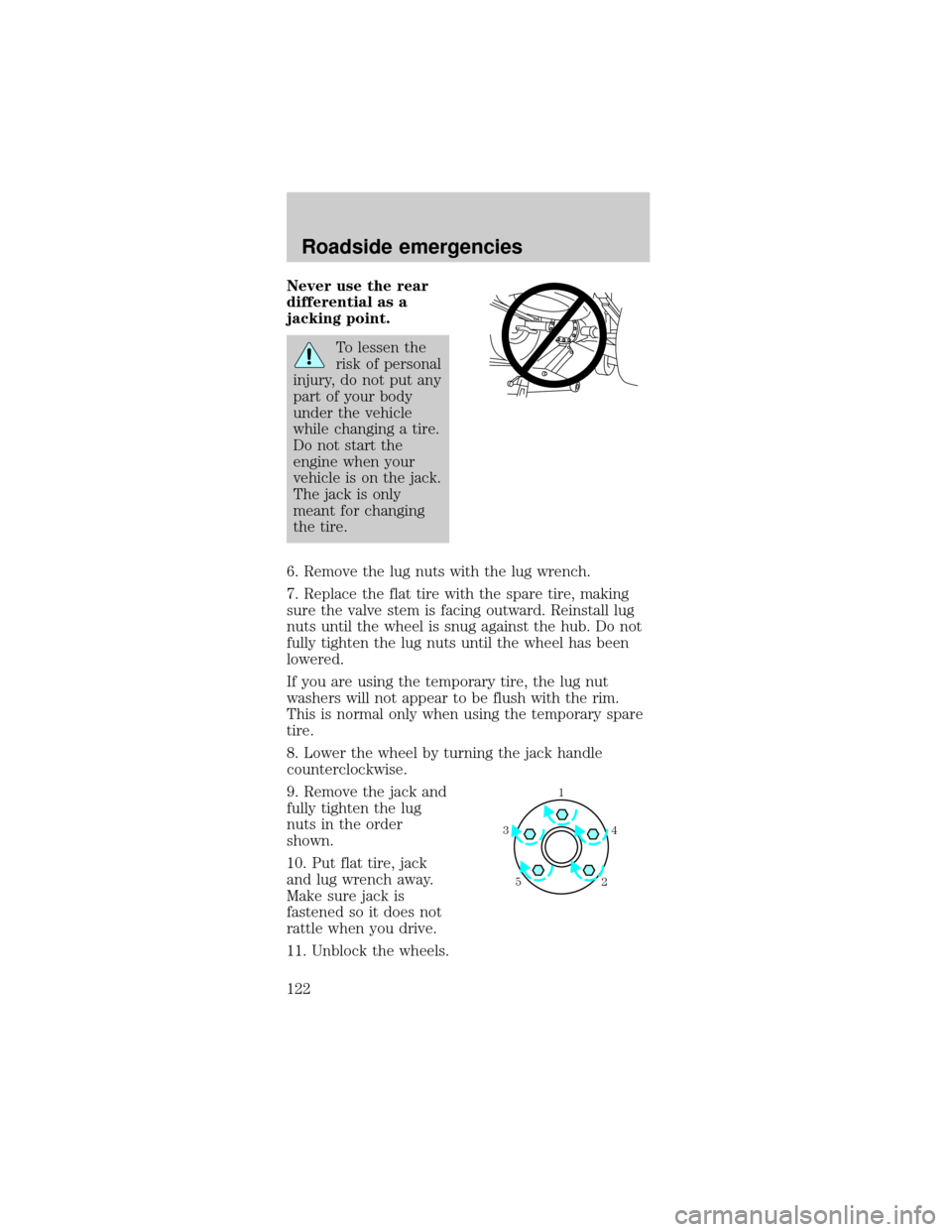
Never use the rear
differential as a
jacking point.
To lessen the
risk of personal
injury, do not put any
part of your body
under the vehicle
while changing a tire.
Do not start the
engine when your
vehicle is on the jack.
The jack is only
meant for changing
the tire.
6. Remove the lug nuts with the lug wrench.
7. Replace the flat tire with the spare tire, making
sure the valve stem is facing outward. Reinstall lug
nuts until the wheel is snug against the hub. Do not
fully tighten the lug nuts until the wheel has been
lowered.
If you are using the temporary tire, the lug nut
washers will not appear to be flush with the rim.
This is normal only when using the temporary spare
tire.
8. Lower the wheel by turning the jack handle
counterclockwise.
9. Remove the jack and
fully tighten the lug
nuts in the order
shown.
10. Put flat tire, jack
and lug wrench away.
Make sure jack is
fastened so it does not
rattle when you drive.
11. Unblock the wheels.
1
4 3
52
Roadside emergencies
122
Page 123 of 216
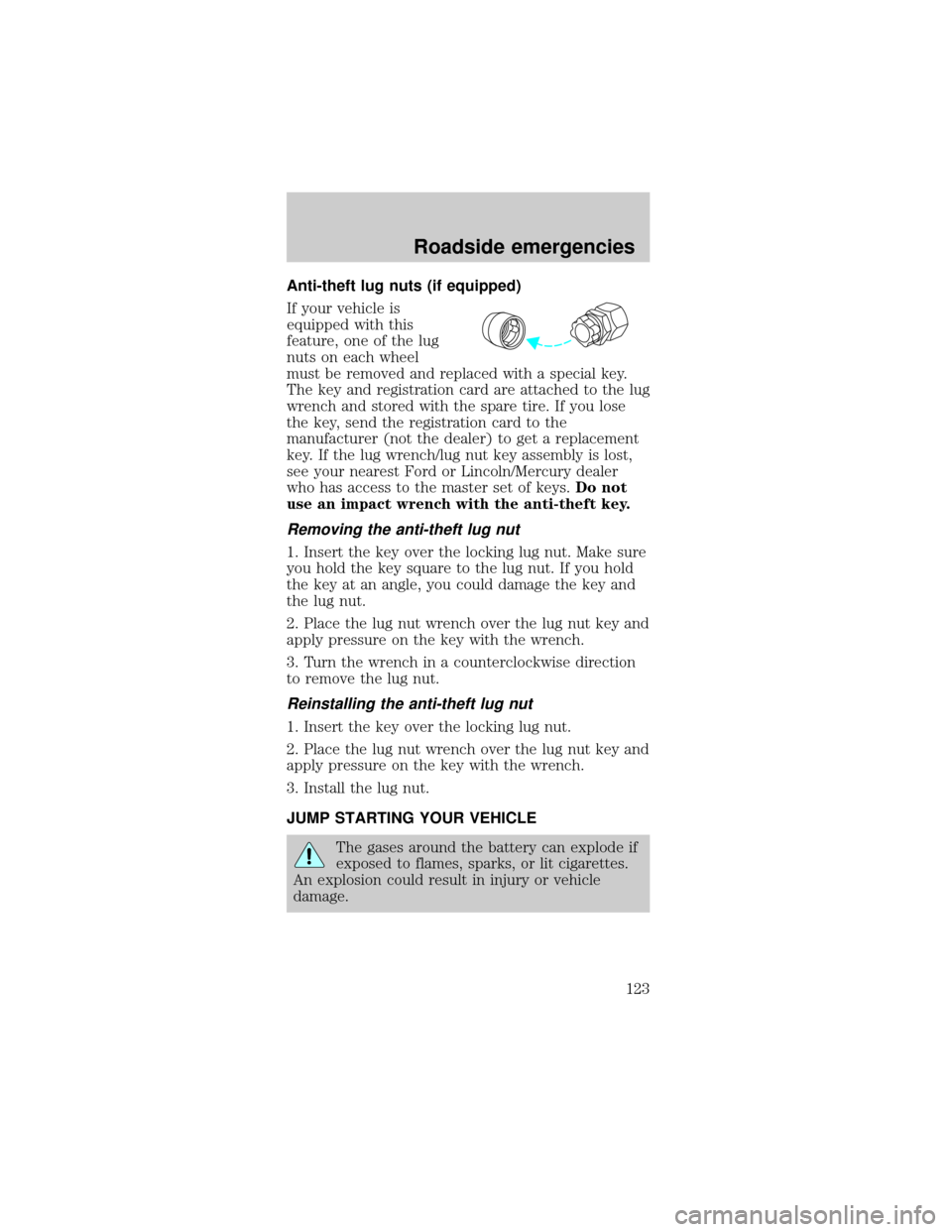
Anti-theft lug nuts (if equipped)
If your vehicle is
equipped with this
feature, one of the lug
nuts on each wheel
must be removed and replaced with a special key.
The key and registration card are attached to the lug
wrench and stored with the spare tire. If you lose
the key, send the registration card to the
manufacturer (not the dealer) to get a replacement
key. If the lug wrench/lug nut key assembly is lost,
see your nearest Ford or Lincoln/Mercury dealer
who has access to the master set of keys.Do not
use an impact wrench with the anti-theft key.
Removing the anti-theft lug nut
1. Insert the key over the locking lug nut. Make sure
you hold the key square to the lug nut. If you hold
the key at an angle, you could damage the key and
the lug nut.
2. Place the lug nut wrench over the lug nut key and
apply pressure on the key with the wrench.
3. Turn the wrench in a counterclockwise direction
to remove the lug nut.
Reinstalling the anti-theft lug nut
1. Insert the key over the locking lug nut.
2. Place the lug nut wrench over the lug nut key and
apply pressure on the key with the wrench.
3. Install the lug nut.
JUMP STARTING YOUR VEHICLE
The gases around the battery can explode if
exposed to flames, sparks, or lit cigarettes.
An explosion could result in injury or vehicle
damage.
Roadside emergencies
123
Page 136 of 216
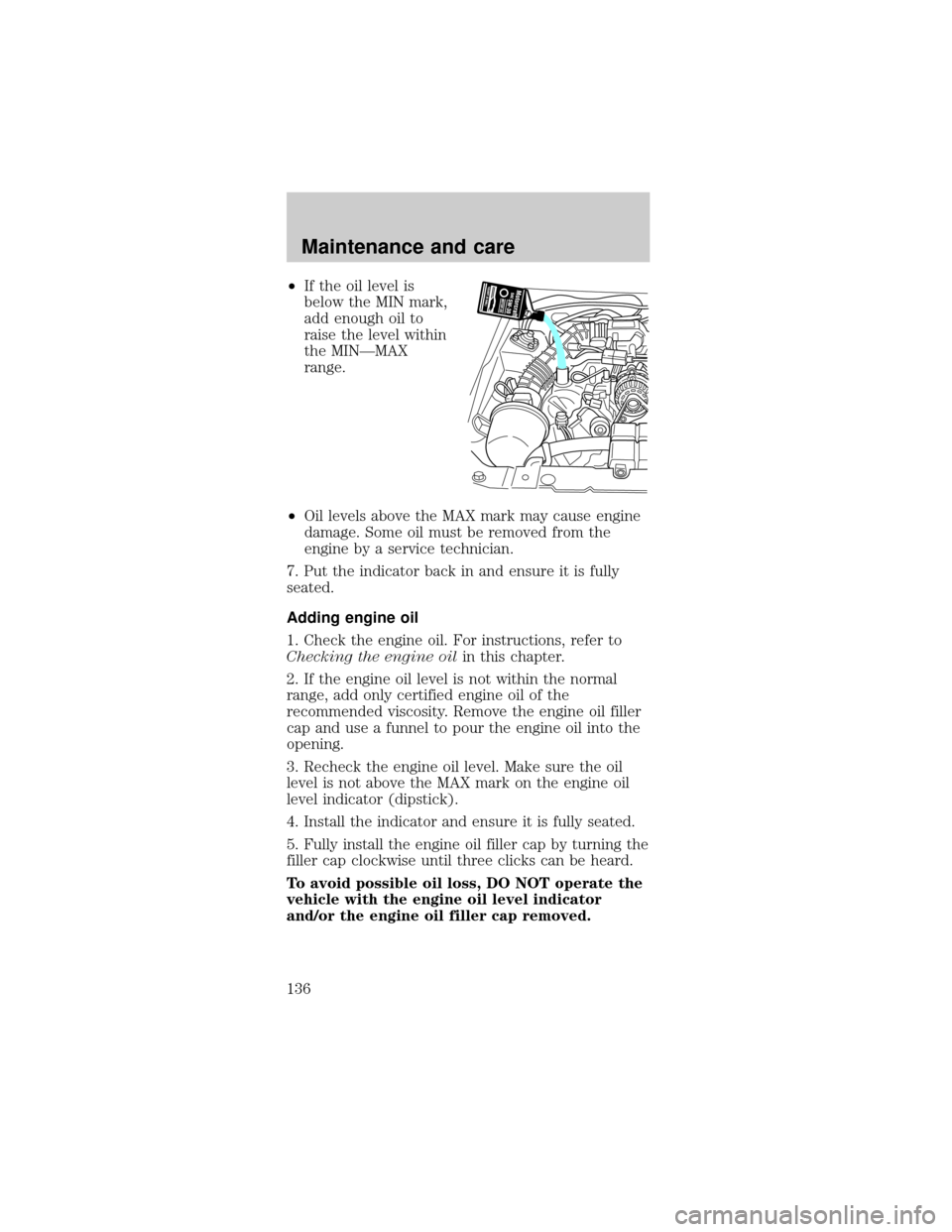
²If the oil level is
below the MIN mark,
add enough oil to
raise the level within
the MINÐMAX
range.
²Oil levels above the MAX mark may cause engine
damage. Some oil must be removed from the
engine by a service technician.
7. Put the indicator back in and ensure it is fully
seated.
Adding engine oil
1. Check the engine oil. For instructions, refer to
Checking the engine oilin this chapter.
2. If the engine oil level is not within the normal
range, add only certified engine oil of the
recommended viscosity. Remove the engine oil filler
cap and use a funnel to pour the engine oil into the
opening.
3. Recheck the engine oil level. Make sure the oil
level is not above the MAX mark on the engine oil
level indicator (dipstick).
4. Install the indicator and ensure it is fully seated.
5. Fully install the engine oil filler cap by turning the
filler cap clockwise until three clicks can be heard.
To avoid possible oil loss, DO NOT operate the
vehicle with the engine oil level indicator
and/or the engine oil filler cap removed.
Maintenance and care
136
Page 143 of 216
Plain water may be added in an emergency, but you
mustreplace it with a 50/50 mixture of coolant and
distilled water as soon as possible.
Check the coolant level in the coolant reservoir the
next few times you drive the vehicle. If necessary,
add enough of a 50/50 mixture of coolant and
distilled water to bring the liquid level to the fill line
on the reservoir.
Never remove the coolant reservoir cap
while the engine is running or hot.
If you must remove the coolant reservoir cap, follow
these steps to avoid personal injury:
1. Before you remove the cap, turn the engine off
and let it cool.
2. When the engine is cool, wrap a thick cloth
around the cap. Slowly turn cap counterclockwise
until pressure begins to release.
3. Step back while the pressure releases.
4. When you are sure that all the pressure has been
released, use the cloth to turn it counterclockwise
and remove the cap.
Change your engine coolant according to the
appropriate schedule listed in the Scheduled
Maintenance Guide.
Recycled engine coolant
Ford Motor Company recommends that Ford and
Lincoln-Mercury dealers use recycled engine coolant
produced by Ford-approved processes.
Not all coolant recycling processes produce coolant
which meets Ford specification ESE-M97B44±A, and
use of such coolant may harm engine and cooling
system components.
Maintenance and care
143
Page 152 of 216

4. The relearning process will automatically
complete as you drive the vehicle.
²The vehicle may need to be driven 16 km (10
miles) or more to relearn the idle and fuel trim
strategy.
²If you do not allow the engine to relearn its idle
trim, the idle quality of your vehicle may be
adversely affected until the idle trim is eventually
relearned.
If the battery has been disconnected or a new
battery has been installed, the clock and the preset
radio stations must be reset once the battery is
reconnected.
²Always dispose of
automotive batteries
in a responsible
manner. Follow your
local authorized
standards for
disposal. Call your
local authorized
recycling center to find out more about recycling
automotive batteries.
WINDSHIELD WIPER BLADES
Check the wiper blades at least twice a year or when
they seem less effective. Substances such as tree sap
and some hot wax treatments used by commercial
car washes reduce the effectiveness of wiper blades.
Checking the wiper blades
If the wiper blades do not wipe properly, clean both
the windshield and wiper blades using undiluted
windshield wiper solution or a mild detergent. Rinse
thoroughly with clean water. To avoid damaging the
blades, do not use fuel, kerosene, paint thinner or
other solvents.
LEAD
RETURN
RECYCLE
Maintenance and care
152
Page 161 of 216
²Keep the fuel pump nozzle in contact with the
fuel container while filling.
²DO NOT use a device that would hold the fuel
pump handle in the fill position.
Fuel Filler Cap
Your fuel tank filler cap has an indexed design with
a 1/8 turn on/off feature.
When fueling your vehicle:
1. Turn the engine off.
2. Carefully turn the filler cap counterclockwise 1/8
of a turn until it stops.
3. Pull to remove the cap from the fuel filler pipe.
4. To install the cap, align the tabs on the cap with
the notches on the filler pipe.
5. Turn the filler cap clockwise 1/8 of a turn until it
stops.
If the ªService Engine Soon/Check Engineº indicator
comes on and stays on when you start the engine,
the fuel filler cap may not be properly installed.
Turn off the engine, remove the fuel filler cap, align
the cap properly and reinstall it.
If you must replace the fuel filler cap, replace
it with a fuel filler cap that is designed for
your vehicle. The customer warranty may be
void for any damage to the fuel tank or fuel
system if the correct genuine Ford or
Motorcraft fuel filler cap is not used.
The fuel system may be under pressure. If
the fuel filler cap is venting vapor or if you
hear a hissing sound, wait until it stops before
completely removing the fuel filler cap. Otherwise,
fuel may spray out and injure you or others.
Maintenance and care
161
Page 171 of 216
Replacing headlamp bulbs
Handle a halogen headlamp bulb carefully
and keep out of children's reach. Grasp the
bulb only by its plastic base and do not touch the
glass. The oil from your hand could cause the bulb
to break the next time the headlamps are
operated.
To remove the headlamp bulb:
1. Make sure headlamp switch is in OFF position,
then open the hood.
2. At the back of the
headlamp, pull two
retainer pins up to
release the headlamp
assembly.
3. Pull headlamp
assembly forward
disengaging the lamp
from the rear hidden snap retainers to expose the
back of the bulb.
4. Release clip and
disconnect the
electrical connector
from the bulb.
5. Remove the bulb
retaining ring by
rotating it
counterclockwise
(when viewed from the
rear) about
1¤4turn to
free it from the bulb socket, and slide the ring off
the plastic base. Keep the ring to retain the new
bulb.
6. Without turning, remove the old bulb from the
lamp assembly by gently pulling it straight out of the
lamp assembly.
Maintenance and care
171