Page 155 of 200
Your vehicle was not designed to use fuel or fuel additives with metallic
compounds, including manganese-based compounds containing MMT.
Repairs to correct the effects of using a fuel for which your vehicle was
not designed may not be covered by your warranty.
Octane recommendations
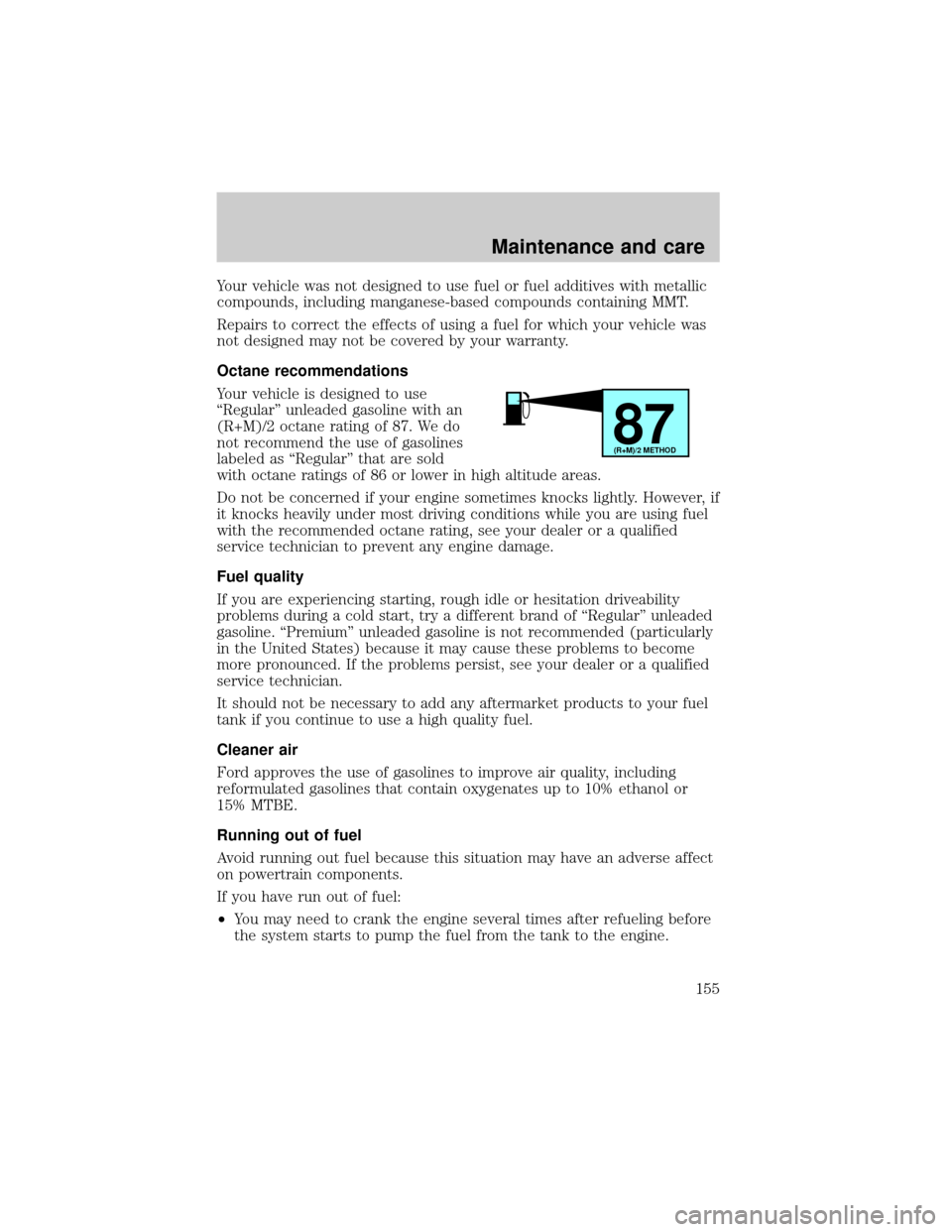
Your vehicle is designed to use
ªRegularº unleaded gasoline with an
(R+M)/2 octane rating of 87. We do
not recommend the use of gasolines
labeled as ªRegularº that are sold
with octane ratings of 86 or lower in high altitude areas.
Do not be concerned if your engine sometimes knocks lightly. However, if
it knocks heavily under most driving conditions while you are using fuel
with the recommended octane rating, see your dealer or a qualified
service technician to prevent any engine damage.
Fuel quality
If you are experiencing starting, rough idle or hesitation driveability
problems during a cold start, try a different brand of ªRegularº unleaded
gasoline. ªPremiumº unleaded gasoline is not recommended (particularly
in the United States) because it may cause these problems to become
more pronounced. If the problems persist, see your dealer or a qualified
service technician.
It should not be necessary to add any aftermarket products to your fuel
tank if you continue to use a high quality fuel.
Cleaner air
Ford approves the use of gasolines to improve air quality, including
reformulated gasolines that contain oxygenates up to 10% ethanol or
15% MTBE.
Running out of fuel
Avoid running out fuel because this situation may have an adverse affect
on powertrain components.
If you have run out of fuel:
²You may need to crank the engine several times after refueling before
the system starts to pump the fuel from the tank to the engine.
87(R+M)/2 METHOD
Maintenance and care
155
Page 157 of 200

²Allow three automatic click-offs when filling.
²Always use fuel with the recommended octane rating.
²Use a known quality gasoline, preferably a national brand.
²Use the same side of the same pump and have the vehicle facing the
same direction each time you fill up.
²Have the vehicle loading and distribution the same every time.
Your results will be most accurate if your filling method is consistent.
Calculating fuel economy
1. Fill the fuel tank completely and record the initial odometer reading
(in kilometers or miles).
2. Each time you fill the tank, record the amount of fuel added (in liters
or gallons).
3. After at least three to five tank fill-ups, fill the fuel tank and record
the current odometer reading.
4. Subtract your initial odometer reading from the current odometer
reading.
5. Follow one of the simple calculations in order to determine fuel
economy:
Multiply liters used by 100, then divide by total kilometers
traveled.
Divide total miles traveled by total gallons used.
Keep a record for at least one month and record the type of driving (city
or highway). This will provide an accurate estimate of the vehicle's fuel
economy under current driving conditions. Additionally, keeping records
during summer and winter will show how temperature impacts fuel
economy. In general, lower temperatures give lower fuel economy.
Driving style Ð good driving and fuel economy habits
Give consideration to the lists that follow and you may be able to change
a number of variables and improve your fuel economy.
Habits
²Smooth, moderate operation can yield up to 10% savings in fuel.
²Steady speeds without stopping will usually give the best fuel
economy.
Maintenance and care
157
Page 195 of 200

Getting the
service you need ....................183
Ordering additional
owner's literature ...................192
The Dispute Settlement
Board .......................................184
Defrost
rear window ..............................42
Dipstick
engine oil .................................130
Driving under special
conditions
through water .........................102
Emergencies, roadside
jump-starting ..........................117
Emission control system ..........159
Engine .................................176,177
check engine/
service engine soon light ...........7
coolant .....................................137
idle speed control ...................144
lubrication
specifications ...................175,176
refill capacities ........................174
service points ...................129,130
starting after a collision .........105
Engine block heater ...................87
Engine oil ..................................130
checking and adding .......130,132
dipstick ....................................130
filter, specifications .........133,174
recommendations ...................133
refill capacities .................130,174
specifications .....130,133,175,176
Exhaust fumes ............................87
Floor mats ...................................54
Fluid capacities .........................174
Foglamps .....................................44
Fuel ............................................152
calculating fuel economy .......156
cap ...........................................154
capacity ...................................174choosing the right fuel ...........154
comparisons with EPA fuel
economy estimates .................159
detergent in fuel .....................155
filling your vehicle
with fuel ....................152,154,156
filter, specifications .........156,174
fuel pump
shut-off switch ...................54,105
gauge .........................................12
improving fuel economy ........156
low fuel warning light ................7
octane rating .............155,176,177
quality ......................................155
running out of fuel .................155
safety information relating to
automotive fuels .....................152
Fuses ..........................................107
Gas cap (see Fuel cap) ............154
Gas mileage
(see Fuel economy) .................156
Gauges .........................................11
engine coolant
temperature gauge ...................12
fuel gauge ..................................12
odometer ...................................13
speedometer .............................13
tachometer ................................13
trip odometer ............................13
GAWR
(Gross Axle Weight Rating) .....100
definition .................................100
driving with a heavy load ......100
location ....................................100
GVWR (Gross
Vehicle Weight Rating) .............100
calculating ...............................100
definition .................................100
driving with a heavy load ......100
location ....................................100
Hazard flashers .........................105
Head restraints ...........................61
Index
195