1999 DODGE RAM Map sensor
[x] Cancel search: Map sensorPage 2 of 1691

"B" ABBREVIATION TABLE
"B" ABBREVIATION TABLE
ABBREVIATION DEFINITION B/P Backpressure BAC By-Pass Air Control BAP Barometric Absolute Pressure Sensor BARO Barometric BBDC Before Bottom Dead Center BCM Body Control Module BDC Bottom Dead Center BHP Brake Horsepower BLK Black BLU Blue BMAP Barometric & Manifold Absolute Pressure
Sensor BOO Brake On-Off Switch BP Barometric Pressure sensor BPS Barometric Pressure sensor BPT Backpressure Transducer BRN Brown BTDC Before Top Dead Center BTU British Thermal Unit BVSV Bimetallic Switching Valve Baro. Barometric Batt. Battery Bbl. Barrel (Example:4-Bbl.) Blst. Ballast Blwr. Blower Brkr. Breaker
"C" ABBREVIATION TABLE
"C" ABBREVIATION TABLE
ABBREVIATION DEFINITION C Celsius (Degrees) C(3) Computer Controlled Coil Ignition C(4) Computer Controlled Catalytic Converter CANP Canister Purge solenoid CARB California Air Resources Board CAT Catalytic Converter CB Circuit Breaker CBD Closed Bowl Distributor CBVV Carburetor Bowl Vent valve cc Cubic Centimeter CCC Computer Command Control CCD Computer Controlled Dwell CCM Central Control Module CCO Converter Clutch Override CCOT Cycling Clutch Orifice Tube CCW Counterclockwise CDI Capacitor Discharge Ignition CEC Computerized Engine Control CFI Central Fuel Injection CID Cubic Inch Displacement CID Cylinder Identification sensor CIS Continuous Injection System CIS-E Continuous Injection System-Electronic
Page 7 of 1691

"M" ABBREVIATION TABLE
"M" ABBREVIATION TABLE
ABBREVIATION DEFINITION mA Milliamps mV Millivolts mfd. Microfarads Mm Millimeters M/T Manual Transaxle or Transmission MA PFI Mass MA or MAF Mass Airflow MAF Mass Air Flow Sensor MAFS Mass Airflow System MAP Manifold Absolute Pressure Sensor MAT Manifold Air Temperature MCU Microprocessor Control Unit MCV Mixture Control Valve MEM-CAL Memory Calibration Chip MFI Multiport Fuel Injection MIL Malfunction Incicator Light MLP Manual Lever Position MPFI Multi Point Fuel Injection MPH Miles Per Hour MPI Multi-Point (Fuel ) Injection Man. Manual Mech. Mechanical Mem. Memory Mtr. Motor
"N" ABBREVIATION TABLE
"N" ABBREVIATION TABLE
ABBREVIATION DEFINITION N.m Newton-Meter NA Not Available NDS Neutral Drive Switch NGS Neutral gear Switch NOx Oxides of Nitrogen NPS Neutral Pressure Switch No. Number Nos. Numbers
"O" ABBREVIATION TABLE
"O" ABBREVIATION TABLE
ABBREVIATION DEFINITION O Oxygen O.D. Outside Diameter O/S Oversize O2 Oxygen OC Oxidation Catalyst OCC Output Circuit Check OD Overdrive ODO Odometer
Page 53 of 1691

HEATER HOSES
HIGH PRESSURE RELIEF VALVES (HPRV)
IDLERS
IN-LINE FILTERS
METAL FITTINGS
METAL LINES
MIX AND AIR CONTROL DOORS (BLEND DOORS)
O-RINGS
ORIFICE TUBES
PILOT-OPERATED ABSOLUTES (POAS)
PLENUMS
PRESSURE CONTROL VALVES
PRESSURE SENSORS
PULLEYS
RADIATORS
RECEIVER-DRIERS
REFRIGERANT
REFRIGERANT OIL
RELAYS
SEALS
SERVICE PORTS
SPRING LOCK COUPLINGS
SUCTION THROTTLING VALVES (STVS)
SWITCHES (ELECTRICAL)
TENSIONERS
THERMISTORS AND PRESSURE SENSORS
THERMOSTATS AND HOUSINGS
VACUUM HOSES AND TUBES
VACUUM RESERVOIRS
VACUUM TUBES
VALVES IN RECEIVER (VIRS)
WATER PUMPS (ELECTRIC AUXILIARY)
WIRING HARNESSES AND CONNECTORS
MOTORIST ASSURANCE PROGRAM (MAP)
OVERVIEW
The Motorist Assurance Program is the consumer outreach
effort of the Automotive Maintenance and Repair Association, Inc.
(AMRA). Participation in the Motorist Assurance Program is drawn from
retailers, suppliers, independent repair facilities, vehicle
manufacturers and industry associations.
Our organization's mission is to strengthen the relationship
between the consumer and the auto repair industry. We produce
materials that give motorists the information and encouragement to
take greater responsibility for their vehicles-through proper,
manufacturer-recommended, maintenance. We encourage participating
service and repair shops (including franchisees and dealers) to adopt
(1) a Pledge of Assurance to their Customers and (2) the Motorist
Assurance Program Standards of Service. All participating service
providers have agreed to subscribe to this Pledge and to adhere to the
promulgated Standards of Service demonstrating to their customers that
they are serious about customer satisfaction.
These Standards of Service require that an inspection of the
vehicle's (problem) system be made and the results communicated to the\
customer according to industry standards. Given that the industry did
not have such standards, the Motorist Assurance Program successfully
promulgated industry inspection communication standards in 1994-95 for
the following systems: Exhaust, Brakes, ABS, Steering and Suspension,
Engine Maintenance and Performance, HVAC, and Electrical Systems.
Further, revisions to all of these inspection communication standards
Page 167 of 1691

2) Disconnect vacuum line at PCV valve located in valve
cover. Install .185" fixed orifice Air Metering Fitting (6714) into
disconnected vacuum line in place of PCV valve.
3) Disconnect purge vacuum hose from passenger's side front
corner of throttle body, next to MAP sensor. Place cap on vacuum hose
fitting on throttle body.
4) Connect scan tool to Data Link Connector (DLC) located
below driver's side of instrument panel, near steering column. See
Fig. 1, 2 or 3.
5) Start engine and warm engine to normal operating
temperature. Using scan tool manufacturer's instructions, select
SYSTEM TEST and then access the MINIMUM AIRFLOW display on scan tool.
When accessed, scan tool will count down to stabilize idle RPM and
display minimum airflow idle RPM. Minimum airflow idle RPM should be
500-900 RPM.
6) Shut engine off. If minimum airflow idle RPM is correct,
throttle body is okay. Go to next step. If minimum airflow idle RPM is
not within specification, using approved cleaner, clean throttle body
and recheck minimum airflow idle RPM. If correct minimum airflow idle
RPM cannot be obtained, replace throttle body. Go to next step.
7) Remove air metering fitting. Reinstall vacuum hoses as
necessary. Reinstall air duct on throttle body. Remove scan tool.
Ram Pickup 8.0L
Throttle body minimum airflow cannot be checked on this
application.
THROTTLE POSITION SENSOR
NOTE: Throttle Position (TP) sensor is nonadjustable. Use following\
procedure to check TP sensor calibration. For complete
testing of TP sensor and wiring circuit, see SELF-DIAGNOSTICS
- JEEP, TRUCKS & RWD VANS article.
Dakota, Ram Pickup, Ram Van & Ram Wagon
1) Remove components for access to electrical connector at TP
sensor mounted on throttle body. With electrical connector installed
on TP sensor, turn ignition on with engine off. DO NOT start engine.
2) Using digital volt-ohmmeter, measure voltage at center
terminal on electrical connector for TP sensor with throttle valve
closed (idle position). Voltage should be greater than .35 volt, but
less than .90 volt.
3) Slowly open throttle to full throttle and note voltage
reading. Voltage should smoothly increase to less than 4.50 volts.
Replace TP sensor if voltage is not within specification.
Page 320 of 1691

SHOE HARDWARE
SHOES
SOCKETS
SPEED SENSORS (ELECTRONIC WHEEL AND VEHICLE)
STEEL BRAKE LINES
STOPLIGHT SWITCHES
SWITCHES
TIRES
TOOTHED RINGS (TONE WHEEL)
VACUUM BOOSTERS
VACUUM HOSES
VALVES
WHEEL ATTACHING HARDWARE
WHEEL BEARINGS, RACES AND SEALS
WHEEL CYLINDERS
WIRING HARNESSES
INTRODUCTION TO MOTORIST ASSURANCE PROGRAM (MAP)
OVERVIEW OF MOTORIST ASSURANCE PROGRAM
The Motorist Assurance Program is the consumer outreach
effort of the Automotive Maintenance and Repair Association, Inc.
(AMRA). Participation in the Motorist Assurance Program is drawn from
retailers, suppliers, independent repair facilities, vehicle
manufacturers and industry associations.
Our organization's mission is to strengthen the relationship
between the consumer and the auto repair industry. We produce
materials that give motorists the information and encouragement to
take greater responsibility for their vehicles-through proper,
manufacturer-recommended, maintenance. We encourage participating
service and repair shops (including franchisees and dealers) to adopt:\
1) a Pledge of Assurance to their Customers and
2) the Motorist Assurance Program Standards of Service.
All participating service providers have agreed to subscribe
to this Pledge and to adhere to the promulgated Standards of Service
demonstrating to their customers that they are serious about customer
satisfaction.
These Standards of Service require that an inspection of the
vehicle's (problem) system be made and the results communicated to the\
customer according to industry standards. Given that the industry did
not have such standards, the Motorist Assurance Program successfully
promulgated industry inspection communication standards in 1994-95 for
the following systems: Exhaust, Brakes, ABS, Steering and Suspension,
Engine Maintenance and Performance, HVAC, and Electrical Systems.
Further, revisions to all of these inspection communication standards
are continually re-published. In addition to these, standards for
Drive Train and Transmissions have recently been promulgated.
Participating shops utilize these Uniform Inspection & Communication
Standards as part of the inspection process and for communicating
their findings to their customers.
The Motorist Assurance Program continues to work
cooperatively and proactively with government agencies and consumer
groups toward solutions that both benefit the customer and are
mutually acceptable to both regulators and industry. We maintain the
belief that industry must retain control over how we conduct our
business, and we must be viewed as part of the solution and not part
of the problem. Meetings with state and other government officials
(and their representatives), concerned with auto repair and/or
consumer protection, are conducted. Feedback from these sessions is
brought back to the association, and the program adjusted as needed.
To assure auto repair customers recourse if they were not
Page 472 of 1691

VEHICLE SPEED SENSORS
VENTS
VIBRATION DAMPERS
WHEEL ATTACHMENT HARDWARE
WHEEL SPEED SENSORS
WIRING HARNESSES AND CONNECTORS
YOKES AND SLIP YOKES
INTRODUCTION TO MOTORIST ASSURANCE PROGRAM (MAP)
OVERVIEW OF MOTORIST ASSURANCE PROGRAM
The Motorist Assurance Program is the consumer outreach
effort of the Automotive Maintenance and Repair Association, Inc.
(AMRA). Participation in the Motorist Assurance Program is drawn from
retailers, suppliers, independent repair facilities, vehicle
manufacturers and industry associations.
Our organization's mission is to strengthen the relationship
between the consumer and the auto repair industry. We produce
materials that give motorists the information and encouragement to
take greater responsibility for their vehicles-through proper,
manufacturer-recommended, maintenance. We encourage participating
service and repair shops (including franchisees and dealers) to adopt
(1) a Pledge of Assurance to their Customers and (2) the Motorist
Assurance Program Standards of Service. All participating service
providers have agreed to subscribe to this Pledge and to adhere to the
promulgated Standards of Service demonstrating to their customers that
they are serious about customer satisfaction.
These Standards of Service require that an inspection of the
vehicle's (problem) system be made and the results communicated to the\
customer according to industry standards. Given that the industry did
not have such standards, the Motorist Assurance Program successfully
promulgated industry inspection communication standards in 1994-95 for
the following systems: Exhaust, Brakes, ABS, Steering and Suspension,
Engine Maintenance and Performance, HVAC, and Electrical Systems.
Further, revisions to all of these inspection were recently published.
Further, revisions to all of these inspection communication standards
are continually republished. In addition to these, standards for Drive
Train and Transmissions have recently been promulgated. Participating
shops utilize these Uniform Inspection & Communication Standards as
part of the inspection process and for communicating their findings to
their customers.
The Motorist Assurance Program continues to work
cooperatively and proactively with government agencies and consumer
groups toward solutions that both benefit the customer and are
mutually acceptable to both regulators and industry. We maintain the
belief that industry must retain control over how we conduct our
business, and we must be viewed as part of the solution and not part
of the problem. Meetings with state and other government officials
(and their representatives), concerned with auto repair and/or
consumer protection, are conducted. Feedback from these sessions is
brought back to the association, and the program adjusted as needed.
To assure auto repair customers recourse if they were not
satisfied with a repair transaction, the Motorist Assurance Program
offers mediation and arbitration through MAP/BBB-CARE and other non-
profit organizations. MAP conducted pilot programs in twelve states
before announcing the program nationally in October, 1998. During the
pilots, participating repair shops demonstrated their adherence to the
Pledge and Standards and agreed to follow the UICS in communicating
the results of their inspection to their customers. To put some
"teeth" in the program, an accreditation requirement for shops was
initiated. The requirements are stringent, and a self-policing method
Page 528 of 1691
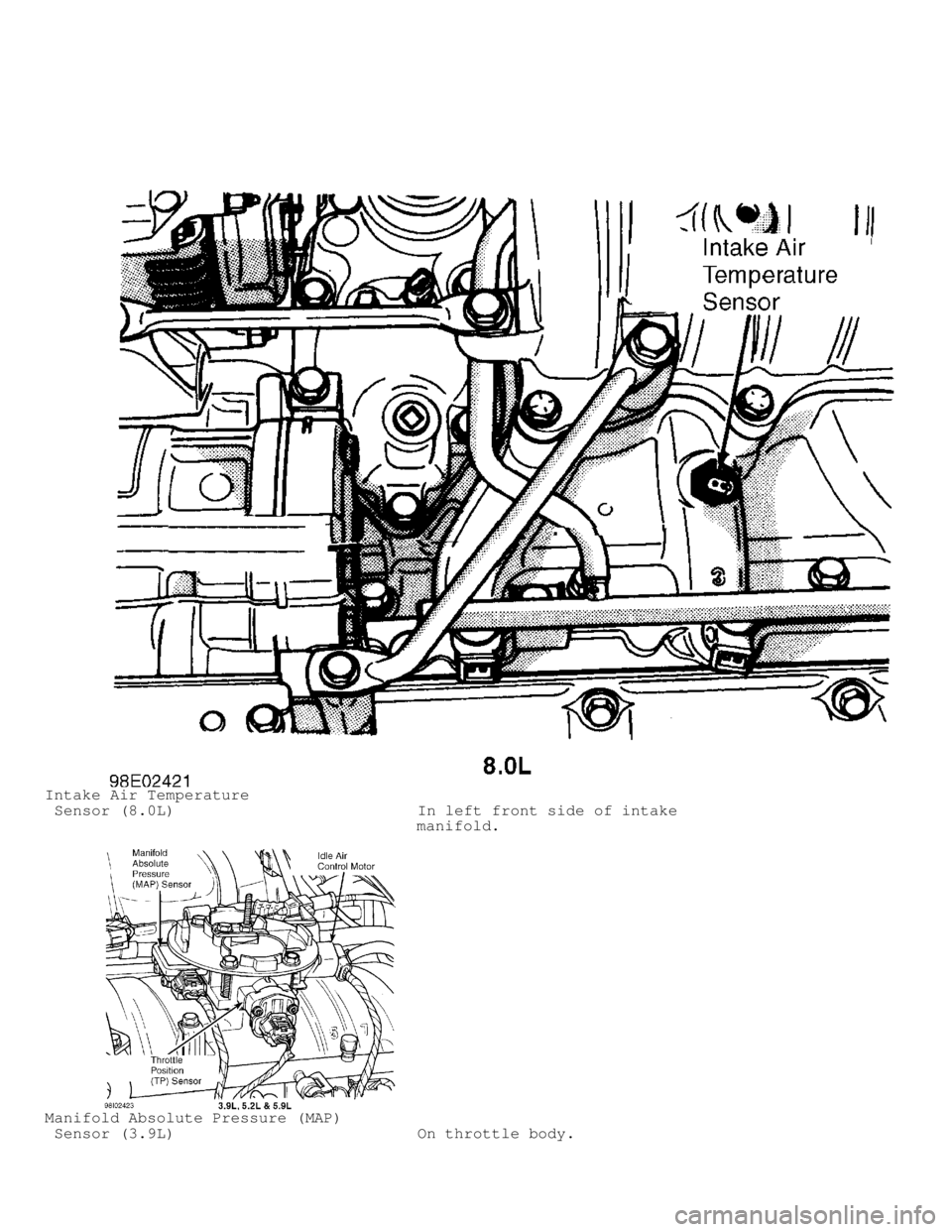
Intake Air Temperature
Sensor (8.0L) In left front side of intake
manifold.
Manifold Absolute Pressure (MAP)
Sensor (3.9L) On throttle body.
Page 529 of 1691
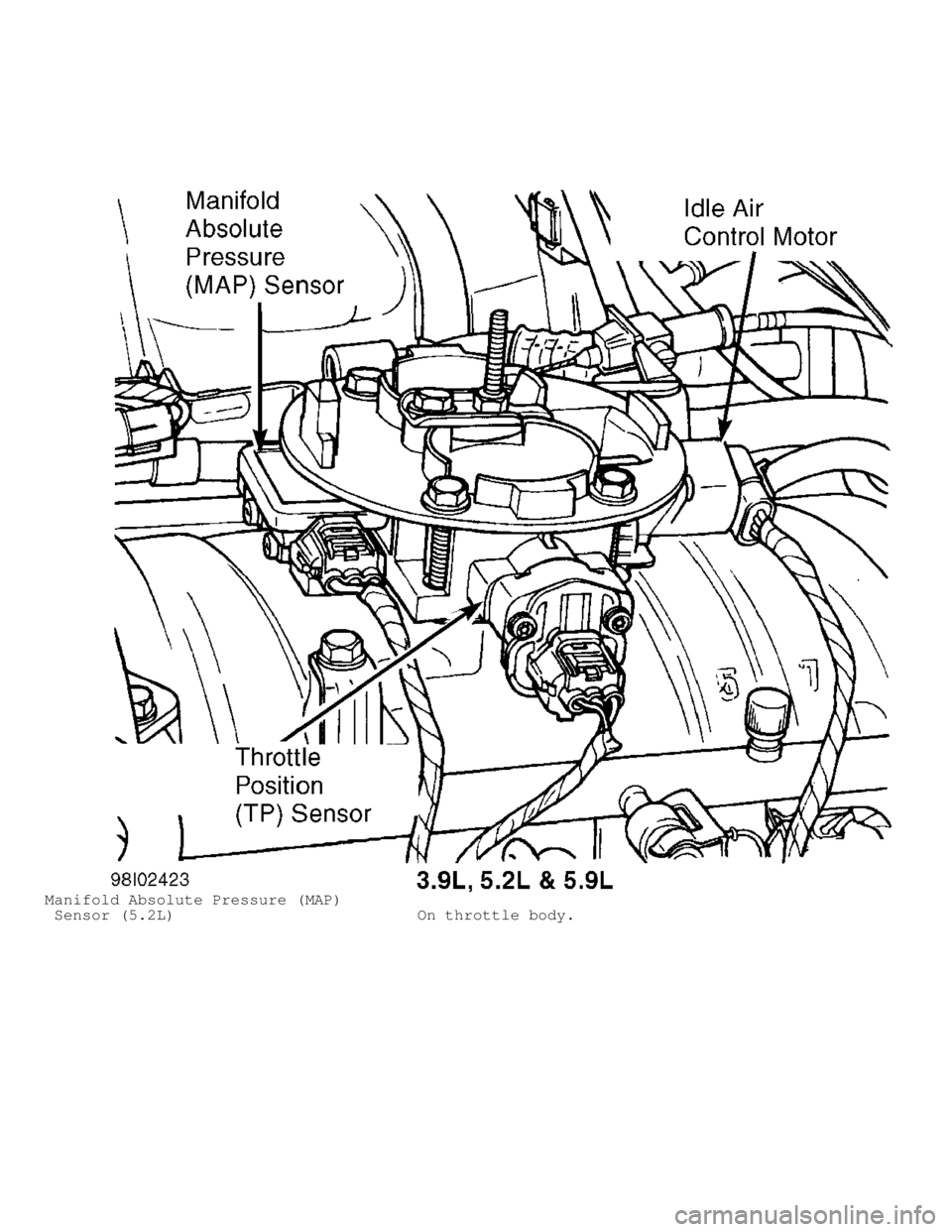
Manifold Absolute Pressure (MAP)
Sensor (5.2L) On throttle body.