1999 DODGE RAM ECU
[x] Cancel search: ECUPage 213 of 1691
For Vehicle Theft Security System (VTSS) testing procedures,
see appropriate BODY CONTROL COMPUTER TESTS article.
REMOVAL & INSTALLATION
CENTRAL TIMER MODULE (CTM)
NOTE: Before removing Central Timer Module (CTM), use scan tool to
view settings for programmable features. Use these settings
to program replacement CTM.
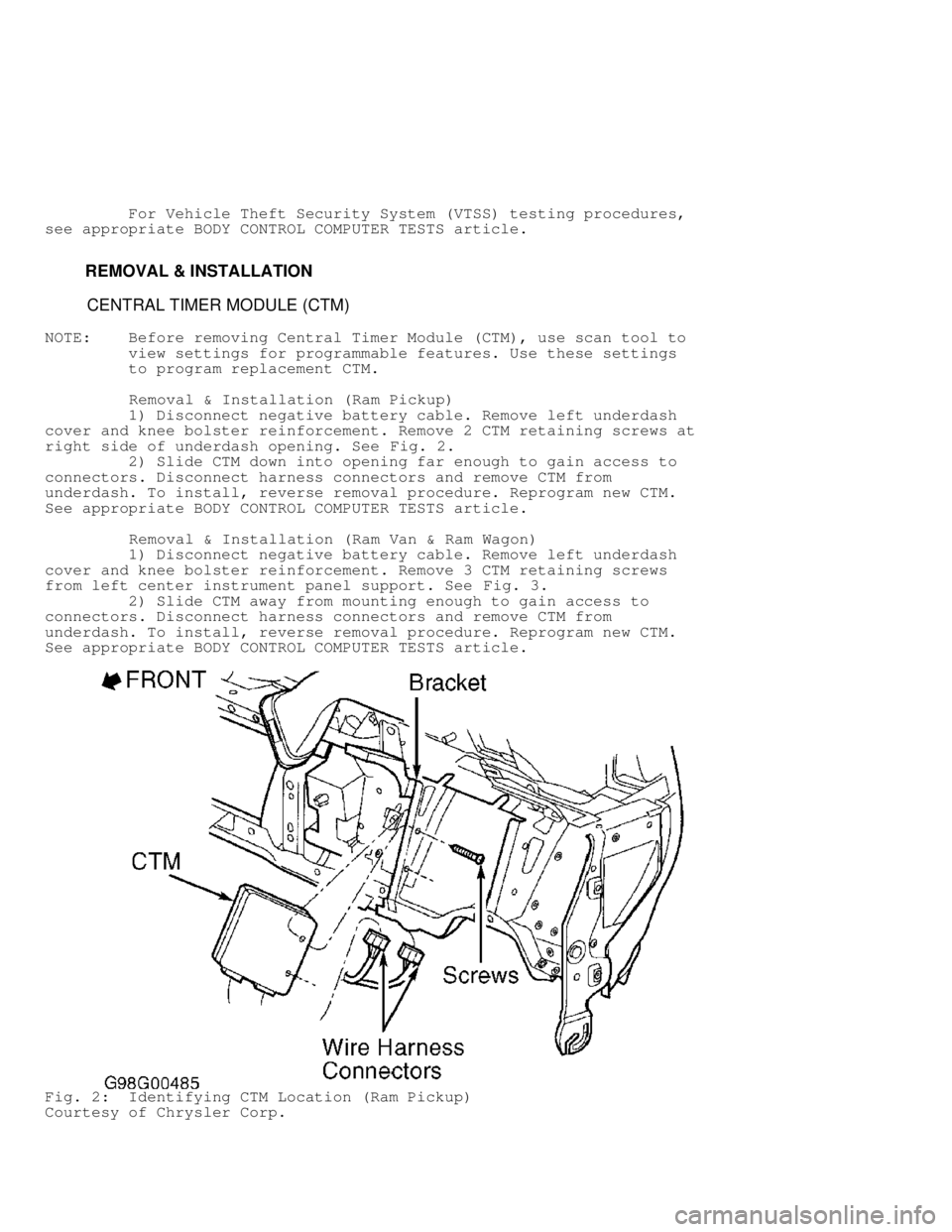
Removal & Installation (Ram Pickup)
1) Disconnect negative battery cable. Remove left underdash
cover and knee bolster reinforcement. Remove 2 CTM retaining screws at
right side of underdash opening. See Fig. 2.
2) Slide CTM down into opening far enough to gain access to
connectors. Disconnect harness connectors and remove CTM from
underdash. To install, reverse removal procedure. Reprogram new CTM.
See appropriate BODY CONTROL COMPUTER TESTS article.
Removal & Installation (Ram Van & Ram Wagon)
1) Disconnect negative battery cable. Remove left underdash
cover and knee bolster reinforcement. Remove 3 CTM retaining screws
from left center instrument panel support. See Fig. 3.
2) Slide CTM away from mounting enough to gain access to
connectors. Disconnect harness connectors and remove CTM from
underdash. To install, reverse removal procedure. Reprogram new CTM.
See appropriate BODY CONTROL COMPUTER TESTS article.
Fig. 2: Identifying CTM Location (Ram Pickup)
Courtesy of Chrysler Corp.
Page 235 of 1691

problem is found, measure resistance between output speed sensor
terminals. If resistance is 300-1200 ohms, go to next step. If
resistance is not as specified, replace output speed sensor.
7) Reconnect output speed sensor. Measure resistance between
ground and output speed sensor ground circuit at PCM harness
connector. If resistance is greater than 5 ohms, go to next step. If
resistance is not as specified, repair output speed sensor ground
circuit for a short to ground.
8) Measure resistance between ground and output speed sensor
signal circuit at PCM harness connector. If resistance is less than 5
ohms, repair output speed sensor signal circuit for a short to ground.
If resistance is not as specified, go to next step.
9) Measure resistance between output speed sensor signal
circuit and ground circuit at PCM harness connector. If resistance is
300-1200 ohms, replace PCM. If resistance is not as specified, go to
next step.
10) Disconnect output speed sensor harness connector. Measure
resistance of output speed sensor signal circuit between output speed
sensor harness connector and PCM harness connector. If resistance is
greater than 5 ohms, repair open in output speed sensor signal
circuit. If resistance is not as specified, repair open in output
speed sensor ground circuit.
11) Turn ignition on. Measure voltage between ground and
speed sensor ground circuit at PCM harness connector. Place gearshift
lever in each gear position and record voltage at each position. If
voltage is greater than one volt in any gear position, repair speed
sensor ground circuit for a short to power. If voltage is not as
specified, go to next step.
12) Raise and support vehicle. Start engine. Place gearshift
lever in "OD" position. Release brakes and allow wheels to rotate.
Using scan tool, monitor output speed sensor. While monitoring output
speed sensor, wiggle harness between output speed sensor and PCM. If
reading dropped towards zero while wiggling harness, repair
intermittent short or open in harness. If reading does not drop
towards zero while wiggling harness, problem is intermittent. See
INACTIVE DTC CONDITION under SELF-DIAGNOSTIC SYSTEM. Testing is
complete.
DTC P0740: TORQ CONV CLU, NO RPM DROP AT LOCKUP
Circuit Description
Circuit is monitored continuously while key is on, and gear
selector is not in Park or Neutral. Code sets if Torque Converter
Clutch (TCC) does not achieve desired drop in RPM when TCC solenoid is\
near maximum duty cycle. A bad test 3 consecutive times is required to
set code.
Possible Causes
* Misfire trouble code set.
* Vehicle stalls (faulty TCC solenoid).
* TCC shaft seal/seal defective.
* Transmission fluid contaminated.
* TCC solenoid wiring harness defective.
* TCC defective.
* TCC hydraulic circuit damaged.
Diagnostic Procedure
1) Using scan tool, read DTCs. On all bodies except AB and WJ
bodies, go to next step. On AB and WJ bodies, if DTC SPECIFIC GOOD
TRIPS counter is not displayed or displayed count is not "0", go to
step 10). If DTC SPECIFIC GOOD TRIPS counter is displayed and
displayed count is "0", indicating DTC still exists, go to next step.
Page 267 of 1691

6) Disconnect PNP switch harness connector. Measure
resistance of PNP switch sense circuit between Black PCM harness
connector C1 and PNP switch harness connector. If resistance is less
than 5 ohms, replace PNP switch. If resistance is not as specified,
repair open in PNP switch sense circuit.
7) Conditions required to set DTC P1899 are not present at
this time. Using scan tool, check and record FREEZE FRAME data. Ensure
"CAUSED BY DTC" "P" code matches code on DTC screen. Using wiring
diagram as a guide, inspect wiring and connectors. Repair wiring
harness as necessary. If wiring and connectors are okay, does not
reset, see INACTIVE DTC CONDITION under SELF-DIAGNOSTIC SYSTEM.
Testing is complete.
TEST VER-2A (EXCEPT DIESEL)
NOTE: If Powertrain Control Module (PCM) is replaced, correct
vehicle mileage and Vehicle Identification Number (VIN) must
be programmed into PCM to prevent Diagnostic Trouble Codes
(DTCs) from being set in Anti-Lock Brake System (ABS) modul\
e
and Supplemental Restraint System (SRS) module. To program
PCM and clear DTCs from ABS and SRS modules, proceed to
appropriate procedure listed below. On models equipped with a
Smart Key Immobilizer Module (SKIM), if replacing Powertrain
Control Module (PCM), secret key data must also be updated to\
enable engine starting. To update secret key data, proceed to
appropriate procedure listed below.
Procedure For Programming PCM & Clearing DTCs From ABS & SRS
Modules
Connect scan tool to Data Link Connector (DLC). Using scan
tool, enter correct VIN and mileage into PCM. Using scan tool
manufacturer's instructions, clear DTCs from ABS and SRS modules. Go
to step 1)).
Procedure For Updating Secret Key Data
Connect scan tool to Data Link Connector (DLC). Go to ENGINE
and then MISC menus on scan tool. Place SKIM in SECURED ACCESS MODE by
using appropriate Personal Identification Number (PIN) for this
vehicle. PIN may be obtained from owner, vehicle's invoice, or from
manufacturer. Select UPDATE THE SECRET KEY DATA. Data will be
transferred from Smart Key Immobilizer Module (SKIM) to PCM. Go to
step 1)).
1) Inspect vehicle to ensure all engine components are
connected. Reassemble and reconnect components as necessary. If test
is being performed after performing a NO TROUBLE CODE (NTC) test, go
to next step. If test is being performed after performing an OBD-II
TROUBLE CODE test, perform TEST VER-5A. If test is being performed
after any other TROUBLE CODE test, go to step 3).
2) Check if initial symptom still exists. If initial or
another symptom exists, repair is not complete. Check for Technical
Service Bulletins (TSBs) that apply to symptom and see appropriate
TEST NTC-1A: NO TROUBLE CODE TEST MENU in ENGINE PERFORMANCE, or
appropriate TROUBLE SHOOTING - NO CODES article in ENGINE PERFORMANCE
for diagnosis by symptom. If initial symptom no longer exists, test is
complete. Go to step 8).
3) If any DTCs have not been diagnosed, perform appropriate
test(s) see appropriate SELF-DIAGNOSTIC TESTS in ENGINE PERFORMANCE.
If all DTCs have been diagnosed and repaired, go to next step.
4) If Powertrain Control Module (PCM) has not been replaced,\
use scan tool to clear DTCs from PCM. Using scan tool, reset all
values in adaptive memory. To ensure no other DTCs remain, go to next
step.
Page 268 of 1691

5) If PCM has not been replaced, and TEST VER-2A is being
performed after an A/C relay control circuit DTC test, ensure A/C is
on and go to next step.
6) Road test vehicle for at least 5 minutes. Road test
vehicle at a speed of at least 40 MPH at some point during road test.
Stop vehicle. Turn engine off for at least 10 seconds. Start engine
and continue road test. Ensure transmission shifts through all gears.
After road test, turn engine off and go to next step.
7) Using scan tool, read DTCs. If any DTC returns, perform
appropriate test(s). If no DTCs return, test is complete. Go to next
step.
8) Turn ignition on, with engine off. Using scan tool, erase
DTCs. Turn ignition off. Disconnect scan tool. Test is complete.
TEST VER-2A (DIESEL)
NOTE: If Accelerator Pedal Position Sensor (APPS), battery, Engine
Control Module (ECM) or Powertrain Control Module (PCM) has\
been disconnected or replaced, APPS must be reprogrammed and
correct vehicle mileage and Vehicle Identification Number
(VIN) must be programmed into PCM to prevent Diagnostic
Trouble Codes (DTCs) from being set in Anti-Lock Brake System\
(ABS) module and Supplemental Restraint System (SRS) module\
.
To program PCM and clear DTCs from ABS and SRS modules,
proceed to appropriate procedure listed below. On models
equipped with a Smart Key Immobilizer Module (SKIM), if
replacing Powertrain Control Module (PCM), secret key data
must also be updated to enable engine starting. To update
secret key data, proceed to appropriate procedure listed
below.
CAUTION: DO NOT attempt to adjust screws or disassemble APPS. Settings
are preset at factory and are not intended to by changed.
Procedure For Programming APPS
Reassemble all components. Turn ignition switch to ON or RUN
position without starting engine. Slowly press accelerator pedal to
floor once and slowly release. This procedure programs APPS
calibration in ECM. Go to step 1)).
Procedure For Programming PCM & Clearing DTCs From ABS & SRS
Modules
Connect scan tool to Data Link Connector (DLC). Using scan
tool, enter correct VIN and mileage into PCM. Using scan tool
manufacturer's instructions, clear DTCs from ABS and SRS modules. Go
to step 1)).
Procedure For Updating Secret Key Data
Connect scan tool to Data Link Connector (DLC). Go to ENGINE
and then MISC menus on scan tool. Place SKIM in SECURED ACCESS MODE by
using appropriate Personal Identification Number (PIN) for this
vehicle. PIN may be obtained from owner, vehicle's invoice, or from
manufacturer. Select UPDATE THE SECRET KEY DATA. Data will be
transferred from Smart Key Immobilizer Module (SKIM) to PCM. Go to
step 1)).
1) If PCM has not been replaced, and TEST VER-2A (DIESEL) is\
being performed after a No Trouble Code (NTC) test, inspect vehicle to\
ensure all engine components are connected. Reassemble and reconnect
components as necessary. Check if initial symptom still exists. If
initial symptom exists, check for Technical Service Bulletins (TSBs)
that apply to vehicle and see TEST NTC-1A: NO TROUBLE CODE TEST MENU
in ENGINE PERFORMANCE, or appropriate TROUBLE SHOOTING - NO CODES
Page 269 of 1691
.
2) If PCM has not been replaced, and TEST VER-2A (DIESEL) is\
be")
article in ENGINE PERFORMANCE for diagnosis by symptom. If initial
symptom no longer exists, test is complete. Go to step 6).
2) If PCM has not been replaced, and TEST VER-2A (DIESEL) is\
being performed after a DTC test, inspect vehicle to ensure all engine
components are connected. Reassemble and reconnect components as
necessary. Using scan tool, erase DTCs, reset all memory values and go
to step 4).
3) If PCM has not been replaced, and TEST VER-2A (DIESEL) is\
being performed after an A/C relay control circuit DTC test, ensure
A/C is on and go to next step.
4) Road test vehicle for at least 5 minutes. Road test
vehicle at a speed of at least 40 MPH at some point during road test.
Stop vehicle. Turn engine off for at least 10 seconds. Start engine
and continue road test. Ensure transmission shifts through all gears.
After road test, turn engine off and go to next step.
5) Using scan tool, read DTCs. If any DTC returns, perform
appropriate test(s). If no DTCs return, test is complete. Go to next
step.
6) Turn ignition on, with engine off. Using scan tool, erase
DTCs. Turn ignition off. Disconnect scan tool. Test is complete.
TEST VER-5A (EXCEPT DIESEL)
NOTE: If Powertrain Control Module (PCM) is replaced, correct
vehicle mileage and Vehicle Identification Number (VIN) must
be programmed into PCM to prevent Diagnostic Trouble Codes
(DTCs) from being set in Anti-Lock Brake System (ABS) modul\
e
and Supplemental Restraint System (SRS) module. To program
PCM and clear DTCs from ABS and SRS modules, proceed to
appropriate procedure listed below. On models equipped with a
Smart Key Immobilizer Module (SKIM), if replacing Powertrain
Control Module (PCM), secret key data must also be updated to\
enable engine starting. To update secret key data, proceed to
appropriate procedure listed below.
Procedure For Programming PCM & Clearing DTCs From ABS & SRS
Modules
Connect scan tool to Data Link Connector (DLC). Using scan
tool, enter correct VIN and mileage into PCM. Using scan tool
manufacturer's instructions, clear DTCs from ABS and SRS modules. Go
to step 1)).
Procedure For Updating Secret Key Data
Connect scan tool to Data Link Connector (DLC). Go to ENGINE
and then MISC menus on scan tool. Place SKIM in SECURED ACCESS MODE by
using appropriate Personal Identification Number (PIN) for this
vehicle. PIN may be obtained from owner, vehicle's invoice, or from
manufacturer. Select UPDATE THE SECRET KEY DATA. Data will be
transferred from Smart Key Immobilizer Module (SKIM) to PCM. Go to
step 1)).
1) Inspect vehicle to ensure all engine components are
connected. Reassemble and reconnect components as necessary. If any
DTCs have not been diagnosed, return to appropriate test(s). If all
DTCs have been diagnosed and repaired, go to next step.
2) Connect scan tool to Data Link Connector (DLC) if not
previously done. Ensure fuel tank is at least 1/4 full. Ensure A/C is
off. Go to next step.
3) Proper way to ensure DTC is repaired is to allow
Powertrain Control Module (PCM) to run monitor. Monitor operation may
be observed on scan tool. All specified enabling conditions for
specified DTC must be met before PCM will operate monitor. Go to next
step.
Page 270 of 1691

4) Using scan tool, monitor pretest enabling conditions until
all conditions have been met. Once all enabling conditions are met,
observe appropriate monitor for DTC on scan tool. If repaired DTC has
reset or is seen on monitor while on road test, repair is not
complete. Check for related Technical Service Bulletins (TSBs) and
return to appropriate test. If no DTCs return, test is complete. Go to
step 6).
5) If another DTC exists, return to appropriate test(s). If
no DTCs return, test is complete. Go to next step.
6) Turn ignition on, with engine off. Using scan tool, erase
DTCs. Turn ignition off. Disconnect scan tool. Test is complete.
TEST VER-5A (DIESEL)
NOTE: If Accelerator Pedal Position Sensor (APPS), battery, Engine
Control Module (ECM) or Powertrain Control Module (PCM) has\
been disconnected or replaced, APPS must be reprogrammed and
correct vehicle mileage and Vehicle Identification Number
(VIN) must be programmed into PCM to prevent Diagnostic
Trouble Codes (DTCs) from being set in Anti-Lock Brake System\
(ABS) module and Supplemental Restraint System (SRS) module\
.
To program PCM and clear DTCs from ABS and SRS modules,
proceed to appropriate procedure listed below. On models
equipped with a Smart Key Immobilizer Module (SKIM), if
replacing Powertrain Control Module (PCM), secret key data
must also be updated to enable engine starting. To update
secret key data, proceed to appropriate procedure listed
below.
CAUTION: DO NOT attempt to adjust screws or disassemble APPS. Settings
are preset at factory and are not intended to by changed.
Procedure For Programming APPS
Reassemble all components. Turn ignition switch to ON or RUN
position without starting engine. Slowly press accelerator pedal to
floor once and slowly release. This procedure programs APPS
calibration in ECM. Go to step 1)).
Procedure For Programming PCM & Clearing DTCs From ABS & SRS
Modules
Connect scan tool to Data Link Connector (DLC). Using scan
tool, enter correct VIN and mileage into PCM. Using scan tool
manufacturer's instructions, clear DTCs from ABS and SRS modules. Go
to step 1)).
Procedure For Updating Secret Key Data
Connect scan tool to Data Link Connector (DLC). Go to ENGINE
and then MISC menus on scan tool. Place SKIM in SECURED ACCESS MODE by
using appropriate Personal Identification Number (PIN) for this
vehicle. PIN may be obtained from owner, vehicle's invoice, or from
manufacturer. Select UPDATE THE SECRET KEY DATA. Data will be
transferred from Smart Key Immobilizer Module (SKIM) to PCM. Go to
step 1)).
1) If PCM has not been replaced, inspect vehicle to ensure
all engine components are connected. Reassemble and reconnect
components as necessary. If any DTCs have not been diagnosed, return
to appropriate test(s). If all DTCs have been diagnosed and repaired,
go to next step.
2) Ensure fuel tank is at least 1/4 full. Ensure A/C is off.
Proper way to ensure DTC is repaired is to connect scan tool to Data
Link Connector (DLC) and allow Powertrain Control Module (PCM) to ru\
n
a DTC SPECIFIC GOOD TRIP COUNTER for 2 minutes. If DTC SPECIFIC GOOD
Page 290 of 1691

outlet port. See Fig. 7. Start engine. Outlet pressure should not be
more 5 psi (0.4 kg/cm) less than inlet pressure. If pressure drop is
more than 5 psi (0.4 kg/cm), replace fuel filter and retest pressure.
If pressure drop is less than 5 psi (0.4 kg/cm), check for fuel
supply restriction.
NOTE: Due to very small vacuum specifications, use a scan tool and
Periphal Expansion Port (PEP) module with 0-15 psi transducer\
to perform following test.
Fuel Supply Restriction Test
Ensure transfer pump pressure is okay. Disconnect fuel supply
line at fuel transfer pump inlet. Remove plastic clip from pump inlet
and install in end of fuel supply line. Install 3/8" Adapter Hose
(6631) between fuel supply line and pump inlet. Install transducer
from PEP module to "T" fitting on adapter. Connect scan tool to
module. Start engine. Check vacuum reading with engine at full
throttle with no load. If vacuum reading is less than 6 in. Hg, check
for fuel supply air leaks. If vacuum reading is 6 in. Hg or more,
check fuel line for damage, dents and kinks. Repair as necessary. If
no problem is found, remove fuel module from fuel tank and check for
obstructions. Repair as necessary.
NOTE: A 3' section of 1/4" I.D. clear tubing and a 1/8" NPT fitting
are required for the following test.
Fuel Supply Air Leak Test
Clean area around filter inlet fitting plug, then remove
plug. See Fig. 7. Install 1/8" NPT fitting with 1/4" nipple fitting in
test port. Attach clear hose with a clamp to fitting. Place other end
of hose in a fuel container. Turn ignition switch to START position,
then release to RUN position without starting engine. Fuel transfer
pump should run for 25 seconds. After hose has been purged, watch for
any air bubbles in hose. If no bubbles exist, system is okay. If
bubbles exist, check fuel line, fittings and fuel module in tank.
Repair as necessary.
OVERFLOW VALVE
1) Fuel transfer pump delivers more fuel to fuel injection
pump than needed. Surplus fuel is routed back to fuel tank by overflow
valve. Overflow valve is used to secure fuel return line to side of
fuel injection pump. See Fig. 1. A sticking check valve in the
overflow valve may result in low power. Pressure release is set at 14
psi. (1.0 kg/cm
). If outlet valve is stuck closed, a FTC may set.
2) Clean area around outlet valve and fuel return line.
Remove valve from pump and fitting. Using regulated air pressure, test
valve by blowing into valve inlet. Valve should open at 14-16 psi. (1.
0-1.1 kg/cm
). If valve does not open, replace valve. Reduce air
pressure to 10 psi. (0.7 kg/cm). Valve should close. If valve does
not close, replace valve. Using NEW gaskets, install valve through
banjo fitting into fuel injection pump. Tighten valve to 24 ft. lbs.
(30 N.m).
FUEL INJECTOR & HIGH-PRESSURE FUEL LINES
WARNING: DO NOT allow diesel fuel to contact hot engine when checking
fuel injector, as high exhaust temperatures could cause fire.
Use care when working around high-pressure fuel lines, as
fuel is under extreme pressure and could penetrate skin,
causing personal injury. Wear safety goggles and protective
clothing when checking fuel injectors.
Page 298 of 1691

* ONE GAUGE NOT OPERATING PROPERLY
OVERHEAD CONSOLE CONCERNS
* AVERAGE MPH/FUEL ECON INOPERATIVE OR WRONG (CMTC FAILS TO
RESPOND TO INSTRUMENT CLUSTER DIMMING, DISTANCE TO EMPTY
INOPERATIVE OR WRONG, ELAPSED TIME INOPERATIVE/WRONG, SWITCH
ON CMTC INOPERATIVE, TRIP ODOMETER INOPERATIVE/WRONG)
* CMTC DISPLAY SHOWS FAILED
* CMTC SEGMENTS FAIL TO LIGHT UP
* INCORRECT READING BEYOND +/- 5
* REPAIRING "OC" IN CMTC DISPLAY
* REPAIRING "SC" IN CMTC DISPLAY
POWER DOOR LOCK SYSTEM
* DOOR LOCK SWITCH FAILURE (PDL)
* DOOR UNLOCK SWITCH FAILURE (PDL)
* AUTOMATIC (ROLLING) DOOR LOCKS INOPERATIVE
* DOORS LOCK WITH KEY IN IGNITION & LEFT DOOR OPEN
* ONE OR ALL DOORS FAILING TO LOCK FROM ONE SWITCH (ONE OR ALL
DOORS FAILING TO UNLOCK FROM ONE SWITCH)
* REMOTE KEYLESS ENTRY PROBLEM
VEHICLE THEFT/SECURITY SYSTEM
* DOOR DISARM SWITCH FAILURE
* DOOR LOCK SWITCH FAILURE
* DOOR UNLOCK SWITCH FAILURE
* EEPROM CHECKSUM FAILURE
* INTERNAL ROM TEST FAILURE
* IDENTIFYING VTSS PROBLEMS
WINDSHIELD WIPER SYSTEM
* WIPER PARK SWITCH FAILURE
* INTERMITTENT WIPERS INOPERATIVE
* NO WIPER ACTUATION AFTER WASH BUTTON PUSHED
* WIPER SPEED SENSITIVE FEATURE INOPERATIVE
CHIME SYSTEM
CHIME INOPERATIVE WITH EXTREME COOLANT TEMPERATURE
NOTE: For connector terminal identification and wiring diagrams,
see BODY CONTROL COMPUTER - INTRODUCTION article. Perform
VERIFICATION TEST VER-1A after each repair.
CAUTION: Always turn ignition switch to OFF position prior to
disconnecting any module connector.
1) Using scan tool, actuate chime. If chime sounds, go to
next step. If chime does not sound, replace Central Timer Module
(CTM). CTM is located under left side of instrument panel.
2) Using scan tool, read Powertrain Control Module (PCM)
DTCs. If no engine coolant temperature related codes exist, go to next
step. If engine coolant temperature related codes exist, see
appropriate SELF-DIAGNOSTICS article in ENGINE PERFORMANCE section.
3) Due to difficult access of coolant temperature sensor, Oil
Pressure Switch (OPS) will be used to verify CCD bus message from PCM.\
Disconnect OPS connector. OPS is located near bottom of distributor.