Page 213 of 432

yellowblue
4-23
Q:What should I do if my vehicle stalls, or is about
to stall, and I can't make it up the hill?
A:If this happens, there are some things you should
do, and there are some things you must not do.
First, here's what you should do:
�Push the brake pedal to stop the vehicle and keep it
from rolling backwards. Also, apply the parking brake.
�If your engine is still running, shift the transmission
to REVERSE (R), release the parking brake, and
slowly back down the hill in REVERSE (R).
�If your engine has stopped running, you'll need to
restart it. With the brake pedal pressed and the
parking brake still applied, shift the transmission to
PARK (P) (or, shift to NEUTRAL (N) if your
vehicle has a manual transmission) and restart the
engine. Then, shift to REVERSE (R), release the
parking brake, and slowly back down the hill as
straight as possible in REVERSE (R).
�As you are backing down the hill, put your left hand
on the steering wheel at the 12 o'clock position. This
way, you'll be able to tell if your wheels are straight
and maneuver as you back down. It's best that you
back down the hill with your wheels straight rather
than in the left or right direction. Turning the wheel
too far to the left or right will increase the possibility
of a rollover.Here are some things you must not do if you stall, or are
about to stall, when going up a hill.
�Never attempt to prevent a stall by shifting into
NEUTRAL (N) (or depressing the clutch, if you
have a manual transmission) to ªrev
-upº the engine
and regain forward momentum. This won't work.
Your vehicle will roll backwards very quickly and
you could go out of control.
Instead, apply the regular brake to stop the vehicle.
Then apply the parking brake. Shift to
REVERSE (R), release the parking brake, and
slowly back straight down.
�Never attempt to turn around if you are about to stall
when going up a hill. If the hill is steep enough to
stall your vehicle, it's steep enough to cause you to
roll over if you turn around. If you can't make it up
the hill, you must back straight down the hill.
Page 276 of 432
yellowblue
5-16
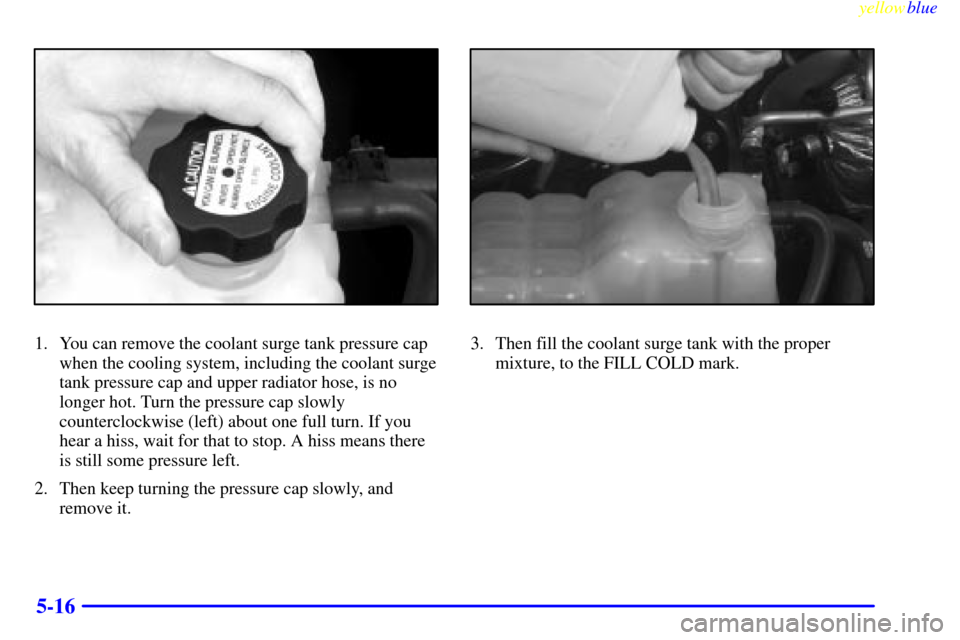
1. You can remove the coolant surge tank pressure cap
when the cooling system, including the coolant surge
tank pressure cap and upper radiator hose, is no
longer hot. Turn the pressure cap slowly
counterclockwise (left) about one full turn. If you
hear a hiss, wait for that to stop. A hiss means there
is still some pressure left.
2. Then keep turning the pressure cap slowly, and
remove it.3. Then fill the coolant surge tank with the proper
mixture, to the FILL COLD mark.
Page 280 of 432
yellowblue
5-20 Removing the Spare Tire and Tools
Regular Cab
Extended Cab
The equipment you'll need is behind the passenger's seat.
1. If there is a cover, move the seats forward and turn the
wing nut on the cover counterclockwise to remove it.
2. The wheel blocks and the wheel block retainer can be
removed by turning the wing nut counterclockwise.
3. To release the bottle jack from it's holder, turn the
knob on the bottle jack counterclockwise to lower
the jack head slightly.
4. There is also a wing nut used to retain the storage
bag and tools. To remove it, turn the wing
nut counterclockwise.
Page 281 of 432

yellowblue
5-21
You'll use the jack handle and the wheel wrench to
remove the underbody
-mounted spare tire.
A. Hoist Assembly
B. Wheel Wrench
C. Extensions
D. Hoist Shaft
E. Valve Stem,
Pointed Down
F. Spare TireG. Tire Retainer
H. Hoist Cable
I. Hoist Lock
J. Hoist Shaft
Access Hole
K. Hoist EndFollow these instructions to lower the spare tire:
1. If the vehicle is equipped with a hoist lock, open the
spare tire lock cover on the bumper and use the
ignition key to remove the lock.
2. Assemble the wheel wrench and the two jack handle
extensions as shown. Insert the hoist end of the
extension through the hole in the rear bumper. Be
sure the hoist end of the extension connects into the
hoist shaft.
3. Turn the wheel wrench counterclockwise to lower
the spare tire to the ground. Continue to turn the
wheel wrench until the spare tire can be pulled out
from under the vehicle. The wheel wrench has a
hook feature that allows you to pull the hoist cable
towards you, to assist you in reaching the spare tire.
4. When the tire has been lowered, tilt the retainer at
the end of the cable so it can be pulled up through
the wheel opening.
5. Put the spare tire near the flat tire.
Page 283 of 432
yellowblue
5-23
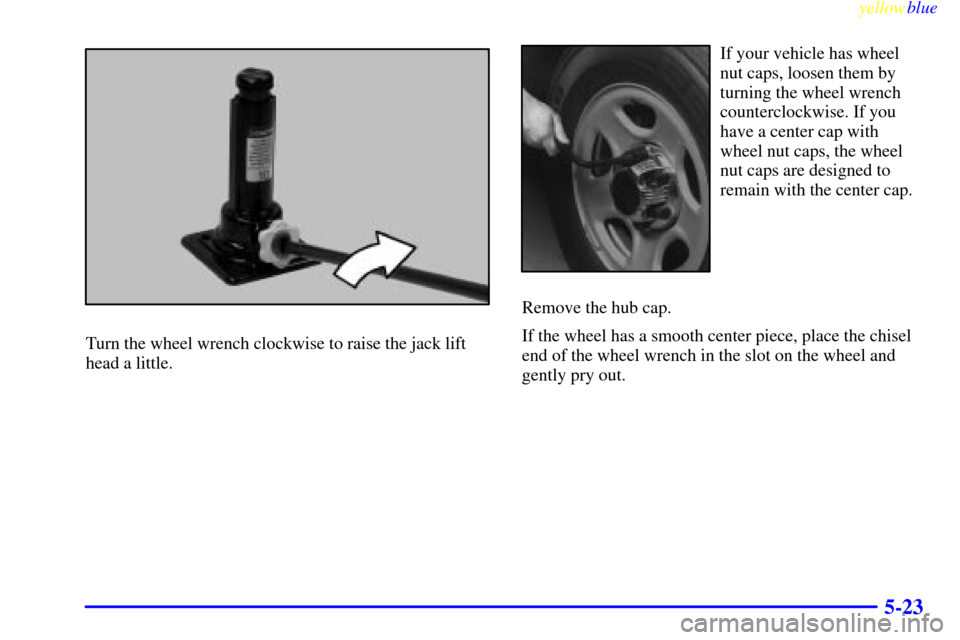
Turn the wheel wrench clockwise to raise the jack lift
head a little.
If your vehicle has wheel
nut caps, loosen them by
turning the wheel wrench
counterclockwise. If you
have a center cap with
wheel nut caps, the wheel
nut caps are designed to
remain with the center cap.
Remove the hub cap.
If the wheel has a smooth center piece, place the chisel
end of the wheel wrench in the slot on the wheel and
gently pry out.
Page 284 of 432
yellowblue
5-24 Removing the Flat Tire and Installing
the Spare Tire
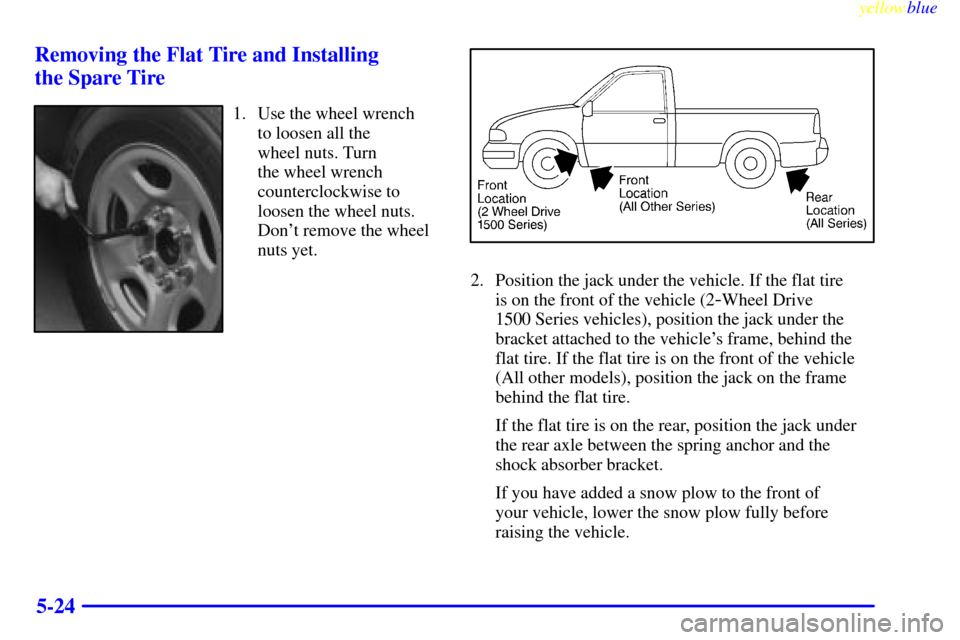
1. Use the wheel wrench
to loosen all the
wheel nuts. Turn
the wheel wrench
counterclockwise to
loosen the wheel nuts.
Don't remove the wheel
nuts yet.
2. Position the jack under the vehicle. If the flat tire
is on the front of the vehicle (2
-Wheel Drive
1500 Series vehicles), position the jack under the
bracket attached to the vehicle's frame, behind the
flat tire. If the flat tire is on the front of the vehicle
(All other models), position the jack on the frame
behind the flat tire.
If the flat tire is on the rear, position the jack under
the rear axle between the spring anchor and the
shock absorber bracket.
If you have added a snow plow to the front of
your vehicle, lower the snow plow fully before
raising the vehicle.
Page 286 of 432
yellowblue
5-26
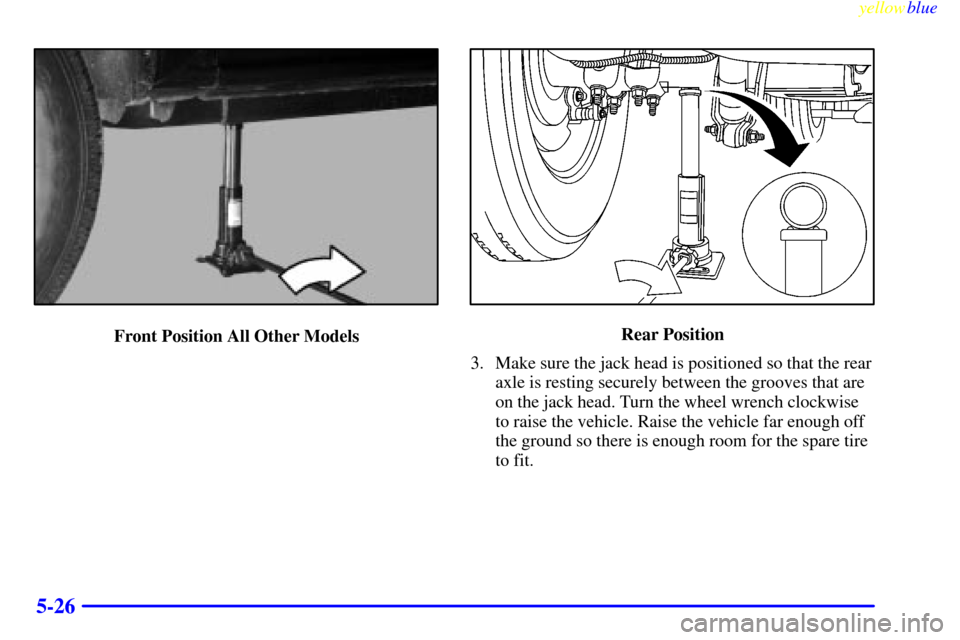
Front Position All Other ModelsRear Position
3. Make sure the jack head is positioned so that the rear
axle is resting securely between the grooves that are
on the jack head. Turn the wheel wrench clockwise
to raise the vehicle. Raise the vehicle far enough off
the ground so there is enough room for the spare tire
to fit.
Page 289 of 432
yellowblue
5-29
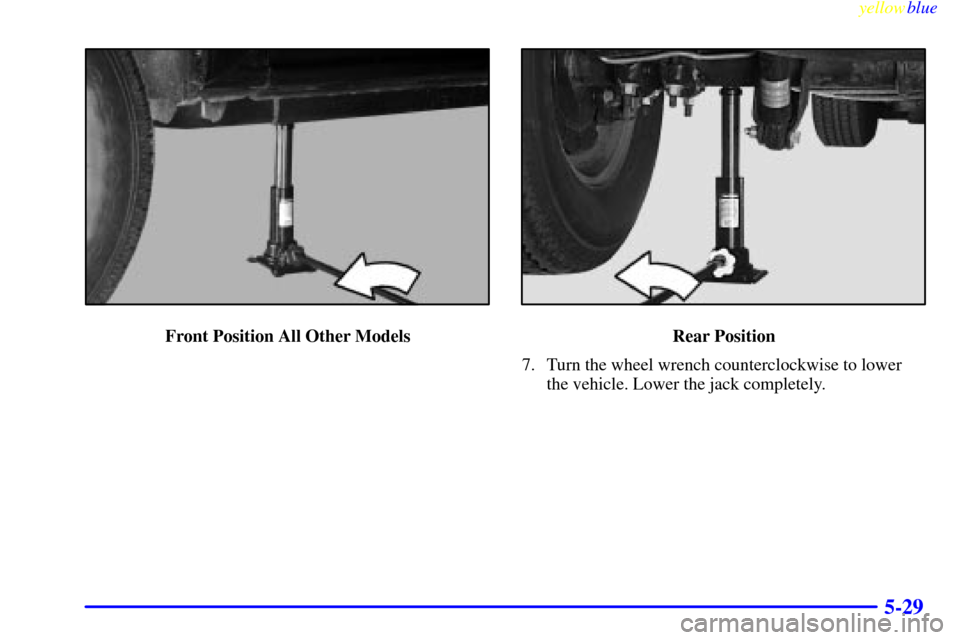
Front Position All Other ModelsRear Position
7. Turn the wheel wrench counterclockwise to lower
the vehicle. Lower the jack completely.