Page 148 of 432
yellowblue
2-76
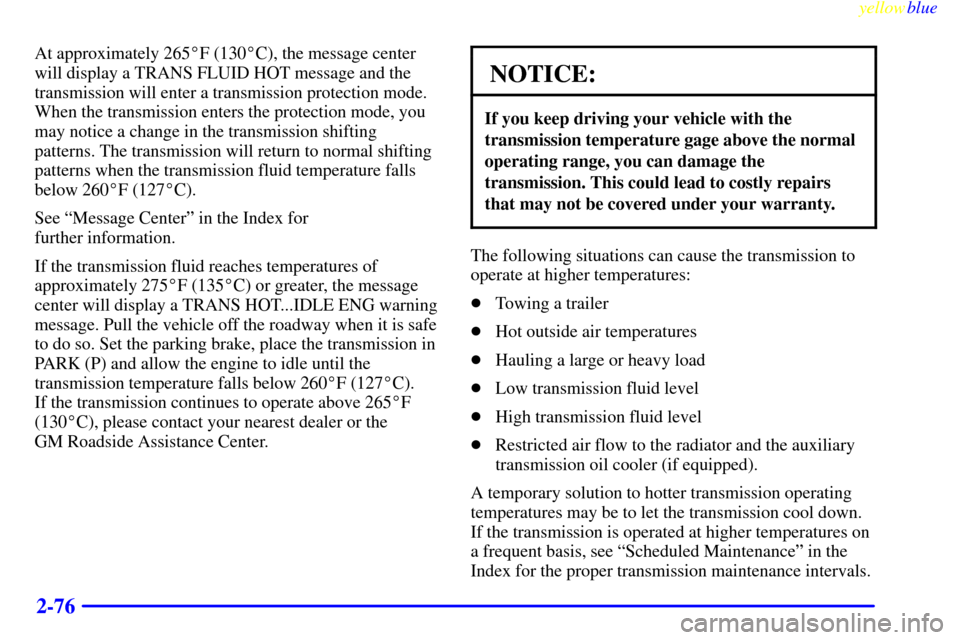
At approximately 265�F (130�C), the message center
will display a TRANS FLUID HOT message and the
transmission will enter a transmission protection mode.
When the transmission enters the protection mode, you
may notice a change in the transmission shifting
patterns. The transmission will return to normal shifting
patterns when the transmission fluid temperature falls
below 260�F (127�C).
See ªMessage Centerº in the Index for
further information.
If the transmission fluid reaches temperatures of
approximately 275�F (135�C) or greater, the message
center will display a TRANS HOT...IDLE ENG warning
message. Pull the vehicle off the roadway when it is safe
to do so. Set the parking brake, place the transmission in
PARK (P) and allow the engine to idle until the
transmission temperature falls below 260�F (127�C).
If the transmission continues to operate above 265�F
(130�C), please contact your nearest dealer or the
GM Roadside Assistance Center.
NOTICE:
If you keep driving your vehicle with the
transmission temperature gage above the normal
operating range, you can damage the
transmission. This could lead to costly repairs
that may not be covered under your warranty.
The following situations can cause the transmission to
operate at higher temperatures:
�Towing a trailer
�Hot outside air temperatures
�Hauling a large or heavy load
�Low transmission fluid level
�High transmission fluid level
�Restricted air flow to the radiator and the auxiliary
transmission oil cooler (if equipped).
A temporary solution to hotter transmission operating
temperatures may be to let the transmission cool down.
If the transmission is operated at higher temperatures on
a frequent basis, see ªScheduled Maintenanceº in the
Index for the proper transmission maintenance intervals.
Page 155 of 432
yellowblue
2-83
NOTICE:
If you keep driving your vehicle with the
transmission TRANS FLUID HOT message
displayed, you can damage the transmission.
This could lead to costly repairs that may not be
covered under your warranty.
The following situations can cause the transmission to
operate at higher temperatures:
�Towing a trailer
�Hot outside air temperatures
�Hauling a large or heavy load
�Low transmission fluid level
�High transmission fluid level
�Restricted air flow to the radiator and the auxiliary
transmission oil cooler (if equipped).
A temporary solution to hotter transmission operating
temperatures may be to let the transmission cool down.
If the transmission is operated at higher temperatures on
a frequent basis, see ªScheduled Maintenanceº in the
Index for the proper transmission maintenance intervals.
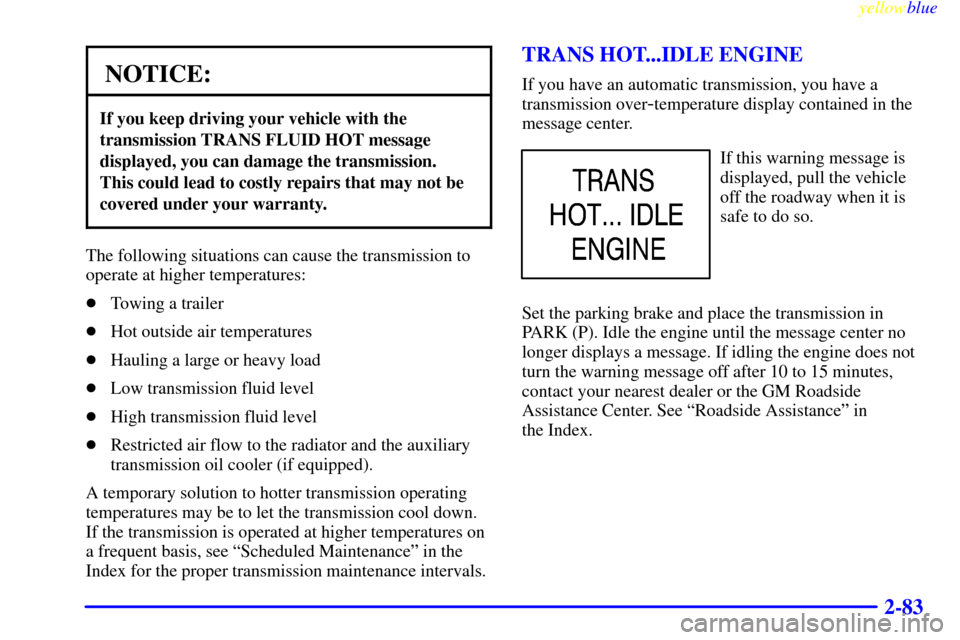
TRANS HOT...IDLE ENGINE
If you have an automatic transmission, you have a
transmission over
-temperature display contained in the
message center.
If this warning message is
displayed, pull the vehicle
off the roadway when it is
safe to do so.
Set the parking brake and place the transmission in
PARK (P). Idle the engine until the message center no
longer displays a message. If idling the engine does not
turn the warning message off after 10 to 15 minutes,
contact your nearest dealer or the GM Roadside
Assistance Center. See ªRoadside Assistanceº in
the Index.
Page 156 of 432
yellowblue
2-84
NOTICE:
If you keep driving your vehicle with the
transmission TRANS HOT...IDLE ENGINE
message displayed, you can damage the
transmission. This could lead to costly repairs
that may not be covered under your warranty.
The following situations can cause the transmission to
operate at higher temperatures:
�Towing a trailer
�Hot outside air temperatures
�Hauling a heavy load
�Low transmission fluid level
�High transmission fluid level
�Restricted air flow to the radiator and the auxiliary
transmission oil cooler (if equipped).
A temporary solution to hotter transmission operating
temperatures may be to let the transmission cool down.
If the transmission is operated at higher temperatures on
a frequent basis, see ªScheduled Maintenanceº in the
Index for the proper transmission maintenance intervals.
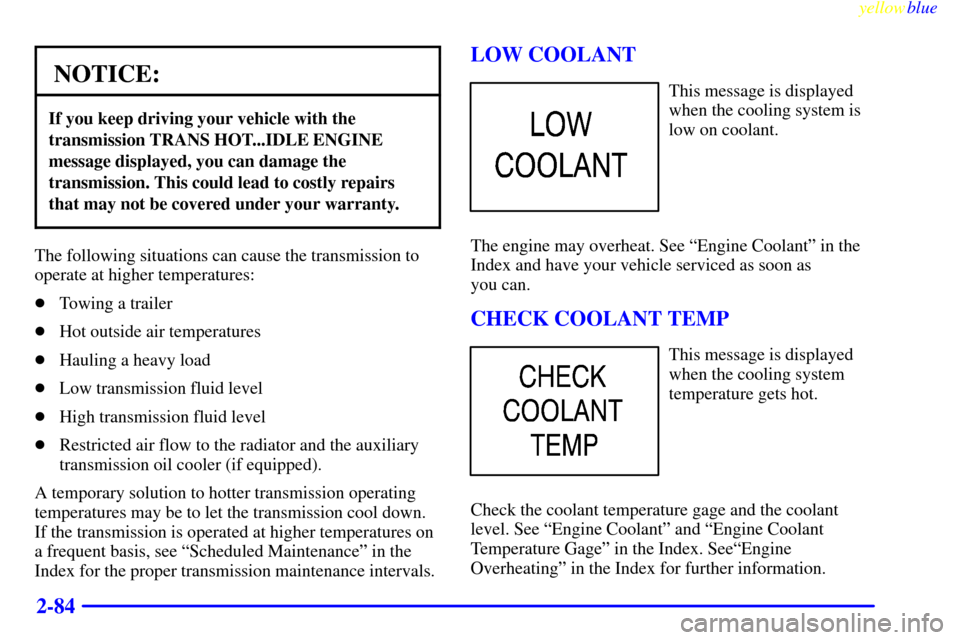
LOW COOLANT
This message is displayed
when the cooling system is
low on coolant.
The engine may overheat. See ªEngine Coolantº in the
Index and have your vehicle serviced as soon as
you can.
CHECK COOLANT TEMP
This message is displayed
when the cooling system
temperature gets hot.
Check the coolant temperature gage and the coolant
level. See ªEngine Coolantº and ªEngine Coolant
Temperature Gageº in the Index. SeeªEngine
Overheatingº in the Index for further information.
Page 253 of 432
yellowblue
4-63
When towing at high altitude on steep uphill grades,
consider the following: Engine coolant will boil at a
lower temperature than at normal altitudes. If you turn
your engine off immediately after towing at high altitude
on steep uphill grades, your vehicle may show signs
similar to engine overheating. To avoid this, let the
engine run while parked (preferably on level ground)
with the automatic transmission in PARK (P) (or the
manual transmission out of gear and the parking brake
applied) for a few minutes before turning the engine off.
If you do get the overheat warning, see ªEngine
Overheatingº in the Index.
Parking on Hills
CAUTION:
You really should not park your vehicle, with a
trailer attached, on a hill. If something goes
wrong, your rig could start to move. People can
be injured, and both your vehicle and the trailer
can be damaged.
But if you ever have to park your rig on a hill, here's
how to do it:
1. Apply your regular brakes, but don't shift into
PARK (P) yet for an automatic transmission, or into
gear for a manual transmission.
2. Have someone place chocks under the trailer wheels.
3. When the wheel chocks are in place, release the
regular brakes until the chocks absorb the load.
4. Reapply the regular brakes. Then apply your
parking brake and shift into PARK (P) for an
automatic transmission, or REVERSE (R) for a
manual transmission.
5. If you have a four
-wheel-drive vehicle, be sure
the transfer case is in a drive gear and not in
NEUTRAL (N).
6. Release the regular brakes.
Page 254 of 432
yellowblue
4-64
CAUTION:
It can be dangerous to get out of your vehicle if
the shift lever is not fully in PARK (P) with the
parking brake firmly set. Your vehicle can roll.
If you have left the engine running, the vehicle
can move suddenly. You or others could be
injured. To be sure your vehicle won't move, even
when you're on fairly level ground, use the steps
that follow.
Always put the shift lever fully in PARK (P) with
the parking brake firmly set.
If the transfer case on four-wheel drive vehicles is
in NEUTRAL (N), your vehicle will be free to
roll, even if your shift lever is in PARK (P). So, be
sure the transfer case is in a drive gear
-- not in
NEUTRAL (N).
When You Are Ready to Leave After
Parking on a Hill
1. Apply your regular brakes and hold the pedal down
while you:
�Start your engine;
�Shift into a gear; and
�Release the parking brake.
2. Let up on the brake pedal.
3. Drive slowly until the trailer is clear of the chocks.
4. Stop and have someone pick up and store the chocks.
Maintenance When Trailer Towing
Your vehicle will need service more often when you're
pulling a trailer. See the Maintenance Schedule for more
on this. Things that are especially important in trailer
operation are automatic transmission fluid (don't
overfill), engine oil, axle lubricant, belt, cooling system
and brake system. Each of these is covered in this
manual, and the Index will help you find them quickly.
If you're trailering, it's a good idea to review these
sections before you start your trip.
Check periodically to see that all hitch nuts and bolts
are tight.
Page 299 of 432
6-
yellowblue
6-1
Section 6 Service and Appearance Care
Here you will find information about the care of your vehicle. This section begins with service and fuel information,
and then it shows how to check important fluid and lubricant levels. There is also technical information about your
vehicle, and a part devoted to its appearance care.
6
-2 Service
6
-3 Fuel (Gasoline Engine)
6
-5 Fuels in Foreign Countries (Gasoline Engines)
6
-6 Filling Your Tank (Gasoline Engine)
6
-8 Checking Things Under the Hood
6
-12 Engine Oil (Gasoline Engine)
6
-16 Engine Air Cleaner/Filter
6
-19 Automatic Transmission Fluid
6
-22 Manual Transmission Fluid
6
-24 Hydraulic Clutch
6
-25 Rear Axle
6
-25 Four-Wheel Drive
6
-28 Coolant Surge Tank Pressure Cap
(Gasoline Engine)
6
-28 Thermostat
6
-29 Engine Coolant
6
-32 Power Steering Fluid6
-33 Windshield Washer Fluid
6
-34 Brakes
6
-37 Battery
6
-38 Bulb Replacement
6
-44 Windshield Wiper Blade Replacement
6
-45 Tires
6
-54 Appearance Care
6
-54 Cleaning the Inside of Your Vehicle
6
-58 Cleaning the Outside of Your Vehicle
6
-62 GM Vehicle Care/Appearance Materials
6
-63 Vehicle Identification Number (VIN)
6
-64 Electrical System
6
-73 Replacement Bulbs
6
-74 Capacities and Specifications
6
-76 Air Conditioning Refrigerants
6
-77 Normal Maintenance Replacement Parts
Page 308 of 432
yellowblue
6-10
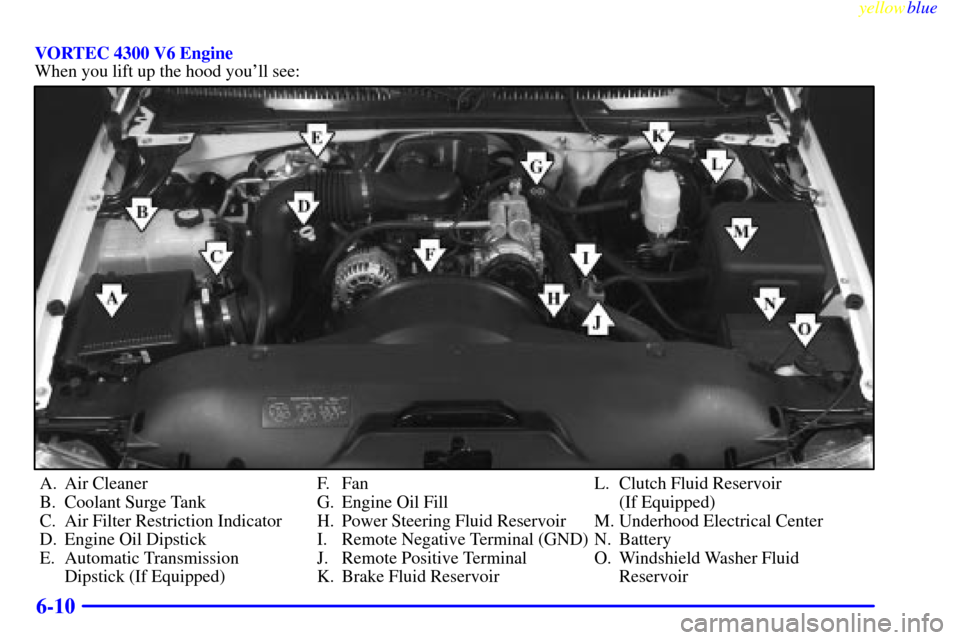
VORTEC 4300 V6 Engine
When you lift up the hood you'll see:
A. Air Cleaner
B. Coolant Surge Tank
C. Air Filter Restriction Indicator
D. Engine Oil Dipstick
E. Automatic Transmission
Dipstick (If Equipped)F. Fan
G. Engine Oil Fill
H. Power Steering Fluid Reservoir
I. Remote Negative Terminal (GND)
J. Remote Positive Terminal
K. Brake Fluid ReservoirL. Clutch Fluid Reservoir
(If Equipped)
M. Underhood Electrical Center
N. Battery
O. Windshield Washer Fluid
Reservoir
Page 309 of 432
yellowblue
6-11
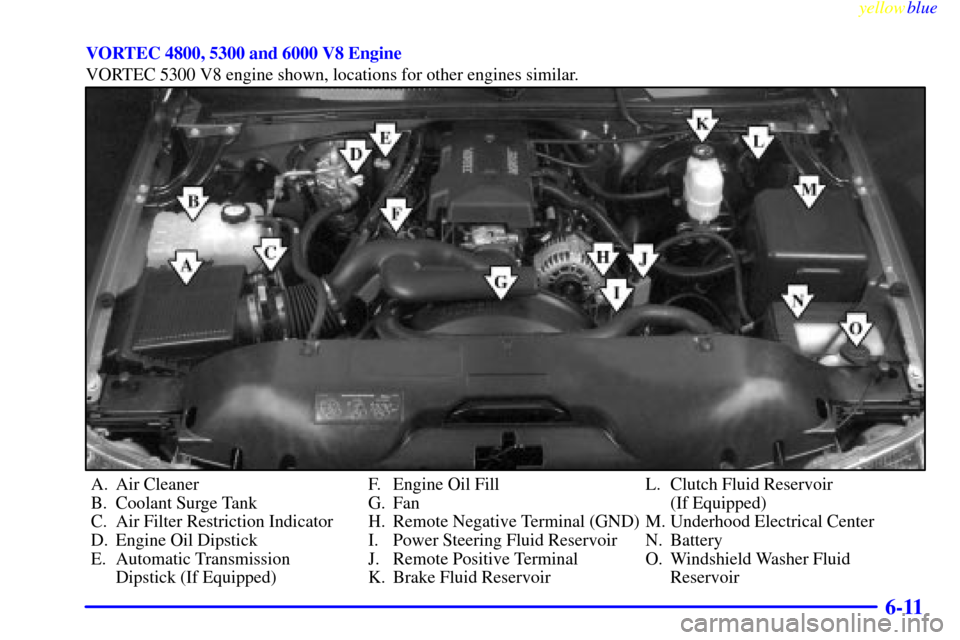
VORTEC 4800, 5300 and 6000 V8 Engine
VORTEC 5300 V8 engine shown, locations for other engines similar.
A. Air Cleaner
B. Coolant Surge Tank
C. Air Filter Restriction Indicator
D. Engine Oil Dipstick
E. Automatic Transmission
Dipstick (If Equipped)F. Engine Oil Fill
G. Fan
H. Remote Negative Terminal (GND)
I. Power Steering Fluid Reservoir
J. Remote Positive Terminal
K. Brake Fluid ReservoirL. Clutch Fluid Reservoir
(If Equipped)
M. Underhood Electrical Center
N. Battery
O. Windshield Washer Fluid
Reservoir