Page 1 of 328

yellowblue
i
The 1999 Chevrolet Metro Owner's Manual
1-1 Seats and Restraint SystemsThis section tells you how to use your seats and safety belts properly. It also explains the air bag system.
2-1 Features and ControlsThis section explains how to start and operate your vehicle.
3-1 Comfort Controls and Audio SystemsThis section tells you how to adjust the ventilation and comfort controls and how to operate your audio system.
4-1 Your Driving and the RoadHere you'll find helpful information and tips about the road and how to drive under different conditions.
5-1 Problems on the RoadThis section tells you what to do if you have a problem while driving, such as a flat tire or overheated engine, etc.
6-1 Service and Appearance CareHere the manual tells you how to keep your vehicle running properly and looking good.
7-1 Maintenance ScheduleThis section tells you when to perform vehicle maintenance and what fluids and lubricants to use.
8-1 Customer Assistance InformationThis section tells you how to contact Chevrolet for assistance and how to get service and owner publications.
It also gives you information on ªReporting Safety Defectsº on page 8-10.
9-1 IndexHere's an alphabetical listing of almost every subject in this manual. You can use it to quickly find
something you want to read.
Page 73 of 328
yellowblue
2-15
DRIVE (D): This position is for normal driving.
If you need more power for passing, and you're:
�Going less than about 27 mph (43 km/h), push your
accelerator pedal about halfway down.
�Going about 27 mph (43 km/h) or more, push your
accelerator pedal all the way down.
You'll shift down to the next gear and have more power.
SECOND (2): This position gives you more power but
lower fuel economy. You can use SECOND (2) on hills.
It can help control your speed as you go down steep
mountain roads, but then you would also want to use
your brakes off and on.
NOTICE:
Don't shift into SECOND (2) unless you are going
slower than 70 mph (112 km/h); or you can
damage your engine.
LOW (L): This position gives you even more power but
lower fuel economy than SECOND (2). You can use it
on very steep hills, or in deep snow or mud. If the
selector lever is put in LOW (L), the transaxle won't
shift into low gear until the vehicle is going
slowly enough.
NOTICE:
If your front wheels can't rotate, don't try to
drive. This might happen if you were stuck in
very deep sand or mud or were up against a solid
object. You could damage your transaxle.
Also, if you stop when going uphill, don't hold
your vehicle there with only the accelerator
pedal. This could overheat and damage the
transaxle. Use your brakes to hold your vehicle in
position on a hill.
Page 78 of 328
yellowblue
2-20 Leaving Your Vehicle With the Engine
Running (Automatic Transaxle Only)
CAUTION:
It can be dangerous to leave your vehicle with the
engine running. Your vehicle could move
suddenly if the shift lever is not fully in PARK (P)
with the parking brake firmly set. And, if you
leave the vehicle with the engine running, it could
overheat and even catch fire. You or others could
be injured. Don't leave your vehicle with the
engine running unless you have to.
Torque Lock (Automatic Transaxle)
If you are parking on a hill and you don't shift your
transaxle into PARK (P) properly, the weight of the
vehicle may put too much force on the parking pawl in
the transaxle. You may find it difficult to pull the shift
lever out of PARK (P). This is called ªtorque lock.º To
prevent torque lock, set the parking brake and then shift
into PARK (P) properly before you leave the driver's
seat. To find out how, see ªShifting Into PARK (P)º in
the Index.
When you are ready to drive, move the shift lever out of
PARK (P) before you release the parking brake.
If torque lock does occur, you may need to have another
vehicle push yours a little uphill to take some of the
pressure from the parking pawl in the transaxle, so you
can pull the shift lever out of PARK (P).
Page 99 of 328

yellowblue
2-41 Anti-Lock Brake System Active Light
(Option)
When your anti-lock system
is adjusting brake pressure
to help avoid a braking skid,
the anti
-lock brake system
active light will come on.
Slippery road conditions may exist if this light comes
on, so adjust your driving accordingly. The light will
stay on for a few seconds after the system stops
adjusting brake pressure.
The anti
-lock brake system active light also comes on
briefly when you turn the ignition key to ON. If the light
doesn't come on then, have it fixed so it will be there to
tell you when the system is active.
Engine Coolant Temperature Gage
Standard Cluster Optional Cluster
This gage shows the engine coolant temperature. If the
gage pointer moves to the HOT (H) side of the band,
your engine is too hot! It means that your engine coolant
has overheated and you should stop your vehicle and
turn off the engine as soon as possible.
In ªProblems on the Road,º this manual shows what to
do. See ªEngine Overheatingº in the Index.
Page 161 of 328
5-
yellowblue
5-1
Section 5 Problems on the Road
Here you'll find what to do about some problems that can occur on the road.
5
-2 Hazard Warning Flashers
5
-3 Other Warning Devices
5
-3 Jump Starting
5
-8 Towing Your Vehicle
5
-8 Engine Overheating5
-11 Cooling System
5
-18 If a Tire Goes Flat
5
-19 Changing a Flat Tire
5
-30 Compact Spare Tire
5
-31 If You're Stuck: In Sand, Mud, Ice or Snow
Page 168 of 328
yellowblue
5-8
Towing Your Vehicle
CAUTION:
To help avoid serious personal injury to you
or others:
�Never let passengers ride in a vehicle that is
being towed.
�Never tow faster than safe or posted speeds.
�Never tow with damaged parts not
fully secured.
�Never get under your vehicle after it has
been lifted by the tow truck.
�Always secure the vehicle on each side with
separate safety chains when towing it.
�Use only the correct hooks.
NOTICE:
Use the proper towing equipment to avoid
damage to the bumper, fascia or fog lamp areas
of the vehicle.
With current trends in automotive styles and design, it is
essential that the correct towing equipment is used to
tow a vehicle. Your vehicle can be towed with wheel
-lift
or car carrier equipment.
Consult your dealer or a professional towing service if
you need to have your vehicle towed. See ªRoadside
Assistanceº in the Index.
Engine Overheating
You will find a coolant temperature gage on your
vehicle's instrument panel. See ªEngine Coolant
Temperature Gageº in the Index.
Page 169 of 328
yellowblue
5-9 If Steam Is Coming From Your Engine
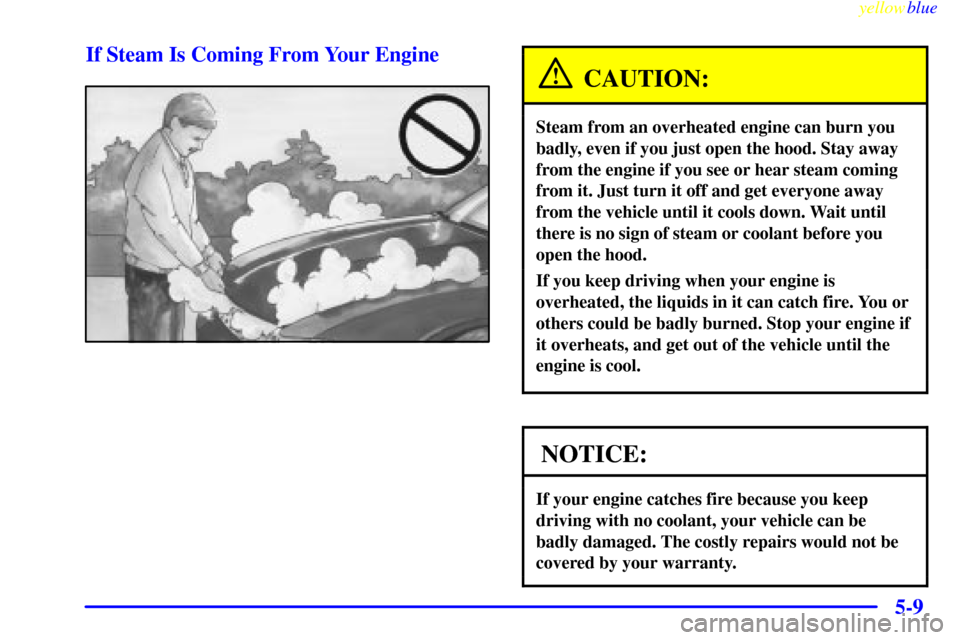
CAUTION:
Steam from an overheated engine can burn you
badly, even if you just open the hood. Stay away
from the engine if you see or hear steam coming
from it. Just turn it off and get everyone away
from the vehicle until it cools down. Wait until
there is no sign of steam or coolant before you
open the hood.
If you keep driving when your engine is
overheated, the liquids in it can catch fire. You or
others could be badly burned. Stop your engine if
it overheats, and get out of the vehicle until the
engine is cool.
NOTICE:
If your engine catches fire because you keep
driving with no coolant, your vehicle can be
badly damaged. The costly repairs would not be
covered by your warranty.
Page 170 of 328

yellowblue
5-10 If No Steam Is Coming From Your Engine
If you get an engine overheat warning but see or hear no
steam, the problem may not be too serious. Sometimes
the engine can get a little too hot when you:
�Climb a long hill on a hot day.
�Stop after high
-speed driving.
�Idle for long periods in traffic.
If you get the overheat warning with no sign of steam,
try this for a minute or so:
1. If you have an air conditioner and it's on, turn it off.
2. Turn on your heater to full hot at the highest fan
speed and open the window as necessary.
3. If you're in a traffic jam, shift to NEUTRAL (N);
otherwise, shift to the highest gear while
driving
-- DRIVE (D) for automatic transaxles.If you no longer have the overheat warning, you can
drive. Just to be safe, drive slower for about 10 minutes.
If the warning doesn't come back on, you can
drive normally.
If the warning continues, pull over, stop, and park your
vehicle right away.
If there's still no sign of steam, idle the engine for three
minutes while you're parked. If you still have the
warning, turn off the engine and get everyone out of the
vehicle until it cools down.
You may decide not to lift the hood but to get service
help right away.