Page 156 of 328
yellowblue
4-32
3. Shift your manual transaxle to NEUTRAL (N).
4. Release the parking brake.
NOTICE:
The front wheels transmit shocks during towing.
The steering column may not be strong enough to
withstand the shocks. Always unlock the steering
wheel before towing.
NOTICE:
Make sure that the towing speed does not exceed
55 mph (90 km/h), or your vehicle could be
badly damaged.
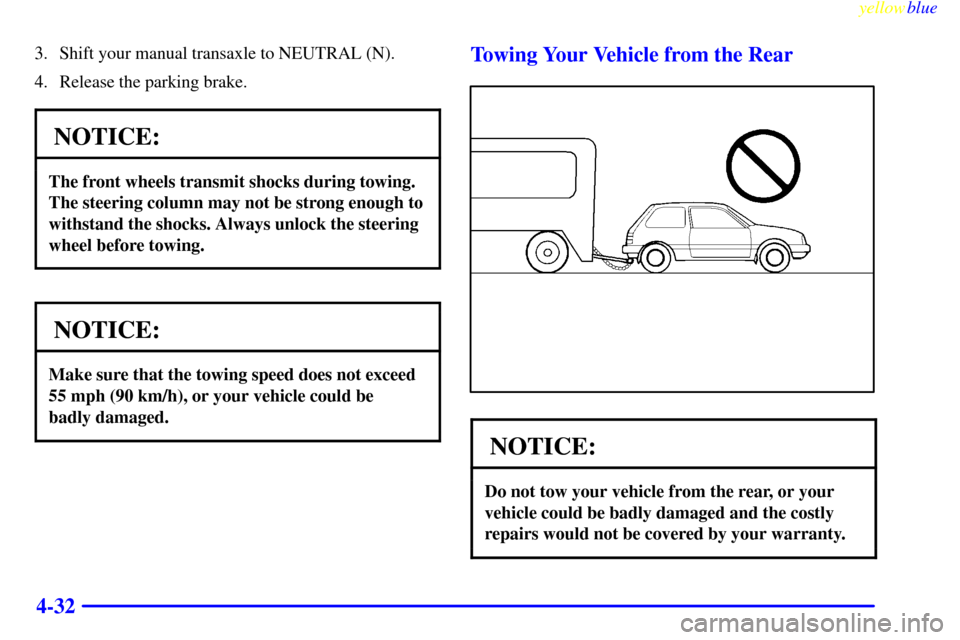
Towing Your Vehicle from the Rear
NOTICE:
Do not tow your vehicle from the rear, or your
vehicle could be badly damaged and the costly
repairs would not be covered by your warranty.
Page 158 of 328
yellowblue
4-34
CAUTION:
Do not load your vehicle any heavier than the
GVWR, or either the maximum front or rear
GAWR. If you do, parts on your vehicle can
break, and it can change the way your vehicle
handles. These could cause you to lose control
and crash. Also, overloading can shorten the life
of your vehicle.
NOTICE:
Your warranty does not cover parts or
components that fail because of overloading.
CAUTION:
Things you put inside your vehicle can strike and
injure people in a sudden stop or turn, or in
a crash.
�Put things in the trunk or rear area of your
vehicle. In a trunk, put them as far forward
as you can. Try to spread the weight evenly.
�Never stack heavier things, like suitcases,
inside the vehicle so that some of them are
above the tops of the seats.
�Don't leave an unsecured child restraint in
your vehicle.
�When you carry something inside the
vehicle, secure it whenever you can.
�Don't leave a seat folded down unless you
need to.
Towing A Trailer
Your vehicle is neither designed nor intended to tow
a trailer.
Page 161 of 328
5-
yellowblue
5-1
Section 5 Problems on the Road
Here you'll find what to do about some problems that can occur on the road.
5
-2 Hazard Warning Flashers
5
-3 Other Warning Devices
5
-3 Jump Starting
5
-8 Towing Your Vehicle
5
-8 Engine Overheating5
-11 Cooling System
5
-18 If a Tire Goes Flat
5
-19 Changing a Flat Tire
5
-30 Compact Spare Tire
5
-31 If You're Stuck: In Sand, Mud, Ice or Snow
Page 168 of 328
yellowblue
5-8
Towing Your Vehicle
CAUTION:
To help avoid serious personal injury to you
or others:
�Never let passengers ride in a vehicle that is
being towed.
�Never tow faster than safe or posted speeds.
�Never tow with damaged parts not
fully secured.
�Never get under your vehicle after it has
been lifted by the tow truck.
�Always secure the vehicle on each side with
separate safety chains when towing it.
�Use only the correct hooks.
NOTICE:
Use the proper towing equipment to avoid
damage to the bumper, fascia or fog lamp areas
of the vehicle.
With current trends in automotive styles and design, it is
essential that the correct towing equipment is used to
tow a vehicle. Your vehicle can be towed with wheel
-lift
or car carrier equipment.
Consult your dealer or a professional towing service if
you need to have your vehicle towed. See ªRoadside
Assistanceº in the Index.
Engine Overheating
You will find a coolant temperature gage on your
vehicle's instrument panel. See ªEngine Coolant
Temperature Gageº in the Index.
Page 178 of 328
yellowblue
5-18
8. Then replace the pressure cap. At any time during
this procedure if coolant begins to flow out of the
filler neck, reinstall the pressure cap. Be sure the ears
on the pressure cap are in line with the vent tube.
If a Tire Goes Flat
It's unusual for a tire to ªblow outº while you're driving,
especially if you maintain your tires properly. If air goes
out of a tire, it's much more likely to leak out slowly.
But if you should ever have a ªblowout,º here are a few
tips about what to expect and what to do:
If a front tire fails, the flat tire will create a drag that
pulls the vehicle toward that side. Take your foot off the
accelerator pedal and grip the steering wheel firmly.
Steer to maintain lane position, and then gently brake to
a stop well out of the traffic lane.
A rear blowout, particularly on a curve, acts much like a
skid and may require the same correction you'd use in a
skid. In any rear blowout, remove your foot from the
accelerator pedal. Get the vehicle under control by
steering the way you want the vehicle to go. It may be
very bumpy and noisy, but you can still steer. Gently
brake to a stop
-- well off the road if possible.
If a tire goes flat, the next part shows how to use your
jacking equipment to change a flat tire safely.
Page 182 of 328
yellowblue
5-22
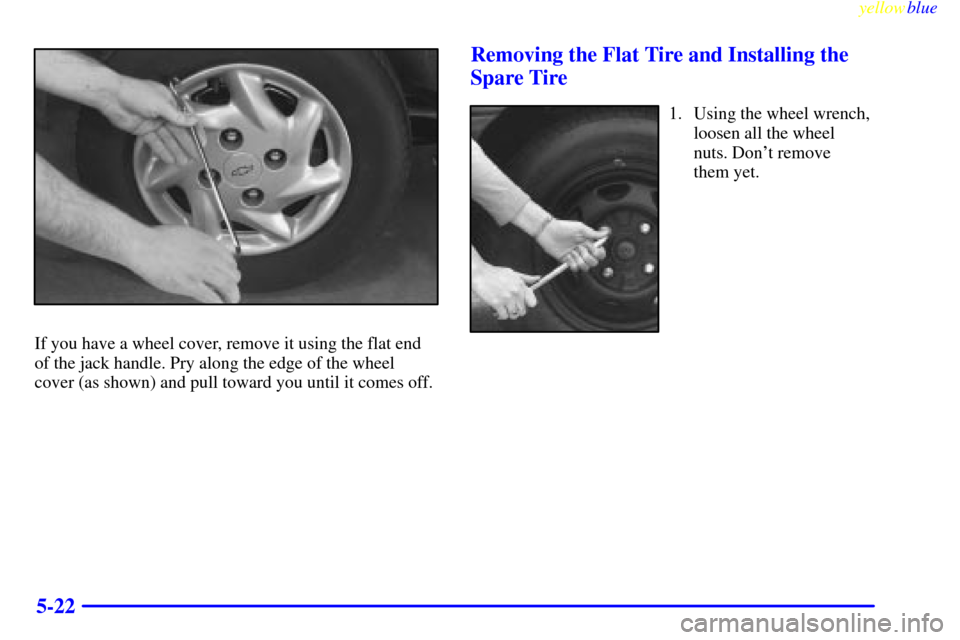
If you have a wheel cover, remove it using the flat end
of the jack handle. Pry along the edge of the wheel
cover (as shown) and pull toward you until it comes off.
Removing the Flat Tire and Installing the
Spare Tire
1. Using the wheel wrench,
loosen all the wheel
nuts. Don't remove
them yet.
Page 185 of 328
yellowblue
5-25
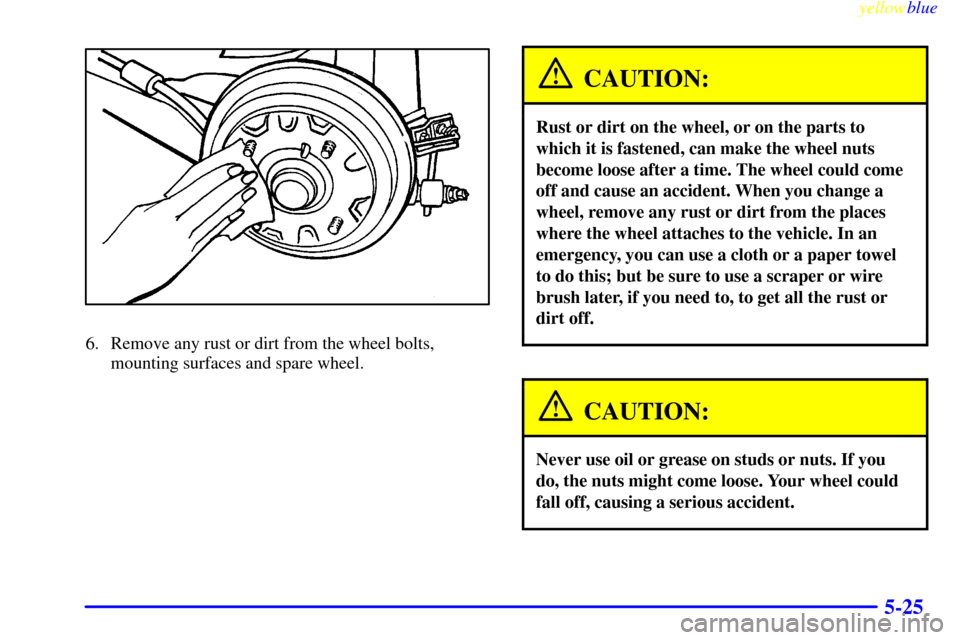
6. Remove any rust or dirt from the wheel bolts,
mounting surfaces and spare wheel.
CAUTION:
Rust or dirt on the wheel, or on the parts to
which it is fastened, can make the wheel nuts
become loose after a time. The wheel could come
off and cause an accident. When you change a
wheel, remove any rust or dirt from the places
where the wheel attaches to the vehicle. In an
emergency, you can use a cloth or a paper towel
to do this; but be sure to use a scraper or wire
brush later, if you need to, to get all the rust or
dirt off.
CAUTION:
Never use oil or grease on studs or nuts. If you
do, the nuts might come loose. Your wheel could
fall off, causing a serious accident.
Page 186 of 328
yellowblue
5-26
7. Replace the wheel nuts
with the rounded end of
the nuts toward the
wheel. Tighten each nut
by hand until the wheel
is held against the hub.
8. Lower the vehicle by turning the jack handle
counterclockwise. Lower the jack completely.