Page 191 of 328
yellowblue
5-31
If You're Stuck: In Sand, Mud,
Ice or Snow
In order to free your vehicle when it is stuck, you will
need to spin the wheels, but you don't want to spin your
wheels too fast. The method known as ªrockingº can
help you get out when you're stuck, but you must
use caution.
CAUTION:
If you let your tires spin at high speed, they can
explode, and you or others could be injured. And,
the transaxle or other parts of the vehicle can
overheat. That could cause an engine
compartment fire or other damage. When you're
stuck, spin the wheels as little as possible. Don't
spin the wheels above 35 mph (55 km/h) as shown
on the speedometer.
NOTICE:
Spinning your wheels can destroy parts of your
vehicle as well as the tires. If you spin the wheels
too fast while shifting your transaxle back and
forth, you can destroy your transaxle.
For information about using tire chains on your vehicle,
see ªTire Chainsº in the Index.
Rocking Your Vehicle To Get It Out
First, turn your steering wheel left and right. That will
clear the area around your front wheels. Then shift back
and forth between REVERSE (R) and a forward gear (or
with a manual transaxle, between FIRST (1) or
SECOND (2) and REVERSE (R)), spinning the wheels
as little as possible. Release the accelerator pedal while
you shift, and press lightly on the accelerator pedal
when the transaxle is in gear. By slowly spinning your
wheels in the forward and reverse directions, you will
cause a rocking motion that may free your vehicle. If
that doesn't get you out after a few tries, you may need
to be towed out. If you do need to be towed out, see
ªTowing Your Vehicleº in the Index.
Page 201 of 328
yellowblue
6-9 Hood Release
To open the hood, first
pull the handle inside
the vehicle.
Then go to the front of the vehicle to release the
secondary hood release. Reach under the hood toward
the center. Pull the lever all the way up with one hand
and lift the hood up with your other hand.
Page 206 of 328
yellowblue
6-14 Checking Engine Oil
Pull out the dipstick and
clean it with a paper towel
or cloth, then push it back in
all the way. Remove it
again, keeping the tip down,
and check the level.
When to Add Engine Oil
If the oil is at or below the upper mark, then you'll need
to add at least one quart of oil. But you must use the
right kind. This part explains what kind of oil to use. For
crankcase capacity, see ªCapacities and Specificationsº
in the Index.
NOTICE:
Don't add too much oil. If your engine has so
much oil that the oil level gets above the upper
mark that shows the proper operating range,
your engine could be damaged.
The engine oil fill cap is
located at the center of the
engine compartment.
Be sure to fill it enough to put the level somewhere in
the proper operating range. Push the dipstick all the way
back in when you're through.
Page 213 of 328
yellowblue
6-21
Wait at least 30 minutes before checking the transaxle
fluid level if you have been driving:
�When outside temperatures are above 90�F (32�C).
�At high speed for quite a while.
�In heavy traffic
-- especially in hot weather.
To get the right reading, the fluid should be at normal
operating temperature, which is 180�F to 200�F
(82�C to 93�C).
Get the vehicle warmed up by driving about 15 miles
(24 km) when outside temperatures are above 50�F
(10�C). If it's colder than 50�F (10�C), you may have
to drive longer.
Checking the Fluid Level
�Park your vehicle on a level place. Keep the
engine running.
�With the parking brake applied, place the shift lever
in PARK (P).
�With your foot on the brake pedal, move the shift
lever through each gear range, pausing for about
three seconds in each range. Then, position the shift
lever in PARK (P).
�Let the engine run at idle for three to five minutes.Then, without shutting off the engine, follow
these steps:
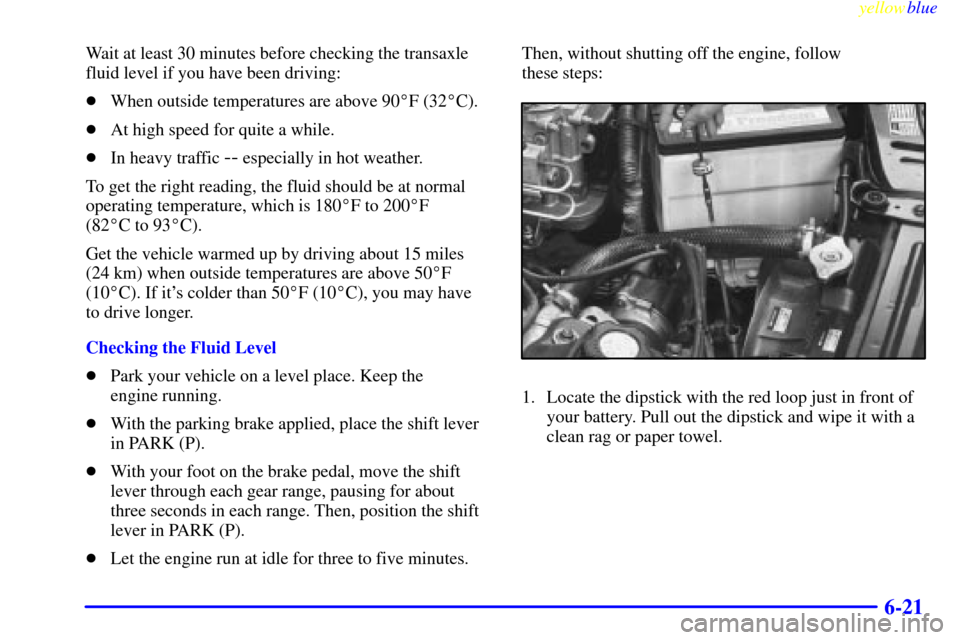
1. Locate the dipstick with the red loop just in front of
your battery. Pull out the dipstick and wipe it with a
clean rag or paper towel.
Page 234 of 328
yellowblue
6-42 Tire Inspection and Rotation
Tires should be rotated every 6,000 to 8,000 miles (10 000 to
13 000 km). Any time you notice unusual wear, rotate your
tires as soon as possible and check wheel alignment. Also
check for damaged tires or wheels. See ªWhen It's Time for
New Tiresº and ªWheel Replacementº later in this section
for more information.
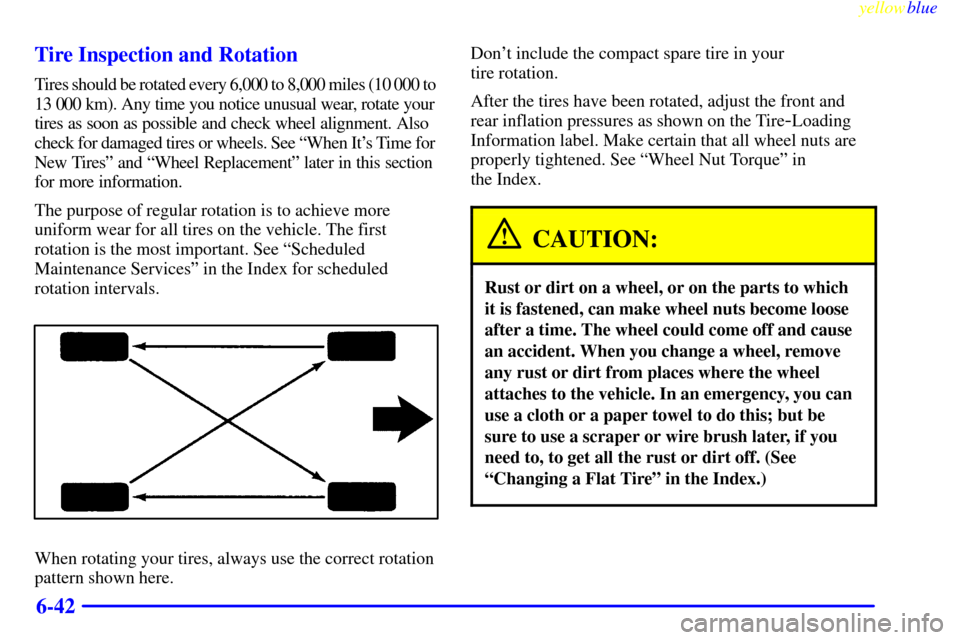
The purpose of regular rotation is to achieve more
uniform wear for all tires on the vehicle. The first
rotation is the most important. See ªScheduled
Maintenance Servicesº in the Index for scheduled
rotation intervals.
When rotating your tires, always use the correct rotation
pattern shown here.Don't include the compact spare tire in your
tire rotation.
After the tires have been rotated, adjust the front and
rear inflation pressures as shown on the Tire
-Loading
Information label. Make certain that all wheel nuts are
properly tightened. See ªWheel Nut Torqueº in
the Index.
CAUTION:
Rust or dirt on a wheel, or on the parts to which
it is fastened, can make wheel nuts become loose
after a time. The wheel could come off and cause
an accident. When you change a wheel, remove
any rust or dirt from places where the wheel
attaches to the vehicle. In an emergency, you can
use a cloth or a paper towel to do this; but be
sure to use a scraper or wire brush later, if you
need to, to get all the rust or dirt off. (See
ªChanging a Flat Tireº in the Index.)
Page 241 of 328

yellowblue
6-49
�Use a clean cloth or sponge, and change to a clean
area often. A soft brush may be used if stains
are stubborn.
�If a ring forms on fabric after spot cleaning, clean the
entire area immediately or it will set.
Using Multi-Purpose Interior Cleaner
on Fabric
1. Vacuum and brush the area to remove any loose dirt.
2. Always clean a whole trim panel or section. Mask
surrounding trim along stitch or welt lines.
3. Mix powdered cleaner following the directions on
the container label to form thick suds.
4. Use suds only and apply with a clean sponge. Don't
saturate the material and don't rub it roughly.
5. As soon as you've cleaned the section, use a sponge
to remove the suds.
6. Wipe cleaned area with a clean, damp towel or cloth.
7. Wipe with a clean cloth and let dry.
Special Fabric Cleaning Problems
Stains caused by such things as catsup, coffee (black),
egg, fruit, fruit juice, milk, soft drinks, vomit, urine and
blood can be removed as follows:
1. Carefully scrape off excess stain, then sponge the
soiled area with cool water.
2. If a stain remains, follow the multi
-purpose interior
cleaner instructions described earlier.
3. If an odor lingers after cleaning vomit or urine,
treat the area with a water/baking soda solution:
1 teaspoon (5 ml) of baking soda to 1 cup (250 ml)
of lukewarm water.
4. Let dry.
Stains caused by candy, ice cream, mayonnaise, chili
sauce and unknown stains can be removed as follows:
1. Carefully scrape off excess stain.
2. First, clean with cool water and allow to
dry completely.
3. If a stain remains, follow instructions for
Multi
-Purpose Interior Cleaner.
Page 244 of 328
yellowblue
6-52
Cleaning the Outside of Your Vehicle
The paint finish on your vehicle provides beauty, depth
of color, gloss retention and durability.
Washing Your Vehicle
The best way to preserve your vehicle's finish is to
keep it clean by washing it often with lukewarm or
cold water.
Don't wash your vehicle in the direct rays of the sun.
Use a car washing soap. Don't use strong soaps or
chemical detergents. Be sure to rinse the vehicle well,
removing all soap residue completely. You can get
GM
-approved cleaning products from your dealer. (See
ªAppearance Care and Materialsº in the Index.) Don't
use cleaning agents that are petroleum based, or that
contain acid or abrasives. All cleaning agents should be
flushed promptly and not allowed to dry on the surface,
or they could stain. Dry the finish with a soft, clean
chamois or an all
-cotton towel to avoid surface
scratches and water spotting.
High pressure car washes may cause water to enter
your vehicle.Cleaning Exterior Lamps/Lenses
Use lukewarm or cold water, a soft cloth and a car
washing soap to clean exterior lamps and lenses. Follow
instructions under ªWashing Your Vehicle.º
Finish Care
Occasional waxing or mild polishing of your vehicle by
hand may be necessary to remove residue from the paint
finish. You can get GM
-approved cleaning products
from your dealer. (See ªAppearance Care and Materialsº
in the Index.)
Your vehicle may have a ªbasecoat/clearcoatº paint
finish. The clearcoat gives more depth and gloss to the
colored basecoat. Always use waxes and polishes that
are non
-abrasive and made for a basecoat/clearcoat
paint finish.
NOTICE:
Machine compounding or aggressive polishing on
a basecoat/clearcoat paint finish may dull the
finish or leave swirl marks.
Page 262 of 328
Scheduled Maintenance
yellowblue
7-6
Short Trip/City Intervals
Every 50,000 Miles (83 000 km): Automatic Transaxle
Service (severe conditions only).
Every 60,000 Miles (100 000 km): Camshaft Timing
Belt Inspection. Brake Fluid Service. Spark Plug Wire
Replacement (or every 60 months, whichever occurs
first). Wiring Harness and Connectors Inspection (or
every 60 months, whichever occurs first).
Every 100,000 Miles (166 000 km): Fuel Filter
Replacement. Camshaft Timing Belt Replacement.
Every 120,000 Miles (200 000 km): Evaporative
Emissions Canister Air Suction Filter Replacement
(or every 120 months, whichever occurs first).
These intervals only summarize maintenance services.
Be sure to follow the complete scheduled maintenance
on the following pages.
Long Trip/Highway Definition
Follow this scheduled maintenance only if none of the
conditions from the Short Trip/City Scheduled
Maintenance is true. Do not use this schedule if the
vehicle is used for trailer towing, driven in a dusty area
or used off paved roads. Use the Short Trip/City
schedule for these conditions.
Driving a vehicle with a fully warmed engine under
highway conditions causes engine oil to break
down slower.