Page 61 of 328
yellowblue
2-3
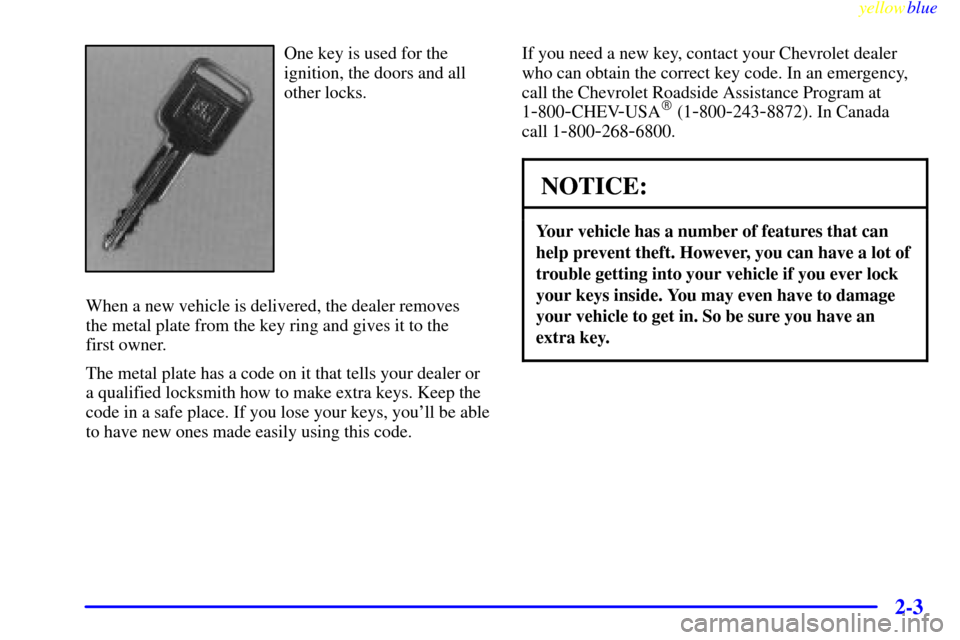
One key is used for the
ignition, the doors and all
other locks.
When a new vehicle is delivered, the dealer removes
the metal plate from the key ring and gives it to the
first owner.
The metal plate has a code on it that tells your dealer or
a qualified locksmith how to make extra keys. Keep the
code in a safe place. If you lose your keys, you'll be able
to have new ones made easily using this code.If you need a new key, contact your Chevrolet dealer
who can obtain the correct key code. In an emergency,
call the Chevrolet Roadside Assistance Program at
1
-800-CHEV-USA� (1-800-243-8872). In Canada
call 1
-800-268-6800.
NOTICE:
Your vehicle has a number of features that can
help prevent theft. However, you can have a lot of
trouble getting into your vehicle if you ever lock
your keys inside. You may even have to damage
your vehicle to get in. So be sure you have an
extra key.
Page 62 of 328
yellowblue
2-4
Door Locks
CAUTION:
Unlocked doors can be dangerous.
Passengers -- especially children -- can easily
open the doors and fall out. When a door is
locked, the inside handle won't open it.
Outsiders can easily enter through an unlocked
door when you slow down or stop your vehicle.
This may not be so obvious: You increase the
chance of being thrown out of the vehicle in a
crash if the doors aren't locked. Wear safety belts
properly, lock your doors, and you will be far
better off whenever you drive your vehicle.
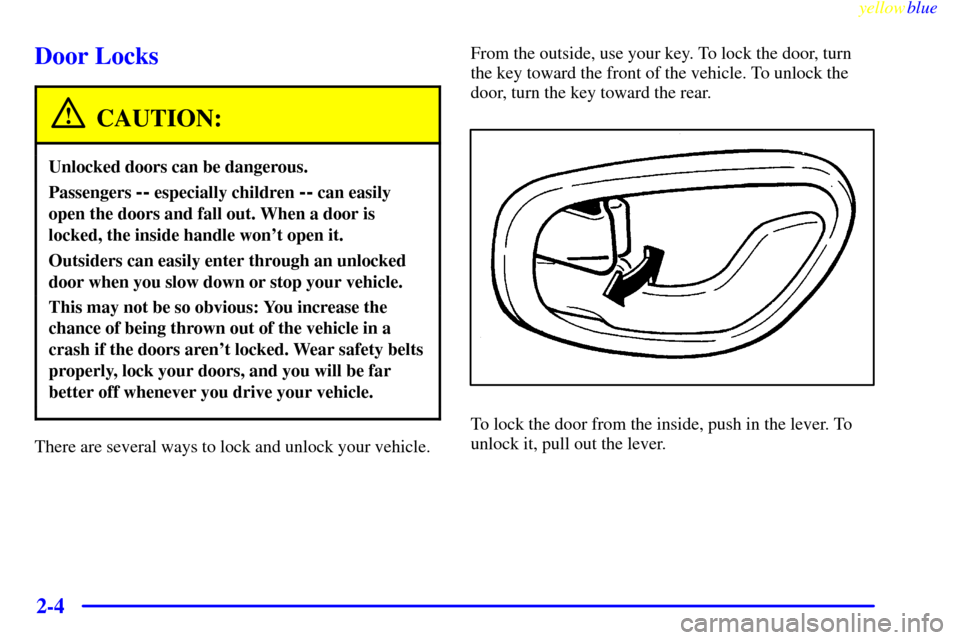
There are several ways to lock and unlock your vehicle.From the outside, use your key. To lock the door, turn
the key toward the front of the vehicle. To unlock the
door, turn the key toward the rear.
To lock the door from the inside, push in the lever. To
unlock it, pull out the lever.
Page 63 of 328
yellowblue
2-5 Power Door Locks (If Equipped)
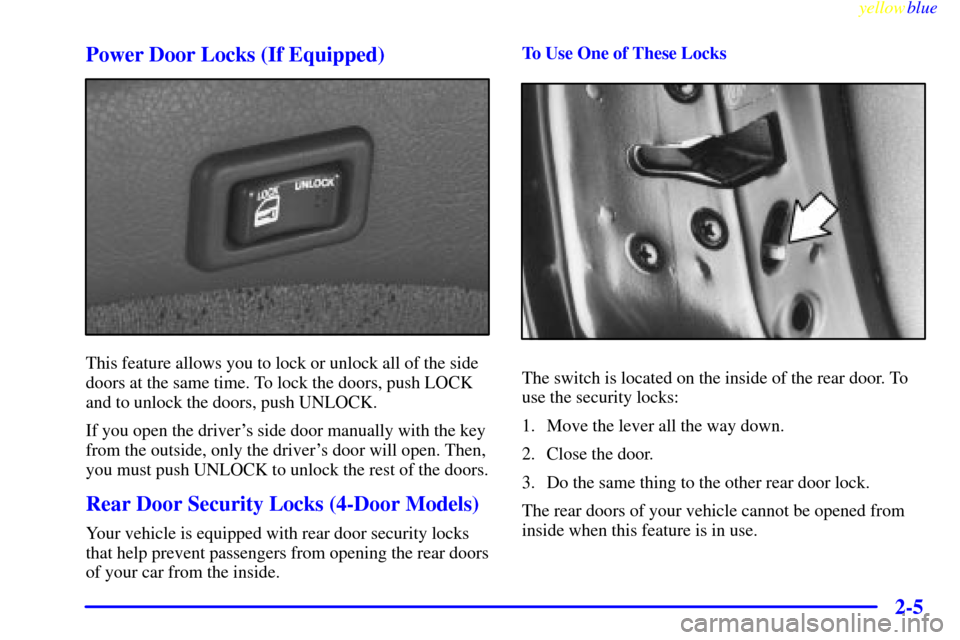
This feature allows you to lock or unlock all of the side
doors at the same time. To lock the doors, push LOCK
and to unlock the doors, push UNLOCK.
If you open the driver's side door manually with the key
from the outside, only the driver's door will open. Then,
you must push UNLOCK to unlock the rest of the doors.
Rear Door Security Locks (4-Door Models)
Your vehicle is equipped with rear door security locks
that help prevent passengers from opening the rear doors
of your car from the inside.To Use One of These Locks
The switch is located on the inside of the rear door. To
use the security locks:
1. Move the lever all the way down.
2. Close the door.
3. Do the same thing to the other rear door lock.
The rear doors of your vehicle cannot be opened from
inside when this feature is in use.
Page 64 of 328
yellowblue
2-6
To Open a Rear Door With the Security Lock
If you want to open a rear door when the security lock
is on:
1. Unlock the door from the inside.
2. Then open the door from the outside.
If you don't cancel the security lock feature, adults or
older children who ride in the rear won't be able to open
the rear door from the inside. You should let adults and
older children know how these security locks work, and
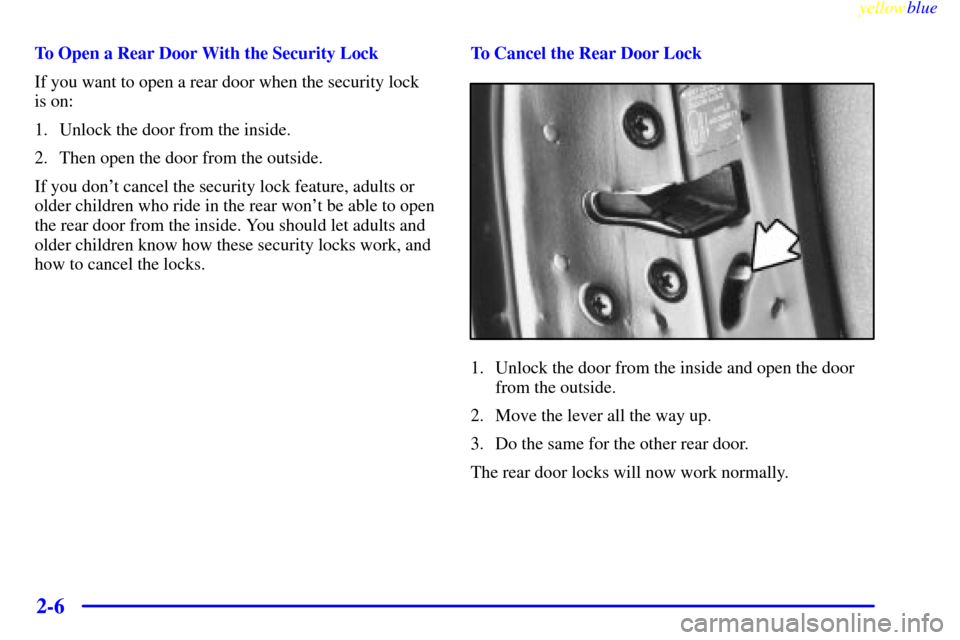
how to cancel the locks.To Cancel the Rear Door Lock
1. Unlock the door from the inside and open the door
from the outside.
2. Move the lever all the way up.
3. Do the same for the other rear door.
The rear door locks will now work normally.
Page 65 of 328
yellowblue
2-7 Leaving Your Vehicle
If you are leaving the vehicle, take your key, open your
door and set the locks from the inside. Then get out and
close the door.
Hatchback/Trunk Lid
CAUTION:
It can be dangerous to drive with the hatchback
or trunk lid open because carbon monoxide (CO)
gas can come into your vehicle. You can't see or
smell CO. It can cause unconsciousness and
even death.
CAUTION: (Continued)
CAUTION: (Continued)
If you must drive with the hatchback or trunk lid
open or if electrical wiring or other cable
connections must pass through the seal between
the body and the hatchback or trunk lid:
�Make sure all other windows are shut.
�Turn the fan on your heating or cooling
system to its highest speed with the setting
on CIRCULATE. That will force outside
air into your vehicle. See ªComfort
Controlsº in the Index.
�If you have air outlets on or under the
instrument panel, open them all the way.
See ªEngine Exhaustº in the Index.
Page 66 of 328
yellowblue
2-8 Hatchback/Trunk Lid Release
Your key opens the hatchback or trunk lid. Turn the key
clockwise to unlock the hatchback or trunk lid.
NOTICE:
If you put things in the hatchback area, be sure
they won't break the glass when you close it.
Never slam the hatchback lid down. You could
break the glass or damage the defogger grid
(if equipped).
Remote Trunk Release (If Equipped)
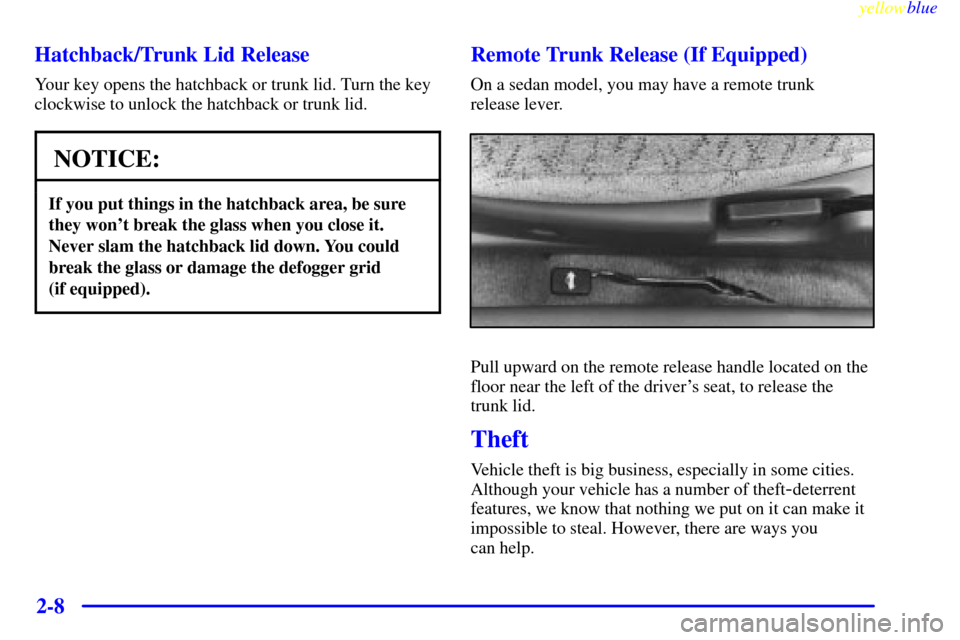
On a sedan model, you may have a remote trunk
release lever.
Pull upward on the remote release handle located on the
floor near the left of the driver's seat, to release the
trunk lid.
Theft
Vehicle theft is big business, especially in some cities.
Although your vehicle has a number of theft
-deterrent
features, we know that nothing we put on it can make it
impossible to steal. However, there are ways you
can help.
Page 67 of 328
yellowblue
2-9 Key in the Ignition
If you leave your vehicle with the keys inside, it's an
easy target for joy riders or professional thieves
-- so
don't do it.
When you park your vehicle and open the driver's door,
you'll hear a tone reminding you to remove your key from
the ignition and take it with you. Always do this. Your
steering wheel will be locked, and so will your ignition. If
you take the key with you, and you have an automatic
transaxle, it will be locked. And remember to lock the doors.
Parking at Night
Park in a lighted spot, close all windows and lock your
vehicle. Remember to keep your valuables out of sight.
Put them in a storage area, or take them with you.
Parking Lots
If you park in a lot where someone will be watching
your vehicle, it's best to lock it up and take your keys.
But what if you have to leave your key?
�If possible, park in a busy, well lit area.
�Put your valuables in a storage area, like your trunk or
glove box. Be sure to close and lock the storage area.
�Close all windows.
�Lock all the doors except the driver's.
New Vehicle ªBreak-Inº
NOTICE:
Your vehicle doesn't need an elaborate
ªbreak
-in.º But it will perform better in the long
run if you follow these guidelines:
�Don't drive at any one speed
-- fast or
slow
-- for the first 500 miles (805 km).
Don't make full
-throttle starts.
�Avoid making hard stops for the first
200 miles (322 km) or so. During this time
your new brake linings aren't yet broken
in. Hard stops with new linings can mean
premature wear and earlier replacement.
Follow this breaking
-in guideline every
time you get new brake linings.
Page 68 of 328

yellowblue
2-10
Ignition Positions
CAUTION:
Leaving children in a vehicle with the ignition
key is dangerous for many reasons. A child or
others could be badly injured or even killed.
They could operate controls or even make the
vehicle move. Don't leave the keys in the vehicle
with children.
With the key in the ignition
switch, you can turn the
switch to four positions.
LOCK (A): This is the only position in which you can
remove the key. This locks your steering wheel, ignition
and automatic transaxle. Press in on the key as you turn
it toward you to LOCK.If you have an automatic transaxle, the ignition switch
can't be turned to LOCK unless the shift lever is in the
PARK (P) position.
ACC (ACCESSORY) (B): In this position, you can
operate some of your electrical power accessories. It
unlocks the steering wheel and ignition. Use this
position if your vehicle must be pushed or towed.
ON (C): This is the position to which the switch returns
after you start your engine and release the switch. The
switch stays in the ON position when the engine is
running. But even when the engine is not running, you
can use ON to operate your electrical power accessories
(including the heater) and to display some instrument
panel warning lights.
START (D): This position starts the engine. When the
engine starts, release the key. The ignition switch will
return to ON for normal driving.
Note that even if the engine is not running, ACC and
ON are on positions that allow you to operate your
electrical accessories, such as the radio.
A warning tone will sound if you open the driver's door
when the ignition is in ACC or LOCK and the key is in
the ignition.