Page 68 of 328

yellowblue
2-10
Ignition Positions
CAUTION:
Leaving children in a vehicle with the ignition
key is dangerous for many reasons. A child or
others could be badly injured or even killed.
They could operate controls or even make the
vehicle move. Don't leave the keys in the vehicle
with children.
With the key in the ignition
switch, you can turn the
switch to four positions.
LOCK (A): This is the only position in which you can
remove the key. This locks your steering wheel, ignition
and automatic transaxle. Press in on the key as you turn
it toward you to LOCK.If you have an automatic transaxle, the ignition switch
can't be turned to LOCK unless the shift lever is in the
PARK (P) position.
ACC (ACCESSORY) (B): In this position, you can
operate some of your electrical power accessories. It
unlocks the steering wheel and ignition. Use this
position if your vehicle must be pushed or towed.
ON (C): This is the position to which the switch returns
after you start your engine and release the switch. The
switch stays in the ON position when the engine is
running. But even when the engine is not running, you
can use ON to operate your electrical power accessories
(including the heater) and to display some instrument
panel warning lights.
START (D): This position starts the engine. When the
engine starts, release the key. The ignition switch will
return to ON for normal driving.
Note that even if the engine is not running, ACC and
ON are on positions that allow you to operate your
electrical accessories, such as the radio.
A warning tone will sound if you open the driver's door
when the ignition is in ACC or LOCK and the key is in
the ignition.
Page 75 of 328
yellowblue
2-17
You cannot go directly from FIFTH (5) into
REVERSE (R). If you try, you will be locked out. You
must first shift into NEUTRAL (N), move the lever to
the left, back to the right, and then shift into
REVERSE (R). This is a safety feature.
NOTICE:
Shift to REVERSE (R) only after your vehicle is
stopped. Shifting to REVERSE (R) while your
vehicle is moving could damage your transaxle.
Also, use REVERSE (R) along with the parking brake
for parking your vehicle.
Shift Speeds
CAUTION:
If you skip more than one gear when you
downshift, you could lose control of your vehicle.
You could injure yourself or others. Don't shift
down more than one gear at a time when
you downshift.
Shift Light (United States Only)
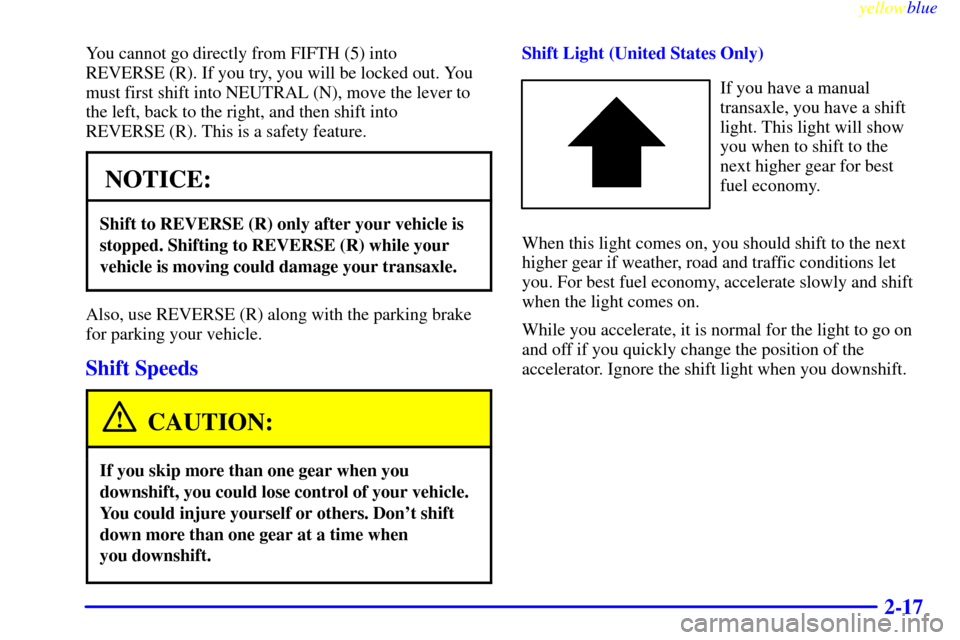
If you have a manual
transaxle, you have a shift
light. This light will show
you when to shift to the
next higher gear for best
fuel economy.
When this light comes on, you should shift to the next
higher gear if weather, road and traffic conditions let
you. For best fuel economy, accelerate slowly and shift
when the light comes on.
While you accelerate, it is normal for the light to go on
and off if you quickly change the position of the
accelerator. Ignore the shift light when you downshift.
Page 76 of 328
yellowblue
2-18
Parking Brake
The parking brake is located between the seats. To set
the parking brake, hold the brake pedal down and pull
up on the parking brake lever. If the ignition is on, the
brake system warning light will come on.
To release the parking brake, hold the brake pedal down.
Pull the parking brake lever up until you can press the
release button. Hold the release button in as you move
the lever all the way down.
NOTICE:
Driving with the parking brake on can cause
your rear brakes to overheat. You may have to
replace them, and you could also damage other
parts of your vehicle.
Page 83 of 328

yellowblue
2-25 Headlamp High/Low Beam Changer
To change the headlamps from low beam to high or high
beam to low, push the turn signal away from you. To
switch back to low beams, pull the lever toward you.
When the high beams are
on, this light on the
instrument panel also will
be on. It will go off when
you switch to the
low beams.
Flash-to-Pass
This feature lets you use your high-beam headlamps to
signal a driver in front of you that you want to pass.
To use it, pull the turn signal/multifunction lever toward
you until the high
-beam headlamps come on, then
release the lever to turn them off.
Windshield Wipers
You control the windshield wipers by moving the stalk
with the windshield wiper symbol on it up or down.
For steady wiping at low speed, move the stalk down to
LO. For high
-speed wiping, move the stalk down to HI.
To stop the wipers, move the stalk to OFF.
If your vehicle is equipped with intermittent wipers, you
can use this function by moving the stalk to INT. In light
rain or snow, you might want to use this position rather
than continuous wiping.
Page 86 of 328

yellowblue
2-28
When you turn off the headlamp switch, the regular
lamps will go off and your low
-beam headlamps will
come on at the reduced brightness of DRL.
To idle your vehicle with the DRL off, set the parking
brake. The DRL will stay off until you release the
parking brake.
As with any vehicle, you should turn on the regular
headlamp system when you need it.
Interior Lamps
Instrument Panel Brightness Control
This knob controls the
brightness of your
instrument panel lights.
Turn the knob clockwise to
brighten the lights or
counterclockwise to
dim them.
Dome Lamp
The dome lamp is located between the sun visors on
the two
-door model, and in the center of the roof on
the four
-door model. The dome lamp has a
three
-position switch.
OFF: The lamp stays off even when the driver's door
is open.
CENTER: The lamp comes on when the driver's door
is opened.
ON: The lamp comes on and stays on whether or not a
door is open.
Mirrors
Inside Day/Night Rearview Mirror
An inside rearview mirror is attached above your
windshield. The mirror has a pivot so that you can adjust
it up and down or side to side.
You can adjust the mirror for day or night driving. Pull
the tab toward you for night driving to reduce glare.
Push the tab away from you for daytime driving.
Page 89 of 328
yellowblue
2-31
CAUTION:
An improperly stored cargo cover could be
thrown about the vehicle during a collision or
sudden maneuver. You or others could be
injured. If you remove the cover, always store it
horizontally between the front seatbacks and rear
seat cushion. When you put it back, always be
sure that it is securely reattached.
To install the cargo cover:
1. Raise the rear seatback.
2. Place the cover into its retainers and slide it gently
away from you until it is secure.
3. Attach the lifter lines to the hatchback lid.
Ashtray and Cigarette Lighter
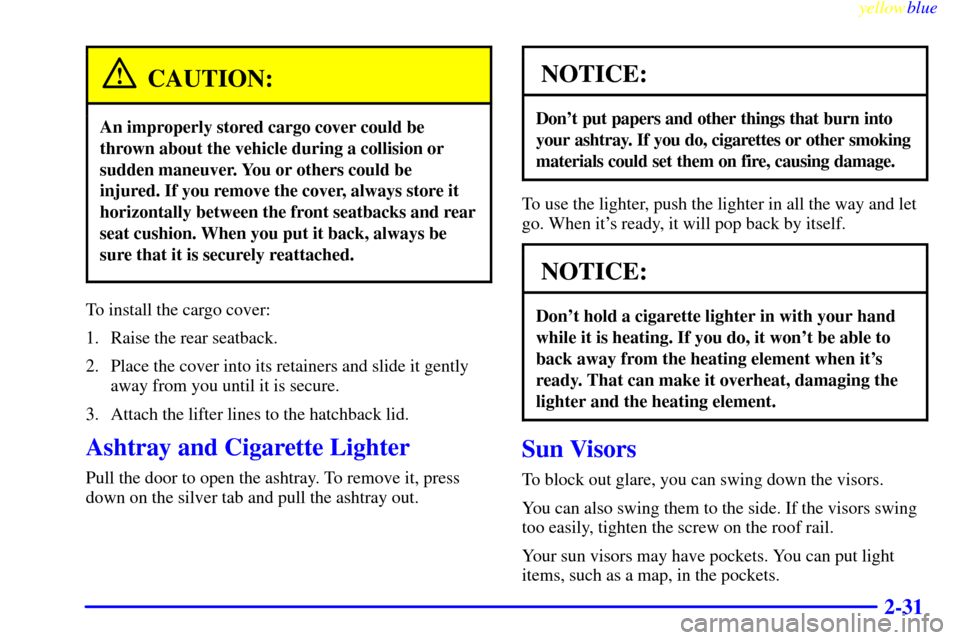
Pull the door to open the ashtray. To remove it, press
down on the silver tab and pull the ashtray out.
NOTICE:
Don't put papers and other things that burn into
your ashtray. If you do, cigarettes or other smoking
materials could set them on fire, causing damage.
To use the lighter, push the lighter in all the way and let
go. When it's ready, it will pop back by itself.
NOTICE:
Don't hold a cigarette lighter in with your hand
while it is heating. If you do, it won't be able to
back away from the heating element when it's
ready. That can make it overheat, damaging the
lighter and the heating element.
Sun Visors
To block out glare, you can swing down the visors.
You can also swing them to the side. If the visors swing
too easily, tighten the screw on the roof rail.
Your sun visors may have pockets. You can put light
items, such as a map, in the pockets.
Page 91 of 328
yellowblue
2-33
1. Rear Window Wiper Switch (If Equipped)
2. Turn Signal/Multifunction Lever
3. Air Vent
4. Brightness Control
5. Horn
6. Hazard Warning Flasher
7. Instrument Cluster
8. Ignition Switch
9. Windshield Wiper/Washer Lever
10. Coinholder
11. Comfort Controls
12. Side Defroster Vent13. Glove Box
14. Audio System
15. Cigarette Lighter
16. Cupholder
17. Storage Compartment
18. Parking Brake Lever
19. Transaxle Shift Lever
20. Ashtray
21. Fuse Block
22. Hood Release
23. Rear Window Defogger Switch
24. Rear Window Washer Switch (If Equipped)
Page 95 of 328

yellowblue
2-37
Warning Lights, Gages and Indicators
This part describes the warning lights and gages that may
be on your vehicle. The pictures will help you locate them.
Warning lights and gages can signal that something is
wrong before it becomes serious enough to cause an
expensive repair or replacement. Paying attention to
your warning lights and gages could also save you or
others from injury.
Warning lights come on when there may be or is a
problem with one of your vehicle's functions. As you will
see in the details on the next few pages, some warning
lights come on briefly when you start the engine just to let
you know they're working. If you are familiar with this
section, you should not be alarmed when this happens.
Gages can indicate when there may be or is a problem
with one of your vehicle's functions. Often gages and
warning lights work together to let you know when
there's a problem with your vehicle.
When one of the warning lights comes on and stays on
when you are driving, or when one of the gages shows
there may be a problem, check the section that tells you
what to do about it. Please follow this manual's advice.
Waiting to do repairs can be costly
-- and even
dangerous. So please get to know your warning lights
and gages. They're a big help.
Safety Belt Reminder Light
When the key is turned to ON or START, a tone will
come on for about eight seconds to remind people to
fasten their safety belts, unless the driver's safety belt is
already buckled.
The safety belt light will
also come on and stay on
until the driver's belt
is buckled.
Air Bag Readiness Light
There is an air bag readiness light on the instrument
panel, which shows AIR BAG. The system checks the
air bag's electrical system for malfunctions. The light
tells you if there is an electrical problem. The system
check includes the air bag sensors, the air bag modules,
the wiring and the crash sensing and diagnostic module.
For more information on the air bag system, see ªAir
Bagº in the Index.