Page 100 of 376
yellowblue
2-48
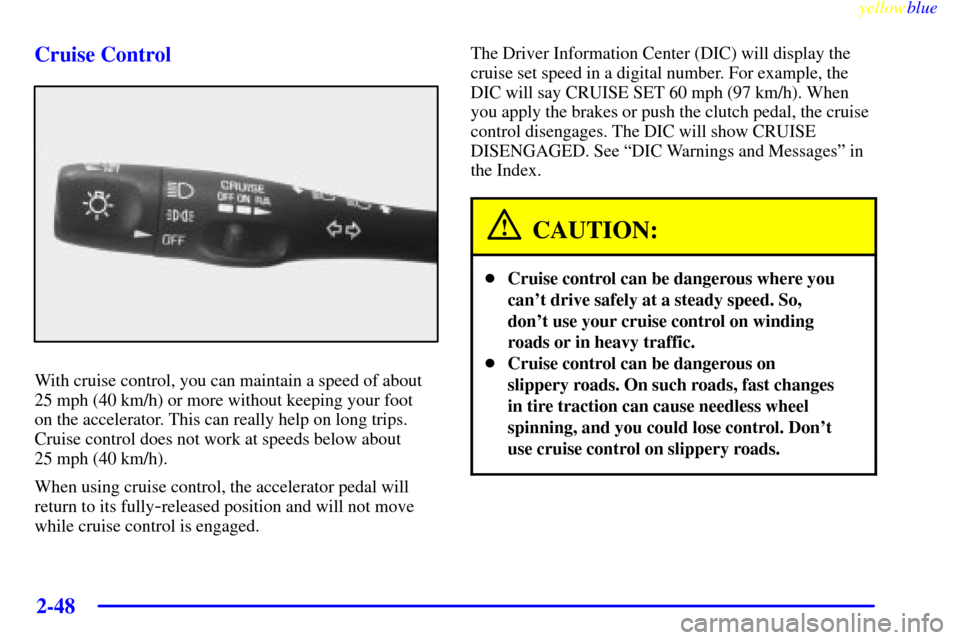
Cruise Control
With cruise control, you can maintain a speed of about
25 mph (40 km/h) or more without keeping your foot
on the accelerator. This can really help on long trips.
Cruise control does not work at speeds below about
25 mph (40 km/h).
When using cruise control, the accelerator pedal will
return to its fully
-released position and will not move
while cruise control is engaged.The Driver Information Center (DIC) will display the
cruise set speed in a digital number. For example, the
DIC will say CRUISE SET 60 mph (97 km/h). When
you apply the brakes or push the clutch pedal, the cruise
control disengages. The DIC will show CRUISE
DISENGAGED. See ªDIC Warnings and Messagesº in
the Index.
CAUTION:
�Cruise control can be dangerous where you
can't drive safely at a steady speed. So,
don't use your cruise control on winding
roads or in heavy traffic.
�Cruise control can be dangerous on
slippery roads. On such roads, fast changes
in tire traction can cause needless wheel
spinning, and you could lose control. Don't
use cruise control on slippery roads.
Page 127 of 376
yellowblue
2-75
The main components of your instrument panel are:
A. HUD Controls (Option)
B. Turn Signal/Multifunction Lever
C. Driver Information Center (DIC)
(Located in the Instrument Cluster)
D. Instrument Panel Cluster
E. Windshield Wiper/Washer Lever
F. Driver Information Center (DIC) Buttons
G. Hazard Warning Flasher Button
H. Center Air Vent
I. Audio System
J. Comfort Controls
K. Fog Lamp Button (Option)
L. Remote Hatch Release Button (Coupe) or Remote
Trunk Release Button (Convertible/Hardtop)M. Ignition Switch
N. Shift Lever (Automatic Shown)
O. Traction Control System (TCS) Switch/Active
Handling Switch (Option)
P. Accessory Power Outlet
(Located in the Center Console)
Q. Selective Real Time Damping (SRTD) (Option)
R. Instrument Panel Cupholder
S. Remote Fuel Door Release Button
(Located in the Center Console)
T. Ashtray and Cigarette Lighter
U. Parking Brake
V. Glove Box
W. Instrument Panel Fuse Block
Page 128 of 376
yellowblue
2-76
Instrument Panel Cluster
Your instrument panel cluster and Driver Information Center (DIC) are designed to let you know at a glance how the
vehicle is running. You'll know how fast you're going, about how much fuel you have left and many other things
you'll need to know to drive safely and economically. The instrument panel cluster indicator warning lights, gages
and DIC messages are explained on the following pages.
Page 129 of 376

yellowblue
2-77 Speedometer and Odometer
Your speedometer lets you see your speed in either miles
per hour (mph) or kilometers per hour (km/h).
You may note that there are not two separate scales for
mph and km/h. When you press the E/M
(English/Metric) button on the Driver Information
Center (DIC), the cluster will calculate the proper speed
and move the needle to the correct position. Either the
MPH or the km/h telltale will illuminate, depending on
which measurement you choose.
You may wonder what happens if your vehicle needs a
new odometer installed. If the new one can be set to the
mileage total of the old odometer, then that will be done.
If it can't, then a new instrument cluster is replaced in
the vehicle and a label must be put on the driver's door
to show the old mileage reading when the new odometer
was installed. See your dealer if a new odometer must
be replaced in your vehicle.
Tachometer
The tachometer displays the engine speed in thousands
of revolutions per minute (rpm).
Fuel will shut off at about 6200 rpm.
If you continue to drive your vehicle at the fuel shut off
rpm, you could damage your engine. Be sure to operate
your vehicle below the fuel shut off rpm or reduce your
rpm quickly when the fuel shuts off.
Warning Lights, Gages and Messages
This part describes the warning lights and gages that
may be on your vehicle. The pictures will help you
locate them.
Warning lights and gages can signal that something is
wrong before it becomes serious enough to cause an
expensive repair or replacement. Paying attention to
your warning lights and gages could also save you or
others from injury.
Warning lights come on when there may be or is a
problem with one of your vehicle's functions. As you
will see in the details on the next few pages, some
warning lights come on briefly when you start the
engine just to let you know they're working. If you are
familiar with this section, you should not be alarmed
when this happens.
Page 130 of 376

yellowblue
2-78
Gages can indicate when there may be or is a problem
with one of your vehicle's functions. Often gages and
warning lights work together to let you know when
there's a problem with your vehicle.
When one of the warning lights comes on and stays on
when you are driving, or when one of the gages shows
there may be a problem, check the section that tells you
what to do about it. Please follow this manual's advice.
Waiting to do repairs can be costly
-- and even
dangerous. So please get to know your warning lights
and gages. They're a big help.
Your vehicle also has a Driver Information Center that
works along with the warning lights and gages. See
ªDriver Information Center (DIC)º in the Index.
Safety Belt Reminder Light
When the key is turned to ON or START, a chime will
come on for about eight seconds to remind people to
fasten their safety belts, unless the driver's safety belt is
already buckled.
The safety belt light will
also come on and stay
on until the driver's belt
is buckled.
Air Bag Readiness Light
There is an air bag readiness light on the instrument
panel, which shows a deployed air bag symbol. The
system checks the air bag's electrical system for
malfunctions. The light tells you if there is an electrical
problem. The system check includes the air bag sensors,
the air bag modules, the wiring and the diagnostic
module. For more information on the air bag system, see
ªAir Bagº in the Index.
This light will come on
when you start your engine,
and it will flash for a few
seconds. Then the light
should go out. This means
the system is ready.
Page 131 of 376

yellowblue
2-79
If the air bag readiness light stays on after you start the
engine or comes on when you are driving, your air bag
system may not work properly. Have your vehicle
serviced right away.
The air bag readiness light should flash for a few
seconds when you turn the ignition key to ON. If the
light doesn't come on then, have it fixed so it will be
ready to warn you if there is a problem.
Voltmeter
When the key is in ON with
the engine not running, the
voltmeter shows the voltage
output of your battery.
When the engine is running,
it shows the voltage output
of the charging system.The reading will change as the rate of charge changes
(with engine speed, for example), but if the voltmeter
reads at 9 volts or below, your instrument panel and
other systems may shut down. The Driver Information
Center (DIC) will read LOW VOLTAGE when your
vehicle is at 10 volts or below. Have it checked right
away. Driving with the voltmeter reading at 10 volts or
below could drain your battery and disable your vehicle.
Brake System Warning Light
Your vehicle's hydraulic brake system is divided into
two parts. If one part isn't working, the other part can
still work and stop you. For good braking, though, you
need both parts working well.
This light should come on
when you turn the ignition
key to START.
Page 132 of 376

yellowblue
2-80
If it doesn't come on then, have it fixed so it will be
ready to warn you if there's a problem. If this warning
light stays on after you start the engine, the parking
brake may not be set or there could be a brake problem.
Refer to ªParking Brakeº in the Index to see if it is set.
If the parking brake is not set, have your brake system
inspected right away.
If the light comes on while you are driving and you have
a LOW BRAKE FLUID message showing on the DIC,
pull off the road and stop carefully. You may notice that
the pedal is harder to push. Or, the pedal may go closer
to the floor. It may take longer to stop. If the light is still
on, have the vehicle towed for service. (See ªTowing
Your Vehicleº in the Index.)
CAUTION:
Your brake system may not be working properly
if the brake warning light is on. Driving with the
brake warning light on can lead to an accident.
If the light is still on after you've pulled off the
road and stopped carefully, have the vehicle
towed for service.
Anti-Lock Brake System Warning Light
With the anti-lock brake
system, the light will come
on when you start your
engine and may stay on
for several seconds.
That's normal.
If the light stays on, turn the ignition to OFF. Or, if the
light comes on when you're driving, stop as soon as
possible and turn the ignition off. Then start the engine
again to reset the system. If the light still stays on, or
comes on again while you're driving, your vehicle needs
service. If the regular brake system warning light isn't
on, you still have brakes, but you don't have anti
-lock
brakes. If the regular brake system warning light is also
on, you don't have anti
-lock brakes and there's a
problem with your regular brakes. See ªBrake System
Warning Lightº earlier in this section.
The anti
-lock brake system warning light should come
on briefly when you turn the ignition key to ON. If the
light doesn't come on then, have it fixed so it will be
ready to warn you if there is a problem.
Page 138 of 376
yellowblue
2-86
CAUTION:
Don't keep driving if the oil pressure is low. If
you do, your engine can become so hot that it
catches fire. You or others could be burned.
Check your oil as soon as possible and have your
vehicle serviced.
NOTICE:
Damage to your engine from neglected oil
problems can be costly and is not covered by
your warranty.
Security Light
This light comes on to
remind you to arm your
theft
-deterrent system. If it
comes on and stays on when
your ignition is on, there
may be a problem with your
theft
-deterrent system.
See ªUniversal Theft
-Deterrentº and ªPASS-Key
Systemº in the Index.
Check Gages Warning Light
This light will come on
briefly when you are
starting the engine. If the
light comes on and stays on
while you are driving, check
your gages to see if they are
in the warning areas.