Page 73 of 376
yellowblue
2-21
Front Air Dam
Your vehicle is equipped with a front air dam which has
minimal ground clearance for aerodynamics. For this
reason, the air dam has a spring
- loaded hinge provided
and it will retract with road contact.
In normal operation, the air dam will occasionally
contact some road surfaces (speed bumps, driveway
ramps, etc.). This can be heard inside the vehicle as a
scraping noise. This is normal and does not indicate
a problem.
Use care when approaching bumps or objects on road
surfaces and avoid them when possible.
Ignition Positions
CAUTION:
Leaving children in a vehicle with the ignition
key is dangerous for many reasons. A child or
others could be injured or even killed. They could
operate power windows or other controls or even
make the vehicle move. Don't leave the keys in
the vehicle with children.
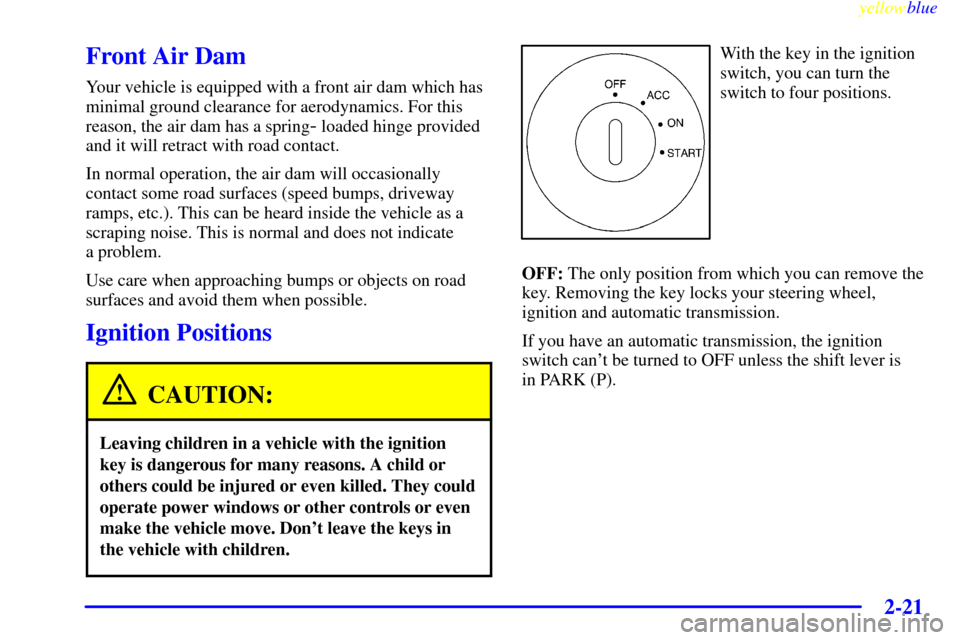
With the key in the ignition
switch, you can turn the
switch to four positions.
OFF: The only position from which you can remove the
key. Removing the key locks your steering wheel,
ignition and automatic transmission.
If you have an automatic transmission, the ignition
switch can't be turned to OFF unless the shift lever is
in PARK (P).
Page 74 of 376
yellowblue
2-22
ACC: This is an on position in which you can operate
your electrical power accessories. With the key in this
position, the automatic transmission and steering
column will unlock.
ON: This is the position to which the switch returns
after you start the engine and release the switch. The
switch stays in ON when the engine is running. But even
when the engine is not running, you can use ON to
operate your electrical power accessories and to display
some instrument panel messages and telltales.
START: This position starts the engine. When the
engine starts, release the key. The ignition switch will
return to ON for normal driving.
When the engine is not running, ACC and ON allow you
to operate your electrical accessories, such as the radio.
A warning tone will sound if you open the driver's door
when the ignition is in OFF or ACC and the key is in
the ignition.
CAUTION:
Removing the key from the ignition switch will
lock the steering column and result in a loss of
ability to steer the vehicle. This could cause a
collision. If you need to turn the engine off while
the vehicle is moving, turn the key to ACC.
NOTICE:
If your key seems stuck in OFF and you can't
turn it, be sure you are using the correct key; if
so, is it all the way in? Turn the key only with
your hand. Using a tool to force it could break
the key or the ignition switch. If none of this
works, then your vehicle needs service.
Page 92 of 376
yellowblue
2-40
Selective Real Time Damping
(SRTD) (Option)
You may have a ride control system on your vehicle
called Selective Real Time Damping (SRTD). The
system provides the following performance benefits:
�Reduced Impact Harshness
�Improved Road Isolation
�Improved High
-Speed Stability
�Improved Handling Response
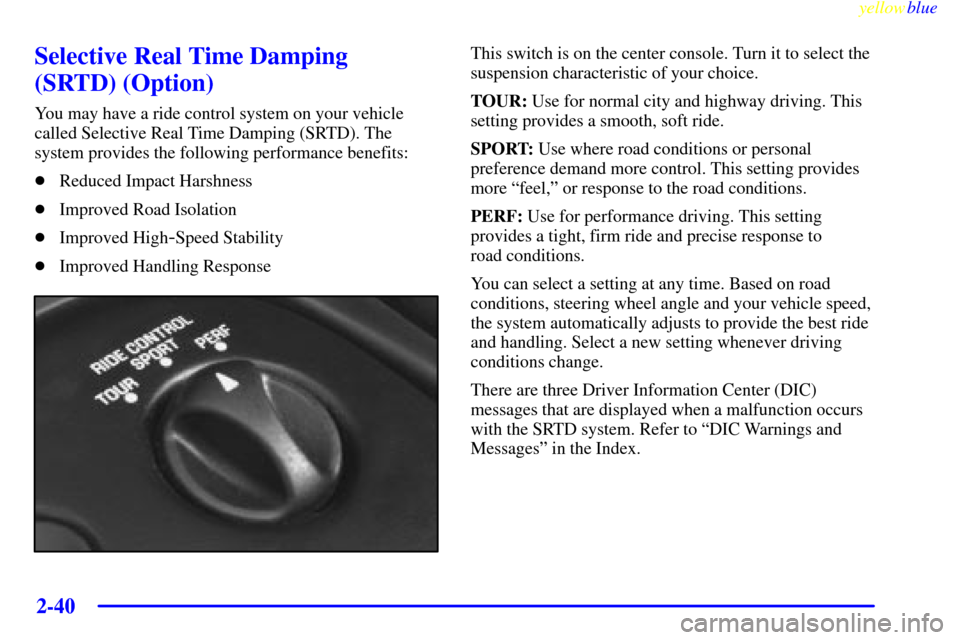
This switch is on the center console. Turn it to select the
suspension characteristic of your choice.
TOUR: Use for normal city and highway driving. This
setting provides a smooth, soft ride.
SPORT: Use where road conditions or personal
preference demand more control. This setting provides
more ªfeel,º or response to the road conditions.
PERF: Use for performance driving. This setting
provides a tight, firm ride and precise response to
road conditions.
You can select a setting at any time. Based on road
conditions, steering wheel angle and your vehicle speed,
the system automatically adjusts to provide the best ride
and handling. Select a new setting whenever driving
conditions change.
There are three Driver Information Center (DIC)
messages that are displayed when a malfunction occurs
with the SRTD system. Refer to ªDIC Warnings and
Messagesº in the Index.
Page 93 of 376
yellowblue
2-41
Windows
Power Windows
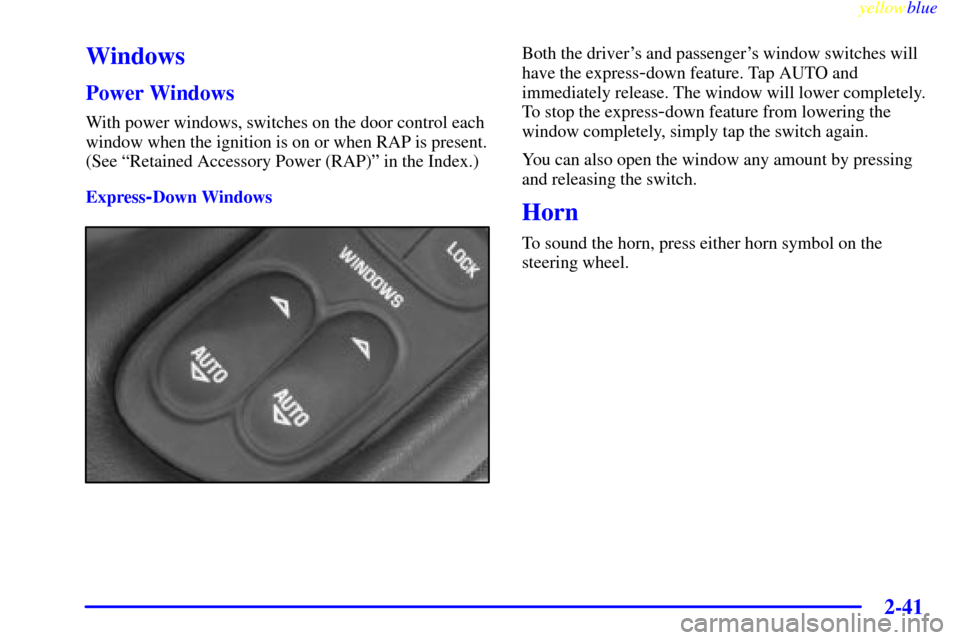
With power windows, switches on the door control each
window when the ignition is on or when RAP is present.
(See ªRetained Accessory Power (RAP)º in the Index.)
Express
-Down Windows
Both the driver's and passenger's window switches will
have the express
-down feature. Tap AUTO and
immediately release. The window will lower completely.
To stop the express
-down feature from lowering the
window completely, simply tap the switch again.
You can also open the window any amount by pressing
and releasing the switch.
Horn
To sound the horn, press either horn symbol on the
steering wheel.
Page 94 of 376
yellowblue
2-42
Tilt Wheel
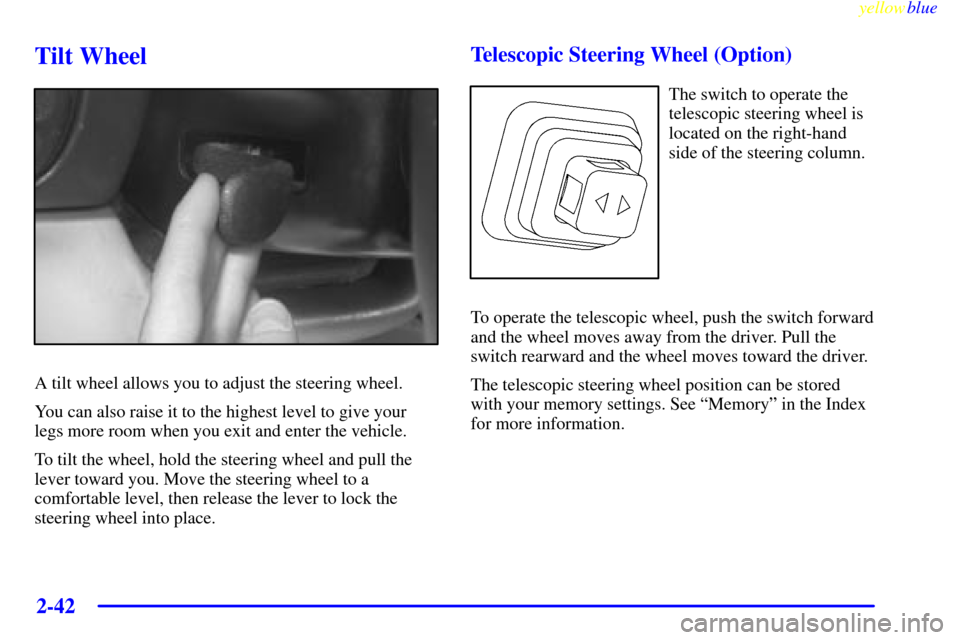
A tilt wheel allows you to adjust the steering wheel.
You can also raise it to the highest level to give your
legs more room when you exit and enter the vehicle.
To tilt the wheel, hold the steering wheel and pull the
lever toward you. Move the steering wheel to a
comfortable level, then release the lever to lock the
steering wheel into place.
Telescopic Steering Wheel (Option)
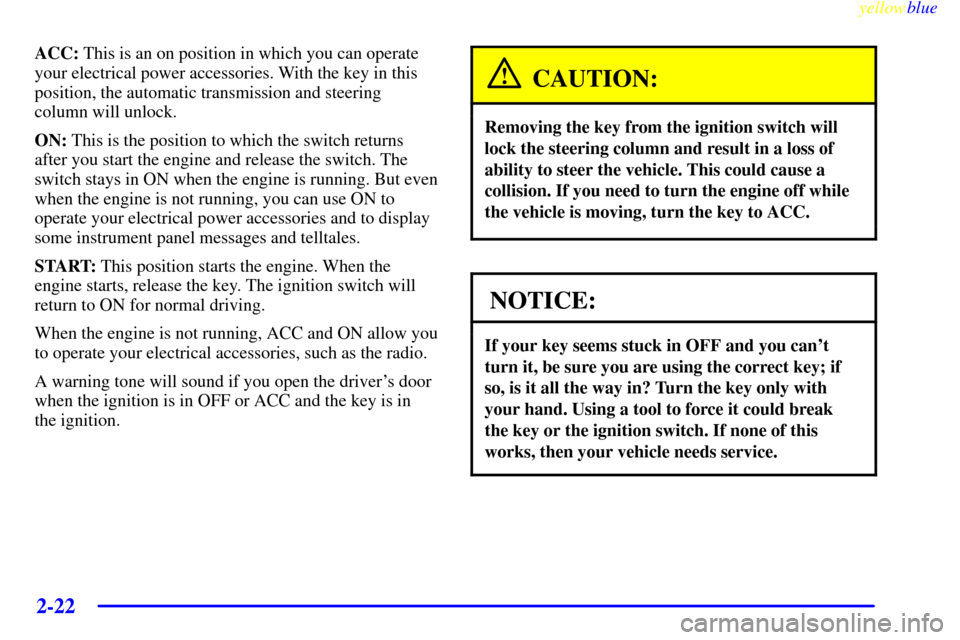
The switch to operate the
telescopic steering wheel is
located on the right-hand
side of the steering column.
To operate the telescopic wheel, push the switch forward
and the wheel moves away from the driver. Pull the
switch rearward and the wheel moves toward the driver.
The telescopic steering wheel position can be stored
with your memory settings. See ªMemoryº in the Index
for more information.
Page 95 of 376

yellowblue
2-43
Turn Signal/Multifunction Lever
The multifunction lever on the left-hand side of the
steering column includes your:
�Turn Signal and Lane Change Control
�Headlamp High/Low
-Beam Changer
�Cruise Control
�Headlamps Switch
�Flash
-to-Pass
Turn and Lane Change Signals
The turn signal has two upward (for right) and two
downward (for left) positions. These positions allow you
to signal a turn or a lane change.
To signal a turn, move the multifunction lever all the
way up or down. When the turn is finished, the lever
will return automatically.
An arrow on the instrument
cluster will flash in the
direction of the turn or
lane change.
To signal a lane change, just raise or lower the lever
until the arrow starts to flash. Hold it there until you
complete your lane change. The lever will return by
itself when you release it.
As you signal a turn or a lane change, if the arrows flash
faster than normal, a signal bulb may be burned out.
If a bulb is burned out, replace it to help avoid an
accident. If the arrows don't go on at all when you
signal a turn, check the fuses and check for burned
-out
bulbs. (See ªFuses and Circuit Breakersº in the Index.)
Page 98 of 376

yellowblue
2-46
Headlamp High/Low-Beam Changer
To change the headlamps
from low beam to high or
high to low, push the turn
signal lever all the way
forward.
When the high beams are on, this light on the instrument
panel also will be on. To change the headlamps from
high to low, pull the lever rearward.
Lamps on Reminder
If you turn the ignition off and leave the headlamps or
parking lamps on and open the door, you will hear a
chime reminding you to turn off all lamps.
Flash-to-Pass
Momentarily pull the turn signal lever toward you. The
high
-beam indicator will flash to indicate to the other
driver that you intend to pass. If the low
-beam
headlamps are off and you have the optional fog lamps
on, the fog lamps will flash.
Windshield Wipers
You can control the windshield wipers by moving the
lever with the wiper symbol on it. This lever is located
on the right side of the steering column.
For a single wiping cycle, push the lever down to MIST.
Hold it there until the wipers start, then let go. The
wipers will stop after one cycle. If you want more
cycles, hold the lever on MIST longer.
Page 99 of 376

yellowblue
2-47
You can set the wiper speed for a long or short delay
between wipes. This can be very useful in light rain or
snow. Push the lever up to INT (intermittent), then turn
the band, located on the lever, to adjust the delay time.
Rotate the band up for a shorter delay, down for a longer
delay. The wiper speed can only be adjusted when the
lever is in the INT position, not in HI or LO.
For steady wiping at low speed, move the lever up to the
LO position. For steady high
-speed wiping, move the
lever up further, to HI. To stop the wipers, move the
lever down to OFF.
Be sure to clear ice and snow from the wiper blades
before using them. If they're frozen to the windshield,
carefully loosen or thaw them. If the blades do become
damaged, get new blades or blade inserts.
Heavy snow or ice can overload the wipers. A circuit
breaker will stop them until the motor cools. Clear away
snow or ice to prevent an overload.
Windshield Washer
The lever on the right side of the steering column also
controls the windshield washer. There is a push button at
the end of the lever. To spray washer fluid on the
windshield, push the button and hold it. The washer will
spray until you release the button. The wipers will
continue to clear the window for about six seconds after
the button is released and then stop or return to your
preset speed.
CAUTION:
In freezing weather, don't use your washer until
the windshield is warmed. Otherwise the washer
fluid can form ice on the windshield, blocking
your vision.
If the fluid in the windshield washer fluid reservoir is low,
the message LOW WASHER FLUID will appear on the
Driver Information Center (DIC) display. It will take
60 seconds after the bottle is refilled for this message to
turn off. For information on the correct washer fluid
mixture to use, see ªWindshield Washer Fluidº and
ªRecommended Fluids and Lubricantsº in the Index.