Page 47 of 376
yellowblue
1-35
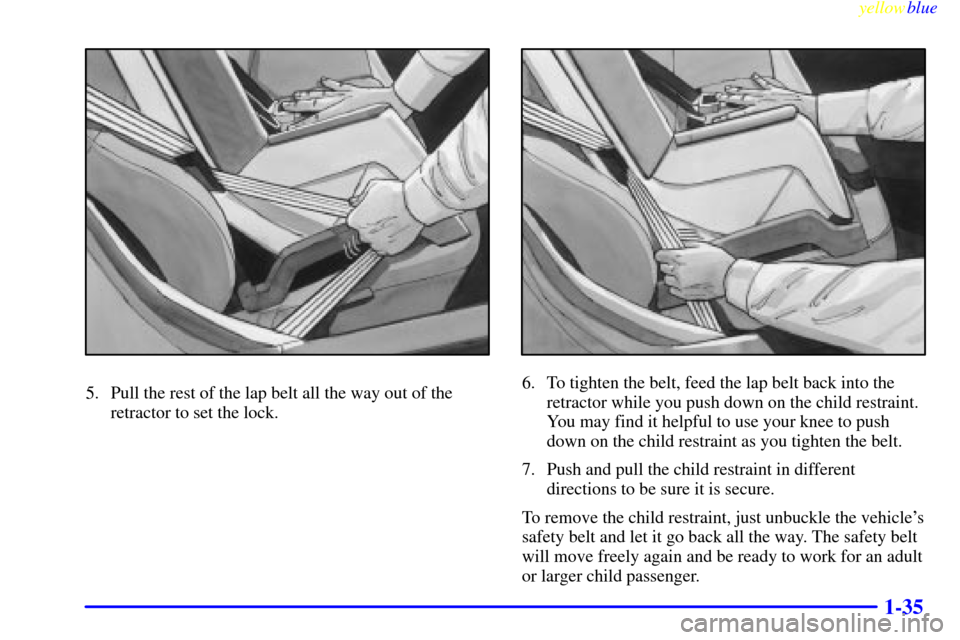
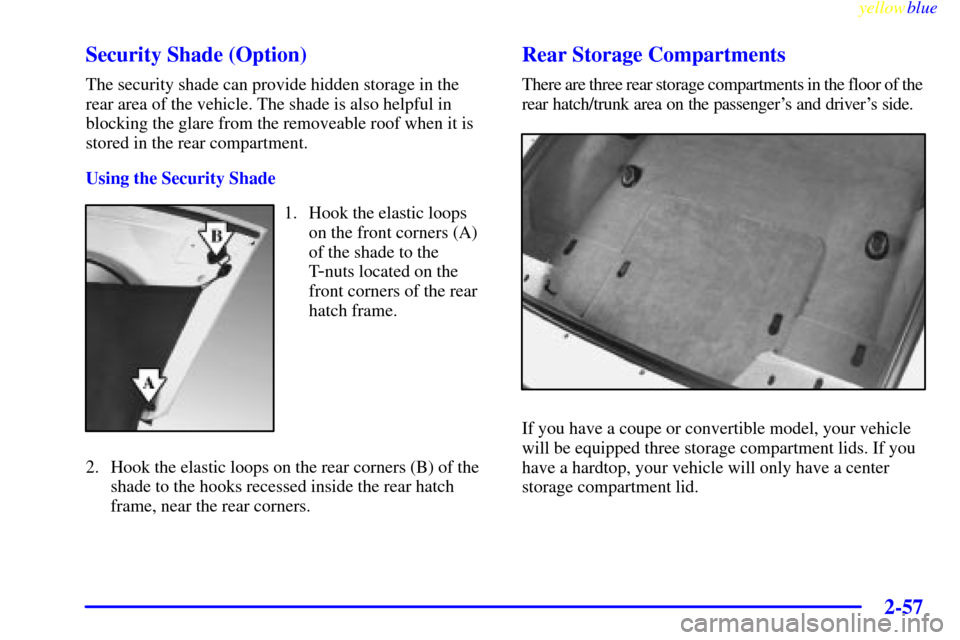
5. Pull the rest of the lap belt all the way out of the
retractor to set the lock.6. To tighten the belt, feed the lap belt back into the
retractor while you push down on the child restraint.
You may find it helpful to use your knee to push
down on the child restraint as you tighten the belt.
7. Push and pull the child restraint in different
directions to be sure it is secure.
To remove the child restraint, just unbuckle the vehicle's
safety belt and let it go back all the way. The safety belt
will move freely again and be ready to work for an adult
or larger child passenger.
Page 66 of 376
yellowblue
2-14
Resynchronizing Your Transmitter
Your RFA system uses a continually changing code for
increased security. Normally, the receiver in your
vehicle will keep track of this changing code. If your
vehicle does not respond to your transmitter, do the
following to determine what's wrong:
1. Get closer to the vehicle and try pressing a button
again. Your battery may be low (If so, see ªBattery
Replacementº in the Index).
2. While standing close to your vehicle, press the
LOCK and UNLOCK buttons on your transmitter at
the same time and hold for seven seconds. This will
attempt to resynchronize the security code in your
RFA key fob transmitter.
3. When resynchronization is achieved, the horn
will chirp.
Loss of synchronization will occur after transmitter
battery replacement or disconnection of the
vehicle's battery.
If attempts to resynchronize your transmitter to the
vehicle are not successful, you may need to match the
transmitter to the vehicle. See ªMatching Transmitter(s)
to Your Vehicleº in the Index.
Remote Hatch/Trunk Lid Release
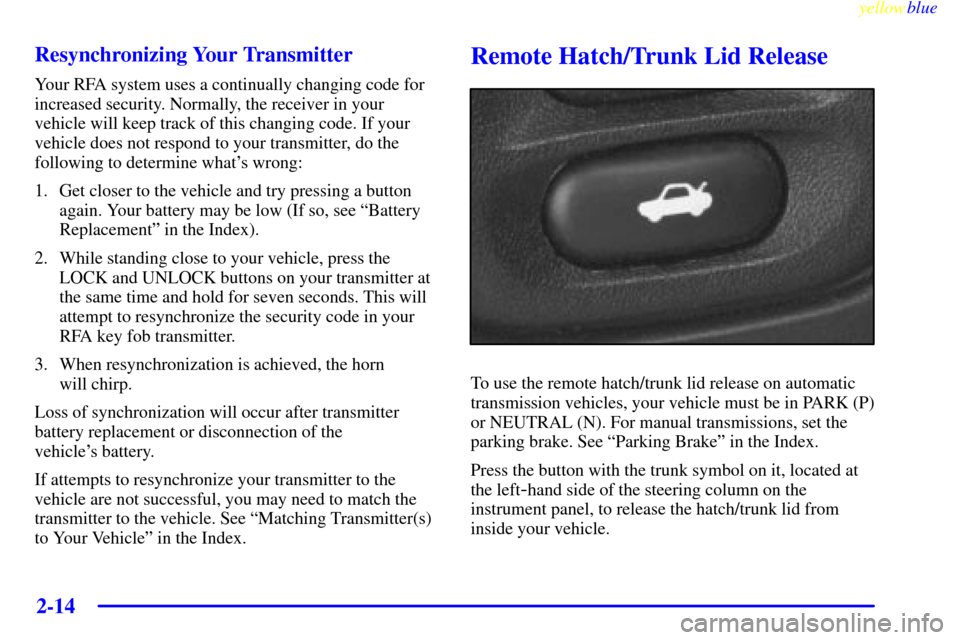
To use the remote hatch/trunk lid release on automatic
transmission vehicles, your vehicle must be in PARK (P)
or NEUTRAL (N). For manual transmissions, set the
parking brake. See ªParking Brakeº in the Index.
Press the button with the trunk symbol on it, located at
the left
-hand side of the steering column on the
instrument panel, to release the hatch/trunk lid from
inside your vehicle.
Page 69 of 376

yellowblue
2-17
Theft
Vehicle theft is big business, especially in some cities.
Although your vehicle has a number of theft
-deterrent
features, we know that nothing we put on it can make
it impossible to steal. However, there are ways you
can help.
Key in the Ignition
If you leave your vehicle with the keys inside, it's an
easy target for joy riders or professional thieves
-- so
don't do it.
When you park your vehicle and open the driver's door,
you'll hear a chime reminding you to remove your key
from the ignition and take it with you. Always do this.
Your steering wheel will be locked, and so will your
ignition. If you take the key with you, and you have an
automatic transmission, it will be locked. And remember
to lock the doors.
Parking at Night
Park in a lighted spot, close all windows and lock your
vehicle. Remember to keep your valuables out of sight.
Put them in a storage area, or take them with you.
Parking Lots
If you park in a lot where someone will be watching
your vehicle, it's best to lock it up and take your keys.
But what if you have to leave your key? Do not leave
valuables in your vehicle, since there would be no place
to secure them.
Universal Theft-Deterrent System
Your vehicle has
a theft
-deterrent
alarm system.
With this system, the SECURITY light will flash as you
open the door (if your ignition is off). This light reminds
you to arm the theft
-deterrent system.
Page 70 of 376

yellowblue
2-18
Arming the System
Use one of the following items listed here to arm
the system:
�Press the LOCK button on the key fob transmitter,
�Walk out of range with the passive switch on, or
�Open the door. (The SECURITY light should flash.)
Lock the door with the power door lock switch. The
SECURITY light will stop flashing and stay on.
Close the door. The SECURITY light should go off.
Testing the Alarm
Use the following to test the system:
1. Make sure the hatch/trunk lid is latched and set the
passive switch on the key fob transmitter to OFF.
2. Lower a window on the door.
3. Manually arm the system.
4. Close the doors and wait 15 seconds.
5. Reach through the open window and unlock the
door. Now open the door. The alarm should sound.
6. Turn off the alarm.If the alarm is inoperative, check to see if the horn
works. If not, check the horn fuse. See ªFuses and
Circuit Breakersº in the Index. If the horn works, but the
alarm doesn't go off, see your dealer.
Disarming the System
Always use your key or the key fob transmitter to
unlock a door. Unlocking a door any other way will set
off the alarm. If your alarm sounds, listed below are the
ways you can disarm it:
�Unlock any door with your key.
�Put the key in the ignition.
�Press the UNLOCK button on the key
fob transmitter.
�Walk into range with the passive switch on.
Page 71 of 376

yellowblue
2-19
Now, if a door or the hatch/trunk lid is opened without
the key or the key fob transmitter, the alarm will go off.
Your horn will sound for two minutes, then it will go off
to save battery power. And, your vehicle won't start.
The theft
-deterrent system won't arm if you lock the
doors with a key, the manual door lock, or if you use the
power door lock after the doors are closed.
If your passenger stays in the vehicle when you leave
with the keys, have the passenger lock the vehicle after
the doors are closed. This way the alarm won't arm, and
your passenger won't set it off.
PASS-Key�
Your vehicle is equipped
with the PASS
-Key
(Personalized Automotive
Security System)
theft
-deterrent system.
PASS
-Key is a passive
theft
-deterrent system. It
works when you insert or
remove the key from
the ignition.PASS
-Key uses a resistor pellet in the ignition key that
matches a decoder in your vehicle.
When the PASS
-Key system senses that someone is
using the wrong key, it shuts down the vehicle's starter
and fuel systems. For about three minutes, the starter
won't work and fuel won't go to the engine. If someone
tries to start your vehicle again or uses another key
during this time, the shutdown period will start over
again. This discourages someone from randomly trying
different keys with different resistor pellets in an attempt
to make a match.
The key must be clean and dry before it's inserted in the
ignition or the engine may not start. If the SECURITY
light comes on, the key may be dirty or wet.
If this happens and the starter won't work, turn the
ignition off. Clean and dry the key, wait three minutes
and try again. If the starter still won't work, wait three
minutes and try the other ignition key. At this time, you
may also want to check the fuses (see ªFuses and Circuit
Breakersº in the Index). If the starter won't work with
the other key, your vehicle needs service. If your vehicle
does start, the first ignition key may be faulty. See your
dealer or a locksmith who can service the PASS
-Key.
Page 72 of 376

yellowblue
2-20
If you accidentally use a key that has a damaged or
missing resistor pellet, you will see no SECURITY
light. You don't have to wait three minutes before trying
the proper key.
If the resistor pellet is damaged or missing, the starter
won't work. Use the other ignition key, and see your
dealer or a locksmith who can service the PASS
-Key to
have a new key made.
If the SECURITY light comes on while driving, have
your vehicle serviced as soon as possible.
If you lose or damage a PASS
-Key ignition key, see
your dealer or a locksmith who can service PASS
-Key.
In an emergency, call the Chevrolet Roadside Assistance
Center at 1
-800-CHEV-USA� (1-800-243-8872).
(In Canada, call 1
-800-268-6800.)
New Vehicle ªBreak-Inº
NOTICE:
Your vehicle doesn't need an elaborate
ªbreak
-in.º But it will perform better in the long
run if you follow these guidelines:
�Keep your speed at 55 mph (88 km/h) or
less for the first 500 miles (805 km).
�Don't drive at any one speed
-- fast or
slow
-- for the first 500 miles (805 km).
Don't make full
-throttle starts.
�Avoid making hard stops for the first
200 miles (322 km) or so. During this time
your new brake linings aren't yet broken
in. Hard stops with new linings can mean
premature wear and earlier replacement.
Follow this breaking
-in guideline every
time you get new brake linings.
Page 109 of 376
yellowblue
2-57 Security Shade (Option)
The security shade can provide hidden storage in the
rear area of the vehicle. The shade is also helpful in
blocking the glare from the removeable roof when it is
stored in the rear compartment.
Using the Security Shade
1. Hook the elastic loops
on the front corners (A)
of the shade to the
T
-nuts located on the
front corners of the rear
hatch frame.
2. Hook the elastic loops on the rear corners (B) of the
shade to the hooks recessed inside the rear hatch
frame, near the rear corners.
Rear Storage Compartments
There are three rear storage compartments in the floor of the
rear hatch/trunk area on the passenger's and driver's side.
If you have a coupe or convertible model, your vehicle
will be equipped three storage compartment lids. If you
have a hardtop, your vehicle will only have a center
storage compartment lid.
Page 110 of 376
yellowblue
2-58
To access a storage compartment, pull up on the latch to
release the lid. Remove the storage compartment lid.
When replacing a storage compartment lid, make sure
the latch is in the correct location so the latch locks
securely into place.
NOTICE:
If your vehicle is equipped with the optional
trunk
-mounted CD changer, it is stored in the
center rear storage compartment. To help avoid
damage to the compact disc player, do not store
items such as liquids or sharp objects that could
damage, puncture or cut the trunk
-mounted CD
changer or wiring.
NOTICE:
Do not store heavy or sharp objects in the storage
compartments located in the hatch/trunk area. If
you do, the objects could damage the underbody.