Page 83 of 368

yellowblue
2-23
There are several different positions for your shift lever.
PARK (P): This locks your front wheels. It's the best
position to use when you start your engine because your
vehicle can't move easily.
CAUTION:
It is dangerous to get out of your vehicle if the
shift lever is not fully in PARK (P) with the
parking brake firmly set. Your vehicle can roll.
Don't leave your vehicle when the engine is
running unless you have to. If you have left the
engine running, the vehicle can move suddenly.
You or others could be injured. To be sure your
vehicle won't move, even when you're on fairly
level ground, always set your parking brake and
move the shift lever to PARK (P).
See ªShifting Into PARK (P)º in the Index. If
you're pulling a trailer, see ªTowing a Trailerº in
the Index.
Make sure the shift lever is fully in PARK (P) before
starting the engine. Your vehicle has a Brake
-Transaxle
Shift Interlock (BTSI). You must fully apply your
regular brakes before you can shift from PARK (P)
when the ignition is in RUN. If you cannot shift out of
PARK (P), ease pressure on the shift lever by pushing it
all the way into PARK (P) while keeping the brake pedal
pushed down. Release the shift lever button. Then move
the shift lever out of PARK (P). See ªShifting Out of
PARK (P)º in the Index.
REVERSE (R): Use this gear to back up.
NOTICE:
Shifting to REVERSE (R) while your vehicle is
moving forward could damage your transaxle.
Shift to REVERSE (R) only after your vehicle
is stopped.
To rock your vehicle back and forth to get out of snow,
ice or sand without damaging your transaxle, see ªIf
You're Stuck: In Sand, Mud, Ice or Snowº in the Index.
ProCarManuals.com
Page 87 of 368

yellowblue
2-27
Press the button again to return to normal shifting. The
PERF SHIFT light will turn off when in normal shifting
mode. The transaxle will then shift at lower engine
speeds, increasing fuel economy.
Parking Brake
To set the parking brake,
hold the regular brake pedal
down with your right foot.
Push down the parking
brake pedal with your
left foot.
To release the parking brake, hold the regular brake
pedal down with your right foot and push the parking
brake pedal with your left foot. When you lift your left
foot, the parking brake pedal will follow it to the
released position.A warning chime will sound if the parking brake is set,
the ignition is on and the shift lever is not in PARK (P)
or NEUTRAL (N).
NOTICE:
Driving with the parking brake on can cause
your rear brakes to overheat. You may have to
replace them, and you could also damage other
parts of your vehicle.
If you are towing a trailer and parking on any hill, see
ªTowing a Trailerº in the Index. That section shows
what to do first to keep the trailer from moving.
ProCarManuals.com
Page 88 of 368
yellowblue
2-28
Shifting Into PARK (P)
CAUTION:
It can be dangerous to get out of your vehicle if
the shift lever is not fully in PARK (P) with the
parking brake firmly set. Your vehicle can roll. If
you have left the engine running, the vehicle can
move suddenly. You or others could be injured.
To be sure your vehicle won't move, even when
you're on fairly level ground, use the steps that
follow. If you're pulling a trailer, see ªTowing a
Trailerº in the Index.
1. Hold the brake pedal down with your right foot and
set the parking brake with your left foot.
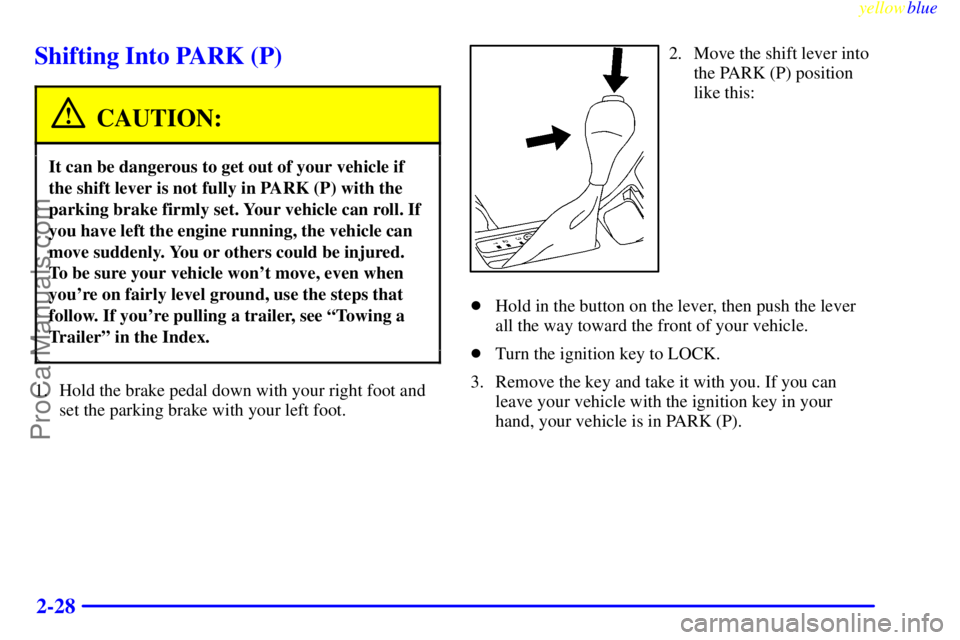
2. Move the shift lever into
the PARK (P) position
like this:
�Hold in the button on the lever, then push the lever
all the way toward the front of your vehicle.
�Turn the ignition key to LOCK.
3. Remove the key and take it with you. If you can
leave your vehicle with the ignition key in your
hand, your vehicle is in PARK (P).
ProCarManuals.com
Page 90 of 368
yellowblue
2-30
Shifting Out of PARK (P)
CAUTION:
Before shifting out of PARK (P) you must fully
apply your regular brakes. Your vehicle can roll.
If you have left the engine running, the vehicle
can move suddenly. You or others could be
injured. If you're pulling a trailer, see ªTowing a
Trailerº in the Index.
Your vehicle has a Brake-Transaxle Shift Interlock
(BTSI). You must fully apply your regular brakes before
you can shift from PARK (P) when the ignition is in
RUN. See ªAutomatic Transaxle Operationº in
the Index.If you cannot shift out of PARK (P), ease pressure on
the shift lever by pushing it all the way into PARK (P)
while keeping the brake pedal pushed down. Release the
shift lever button. Then move the shift lever out of
PARK (P).
If you ever hold the brake pedal down but still can't
shift out of PARK (P), try this:
1. Turn the ignition key to OFF.
2. Apply and hold the brake until the end of Step 4.
3. Shift to NEUTRAL (N).
4. Start the engine and shift to the drive gear you want.
5. Have the vehicle fixed as soon as you can.
ProCarManuals.com
Page 91 of 368

yellowblue
2-31 Shift Lock Release
Your vehicle is equipped
with an electric park lock
system. The system is
designed to prevent ignition
key removal unless the shift
lever is in PARK (P) (with
the shift knob button
fully released).
The system also prevents the shift lever from moving
out of PARK (P) when the ignition is in OFF or in
LOCK. The park lock system is always functional
except in the case of a dead or low voltage
(less than 9 V) battery.
If your vehicle has a dead battery or a battery with low
voltage, there are two override access slots that will
allow you to override the park lock system.The first slot is located underneath the steering column
below the lock cylinder. To use this slot:
1. Verify that the shift lever is in PARK (P) (with the
shift knob button released.)
2. Locate the override access slot below the
lock cylinder.
3. Remove the override access slot cap, which will then
show the override mechanism release button.
4. Insert a key or screwdriver into the access slot and
then press in and hold the override mechanism
release button.
5. Turn the ignition key to OFF.
6. Remove the key or screwdriver from the slot.
7. Remove the key from the ignition switch.
8. Replace the override access slot cap.
ProCarManuals.com
Page 92 of 368
yellowblue
2-32
The second override access slot is located on the upper
right hand side of the console shift panel. To use
this slot:
1. Verify that the shift lever is in PARK (P) and that the
shift knob button is fully released.
2. Locate the override access slot on the upper right
hand side of the shift panel.
3. Remove the override access slot cap, which will then
show the shift lock release button.
4. Insert a key or screwdriver into the access slot and
press in and hold the shift lock release button.
5. Press the shift knob button in and hold.
6. Remove the key or screwdriver from the slot.
7. Pull the shift lever into the desired gear position.
8. Replace the override access slot cap.
You will not be able to remove your key from the
ignition unless the shift lever is in PARK (P) with the
shift knob button fully released.Parking Over Things That Burn
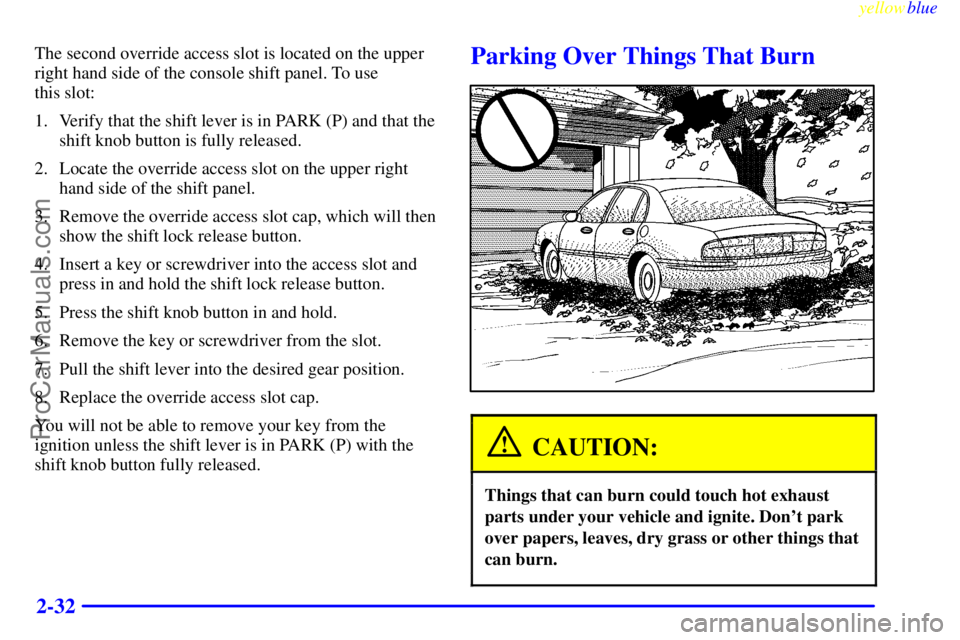
CAUTION:
Things that can burn could touch hot exhaust
parts under your vehicle and ignite. Don't park
over papers, leaves, dry grass or other things that
can burn.
ProCarManuals.com
Page 94 of 368
yellowblue
2-34
CAUTION:
It can be dangerous to get out of your vehicle if
the shift lever is not fully in PARK (P) with the
parking brake firmly set. Your vehicle can roll.
Don't leave your vehicle when the engine is
running unless you have to. If you've left the
engine running, the vehicle can move suddenly.
You or others could be injured. To be sure your
vehicle won't move, even when you're on fairly
level ground, always set your parking brake and
move the shift lever to PARK (P).
Follow the proper steps to be sure your vehicle won't
move. See ªShifting Into PARK (P)º in the Index.
If you are parking on a hill and if you're pulling a
trailer, also see ªTowing a Trailerº in the Index.
Windows
Power Windows
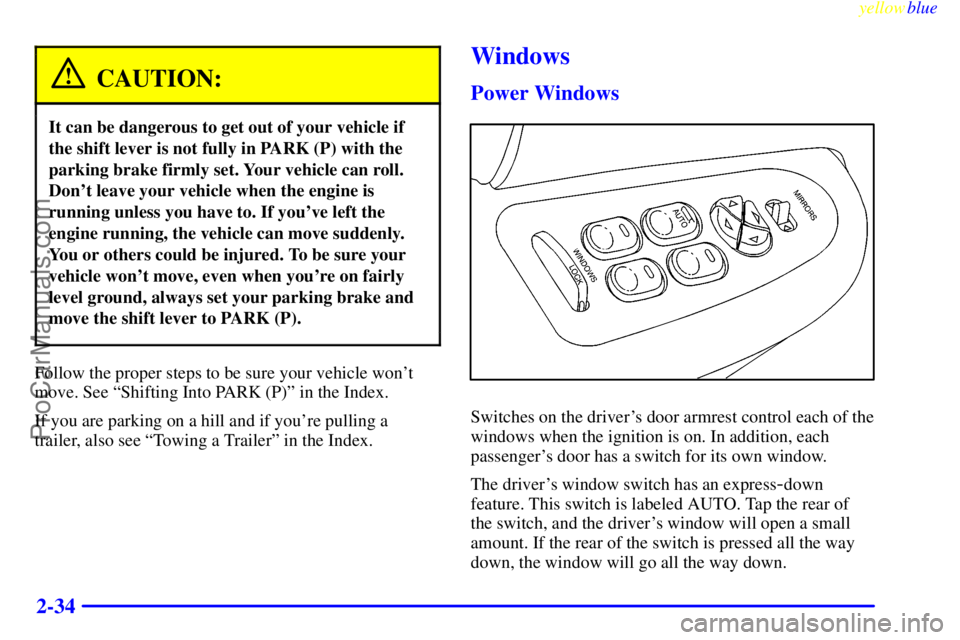
Switches on the driver's door armrest control each of the
windows when the ignition is on. In addition, each
passenger's door has a switch for its own window.
The driver's window switch has an express
-down
feature. This switch is labeled AUTO. Tap the rear of
the switch, and the driver's window will open a small
amount. If the rear of the switch is pressed all the way
down, the window will go all the way down.
ProCarManuals.com
Page 102 of 368

yellowblue
2-42
Using Cruise Control on Hills
How well your cruise control will work on hills depends
upon your speed, load and the steepness of the hills.
When going up steep hills, you may have to step on the
accelerator pedal to maintain your speed. When going
downhill, you may have to brake or shift to a lower gear
to keep your speed down. Of course, applying the brake
takes you out of cruise control. Many drivers find this to
be too much trouble and don't use cruise control on
steep hills.
Ending Cruise Control
There are two ways to turn off the cruise control:
�Step lightly on the brake pedal; OR
�Move the cruise switch to OFF.
Erasing Cruise Speed Memory
When you turn off the cruise control or the ignition, or
shift into PARK (P) or NEUTRAL (N), your cruise
control set speed memory is erased.Exterior Lamps
The lamp controls are located on the instrument panel.
They control these systems:
�Headlamps
�Taillamps
�Parking Lamps
�License Lamps
�Sidemarker Lamps
�Instrument Panel Lights
�Courtesy Lamps
�Fog Lamps
�Cornering Lamps
ProCarManuals.com