Page 259 of 368
yellowblue
6-23
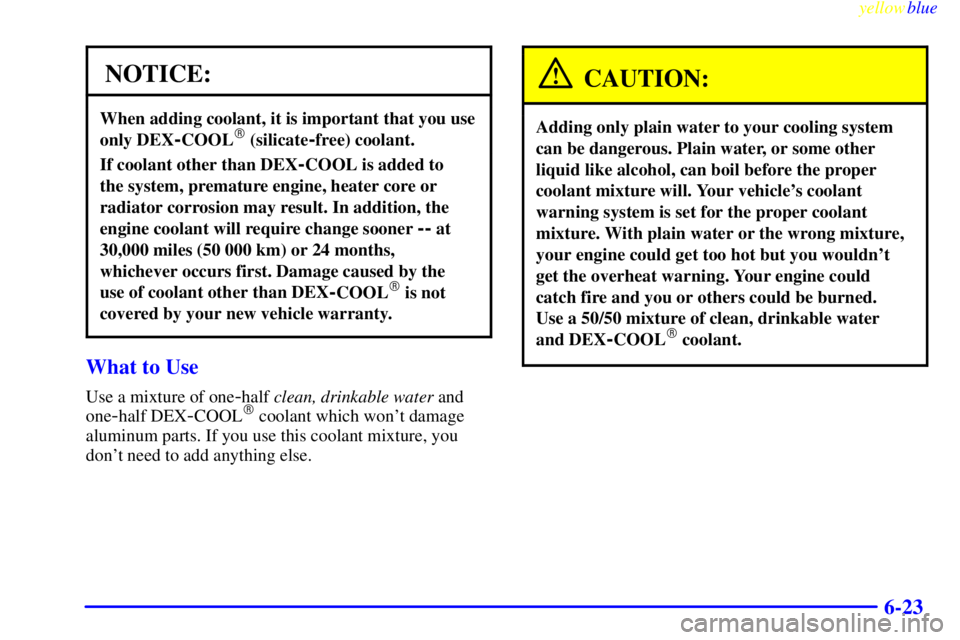
NOTICE:
When adding coolant, it is important that you use
only DEX
-COOL� (silicate-free) coolant.
If coolant other than DEX-COOL is added to
the system, premature engine, heater core or
radiator corrosion may result. In addition, the
engine coolant will require change sooner
-- at
30,000 miles (50 000 km) or 24 months,
whichever occurs first. Damage caused by the
use of coolant other than DEX
-COOL� is not
covered by your new vehicle warranty.
What to Use
Use a mixture of one-half clean, drinkable water and
one
-half DEX-COOL� coolant which won't damage
aluminum parts. If you use this coolant mixture, you
don't need to add anything else.
CAUTION:
Adding only plain water to your cooling system
can be dangerous. Plain water, or some other
liquid like alcohol, can boil before the proper
coolant mixture will. Your vehicle's coolant
warning system is set for the proper coolant
mixture. With plain water or the wrong mixture,
your engine could get too hot but you wouldn't
get the overheat warning. Your engine could
catch fire and you or others could be burned.
Use a 50/50 mixture of clean, drinkable water
and DEX
-COOL� coolant.
Page 260 of 368
yellowblue
6-24
NOTICE:
If you use an improper coolant mixture, your
engine could overheat and be badly damaged.
The repair cost wouldn't be covered by your
warranty. Too much water in the mixture can
freeze and crack the engine, radiator, heater core
and other parts.
If you have to add coolant more than four times a year,
have your dealer check your cooling system.
NOTICE:
If you use the proper coolant, you don't have to
add extra inhibitors or additives which claim to
improve the system. These can be harmful.
Checking Coolant
The vehicle must be on a level surface. When your
engine is cold, the coolant level should be at FULL
COLD or a little higher. When your engine is warm, the
level should be up to FULL HOT or a little higher.
Page 283 of 368

yellowblue
6-47
Each new wheel should have the same load-carrying
capacity, diameter, width, offset and be mounted the
same way as the one it replaces.
If you need to replace any of your wheels, wheel bolts
or wheel nuts, replace them only with new GM original
equipment parts. This way, you will be sure to have the
right wheel, wheel bolts and wheel nuts for your vehicle.
CAUTION:
Using the wrong replacement wheels, wheel bolts
or wheel nuts on your vehicle can be dangerous.
It could affect the braking and handling of your
vehicle, make your tires lose air and make you
lose control. You could have a collision in which
you or others could be injured. Always use the
correct wheel, wheel bolts and wheel nuts
for replacement.
NOTICE:
The wrong wheel can also cause problems with
bearing life, brake cooling, speedometer or
odometer calibration, headlamp aim, bumper
height, vehicle ground clearance and tire or tire
chain clearance to the body and chassis.
See ªChanging a Flat Tireº in the Index for
more information.
Used Replacement Wheels
CAUTION:
Putting a used wheel on your vehicle is
dangerous. You can't know how it's been used or
how far it's been driven. It could fail suddenly
and cause an accident. If you have to replace a
wheel, use a new GM original equipment wheel.
Page 297 of 368
yellowblue
6-61
Fuse Usage
4B Not Used
5B
Anti
-Lock Brake System, Computer
Command Control
6B Brake and Hazard Lamps
7B Not Used
8B Interior Lighting
9B Cigarette Lighter
1C Air Bag System
2C Spare
3C Not Used
4C Not Used
5C Cooling Fans, Transaxle
6C Parking Lamps, Interior Lamps
7C Not Used
8C Parking Lamps
9C Radio, Cluster
1D Telltale, Chime, Cluster, RAC, LCMFuse Usage
2D Spare
3D Heated Mirrors
4D Not Used
5D Manual A/C
6D Not Used
7D TCC
8D Radio
9D Not Used
1E Not Used
2E
Air Bag System, PASS
-Key
3E Not Used
4E Not Used
5E Rear Defog
6E Not Used
7E
Miscellaneous Engine
-Non OBD II
8E Wipers, Washer
9E Not Used
Page 300 of 368
yellowblue
6-64
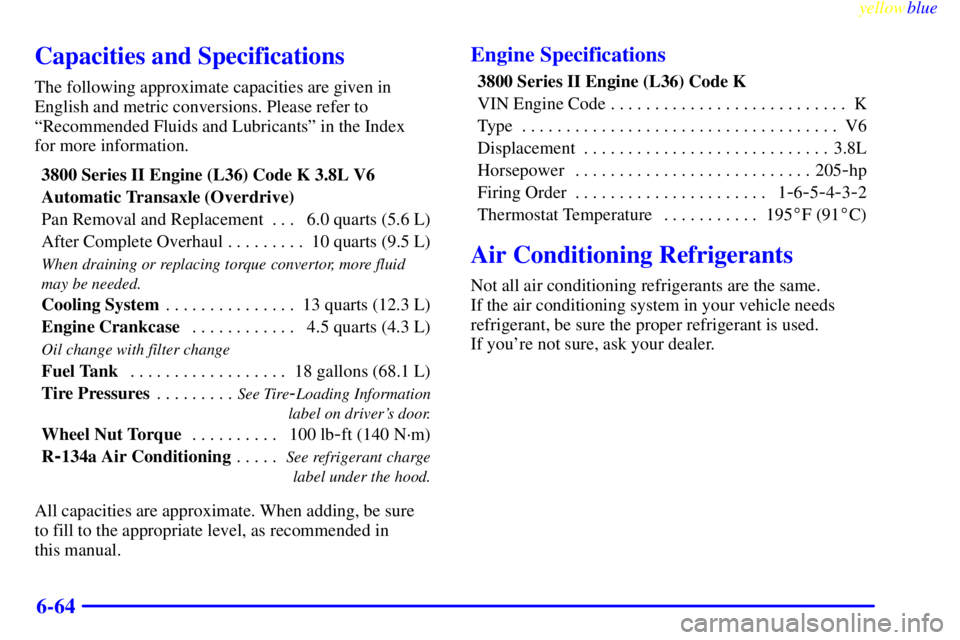
Capacities and Specifications
The following approximate capacities are given in
English and metric conversions. Please refer to
ªRecommended Fluids and Lubricantsº in the Index
for more information.
3800 Series II Engine (L36) Code K 3.8L V6
Automatic Transaxle (Overdrive)
Pan Removal and Replacement 6.0 quarts (5.6 L). . .
After Complete Overhaul 10 quarts (9.5 L). . . . . . . . .
When draining or replacing torque convertor, more fluid
may be needed.
Cooling System13 quarts (12.3 L) . . . . . . . . . . . . . . .
Engine Crankcase4.5 quarts (4.3 L) . . . . . . . . . . . .
Oil change with filter change
Fuel Tank18 gallons (68.1 L) . . . . . . . . . . . . . . . . . .
Tire Pressures
See Tire-Loading Information. . . . . . . . .
label on driver's door.
Wheel Nut Torque100 lb-ft (140 N´m) . . . . . . . . . .
R
-134a Air ConditioningSee refrigerant charge. . . . .
label under the hood.
All capacities are approximate. When adding, be sure
to fill to the appropriate level, as recommended in
this manual.
Engine Specifications
3800 Series II Engine (L36) Code K
VIN Engine Code K. . . . . . . . . . . . . . . . . . . . . . . . . . .
Type V6. . . . . . . . . . . . . . . . . . . . . . . . . . . . . . . . . . . .
Displacement 3.8L. . . . . . . . . . . . . . . . . . . . . . . . . . . .
Horsepower 205
-hp . . . . . . . . . . . . . . . . . . . . . . . . . . .
Firing Order 1
-6-5-4-3-2 . . . . . . . . . . . . . . . . . . . . . .
Thermostat Temperature 195�F (91�C) . . . . . . . . . . .
Air Conditioning Refrigerants
Not all air conditioning refrigerants are the same.
If the air conditioning system in your vehicle needs
refrigerant, be sure the proper refrigerant is used.
If you're not sure, ask your dealer.
Page 307 of 368
Scheduled Maintenance
yellowblue
7-5
Short Trip/City Definition
Follow the Short Trip/City Scheduled Maintenance if
any one of these conditions is true for your vehicle:
�Most trips are less than 5 to 10 miles (8 to 16 km).
This is particularly important when outside
temperatures are below freezing.
�Most trips include extensive idling (such as frequent
driving in stop
-and-go traffic).
�Most trips are through dusty areas.
�You frequently tow a trailer or use a carrier on top of
your vehicle.
�If the vehicle is used for delivery service, police, taxi
or other commercial application.
One of the reasons you should follow this schedule if
you operate your vehicle under any of these conditions
is that these conditions cause engine oil to break
down sooner.
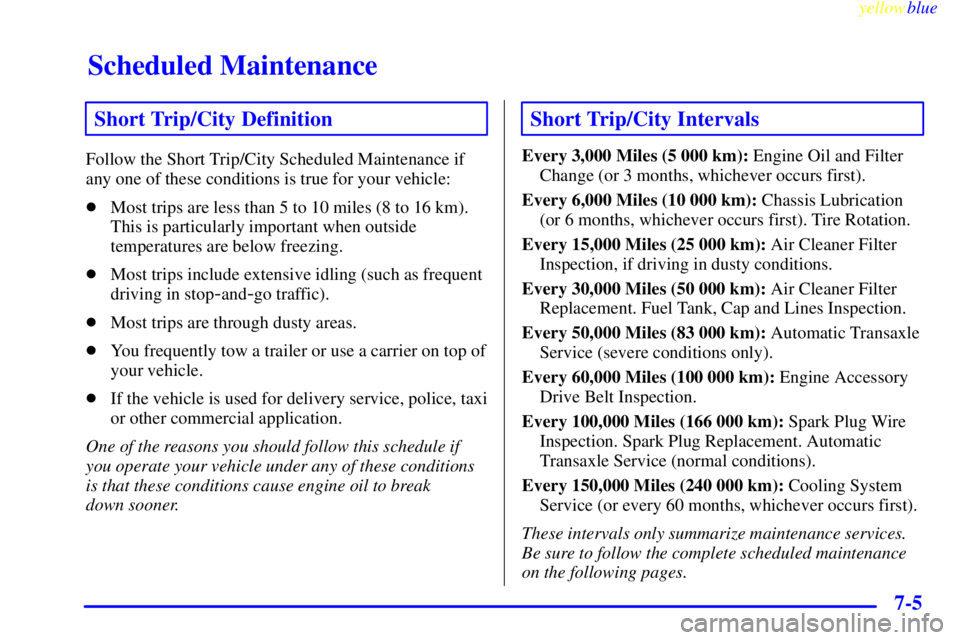
Short Trip/City Intervals
Every 3,000 Miles (5 000 km): Engine Oil and Filter
Change (or 3 months, whichever occurs first).
Every 6,000 Miles (10 000 km): Chassis Lubrication
(or 6 months, whichever occurs first). Tire Rotation.
Every 15,000 Miles (25 000 km): Air Cleaner Filter
Inspection, if driving in dusty conditions.
Every 30,000 Miles (50 000 km): Air Cleaner Filter
Replacement. Fuel Tank, Cap and Lines Inspection.
Every 50,000 Miles (83 000 km): Automatic Transaxle
Service (severe conditions only).
Every 60,000 Miles (100 000 km): Engine Accessory
Drive Belt Inspection.
Every 100,000 Miles (166 000 km): Spark Plug Wire
Inspection. Spark Plug Replacement. Automatic
Transaxle Service (normal conditions).
Every 150,000 Miles (240 000 km): Cooling System
Service (or every 60 months, whichever occurs first).
These intervals only summarize maintenance services.
Be sure to follow the complete scheduled maintenance
on the following pages.
Page 308 of 368
Scheduled Maintenance
yellowblue
7-6
Long Trip/Highway Definition
Follow this scheduled maintenance only if none of the
conditions from the Short Trip/City Scheduled
Maintenance is true. Do not use this schedule if the
vehicle is used for trailer towing, driven in a dusty area
or used off paved roads. Use the Short Trip/City
schedule for these conditions.
Driving a vehicle with a fully warmed engine under
highway conditions causes engine oil to break
down slower.
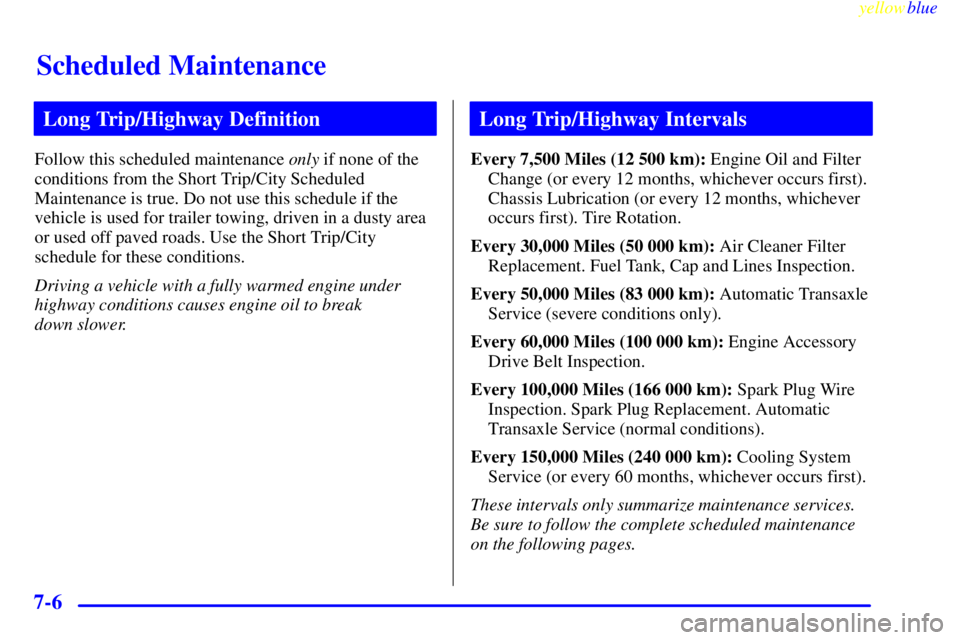
Long Trip/Highway Intervals
Every 7,500 Miles (12 500 km): Engine Oil and Filter
Change (or every 12 months, whichever occurs first).
Chassis Lubrication (or every 12 months, whichever
occurs first). Tire Rotation.
Every 30,000 Miles (50 000 km): Air Cleaner Filter
Replacement. Fuel Tank, Cap and Lines Inspection.
Every 50,000 Miles (83 000 km): Automatic Transaxle
Service (severe conditions only).
Every 60,000 Miles (100 000 km): Engine Accessory
Drive Belt Inspection.
Every 100,000 Miles (166 000 km): Spark Plug Wire
Inspection. Spark Plug Replacement. Automatic
Transaxle Service (normal conditions).
Every 150,000 Miles (240 000 km): Cooling System
Service (or every 60 months, whichever occurs first).
These intervals only summarize maintenance services.
Be sure to follow the complete scheduled maintenance
on the following pages.
Page 324 of 368
Short Trip/City Scheduled Maintenance
yellowblue
7-22
150,000 Miles (240 000 km)
�Drain, flush and refill cooling system (or every 60 months since last service,
whichever occurs first). See ªEngine Coolantº in the Index for what to use.
Inspect hoses. Clean radiator, condenser, pressure cap and neck. Pressure test
cooling system and pressure cap.
An Emission Control Service. ACTUAL
SERVICED BY:MILEAGE
DATE


