1998 VOLVO V90 belt
[x] Cancel search: beltPage 52 of 175
1998 Volvo S90
Chapter 3 - Body and interior (cont.)
Concealed storage bins, Rear seat head restraints (wagon)
pg. 42
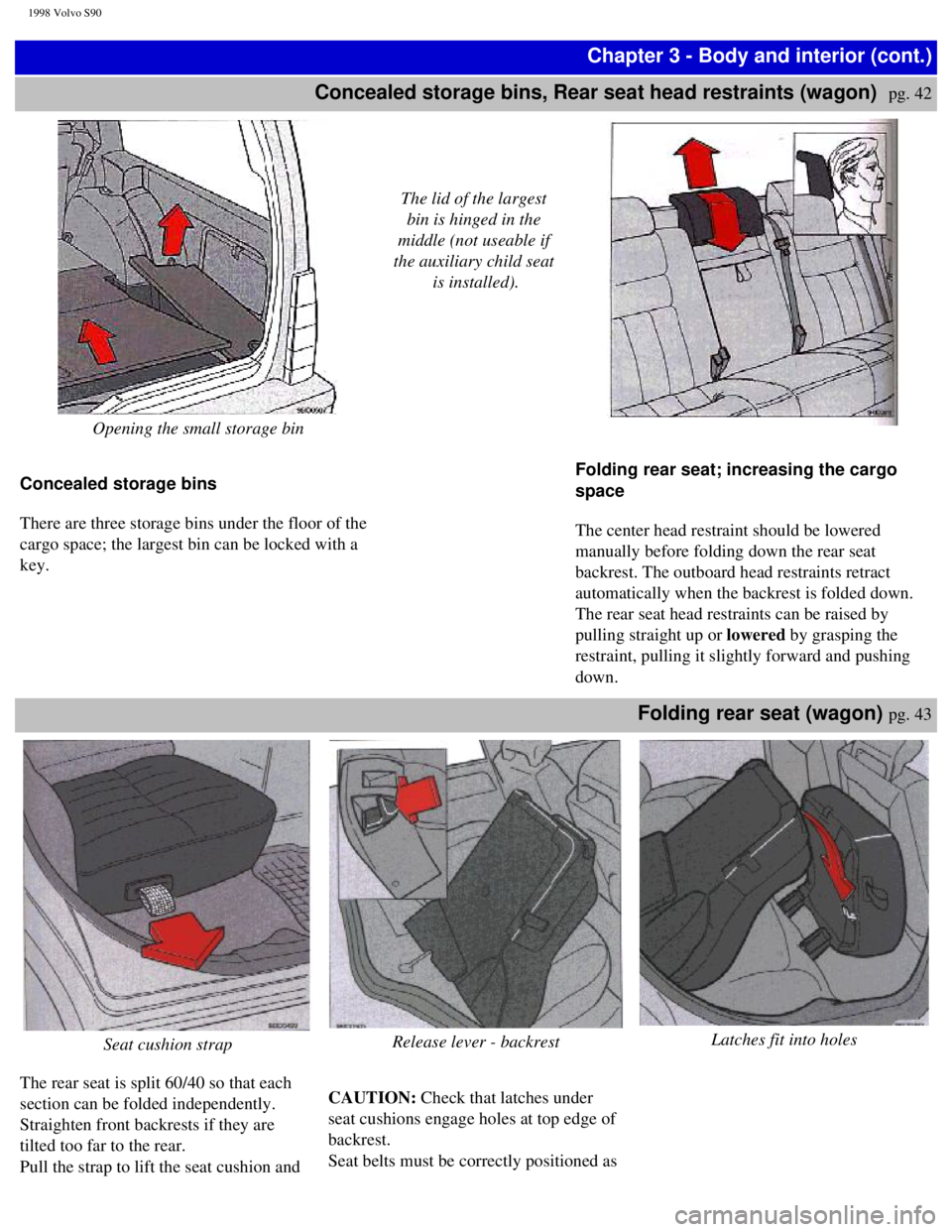
Opening the small storage bin
Concealed storage bins
There are three storage bins under the floor of the
cargo space; the largest bin can be locked with a
key.
The lid of the largest
bin is hinged in the
middle (not useable if
the auxiliary child seat is installed).
Folding rear seat; increasing the cargo
space
The center head restraint should be lowered
manually before folding down the rear seat
backrest. The outboard head restraints retract
automatically when the backrest is folded down.
The rear seat head restraints can be raised by
pulling straight up or lowered by grasping the
restraint, pulling it slightly forward and pushing
down.
Folding rear seat (wagon) pg. 43
Seat cushion strap
The rear seat is split 60/40 so that each
section can be folded independently.
Straighten front backrests if they are
tilted too far to the rear.
Pull the strap to lift the seat cushion and
Release lever - backrest
CAUTION: Check that latches under
seat cushions engage holes at top edge of
backrest.
Seat belts must be correctly positioned as
Latches fit into holes
file:///K|/ownersdocs/1998/1998_SV90/98S90_042.htm (1 of 4)12/30/2006 \
1:52:40 PM
Page 55 of 175
1998 Volvo S90
Loading in cargo space
Seat belts and airbags help give driver and passengers good
protection, especially in head-on collisions. However, there is
also a risk of injury from behind. When loading the car,
remember that objects not properly loaded and secured may
move forward in collisions or when braking suddenly, causing
injury.
Remember that a 44 lbs object weighs the equivalent of
2,200 lbs in a head-on collision at 30 mph.
Remember the following when loading the car:
l Load the cargo against the backrest.
l Load heavy cargo as low down as possible.
l Load wide cargo on either side of the rear seat split.
l Secure the cargo with cargo straps through the eyelets in the
cargo space.
l If nobody is sitting in the rear seat reinforce the backrest by
fastening the rear seat belts.
l Never load cargo above the backrest without a cargo barrier.
Cargo barrier (Wagon) pg. 47
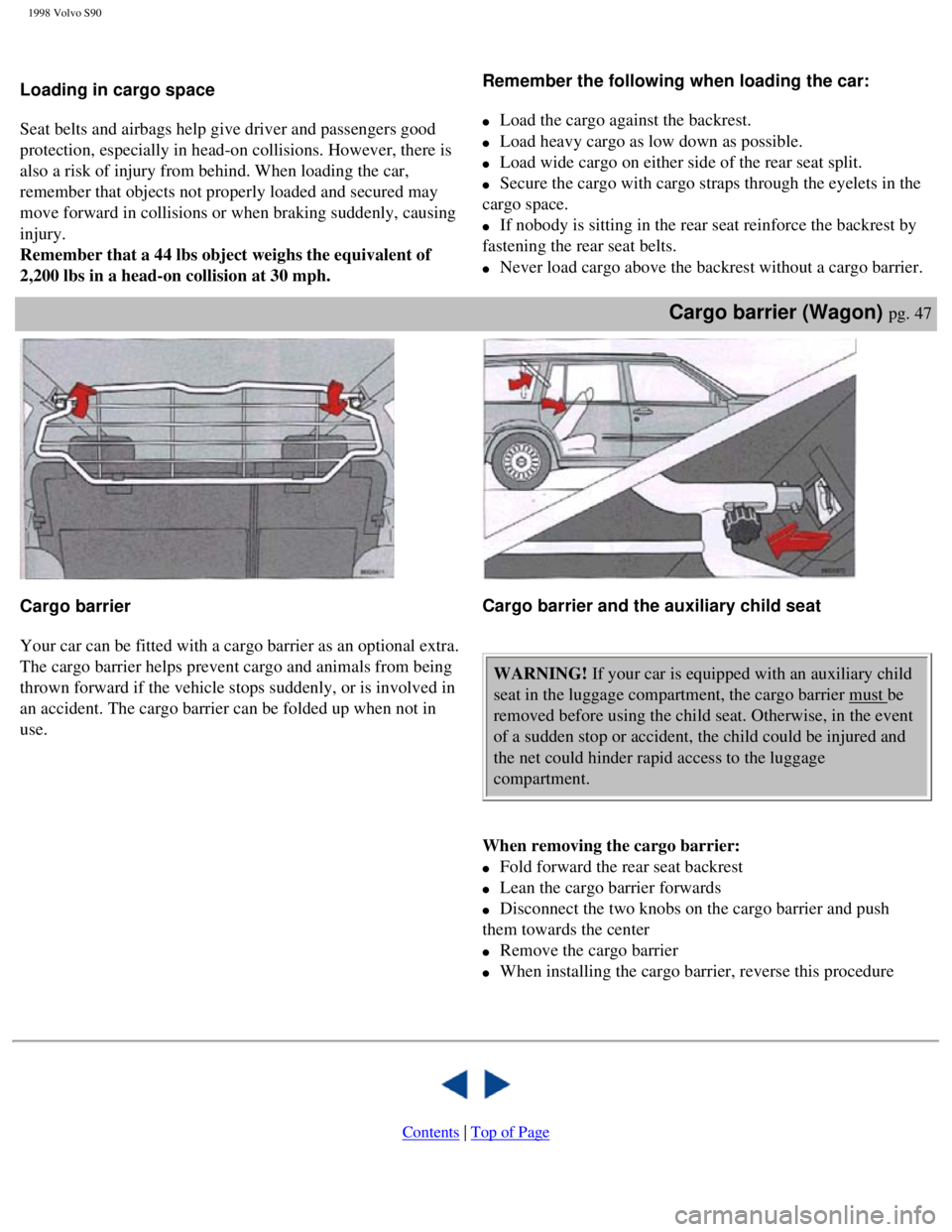
Cargo barrier
Your car can be fitted with a cargo barrier as an optional extra.
The cargo barrier helps prevent cargo and animals from being
thrown forward if the vehicle stops suddenly, or is involved in
an accident. The cargo barrier can be folded up when not in
use.
Cargo barrier and the auxiliary child seat
WARNING! If your car is equipped with an auxiliary child
seat in the luggage compartment, the cargo barrier must be
removed before using the child seat. Otherwise, in the event
of a sudden stop or accident, the child could be injured and
the net could hinder rapid access to the luggage
compartment.
When removing the cargo barrier:
l Fold forward the rear seat backrest
l Lean the cargo barrier forwards
l Disconnect the two knobs on the cargo barrier and push
them towards the center
l Remove the cargo barrier
l When installing the cargo barrier, reverse this procedure
Contents | Top of Page
file:///K|/ownersdocs/1998/1998_SV90/98S90_042.htm (4 of 4)12/30/2006 \
1:52:40 PM
Page 64 of 175

1998 Volvo S90
(check when tires are cold). items and others are checked at
the standard Maintenance
Service intervals.
NOTE: Since using (D)rive
improves fuel economy, it
should be used as often as
possible.
Starting the engine pg. 57
Starting and stopping a
car equipped with
automatic transmission
1 Fasten the seat belt.
WARNING! Before
starting, check that the seat
is adjusted properly. Make
sure the brake pedal can be
depressed completely. Move
the seat closer if necessary.
Refer to section "Front
seats".
2 Apply the parking brake, if
not already set. The gear
selector is locked in the (P)ark
position (SHIFTLOCK).
3Without touching the
accelerator pedal ,turn the
ignition key to the starting
position. Allow the starter to
operate for 5-10 seconds.
Release the key as soon as the
engine starts. If the engine fails
to start, repeat step 3.
5 Select desired gear. The gear
engages after a slight delay,
especially noticeable when
selecting R.
CAUTION: Engine should
be idling; never accelerate
until after you feel the gear
engage! Too rapid
acceleration immediately
after selecting a gear will
cause harsh engagement and
premature transmission
wear.
NOTE:Your car is equipped
with a KEYLOCK system.
When the engine is switched
off, the gear selector must be in
the (P)ark position before the
key can be removed from the
ignition switch.
Engine warm-up - initial
driving procedure
Engines in vehicles driven short
distances are subject to
abnormally rapid wear because
the engine never reaches normal
operating temperature. It is
therefore beneficial to reach
normal operating temperature as
soon as possible. This is best
achieved by driving with a light
foot on the accelerator pedal for
a few minutes after starting,
rather than prolonged idling.
B6304 S Engine
This engine features hydraulic
valve lifters which means that
valve clearance is adjusted
automatically. It is possible that
the valve lifters will produce a
ticking sound for the first few
seconds after the engine is
started, while the oil pressure is
increasing.
If the car has not been used for a
long period of time, this ticking
sound may last for up to 15
minutes. This is entirely normal.
file:///K|/ownersdocs/1998/1998_SV90/98S90_053.htm (5 of 6)12/30/2006 \
1:52:41 PM
Page 80 of 175

1998 Volvo S90
cold-weather oil for hard driving or in warm
weather. See section "Engine oil" for more
information.
l The load placed on the battery is greater during
the winter since the heater, windshield wipers,
lighting etc. are used more often. Moreover, the
capacity of the battery decreases as the
temperature drops. In very cold weather, a poorly
charged battery can freeze and be damaged. It is
therefore advisable to check the state of charge
more frequently and spray an anti-rust oil on the
battery posts.
l Volvo recommends the use of snow tires on all
four wheels for winter driving - see section
"Wheels and tires".
l To prevent the washer reservoir from freezing,
add washer solvents containing antifreeze. This is
important since dirt is often splashed on the
windshield during winter driving, thus requiring
frequent use of the washers and wipers.
functions when the transmission is in reverse.
Also see "Winter/Wet" mode on page 59.
Winter/Wet mode
Enhanced Vehicle Traction
This mode may be selected for starting/moving
off on slippery roads or to lower downshift speeds
if the transmission is in "L".
Mode W
*In position D, the gearbox starts in third gear and
changes up to fourth gear.
*In position 3, second gear is locked and there is
no change up to third gear. In position L, first gear
is locked.
*These positions always offer the kick-down
feature.
Long distance trip pg. 70
Before a long distance trip
It is always worthwhile to have your car checked at a Volvo retailer
before driving long distances. Your retailer will also be able to supply\
you with bulbs, fuses, spark plugs and wiper blades for your use in the \
event that problems occur.
If you prefer to check the car yourself, please note the following:
l Check that the engine runs smoothly and that fuel consumption is
normal.
l Check engine oil, coolant levels, and for possible fuel leakage.
l Check transmission oil level and rear axle for leakage.
l Check condition of drive belts.
l Check state of charge of battery.
l Examine tires carefully (the spare tire as well), and replace those
that are worn. Check tire pressures.
l The brakes, front wheel alignment, and steering gear should be
checked by your Volvo retailer only.
l Check all lights, including high beams.
file:///K|/ownersdocs/1998/1998_SV90/98S90_067.htm (4 of 5)12/30/2006 \
1:52:43 PM
Page 102 of 175
1998 Volvo S90
19 Backup lights, Turn indicators, Cruise control 15
20 Light switch, High/low beam relay 15
21 Seat belt reminder, Timer- electrically heated rear window 5
Location ** Amperage
22 Heated driver's seat 15
23 Heated passenger's seat 15
24 Rear fog light 5
25 Power seats * 30
26 Power windows, Power sunroof * 30
*Automatic circuit breakers
** Some of the equipment/systems listed may be available on certain mode\
ls only and/or as optional
items only.
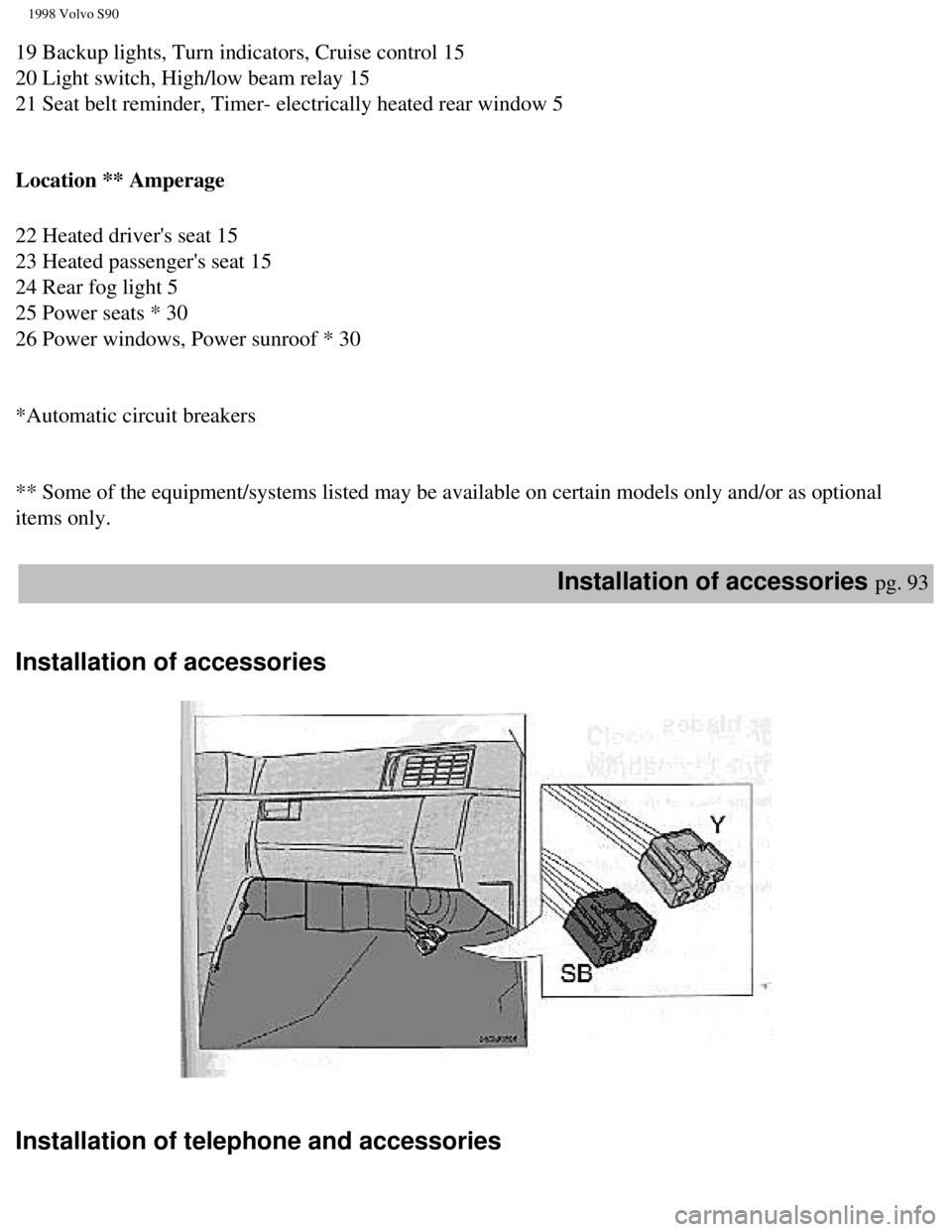
Installation of accessories pg. 93
Installation of accessories
Installation of telephone and accessories
file:///K|/ownersdocs/1998/1998_SV90/98S90_089.htm (6 of 9)12/30/2006 \
1:52:46 PM
Page 106 of 175

1998 Volvo S90
Chapter 7 - Car care
pg. 97
Car care
Car care includes not only maintaining the appearance of the car, but al\
so
protecting the car exterior from the effects of air pollution, rain and \
mud.
The paintwork should also be touched up immediately, if damaged, to prev\
ent rust
formation.
Cleaning the upholstery pg. 98
Paintwork damage pg. 99
Washing the car pg. 100
Cleaning the upholstery
pg. 98
Cleaning the upholstery
The fabric can be cleaned with soapy water or a
detergent. For more difficult spots caused by oil,
ice cream, shoe polish, grease, etc., use a clothing/
clothing fabric stain remover.
The plastic in the upholstery can be washed with
soapy water or a mild detergent.
Leather upholstery/suede-like upholstery
(alcantera) can be cleaned with a soft cloth and
mild soap solution. For more difficult spots,
Volvo offers a leather care kit.
On no account must gasoline, naphtha or
similar cleaning agents be used on the plastic
or the leather since these can cause damage.
Cleaning the seat belts
Clean only with lukewarm water and mild soap
solution.
Bear in mind
l Take extra care when removing stains such as
ink or lipstick since the coloring can spread.
l Use solvents sparingly. Too much solvent can
damage the seat padding.
l Start from the outside of the stain and work
toward the center.
file:///K|/ownersdocs/1998/1998_SV90/98S90_097.htm (1 of 6)12/30/2006 \
1:52:47 PM
Page 112 of 175

1998 Volvo S90
Chapter 8 - Volvo Service
pg. 103
Service - an investment
An investment which will pay dividends in the form of improved reliabili\
ty,
durability, and resale value.
Label information pg. 104
Maintenance service, Warranty pg. 105
Maintenance schedule pg. 106
Engine oil pg. 108
Servicing pg. 110
Fuel/emissions systems pg. 112
Engine compartment pg. 114
Lubrication, body pg. 115
Power steering fluid, brake fluid pg. 116
Drive belt pg. 117
Cooling system pg. 118
Washer fluid reservoir/nozzles pg. 119
Label information
pg. 104
1 Vehicle
Identification
Number
(VIN)*
VIN plate is
located on
top left
surface of
dashboard.
The VIN is
also stamped
on the right
hand door
pillar.
2 Vehicle
Emission
file:///K|/ownersdocs/1998/1998_SV90/98S90_103.htm (1 of 7)12/30/2006 \
1:52:48 PM
Page 115 of 175

1998 Volvo S90
Maintenance service
Volvo advises you to follow the
service program which is
outlined in the "Maintenance
Records Manual". This
maintenance program contains
inspections and services
necessary for the proper
function of your car.
The maintenance services
contain several checks which
require special instruments and
tools and therefore must be
performed by a qualified
technician.
To keep your Volvo in top
condition, specify time tested
and proven Genuine Volvo Parts
and Accessories.
The Federal Clean Air
Act - U.S.
The Clean Air Act requires
vehicle manufacturers to furnish
written instructions to the
ultimate purchaser to assure the
proper functioning of those
components that control
emissions.
The maintenance instructions
listed in the "Servicing" section
of this Manual represent the
minimum maintenance required.
These services are not covered
by the warranty. You will be
required to pay for labor and
material used. Refer to your
Warranty booklet for further
details.
Maintenance services
Your Volvo has passed several
major inspections before being
delivered to you, according to
Volvo specifications. The
maintenance services outlined in
this book should be performed
as indicated. The extended
maintenance service intervals
make it even more advisable to
follow this program. Inspection
and service should also be
performed any time a
malfunction is observed or
suspected.
It is recommended that receipts
for vehicle emission services be
retained in the event that
questions arise concerning
maintenance. See your
"Maintenance Records Manual".Applicable warranties -
U.S.
In accordance with U.S. Federal
Regulations, the following list of
applicable U.S. warranties is
provided. For Canadian
specification vehicles, see your
separate warranty booklet.
l New Car Limited Warranty
l Parts and Accessories Limited
Warranty
l Corrosion Protection Limited
Warranty
l Seatbelt and Supplemental
Restraint Systems Limited
Warranty
l Emission Design and Defect
Warranty
l Emission Performance
Warranty
These are the Federal warranties;
other warranties are provided as
required by state law.
Refer to your separate Warranty
booklet for detailed information
concerning each of the warranties.
Maintenance Schedule pg. 106
file:///K|/ownersdocs/1998/1998_SV90/98S90_103.htm (4 of 7)12/30/2006 \
1:52:48 PM