1998 VOLVO V90 belt
[x] Cancel search: beltPage 13 of 175

1998 Volvo S90
characteristic and does not
indicate fire. area above the glove
compartment) or the area
affected by air bag
deployment (see
illustration).
l There should be no loose
articles, e.g. coffee cups,
on the floor, seat or dash
area.
l Never try to open the
SRS cover on the steering
wheel or the passenger
side SRS hatch. This
should only be done by
an authorized Volvo
service technician.
l Failure to follow these
instructions can result in
injury to the vehicle
occupants in an accident.
VOLVO SRS (cont.) pg. 7
NOTE:The information on this page does not pertain
to the Side Impact Protection System airbags.
When are the airbags deployed?
The SRS system is designed to deploy during certain
frontal or front-angular collisions, impacts, or
decelerations, depending in the crash severity, angle,
speed, and object impacted. The SRS sensor is
designed to react to both the impact of the collision
and the inertial forces generated by it and to
determine if the intensity of the collision is sufficient
for the airbags to be deployed.
WARNING! The SRS is designed to help prevent
serious injury. Deployment occurs very quickly
and with considerable force. During normal
deployment and depending on variables such as
seating position, one may experience abrasions,
bruises, swellings, or other injuries as a result of
airbag(s) deployment.
Seat belts - the heart of the Volvo safety
system
The heart of the Volvo safety system is the three-
point seat belt (a Volvo invention)! In order for the
SRS system to provide the protection intended, seat
belts must be worn at all times by everyone in the car.
The SRS system is a supplement to the seat belts.
WARNING! If your car has been subjected to
flood conditions (e.g. soaked carpeting/standing
water on the floor of the vehicle) or if your car has
become flood-damaged in any way, do not
attempt to start the vehicle or put the key in the
ignition before disconnecting the battery (see
below). This may cause airbag deployment which
could result in personal injury. Have the car towed
to an authorized Volvo retailer for repairs.
Automatic transmission only:
Before attempting to tow the car, use the
following procedure to override the shiftlock
file:///K|/ownersdocs/1998/1998_SV90/98S90_004.htm (4 of 7)12/30/2006 \
1:52:34 PM
Page 14 of 175

1998 Volvo S90
If the airbags have been deployed, we recommend
the following:
l Have the car towed to an authorized Volvo
retailer. Never drive with the airbags
deployed.
l Have an authorized Volvo retailer replace the
SRS system components.
l Use only new, Genuine Volvo Parts when
replacing SRS components (airbags, seat
belts, tensioners, etc.).
When are the airbags NOT deployed?
Not all frontal collisions activate the SRS system. If
the collision involves a non-rigid object (e.g., a snow
drift or bush), or a rigid, fixed object at a low speed,
the SRS system will not necessarily deploy. Airbags
do not normally deploy in a side impact collision, in
a collision from the rear or in a rollover situation.
The amount of damage to the bodywork does not
reliably indicate if the airbags should have deployed
or not.
system to move the gear selector to the neutral
position.
l Disconnect the battery
l Wait at least one minute
l Insert the key in the ignition and turn it to
position 1
l Press firmly on the shiftlock override
button (located near the base of the gear
selector).
l While holding the override button down,
move the gear selector from the park
position.
WARNING! Never drive with the airbags
deployed. The fact that they hang out can impair
the steering of your car. Other safety systems can
also be damaged. The smoke and dust formed
when the airbags are deployed can cause skin and
eye irritation in the event of prolonged exposure.
Volvo Side Impact Protection System (SIPS) airbag pg. 8
WARNING!
l The SIPS airbag
system is a
supplement to the
Side Impact
Protection System
and the three-point
seat belt system. It
is not designed to
deploy during
collisions from the
front or rear of the
car or in rollover
situations.
l Only Volvo
approved seat
1- Airbag, 2 - cable, 3 - sensor
unit, 4 - gas generator
file:///K|/ownersdocs/1998/1998_SV90/98S90_004.htm (5 of 7)12/30/2006 \
1:52:34 PM
Page 15 of 175

1998 Volvo S90
SIPS airbag decal*
SIPS airbag (front seats only)
As an enhancement to the structural Side
Impact Protection System built into your
car, your car is also equipped with Side
Impact Protection System (SIPS) airbags.
The SIPS airbag system consists of airbag
modules built into the sides of both front
seat backrests (1), cables (2) from these
modules to the mechanical sensor units (3)
and gas generators (4).
The SIPS airbag system is designed to help
increase occupant protection in the event of
certain side impact collisions. The SIPS
airbags are designed to deploy only during
certain side-impact collisions, depending on
the crash severity, angle, speed, and point of
impact. The airbags are not designed to
deploy in all side impact situations.
covers may be
used. The use of
non-approved
aftermarket seat
covers may impede
SIPS airbag
deployment.
l No objects,
accessory
equipment or
stickers may be
placed on, attached
to or installed near
the SIPS airbag
system or in the
area affected by
SIPS airbag
deployment (see
illustration to the
right above).
l Never try to open
or repair any
components of the
SIPS airbag system.
This should only be
done by an
authorized Volvo
service technician.
l For best protection
from the SIPS
airbag system, both
front seat occupants
should sit in an
upright position
with the seat belt
properly fastened.
NOTE: SIPS airbag
deployment (one airbag)
occurs only on the side of
the vehicle affected by the
impact.
WARNING!
l Never drive with the
airbags deployed. The
fact that they hang out
can impair the steering
of your car. Other
safety systems can
also be damaged. The
smoke and dust
formed when the
airbags are deployed
can cause skin and eye
irritation in the event
of prolonged
exposure.
l If your car has been
subjected to flood
conditions (e.g.
soaked carpeting/
standing water on the
floor of the vehicle) or
if your car has become
flood-damaged in any
way, do not attempt to
start the vehicle or put
the key in the ignition
before disconnecting
the battery. This may
cause airbag
deployment which
could result in
personal injury. Have
the car towed to an
authorized Volvo
retailer for repairs.
file:///K|/ownersdocs/1998/1998_SV90/98S90_004.htm (6 of 7)12/30/2006 \
1:52:34 PM
Page 17 of 175

1998 Volvo S90
Chapter 1 - (cont.)Child Safety
pg. 9
Child Restraint Anchorages
Volvo cars are fitted with Child
Restraint Top Tether Anchorages in the
rear seat. There are three anchorages
under the rear section of the car's rear
window shelf on sedans and on the back
rest on wagons. The backrest on wagons
must be folded down slightly to reach
the anchorages. When the car is
delivered, the holes for these anchorages
are covered by plastic covers. In cars
designated for Canada, one top tether
anchorage set will be in the glove box.
The top tether anchorage set includes the
top tether anchorage plate, an 5/16"
UNC bolt and a plastic trim cover. If
another set is needed, consult your
Volvo retailer. Installing the top tether
Remove the plastic cover on the
anchorage point you want to use. This
can be done with a suitable coin. The
cover is removed counter-clockwise.
Refer to the child seat manufacturer's
instructions for securing the seat.
WARNING! Child Restraint
Anchorages are designed to withstand
only those loads imposed by correctly
fitted Child Restraints. Under no
circumstances are they to be used for
adult seat belts or harnesses. The
anchorages are not able to withstand
excessive forces on them in the event of
collision if full harness seat belts or
adult seat belts are installed to them. An
adult who uses a belt anchored in a
Child Restraint Anchorage runs a great
risk of suffering severe injuries should
a collision occur. Do not install rear
speakers which would require the
removal of the top tether anchors or
interfere with the proper use of the top
tether strap.
Child Safety (cont.) pg. 10
Sedans/Wagons
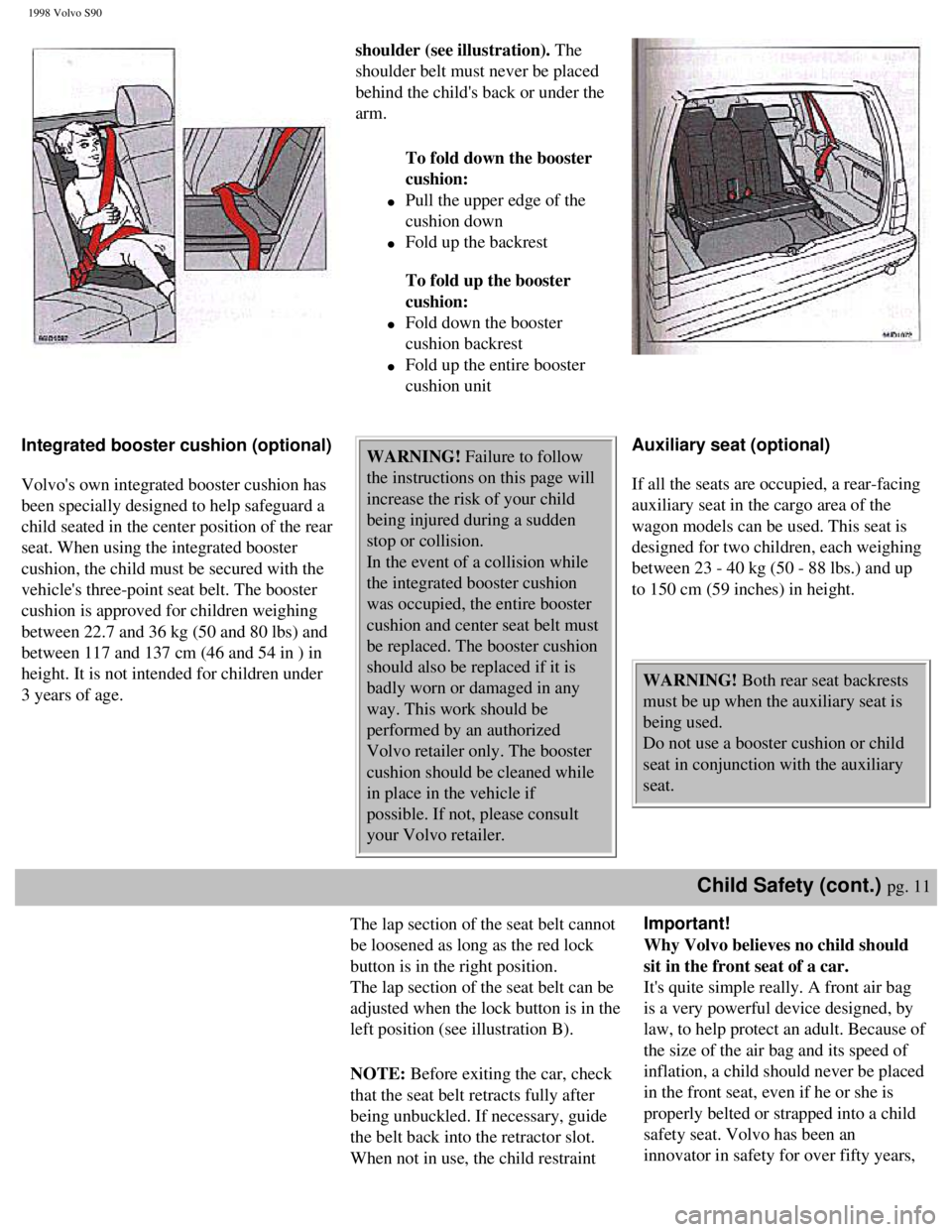
With the child properly seated on
the booster cushion (see
illustration), adjust the head
restraint to support the child's head
(see page 3). The hip section of the
three-point seat belt must fit
snugly across the child's hips, not
across the stomach.
The shoulder section of the three-
point seat belt should be
positioned across the chest and
file:///K|/ownersdocs/1998/1998_SV90/98S90_009.htm (1 of 5)12/30/2006 \
1:52:35 PM
Page 18 of 175
1998 Volvo S90
shoulder (see illustration). The
shoulder belt must never be placed
behind the child's back or under the
arm. To fold down the booster
cushion:
l Pull the upper edge of the
cushion down
l Fold up the backrest
To fold up the booster
cushion:
l Fold down the booster
cushion backrest
l Fold up the entire booster
cushion unit
Integrated booster cushion (optional)
Volvo's own integrated booster cushion has
been specially designed to help safeguard a
child seated in the center position of the rear
seat. When using the integrated booster
cushion, the child must be secured with the
vehicle's three-point seat belt. The booster
cushion is approved for children weighing
between 22.7 and 36 kg (50 and 80 lbs) and
between 117 and 137 cm (46 and 54 in ) in
height. It is not intended for children under
3 years of age. WARNING! Failure to follow
the instructions on this page will
increase the risk of your child
being injured during a sudden
stop or collision.
In the event of a collision while
the integrated booster cushion
was occupied, the entire booster
cushion and center seat belt must
be replaced. The booster cushion
should also be replaced if it is
badly worn or damaged in any
way. This work should be
performed by an authorized
Volvo retailer only. The booster
cushion should be cleaned while
in place in the vehicle if
possible. If not, please consult
your Volvo retailer. Auxiliary seat (optional)
If all the seats are occupied, a rear-facing
auxiliary seat in the cargo area of the
wagon models can be used. This seat is
designed for two children, each weighing
between 23 - 40 kg (50 - 88 lbs.) and up
to 150 cm (59 inches) in height.
WARNING! Both rear seat backrests
must be up when the auxiliary seat is
being used.
Do not use a booster cushion or child
seat in conjunction with the auxiliary
seat.
Child Safety (cont.) pg. 11
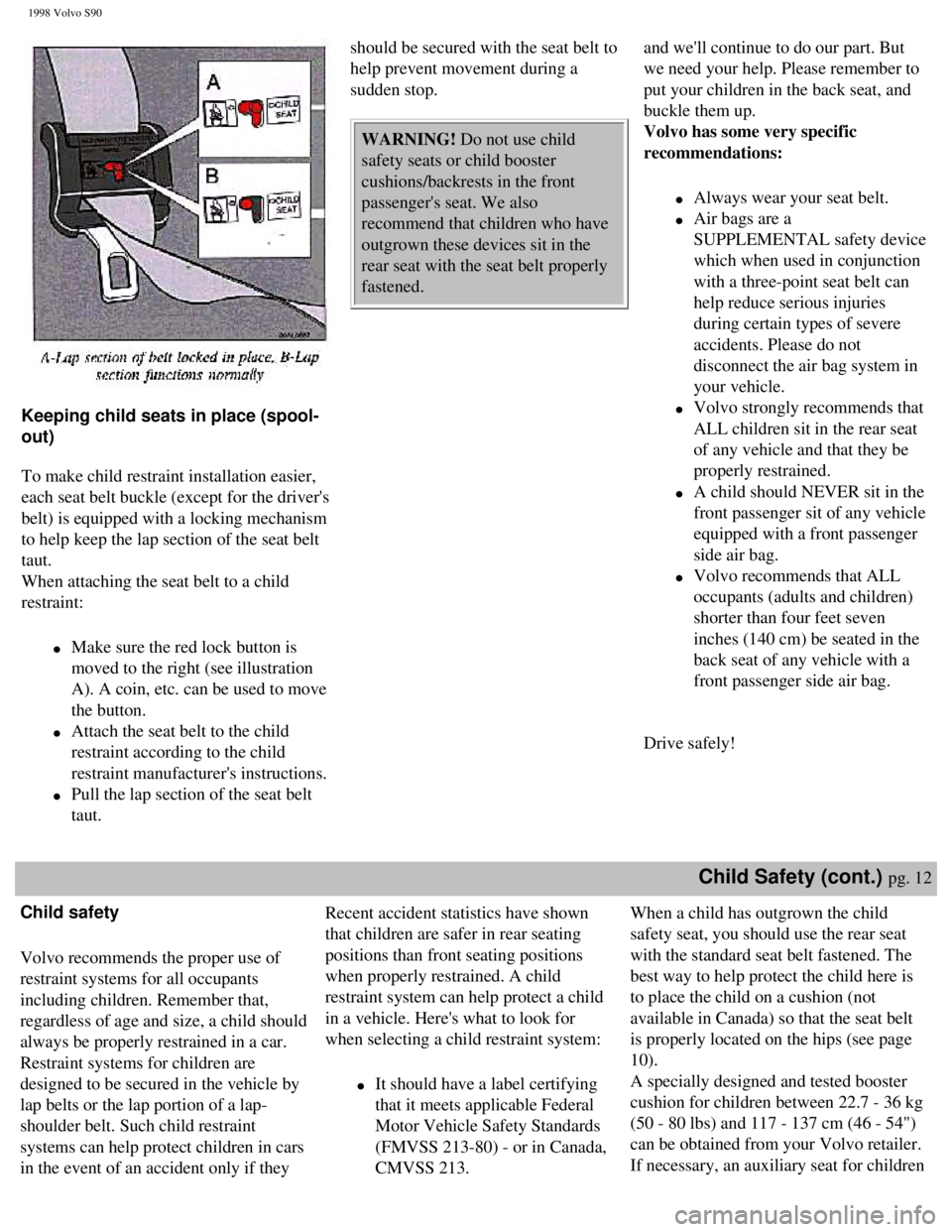
The lap section of the seat belt cannot
be loosened as long as the red lock
button is in the right position.
The lap section of the seat belt can be
adjusted when the lock button is in the
left position (see illustration B).
NOTE: Before exiting the car, check
that the seat belt retracts fully after
being unbuckled. If necessary, guide
the belt back into the retractor slot.
When not in use, the child restraint Important!
Why Volvo believes no child should
sit in the front seat of a car.
It's quite simple really. A front air bag
is a very powerful device designed, by
law, to help protect an adult. Because of
the size of the air bag and its speed of
inflation, a child should never be placed
in the front seat, even if he or she is
properly belted or strapped into a child
safety seat. Volvo has been an
innovator in safety for over fifty years,
file:///K|/ownersdocs/1998/1998_SV90/98S90_009.htm (2 of 5)12/30/2006 \
1:52:35 PM
Page 19 of 175
1998 Volvo S90
Keeping child seats in place (spool-
out)
To make child restraint installation easier,
each seat belt buckle (except for the driver's
belt) is equipped with a locking mechanism
to help keep the lap section of the seat belt
taut.
When attaching the seat belt to a child
restraint:
l Make sure the red lock button is
moved to the right (see illustration
A). A coin, etc. can be used to move
the button.
l Attach the seat belt to the child
restraint according to the child
restraint manufacturer's instructions.
l Pull the lap section of the seat belt
taut.
should be secured with the seat belt to
help prevent movement during a
sudden stop.
WARNING! Do not use child
safety seats or child booster
cushions/backrests in the front
passenger's seat. We also
recommend that children who have
outgrown these devices sit in the
rear seat with the seat belt properly
fastened. and we'll continue to do our part. But
we need your help. Please remember to
put your children in the back seat, and
buckle them up.
Volvo has some very specific
recommendations:
l Always wear your seat belt.
l Air bags are a
SUPPLEMENTAL safety device
which when used in conjunction
with a three-point seat belt can
help reduce serious injuries
during certain types of severe
accidents. Please do not
disconnect the air bag system in
your vehicle.
l Volvo strongly recommends that
ALL children sit in the rear seat
of any vehicle and that they be
properly restrained.
l A child should NEVER sit in the
front passenger sit of any vehicle
equipped with a front passenger
side air bag.
l Volvo recommends that ALL
occupants (adults and children)
shorter than four feet seven
inches (140 cm) be seated in the
back seat of any vehicle with a
front passenger side air bag.
Drive safely!
Child Safety (cont.) pg. 12
Child safety
Volvo recommends the proper use of
restraint systems for all occupants
including children. Remember that,
regardless of age and size, a child should
always be properly restrained in a car.
Restraint systems for children are
designed to be secured in the vehicle by
lap belts or the lap portion of a lap-
shoulder belt. Such child restraint
systems can help protect children in cars
in the event of an accident only if they
Recent accident statistics have shown
that children are safer in rear seating
positions than front seating positions
when properly restrained. A child
restraint system can help protect a child
in a vehicle. Here's what to look for
when selecting a child restraint system:
l It should have a label certifying
that it meets applicable Federal
Motor Vehicle Safety Standards
(FMVSS 213-80) - or in Canada,
CMVSS 213.
When a child has outgrown the child
safety seat, you should use the rear seat
with the standard seat belt fastened. The
best way to help protect the child here is
to place the child on a cushion (not
available in Canada) so that the seat belt
is properly located on the hips (see page
10).
A specially designed and tested booster
cushion for children between 22.7 - 36 kg
(50 - 80 lbs) and 117 - 137 cm (46 - 54")
can be obtained from your Volvo retailer.
If necessary, an auxiliary seat for children
file:///K|/ownersdocs/1998/1998_SV90/98S90_009.htm (3 of 5)12/30/2006 \
1:52:35 PM
Page 20 of 175

1998 Volvo S90
are used properly. However, children
could be endangered in a crash if the
child restraints are not properly secured
in the vehicle. Failure to follow the
installation instructions for your child
restraint can result in your child striking
the vehicle's interior in a sudden stop.
Holding a child in your arms is NOT a
suitable substitute for a child restraint
system. In an accident, a child held in a
person's arms can be crushed between
the vehicle's interior and an unrestrained
person. The child could also be injured
by striking the interior, or by being
ejected from the vehicle during a sudden
maneuver or impact. The same can also
happen if the infant or child rides
unrestrained on the seat. Other
occupants should also be properly
restrained to help reduce the chance of
injuring or increasing the injury of a
child. All states and provinces have
legislation governing how and where
children should be carried in a car. Find
out the regulations existing in your state
or province. l Make sure the child restraint
system is approved for the child's
height, weight and development -
the label required by the standard
or regulation, or instructions for
infant restraints, typically provide
this information.
l In using any child restraint
system, we urge you to look
carefully over the instructions
that are provided with the
restraint. Be sure you
understand them and can use
the device properly and safely
in this vehicle. A misused child
restraint system can result in
increased injuries for both the
infant or child and other
occupants in the vehicle.
l If your child restraint requires a
top tether strap, consult your
authorized Volvo retailer for top
tether anchorage and installation
information.
is available for use in the luggage
compartment of station wagon models.
This seat is designed for two children,
each weighing between 23 - 40 kg (50 -
88 lbs.) and up to 150 cm (59 inches) in
height.
WARNING!
l When using the auxiliary seat
for children, both sections of
the rear seat backrest must be
secured in the upright position
l Do not use a booster cushion or
child seat in conjunction with
the auxiliary seat.
Occupant Safety pg. 13
Seat belt maintenance
Check periodically that the anchor bolts
are secure and that the belts are in good
condition. Use water and a mild
detergent for cleaning. Check seat belt
mechanism function as follows: Attach
the seat belt and pull rapidly on the strap.
Volvo Concern for Safety
Safety is the cornerstone for Volvo. Our
concern dates back to 1927 when the
first Volvo rolled off the production line.
Three-point seat belts (a Volvo
invention), safety cages, and energy-
absorbing impact zones were designed
into Volvo cars long before it was
fashionable or required by government
regulation. We will not compromise our
commitment to safety. We continue to
seek out new safety features and to refine
those already in our cars. You can help.
We would appreciate hearing your
suggestions about improving automobile
Occupant safety
How safely you drive doesn't depend on
how old you are but rather on:
l how well you see
l your ability to concentrate
l how quickly you make decisions
under stress to avoid an accident.
The tips listed below are
suggestions to help you cope with
the ever changing traffic
environment.
l Never drink and drive.
l If you are taking any medication,
consult your physician about its
potential effects on your driving
abilities.
l Take a driver-retraining course
l Have your eyes checked regularly
l Keep your windshield and
headlamps clean.
l Replace wiper blades when they
start to leave streaks.
l Take into account the traffic,
Reporting Safety Defects in
the U.S.
If you believe that your vehicle has a
defect which could cause a crash or
could cause injury or death, you
should immediately inform the
National Highway Traffic Safety
Administration (NHTSA) in
addition to notifying Volvo Cars of
North America. If NHTSA receives
similar complaints, it may open an
investigation, and if it finds that a
safety defect exists in a group of
vehicles, it may order a recall and
remedy campaign. However,
NHTSA cannot become involved in
individual problems between you,
your retailer, or Volvo Cars of North
America. To contact NHTSA, you
may either call the Auto Safety
Hotline toll-free at 1-800-424-9393
file:///K|/ownersdocs/1998/1998_SV90/98S90_009.htm (4 of 5)12/30/2006 \
1:52:35 PM
Page 25 of 175

1998 Volvo S90
Chapter 2 - Instruments, switches and controls (cont.)Indicator and warning lights
pg. 17
1 Turn signal, left
2 Turn signal, right
3 Malfunction indicator
lamp
4 Direction indicator,
trailer
5 Service reminder
indicator
6 Low washer fluid level
If the lamp glows continuously
when the engine is running,
there is only about 1/2 - 1 US
qts. remaining in the washer
fluid reservoir.
7 Rear fog light
8 Bulb failure
9 Generator not charging
10 Low engine oil pressure
11 High beams
12 Brake failure
13 Parking brake applied
14 ABS-system
15 Low coolant level
16 (Not in use)
17 "Winter" mode engaged/
transmission fault
18 Fasten seat belts
19 SRS
20 (Not in use)
21 (Not in use)
Warning lights
pg. 18
file:///K|/ownersdocs/1998/1998_SV90/98S90_017.htm (1 of 7)12/30/2006 \
1:52:36 PM