Page 134 of 214

T100(U)
134
Use a washer fluid containing an anti-
freeze solution.
This product is available at your Toyota
dealer and most auto parts stores. Follow
the manufacturer ’s directions for how
much to mix with water.
NOTICE
Do not use engine antifreeze or any
other substitute as washer fluid be-
cause it may damage your vehicle’s
paint.
Do not use your parking brake when
there is a possibility it could freeze.
When parking, put the transmission into
”P” (automatic) or into first or reverse
(manual) and block the front wheels. Do
not use the parking brake, or snow or
water accumulated in and around the
parking brake mechanism may freeze,
making it hard to release.
Keep ice and snow from accumulating
under the fenders.
Ice and snow built up under your fenders
can make steering difficult. During bad
winter driving, stop and check under the
fenders occasionally.
Depending on where you are driving,
we recommend you carry some emer-
gency equipment.
Some of the things you might put in the
vehicle are tire chains, window scraper,
bag of sand or salt, flares, small shovel,
jumper cables, etc.
Trailer towing
Your vehicle is designed primarily as a
passenger-and-load-carrying vehicle. Tow-
ing a trailer will have an adverse effect on
handling, performance, braking, durability
and driving economy (fuel consumption,
etc.). Your safety and satisfaction depend
on the proper use of correct equipment
and cautious driving habits. For your safe-
ty and the safety of others, you must not
overload your vehicle or trailer. Ask your
local Toyota dealer for further details be-
fore towing.
WEIGHT LIMITS
Before towing, make sure the total trail-
er weight, gross combination weight,
gross vehicle weight, gross axle weight
and trailer tongue load are all within
the limits.
The total trailer weight and tongue load
can be measured with platform scales
found at a highway weighing station, build-
ing supply company, trucking company,
junk yard, etc.
Page 142 of 214
T100(U)
142
(b) Starting a flooded engine
If the engine will not start, your engine
may be flooded because of repeated
cranking.
Turn the key to ”START” with the acceler-
ator pedal held down. Keep the key and
accelerator pedal so for 15 seconds and
release them. Then try starting the engine
with your foot off the accelerator pedal.
If the engine does not start after 15 se-
conds of cranking, release the key, wait
a few minutes and try again.
If the engine still will not start, it needs
adjustment or repair. Call a Toyota dealer
or qualified repair shop for assistance.
NOTICE
Do not crank for more than 30 se-
conds at a time. This may overheat
the starter and wiring systems.
(c) Jump starting
To avoid serious personal injury and
damage to your vehicle which might re-
sult from battery explosion, acid burns,
electrical burns, or damaged electronic
components, these instructions must be
followed precisely.
If you are unsure about how to follow this
procedure, we strongly recommend that
you seek the help of a competent me-
chanic or towing service.
CAUTION
Batteries contain sulfuric acid
which is poisonous and corrosive.
Wear protective safety glasses when
jump starting, and avoid spilling
acid on your skin, clothing, or ve-
hicle.
If you should accidentally get acid
on yourself or in your eyes, remove
any contaminated clothing and flush
the affected area with water imme-
diately. Then get immediate medical
attention. If possible, continue to
apply water with a sponge or cloth
while en route to the medical office.
The gas normally produced by a
battery will explode if a flame or
spark is brought near. Use only
standardized jumper cables and do
not smoke or light a match while
jump starting.
NOTICE
The battery used for boosting must
be 12 V. Do not jump start unless you
are sure that the booster battery is
correct.
JUMP STARTING PROCEDURE
1. If the booster battery is installed in another vehicle, make sure the vehicles
are not touching. Turn off all unneces-
sary lights and accessories.
2. If required, remove all the vent plugs from the booster and discharged batter-
ies. Lay a cloth over the open vents
on the batteries. (This helps reduce the
explosion hazard, personal injuries and
burns.)
Page 143 of 214
T100(U)143
3. If the engine in the vehicle with the
booster battery is not running, start it
and let it run for a few minutes. During
jump starting, run the engine at about
2000 rpm with the accelerator pedal
lightly depressed.
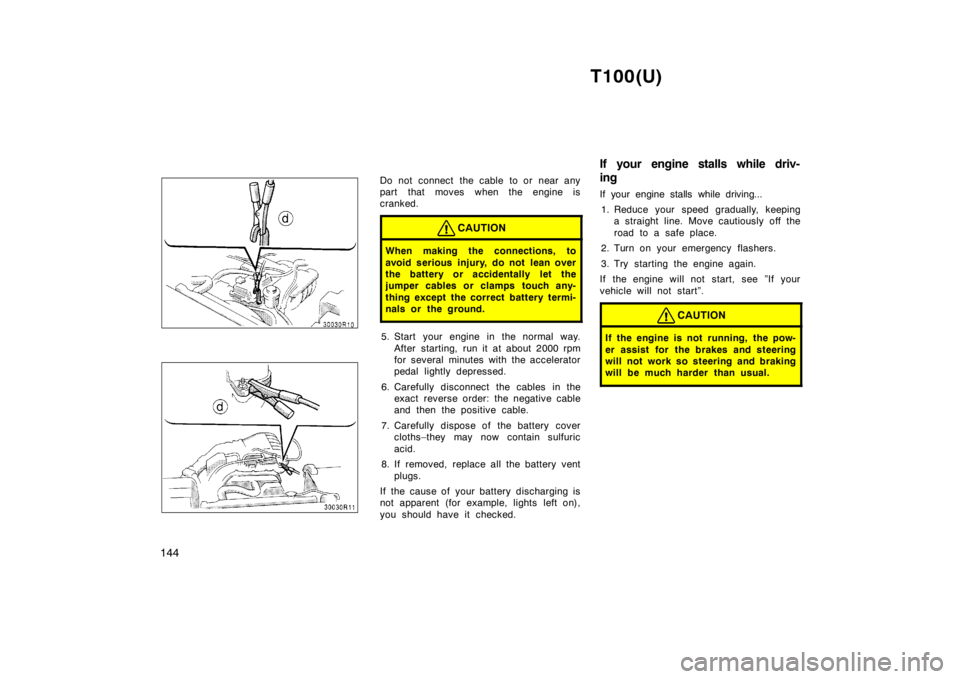
4. Make the cable connections in the or-der a, b, c, d.
a. Connect the clamp of the positive (red) jumper cable to the positive (+) termi-
nal on the discharged battery.
b. Connect the clamp at the other end of the positive (red) jumper cable to the
positive (+) terminal on the booster
battery.c. Connect the clamp of the negative(black) jumper cable to the negative (–)
terminal on the booster battery.
d. Connect the clamp at the other end of the negative (black) jumper cable to a
solid, stationary, unpainted, metallic
point of the vehicle with the discharged
battery.
The recommended connecting points are
shown in the following illustrations:
Page 144 of 214
T100(U)
144
Do not connect the cable to or near any
part that moves when the engine is
cranked.
CAUTION
When making the connections, to
avoid serious injury, do not lean over
the battery or accidentally let the
jumper cables or clamps touch any-
thing except the correct battery termi-
nals or the ground.
5. Start your engine in the normal way. After starting, run it at about 2000 rpm
for several minutes with the accelerator
pedal lightly depressed.
6. Carefully disconnect the cables in the exact reverse order: the negative cable
and then the positive cable.
7. Carefully dispose of the battery cover cloths–they may now contain sulfuric
acid.
8. If removed, replace all the battery vent plugs.
If the cause of your battery discharging is
not apparent (for example, lights left on),
you should have it checked. If your engine stalls while driv-
ing
If your engine stalls while driving...
1. Reduce your speed gradually, keeping a straight line. Move cautiously off the
road to a safe place.
2. Turn on your emergency flashers.
3. Try starting the engine again.
If the engine will not start, see ”If your
vehicle will not start”.
CAUTION
If the engine is not running, the pow-
er assist for the brakes and steering
will not work so steering and braking
will be much harder than usual.