1998 TOYOTA T100 light
[x] Cancel search: lightPage 142 of 214
T100(U)
142
(b) Starting a flooded engine
If the engine will not start, your engine
may be flooded because of repeated
cranking.
Turn the key to ”START” with the acceler-
ator pedal held down. Keep the key and
accelerator pedal so for 15 seconds and
release them. Then try starting the engine
with your foot off the accelerator pedal.
If the engine does not start after 15 se-
conds of cranking, release the key, wait
a few minutes and try again.
If the engine still will not start, it needs
adjustment or repair. Call a Toyota dealer
or qualified repair shop for assistance.
NOTICE
Do not crank for more than 30 se-
conds at a time. This may overheat
the starter and wiring systems.
(c) Jump starting
To avoid serious personal injury and
damage to your vehicle which might re-
sult from battery explosion, acid burns,
electrical burns, or damaged electronic
components, these instructions must be
followed precisely.
If you are unsure about how to follow this
procedure, we strongly recommend that
you seek the help of a competent me-
chanic or towing service.
CAUTION
Batteries contain sulfuric acid
which is poisonous and corrosive.
Wear protective safety glasses when
jump starting, and avoid spilling
acid on your skin, clothing, or ve-
hicle.
If you should accidentally get acid
on yourself or in your eyes, remove
any contaminated clothing and flush
the affected area with water imme-
diately. Then get immediate medical
attention. If possible, continue to
apply water with a sponge or cloth
while en route to the medical office.
The gas normally produced by a
battery will explode if a flame or
spark is brought near. Use only
standardized jumper cables and do
not smoke or light a match while
jump starting.
NOTICE
The battery used for boosting must
be 12 V. Do not jump start unless you
are sure that the booster battery is
correct.
JUMP STARTING PROCEDURE
1. If the booster battery is installed in another vehicle, make sure the vehicles
are not touching. Turn off all unneces-
sary lights and accessories.
2. If required, remove all the vent plugs from the booster and discharged batter-
ies. Lay a cloth over the open vents
on the batteries. (This helps reduce the
explosion hazard, personal injuries and
burns.)
Page 143 of 214

T100(U)143
3. If the engine in the vehicle with the
booster battery is not running, start it
and let it run for a few minutes. During
jump starting, run the engine at about
2000 rpm with the accelerator pedal
lightly depressed.
4. Make the cable connections in the or-der a, b, c, d.
a. Connect the clamp of the positive (red) jumper cable to the positive (+) termi-
nal on the discharged battery.
b. Connect the clamp at the other end of the positive (red) jumper cable to the
positive (+) terminal on the booster
battery.c. Connect the clamp of the negative(black) jumper cable to the negative (–)
terminal on the booster battery.
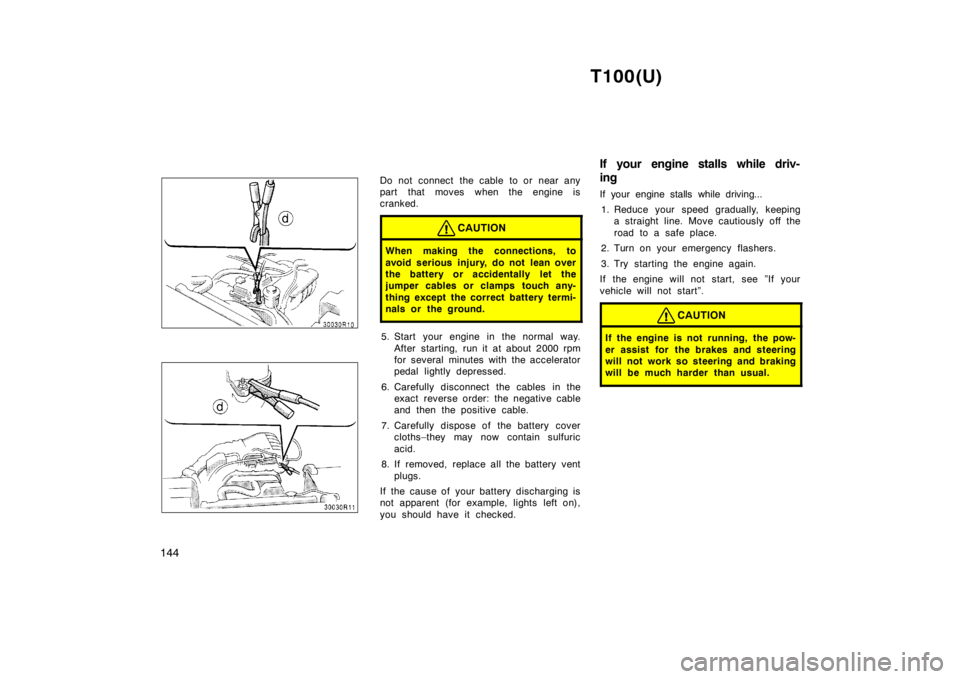
d. Connect the clamp at the other end of the negative (black) jumper cable to a
solid, stationary, unpainted, metallic
point of the vehicle with the discharged
battery.
The recommended connecting points are
shown in the following illustrations:
Page 144 of 214
T100(U)
144
Do not connect the cable to or near any
part that moves when the engine is
cranked.
CAUTION
When making the connections, to
avoid serious injury, do not lean over
the battery or accidentally let the
jumper cables or clamps touch any-
thing except the correct battery termi-
nals or the ground.
5. Start your engine in the normal way. After starting, run it at about 2000 rpm
for several minutes with the accelerator
pedal lightly depressed.
6. Carefully disconnect the cables in the exact reverse order: the negative cable
and then the positive cable.
7. Carefully dispose of the battery cover cloths–they may now contain sulfuric
acid.
8. If removed, replace all the battery vent plugs.
If the cause of your battery discharging is
not apparent (for example, lights left on),
you should have it checked. If your engine stalls while driv-
ing
If your engine stalls while driving...
1. Reduce your speed gradually, keeping a straight line. Move cautiously off the
road to a safe place.
2. Turn on your emergency flashers.
3. Try starting the engine again.
If the engine will not start, see ”If your
vehicle will not start”.
CAUTION
If the engine is not running, the pow-
er assist for the brakes and steering
will not work so steering and braking
will be much harder than usual.
Page 145 of 214

T100(U)145
If your vehicle overheats
If your engine coolant temperature
gauge indicates overheating, if you ex-
perience a loss of power, or if you hear
a loud knocking or pinging noise, the
engine has probably over-heated. You
should follow this procedure...
1. Pull safely off the road, stop the ve- hicle and turn on your emergency
flashers. Put the transmission in ”P”
(automatic) or neutral (manual) and ap-
ply the parking brake. Turn off the air
conditioning if it is being used.
2. If coolant or steam is boiling out of the radiator or reservoir, stop the engine.
Wait until the steam subsides before
opening the hood. If there is no coolant
boiling over or steam, leave the engine
running.
CAUTION
To help avoid personal injury, keep
the hood closed until there is no
steam. Escaping steam or coolant is
a sign of very high pressure.
3. Visually check to see if the engine drive belt (fan belt) is broken or loose.
Look for obvious coolant leaks from the
radiator, hoses, and under the vehicle.
However, note that water draining from
the air conditioning is normal if it has
been used.
CAUTION
When the engine is running, keep
hands and clothing away from the
moving fan and engine drive belts.
4. If the engine drive belt is broken or thecoolant is leaking, stop the engine im-
mediately. Call a Toyota dealer for as-
sistance.
5. If the engine drive belt is O.K. and there are no obvious leaks, you may
help the engine cool down more quickly
by running it at about 1500 rpm for a
few minutes with the accelerator pedal
lightly depressed.
6. Check the coolant reservoir. If it is dry, add coolant to the reservoir while the
engine is running. Fill it about half full.
CAUTION
Do not attempt to remove the radiator
cap when the engine and radiator are
hot. Serious injury could result from
scalding hot fluid and steam blown
out under pressure.
7. After the engine coolant temperaturehas cooled to normal, again check the
coolant level in the reservoir. If neces-
sary, bring it up to half full again. Seri-
ous coolant loss indicates a leak in the
system. You s hould have it checked as
soon as possible at your Toyota dealer.
Page 164 of 214
T100(U)
164
NOTICE
Do not use solvent, thinner, gasoline
or window cleaner on the interior.
Carpets
Use a good foam-type shampoo to
clean the carpets.
Begin by vacuuming thoroughly to remove
as much dirt as possible. Several types of
foam cleaners are available; some are in
aerosol cans and others are powders or
liquids which you mix with water to pro-
duce a foam. To shampoo the carpets,
use a sponge or brush to apply the foam.
Rub in overlapping circles.
Do not apply water–the best results are
obtained by keeping the carpet as dry as
possible. Read the shampoo instructions
and follow them closely.
Seat belts
The seat belts may be cleaned with
mild soap and water or with lukewarm
water.
Use a cloth or sponge. As you are clean-
ing, check the belts for excessive wear,
fraying, or cuts.
NOTICE
Do not use dye or bleach on the belt-
s—it may weaken them.
Windows
The windows may be cleaned with any
household window cleaner.
NOTICE
When cleaning the inside of the win-
dows, be careful not to scratch or
damage the heater wires on the rear
window.
Air conditioning control panel, car au-
dio, instrument panel, console panel,
and switches
Use a soft damp cloth for cleaning.
Soak a clean soft cloth in water or luke-
warm water then lightly wipe off any dirt.
NOTICE
Do not use organic substances (sol-
vents, kerosene, alcohol, gasoline,
etc.) or alkaline or acidic solutions.
These chemicals can cause discol-
oring, staining or peeling of the
surface.
If you use cleaners or polishing
agents, make sure their ingredients
do not include the substances men-
tioned above.
If you use a liquid car freshener, do
not spill the liquid onto the ve-
hicle’s interior surfaces. It may con-
tain the ingredients mentioned
above. Immediately clean any spill
using the method mentioned above.
If you have any questions about the
cleaning of your Toyota, your local
Toyota dealer will be pleased to answer
them.
Page 167 of 214

T100(U)167
Tire surface and wheel nuts
Check the tires carefully for cuts, damage
or excessive wear. See Chapter 7
−2 for
additional information. When checking the
tires, make sure no nuts are missing, and
check the nuts for looseness. Tighten
them if necessary.
Tire rotation
Rotate the tires every 12000 km (7500
miles). See Chapter 7 −2 for additional in-
formation.
Fluid leaks
Check underneath for leaking fuel, oil, wa-
ter or other fluid after the vehicle has
been parked for a while. If you smell fuel
fumes or notice any leak, have the cause
found and corrected immediately.
Doors and engine hood
Check that all doors including tailgate op-
erate smoothly and all latches lock se-
curely. Make sure the engine hood sec-
ondary latch secures the hood from
opening when the primary latch is re-
leased.
INSIDE THE VEHICLE
Items listed below should be checked
regularly, e.g. while performing periodic
services, cleaning the vehicle, etc. Lights
Make sure the headlights, stop lights, tail
lights, turn signal lights, and other lights
are all working. Check headlight aim.
Service reminder indicators and warning
buzzers
Check that all service reminder indicators
and warning buzzers function properly.
Steering wheel
Be alert for changes in steering condition,
such as hard steering or strange noise.
Seats
Check that all seat controls such as seat
adjusters, seatback recliner, etc. operate
smoothly and that all latches lock securely
in any position. Check that the head re-
straints move up and down smoothly and
that the locks hold securely in any latched
position. For folding
−down seatback
(bench seat), check that the latches lock
security.
Seat belts
Check that the seat belt system such as
buckles, retractors and anchors operate
properly and smoothly. Make sure that the
belt webbing is not cut, frayed, worn or
damaged.
Accelerator pedal
Check the pedal for smooth operation and
uneven pedal effort or catching. Clutch pedal
Check the pedal for smooth operation.
Brake pedal
Check the pedal for smooth operation and
that the pedal has the proper clearance.
Check the brake booster function.
Brakes
At a safe place, check that the brakes do
not pull to one side when applied.
Parking brake
Check that the lever has the proper travel
and that, on a safe incline, your vehicle
is held securely with only the parking
brake applied.
Automatic transmission ”Park” mecha-
nism
On a safe incline, check that your vehicle
is held securely with the selector lever in
”P” position and all brakes released.
IN THE ENGINE COMPARTMENT
Items listed below should be checked
from time to time, e.g. each time when
refueling.
Washer fluid
Make sure there is sufficient fluid in the
tank. See Chapter 7
−3 for additional in-
formation.
Page 177 of 214

T100(U)177
Adding washer fluid
Parts:
Water
Washer fluid containing antifreeze (for
winter use)
Tools: Funnel
Replacing light bulbs
Parts: Bulb with same number and wattage
rating as original (See charts in ”Re-
placing light bulbs” in Chapter 7 −3.)
Tools:
Screwdriver
Page 179 of 214

T100(U)179
Part 7
DO-IT-YOURSELF
MAINTENANCE—
Chapter 7
−2
Engine and Chassis
Checking the engine oil level
Checking the engine coolant
level
Checking brake fluid
Checking power steering fluid
Checking tire pressure
Checking and replacing tires
Rotating tires
Installing snow tires and chains
Replacing wheels
Aluminum wheel precautions
Checking the engine oil level
With the engine at operating tempera-
ture and turned off, check the oil level
on the dipstick. 1. To get a true reading, the vehicle should be on a level spot. After turning
off the engine, wait a few minutes for
the oil to drain back into the bottom of
the engine.
2. Pull out the dipstick, and wipe it clean with a rag.
3. Reinsert the dipstick–push it in as far as it will go, or the reading will not be
correct.
4. Pull the dipstick out and look at the oil level on the end.
CAUTION
Be careful not to touch the hot ex-
haust manifold.
If the oil level is below or only slightly
above the low level, add engine oil of
the same type as already in the engine.
Remove the oil filler cap and add engine
oil in small quantities at a time, checking
the dipstick.
The approximate quantity of oil needed to
fill between the low level and the full level
on the dipstick is indicated below for ref-
erence.
When the level reaches within the correct
range, install the filler cap hand-tight.
Oil quantity, L (qt., lmp. qt.):3RZ −FE engine 1.5 (1.6, 1.3)
5VZ −FE engine
Two-wheel drive models 1.5 (1.6, 1.3)
Four-wheel drive models 1.4 (1.5, 1.2)