Page 225 of 261
name. SIENNA (U)
225
Part 7
DO−IT−YOURSELF
MAINTENANCE—
Chapter 7−2
Engine and Chassis
�Checking the engine oil level
�Checking the engine coolant
level
�Checking brake fluid
�Checking power steering fluid
�Checking tire pressure
�Checking and replacing tires
�Rotating tires
�Installing snow tires and chains
�Replacing wheels
�Aluminum wheel precautions
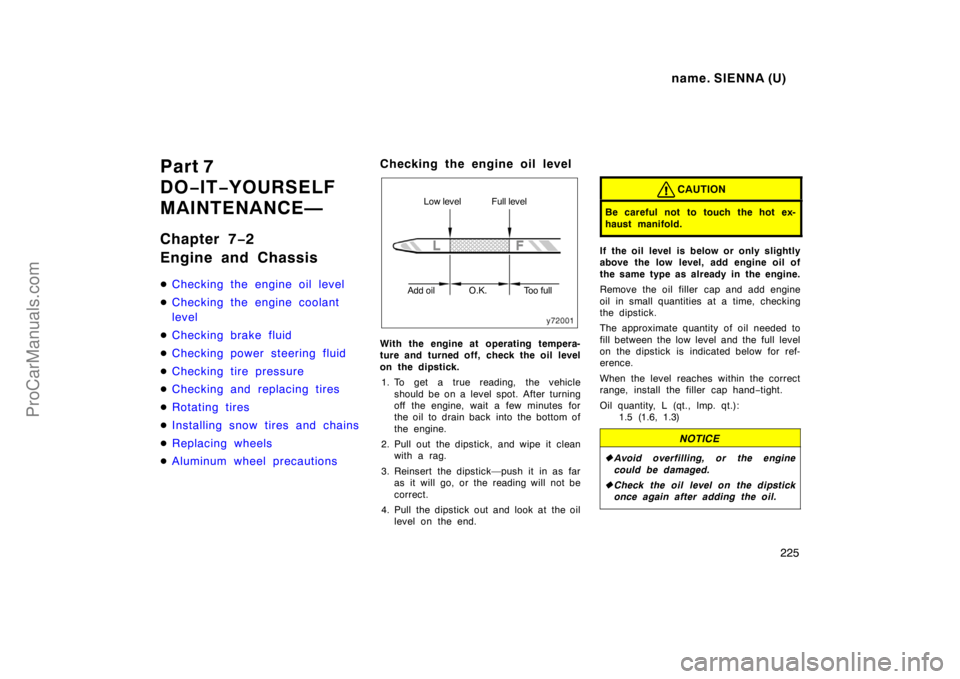
Checking the engine oil level
Low level Full level
Add oil Too fullO.K.
With the engine at operating tempera-
ture and turned off, check the oil level
on the dipstick.
1. To get a true reading, the vehicle
should be on a level spot. After turning
off the engine, wait a few minutes for
the oil to drain back into the bottom of
the engine.
2. Pull out the dipstick, and wipe it clean
with a rag.
3. Reinsert the dipstick—push it in as far
as it will go, or the reading will not be
correct.
4. Pull the dipstick out and look at the oil
level on the end.
CAUTION
Be careful not to touch the hot ex-
haust manifold.
If the oil level is below or only slightly
above the low level, add engine oil of
the same type as already in the engine.
Remove the oil filler cap and add engine
oil in small quantities at a time, checking
the dipstick.
The approximate quantity of oil needed to
fill between the low level and the full level
on the dipstick is indicated below for ref-
erence.
When the level reaches within the correct
range, install the filler cap hand−tight.
Oil quantity, L (qt., lmp. qt.):
1.5 (1.6, 1.3)
NOTICE
�Avoid overfilling, or the engine
could be damaged.
�Check the oil level on the dipstick
once again after adding the oil.
ProCarManuals.com
Page 230 of 261
name. SIENNA (U)
230
Checking and replacing tires
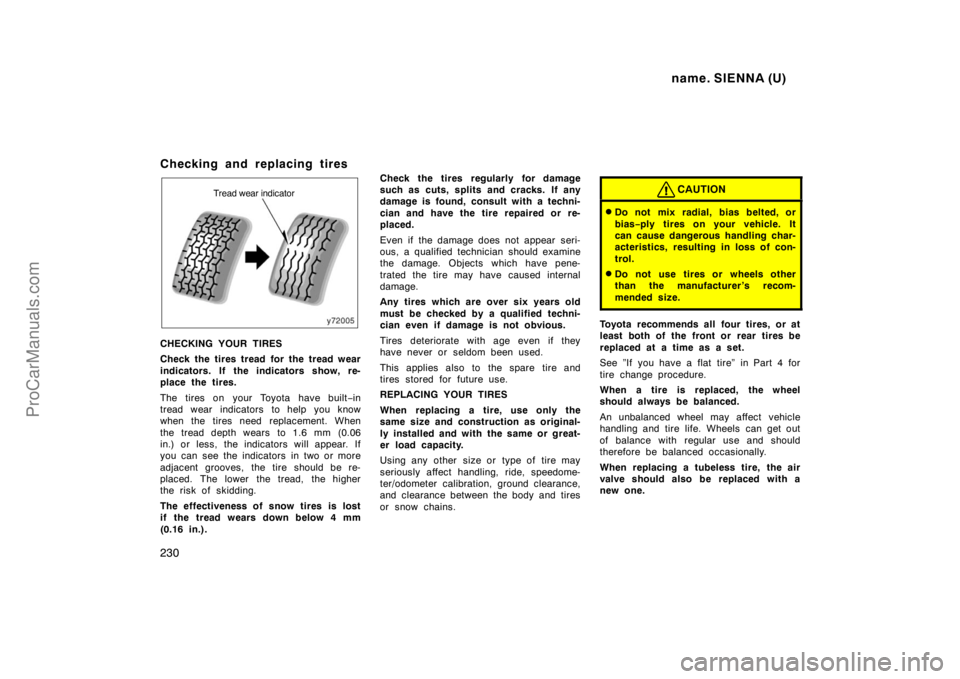
Tread wear indicator
CHECKING YOUR TIRES
Check the tires tread for the tread wear
indicators. If the indicators show, re-
place the tires.
The tires on your Toyota have built−in
tread wear indicators to help you know
when the tires need replacement. When
the tread depth wears to 1.6 mm (0.06
in.) or less, the indicators will appear. If
you can see the indicators in two or more
adjacent grooves, the tire should be re-
placed. The lower the tread, the higher
the risk of skidding.
The effectiveness of snow tires is lost
if the tread wears down below 4 mm
(0.16 in.).Check the tires regularly for damage
such as cuts, splits and cracks. If any
damage is found, consult with a techni-
cian and have the tire repaired or re-
placed.
Even if the damage does not appear seri-
ous, a qualified technician should examine
the damage. Objects which have pene-
trated the tire may have caused internal
damage.
Any tires which are over six years old
must be checked by a qualified techni-
cian even if damage is not obvious.
Tires deteriorate with age even if they
have never or seldom been used.
This applies also to the spare tire and
tires stored for future use.
REPLACING YOUR TIRES
When replacing a tire, use only the
same size and construction as original-
ly installed and with the same or great-
er load capacity.
Using any other size or type of tire may
seriously affect handling, ride, speedome-
ter/odometer calibration, ground clearance,
and clearance between the body and tires
or snow chains.
CAUTION
�Do not mix radial, bias belted, or
bias−ply tires on your vehicle. It
can cause dangerous handling char-
acteristics, resulting in loss of con-
trol.
�Do not use tires or wheels other
than the manufacturer ’s recom-
mended size.
Toyota recommends all four tires, or at
least both of the front or rear tires be
replaced at a time as a set.
See ”If you have a flat tire” in Part 4 for
tire change procedure.
When a tire is replaced, the wheel
should always be balanced.
An unbalanced wheel may affect vehicle
handling and tire life. Wheels can get out
of balance with regular use and should
therefore be balanced occasionally.
When replacing a tubeless tire, the air
valve should also be replaced with a
new one.
ProCarManuals.com
Page 232 of 261
name. SIENNA (U)
232
CAUTION
�Do not drive with the snow tires
incorrectly inflated.
�Never drive over 120 km/h (75 mph)
with any type of snow tires.
TIRE CHAIN SELECTION
Use the tire chains of correct size and
type.
Use SAE Class ”S” type radial tire chains
except radial cable chains or V−bar type
chains.
Regulations regarding the use of tire
chains vary according to location or
type of road, so always check them
before installing chains.
CHAIN INSTALLATION
Install the chains on the front tires as
tightly as possible. Do not use tire
chains on the rear tires. Retighten
chains after driving 0.5—1.0 km
(1/4—1/2 mile).
When installing chains on your tires, care-
fully follow the instructions of the chain
manufacturer.If wheel covers are used, they will be
scratched by the chain band,so remove
the covers before putting on the chains.
CAUTION
�Do not exceed 50 km/h (30 mph) or
the chain manufacturer ’s recom-
mended speed limit, whichever is
lower.
�Drive carefully avoiding bumps,
holes, and sharp turns, which may
cause the vehicle to bounce.
�Avoid sharp turns or locked−wheel
braking, as use of chains may ad-
versely affect vehicle handling.
NOTICE
Do not attempt to use a tire chain on
the compact spare tire, as it may re-
sult in damage to the vehicle as well
as the tire.
Replacing wheels
WHEN TO REPLACE YOUR WHEELS
If you have wheel damage such as
bending, cracks or heavy corrosion, the
wheel should be replaced.
If you fail to replace damaged wheels, the
tire may slip off the wheel or they may
cause loss of handling control.
WHEEL SELECTION
When replacing wheels, care should be
taken to ensure that the wheels are re-
placed by ones with the same load ca-
pacity, diameter, rim width, and offset.
This must be observed on compact spare
tires, too.
Correct replacement wheels are available
at your Toyota dealer.
A wheel of a different size or type may
adversely affect handling, wheel and bear-
ing life, brake cooling, speedometer/odom-
eter calibration, stopping ability, headlight
aim, bumper height, vehicle ground clear-
ance, and tire or snow chain clearance to
the body and chassis.
ProCarManuals.com
Page 248 of 261
name. SIENNA (U)
248
STEERING
Wheel freeplay:
Less than 30 mm (1.2 in.)
Power steering fluid type:
Automatic transmission fluid DEXRON�II
or III
Tires
Wheel nut torque, N�m (kgf�m, ft�lbf):
104 (10.5, 77)Tire sizeTire pressure,
kPa (kgf/cm
2 or bar, psi)Wheel size
P205/70R15 95S240 (2.4, 35)
15 x 6.5JJ
220 (2.2, 32)
T145/80D16 420 (4.2, 60)
15 x 6.5JJ
16 x 4T P215/65R15 95S Normal driving
Trailer towing
Tire sizeTire pressure,
kPa (kgf/cm
2 or bar, psi)Wheel size
P205/70R15 95S 240 (2.4, 35) 15 x 6.5JJ
240 (2.4, 35)
15 x 6.5JJ P215/65R15 95S
When driving under the above vehicle load conditions at sustained high
speeds above 160 km/h (100 mph), in countries where such speeds are
permitted by−law, inflate the front and rear tires to 240 kPa (2.4 kgf/cm
2
or bar, 35 psi) provided that it does not exceed the maximum cold tire
pressure molded on the tire sidewall. Tire size and pressure:
ProCarManuals.com
Page 256 of 261

Publication No. OM45402U
Part No. 01999-45402
Printed in Japan 01−9803−00
(U)
Quick index
�If a service reminder indicator or warning buzzer comes on 106. . . .
�If your vehicle will not start 189. . . . . . . . . . . . . . . . . . . . . . . . . . . . . . . . . . .
�If your engine stalls while driving 192. . . . . . . . . . . . . . . . . . . . . . . . . . . . . .
�If your vehicle overheats 193. . . . . . . . . . . . . . . . . . . . . . . . . . . . . . . . . . . . . .
�If you have a flat tire 194. . . . . . . . . . . . . . . . . . . . . . . . . . . . . . . . . . . . . . . . .
�If your vehicle needs to be towed 202. . . . . . . . . . . . . . . . . . . . . . . . . . . . .
�Tips for driving during break-in period 167. . . . . . . . . . . . . . . . . . . . . . . . . .
�How to start the engine 179. . . . . . . . . . . . . . . . . . . . . . . . . . . . . . . . . . . . . . .
�General maintenance 214. . . . . . . . . . . . . . . . . . . . . . . . . . . . . . . . . . . . . . . . . .
Gas station information
Fuel type:
UNLEADED gasoline, Octan Rating 87 (Research Octane Number
91) or higher.
For improved vehicle performance, the use of premium unleaded
gasoline with an Octane Rating of 91 (Research Octane Number
96) or higher is recommended.
See page 167 for detailed information.
Fuel tank capacity:
79 L (21 gal., 17.5 lmp. gal.)
Engine oil:
API grade SH, ’’Energy−Conserving II’’ or SJ, ’’Energy−Conserving’’
multigrade engine oil or ILSAC multigrade engine oil is
recommended.
See page 226 for detailed information.
Automatic transmission fluid:
Automatic transmission fluid D−II or DEXRON�III (DEXRON�II)
Tire information: See pages 229 through 233.
Tire pressure: See page 248.
gU2
I
ProCarManuals.com