1998 PONTIAC BONNEVILLE cruise control
[x] Cancel search: cruise controlPage 93 of 395
Tilt Wheel Turn SignallMultifunction Lever
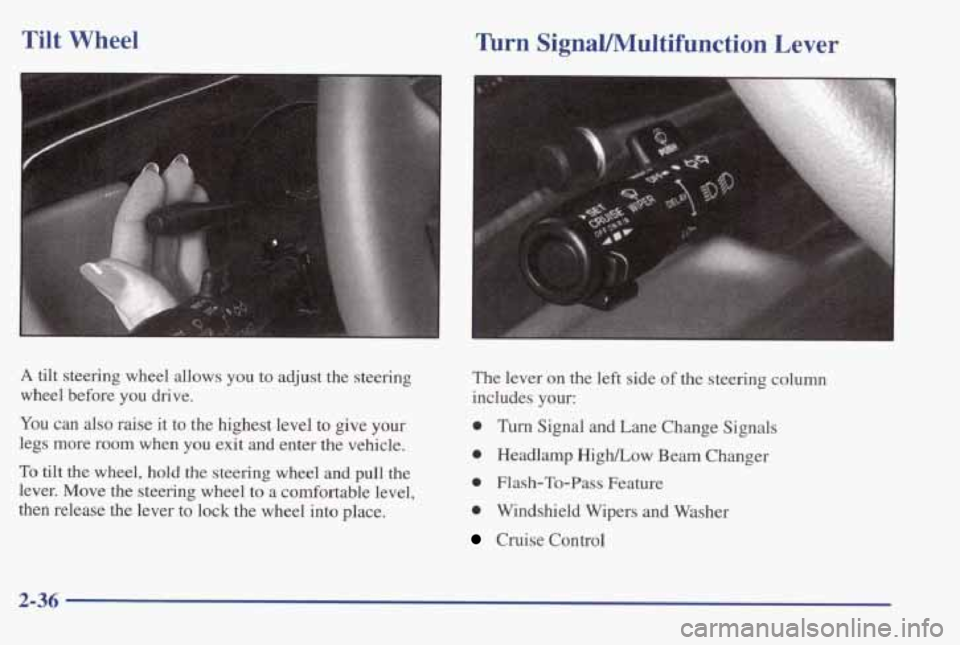
A tilt steering wheel allows you to adjust the steering
wheel before you drive.
You can also raise it to the highest level to give your
legs more room when
you exit and enter the vehicle.
To
tilt the wheel, hold the steering wheel and pull the
lever. Move the steering wheel to a comfortable level,
then release the lever to lock the wheel into place.
The lever on the left side of the steering column
includes your:
0 Turn Signal and Lane Change Signals
0 Headlamp HighLow Beam Changer
0 Flash-To-Pass Feature
0 Windshield Wipers and Washer
Cruise Control
2-36
Page 97 of 395
Cruise Control
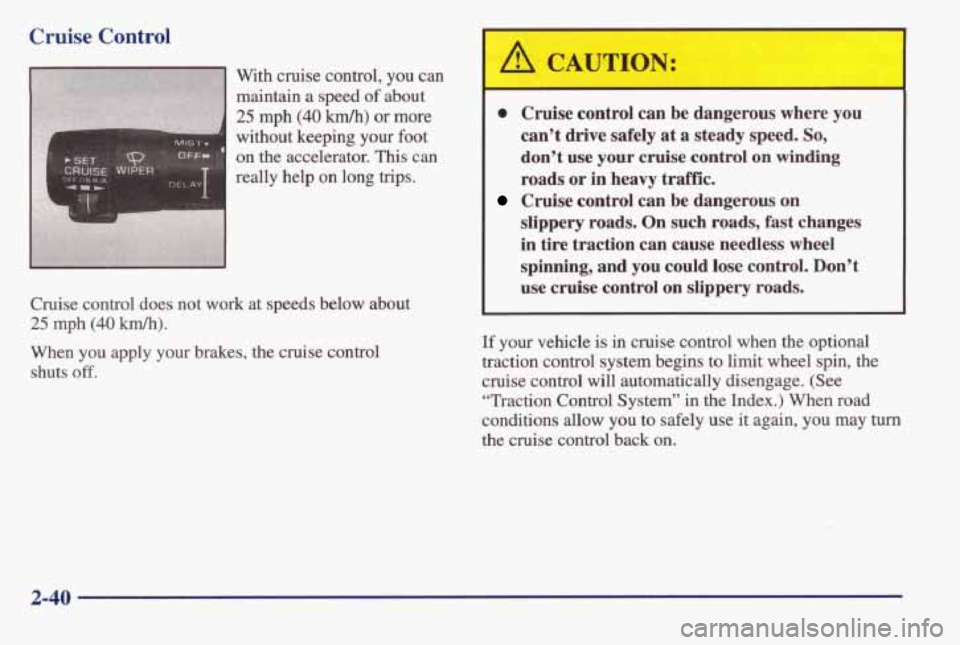
on the accelerator. This can
really help
on long trips.
Cruise control
does not work at speeds below about
25 mph (40 km/h).
When you apply your brakes, the cruise control
shuts off.
I A CAUTION:
0 Cruise control can be dangerous where you
can’t drive safely at a steady speed.
So,
don’t use your cruise control on winding
roads or in heavy traffic.
slippery roads.
On such roads, fast changes
in tire traction can cause needless wheel
spinning,
and you could lose control. Don’t
use cruise control on slippery roads.
Cruise control can be dangerous on
If your vehicle is in cruise control when the optional
traction control system begins to limit wheel spin, the
cruise control will automatically disengage. (See “Traction Control System” in the Index.) When road
conditions allow
you to safely use it again, you may turn
the cruise control back on.
2-40
Page 98 of 395
Setting Cruise Control
‘
A CAUTION:
If you leave your cruise control switch on when
you’re not using cruise, you might hit a button
and go into cruise when you don’t want to. You
could be startled and even lose control.
Keep the
cruise control switch
off until you want to use it.
1. Move the cruise control switch to ON.
2. Get up to the speed you want.
3. Push in the SET button at the end of the lever and
release
it.
4. Take your foot off the accelerator pedal.
Resuming a Set Speed
Suppose you set your cruise control at a desired speed
and then you apply the brake.
This, of course, shuts off
the cruise control. But you don’t need to reset it.
Once you’re going about
25 mph (40 km/h) or more,
you can move the cruise control switch from
ON to
R/A (resume/accelerate) briefly.
You’ll go right back up to your chosen speed and stay there. Remember that
if you hold the switch at WA
longer than half a second, the vehicle will keep going
faster until you release the switch or apply the brake.
So unless you want to go faster, don’t hold the
switch at
WA.
2-41
Page 99 of 395
Increasing Speed While Using Cruise Control
There are two ways to go to a higher speed.
Use the accelerator pedal to get to the higher speed.
Push in the button at the end
of the lever, then
release
the button and the accelerator pedal. You’ll
now
cruise at the higher speed.
Move the cruise switch from ON to WA. Hold it
there until you get up to the speed
you want, and
then release the switch.
To increase your speed in
very small amounts, move the switch to
RfA briefly
and then release it. Each time
you do this, your
vehicle will go about 1 mph (1.6 km/h) faster.
The accelerate feature will only work after you have set
the cruise control speed by pushing the
SET button. 0
Reducing Speed While Using Cruise Control
There are two ways to reduce your speed while using
cruise control:
0 Push in the button at the end of the lever until you
reach the lower speed
you want, then release it.
To slow down in very small amounts, push the
button briefly. Each time you do
this, you’ll go
1 mph (1.6 kmk) slower.
Passing Another Vehicle While Using Cruise Control
Use the accelerator pedal to increase your speed. When
you take your foot off the pedal, your vehicle will slow
down to the cruise control speed you set earlier.
Using Cruise Control on Hills
How well your cruise control will work on hills depends
upon your speed, load and the steepness
of the hills.
When going
up steep hills, you may have to step on the
accelerator
pedal to maintain your speed. When going
downhill, you may have to brake or
shift to a lower gear
to keep your speed down.
Of course, applying the brake
takes you out
of cruise control. Many drivers find this to
be too much trouble and don’t use cruise control on
steep hills.
Ending Cruise Control
There are two ways to turn off the cruise control:
Step lightly on the brake pedal; or
Move the cruise switch to OFF.
Erasing Speed Memory
When you turn off the cruise control or the ignition,
your cruise control set speed memory
is erased.
2-42
Page 182 of 395
Remember: Anti-lock doesn’t change the time you need to get your foot up to the brake pedal or always decrease
stopping distance.
If you get too close to the vehicle in
fiont of you, you won’t have time to apply your brakes
if that vehicle suddenly slows or stops. Always leave
enough room up ahead to stop, even though you have anti-lock brakes.
Using Anti-Lock
Don’t pump the brakes. Just hold the brake pedal down
fiiy and let anti-lock work for you. You may feel a
slight brake pedal pulsation or notice some noise, but
this is normal.
Traction Control System (If Equipped)
Your vehicle may have a traction control system that
limits wheel spin. This is especially useful in slippery
road conditions. The system operates only if it senses
that one or both of the front wheels
are spinning or
beginning to lose traction. When this happens, the system works the front brakes and reduces engine power
to
limit wheel spin.
You may feel
or hear the system working, but this
is normal.
If your vehicle is in cruise control when the traction
control system begins to limit wheel spin, the cruise
control will automatically disengage. When road
conditions allow you to safely use it again, you may
reengage the cruise control. (See “Cruise Control”
in the Index.)
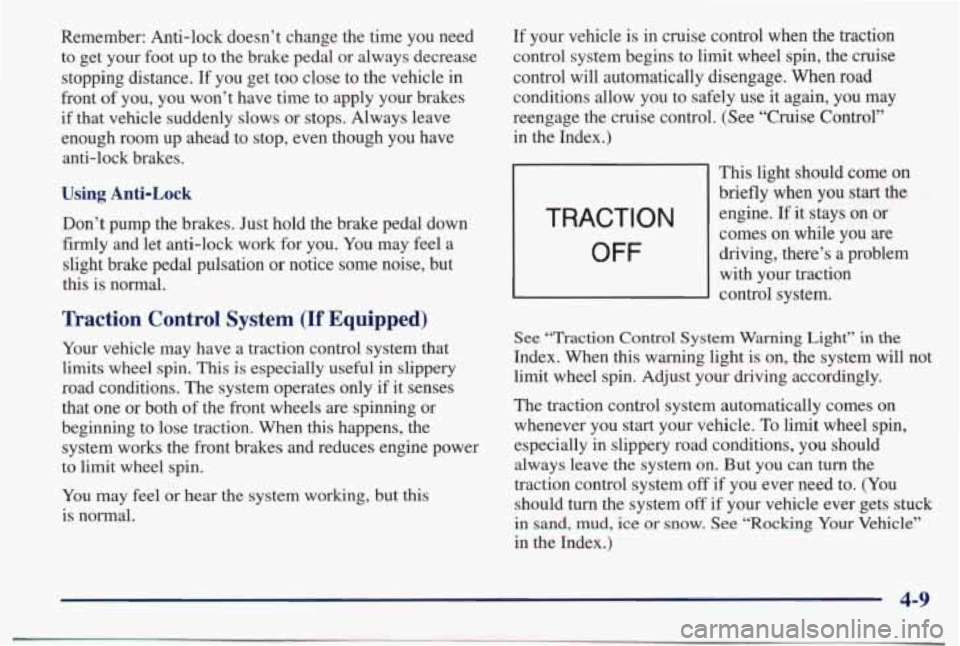
TRACTION
OFF
This light should come on
briefly when you start the
engine.
If it stays on or
comes on while you are
driving, there’s a problem
with your traction
control system.
See “Traction Control System Warning Light” in the
Index. When this warning light is on, the system will not
limit wheel spin. Adjust
your driving accordingly.
The traction control system automatically comes on
whenever you start your vehicle. To limit wheel spin,
especially in slippery road conditions, you should
always leave the system on. But you can turn the
traction control system
off if you ever need to. (You
should turn the system
off if your vehicle ever gets stuck
in
sand, mud, ice or snow. See ‘‘Rockiniz Your Vehicle”
in the Index.)
4-9
Page 312 of 395
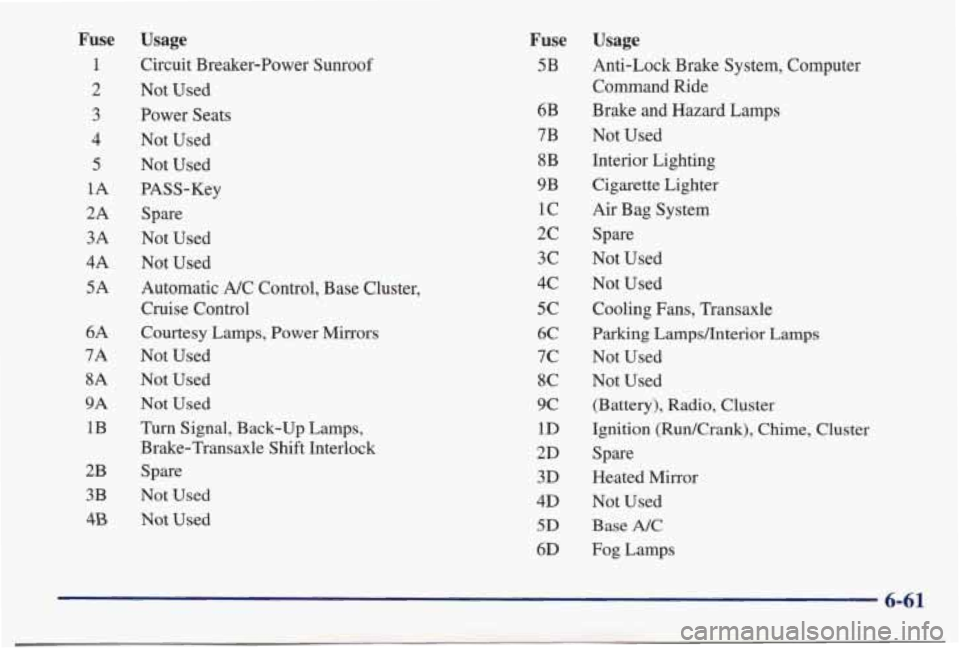
Fuse
1
2 3
4
5
1A
2A
3A
4A
5A
6A
7A
8A
9A
1B
2B
3B
4B
Usage
Circuit Breaker-Power Sunroof
Not Used
Power Seats
Not Used
Not Used
PASS-Key
Spare
Not Used
Not Used
Automatic A/C Control, Base Cluster,
Cruise Control
Courtesy Lamps, Power Mirrors
Not Used
Not Used
Not Used
Turn Signal, Back-up Lamps,
Brake-Transaxle Shift Interlock
Spare
Not Used
Not Used
Fuse Usage
5B Anti-Lock Brake System, Computer
6B
7B 8B
9B
1c
2c
3c
4c
5c 6C
7c
8C
9c
1D
2D
3D
4D
5D
6D
-
Command Ride
Brake and Hazard Lamps
Not Used
Interior Lighting
Cigarette Lighter
Air Bag System Spare
Not Used
Not Used
Cooling Fans, Transaxle
Parking Lampshterior Lamps
Not Used
Not Used
(Battery), Radio, Cluster
Ignition (RudCrank), Chime, Clu
Spare
Heated Mirror
Not Used
Base
NC
Fog Lamps
ste :r
Page 354 of 395
Part C: Periodic Maintenance
Inspections
Listed below are inspections and services which should be
performed at least twice a year (for instance, each spring
and fall). You should let your dealer’s service department
or other qualified service center do these jobs. Make
sure
any necessary repairs are completed at once.
Proper procedures to perform these services may be
found
in a service manual. See “Service and Owner
Publications” in the Index.
Steering, Suspension and Front Drive Axle
Boot and Seal Inspection
Inspect the front and rear suspension and steering system
for damaged, loose or missing parts, signs of wear or lack
of lubrication. Inspect the power steering lines and hoses
for proper hook-up, binding, leaks,
cracks, chafing, etc.
Clean and then inspect the drive axle boot seals for
damage, tears or leakage. Replace seals
if necessary.
Exhaust System Inspection
Inspect the complete exhaust system. Inspect the body near
the exhaust system. Look for broken, damaged,
missing or
out-of-position parts
as well as open seams, holes, loose
connections or other conditions which could cause a
heat
build-up in the floor pan or could let exhaust fumes intw
the vehicle. See “Engine Exhaust” in the Index.
Engine Cooling System Inspection
Inspect the hoses and have them replaced if they are
cracked, swollen or deteriorated. Inspect all pipes, fittings
and clamps; replace as needed. Clean the outside of the
radiator and
air conditioning condenser. To help ensure
proper operation, a pressure test of the cooling system and
pressure cap is recommended at least once a year.
Throttle System Inspection
Inspect the throttle system for interference or binding,
and for damaged or missing
parts. Replace parts as
needed. Replace any components that have high effort
or excessive wear.
Do not lubricate accelerator and
cruise control cables.
7-35
Page 376 of 395
Outside of Your Vehicle ................ ... 6-52
Special Problems
............................. 6-50
Stains ...................................... 6-50
Tires
....................................... 6-54
Vinyl
....................................... 6-50
Wheels
..................................... 6-54
Windshield and Wiper Blades
................... 6-52
Climate Control. Standard
......................... 3-2
Climate Control System
........................... 3-2
Clock. Setting the
................................ 3-9
Comfortcontrols
................................ 3-1
Compact Disc Care
............................. 3-29
Compact Disc Player
....................... 3-20, 3-22
Care
....................................... 3-29
Errors
................................. 3-20. 3-23
Compact Spare Tire
............................. 5-37
Compass. Electronic
............................ 2-79
Computer Command Ride
........................ 2-28
Console Storage
................................ 2-5 1
Control of a Vehicle .............................. 4-6
Convenience Net ............................... 2-52
Convex Outside Mirror
.......................... 2-50
Coolant
....................................... 6-23
Heater. Engine
............................... 2-23
RecoveryTank
............................... 5- 19
Coolant Temperature Gage
....................... 2-68
CoolingSystem
................................ 5-17
Courtesy Transportation
........................... 8-8
CruiseControl ................................. 2-40
Cupholder Center Console
............................... 2-51
Customer Assistance for Text Telephone Users
......... 8-5
Door ....................................... 2-51 Customer Assistance Information
................... 8-1
Customer Satisfaction Procedure
.................. 8-3
Damage. Finish
............................... 6-55
Damage. Sheet Metal
............................ 6-54
Daytime Running Lamps
......................... 2-43
Dead Battery
................................... 5-3
Defects. Reporting Safety
........................ 8-10
Defensive Driving ............................... 4-2
Defogger. Rear Window
.......................... 3-8
Defogging
..................................... 3-8
Defrosting
..................................... 3-8
Delayed Illumination ............................ 2-46
Delayed Locking
................................ 2-7
DIC
.......................................... 2-77
Dimensions. Vehicle
............................ 6-66
Dolby
B Noise Reduction ................... 3-13. 3-17
Door
Ajar Message ................................ 2-78
Locks ....................................... 2-4
Drive Position. Automatic Transaxle
................ 2-26
Driver Information Center
........................ 2-77
DriverPosition
................................. 1-10
Driving
City
........................................ 4-20
Defensive
.................................... 4-2
Drunken
..................................... 4-3
Freeway
.................................... 4-21
InaBlizzard
................................. 4-27
In Foreign Countries
........................... 6-5
IntheRain
.................................. 4-17
OnCurves
.................................. 4-10
Night
...................................... 4-15
9-3