Page 2448 of 6000
Page 2519 of 6000
7C–10CLUTCH
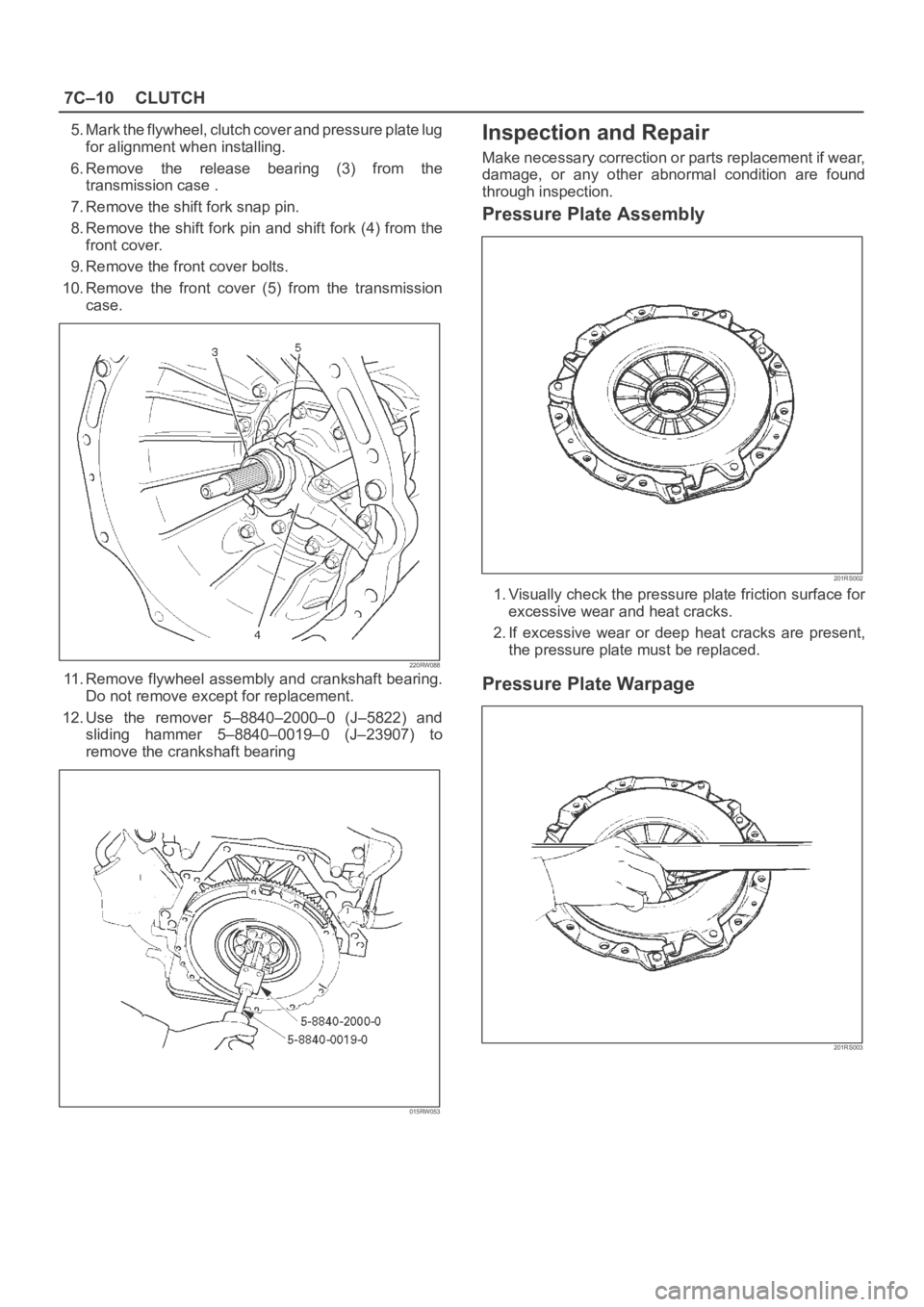
5. Mark the flywheel, clutch cover and pressure plate lug
for alignment when installing.
6. Remove the release bearing (3) from the
transmission case .
7. Remove the shift fork snap pin.
8. Remove the shift fork pin and shift fork (4) from the
front cover.
9. Remove the front cover bolts.
10. Remove the front cover (5) from the transmission
case.
220RW088
11. Remove flywheel assembly and crankshaft bearing.
Do not remove except for replacement.
12. Use the remover 5–8840–2000–0 (J–5822) and
sliding hammer 5–8840–0019–0 (J–23907) to
remove the crankshaft bearing
015RW053
Inspection and Repair
Make necessary correction or parts replacement if wear,
damage, or any other abnormal condition are found
through inspection.
Pressure Plate Assembly
201RS002
1. Visually check the pressure plate friction surface for
excessive wear and heat cracks.
2. If excessive wear or deep heat cracks are present,
the pressure plate must be replaced.
Pressure Plate Warpage
201RS003
Page 2539 of 6000
7C–30CLUTCH
Special Tools
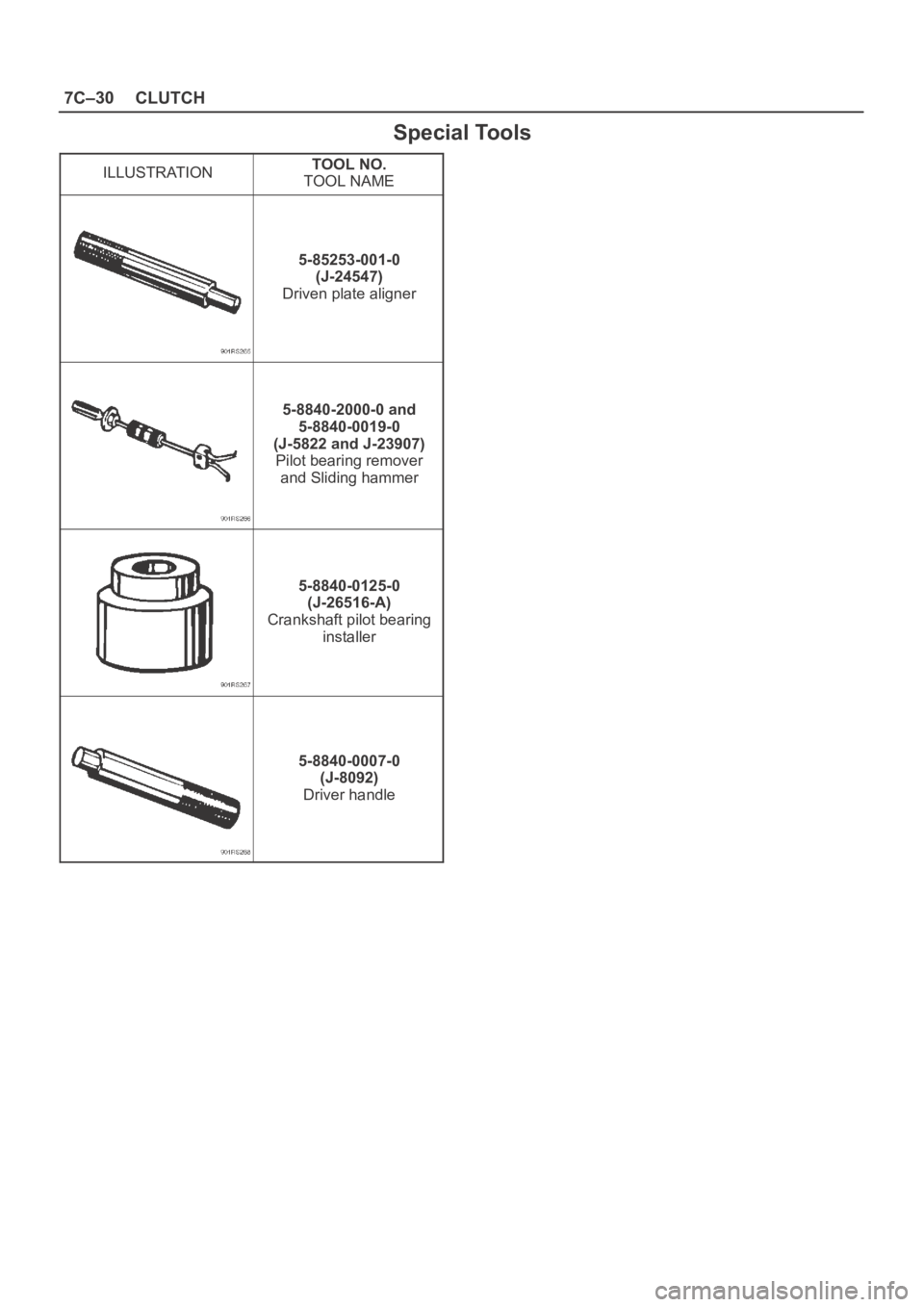
ILLUSTRATIONTOOL NO.
TOOL NAME
5-85253-001-0
(J-24547)
Driven plate aligner
5-8840-2000-0 and
5-8840-0019-0
(J-5822 and J-23907)
Pilot bearing remover
and Sliding hammer
5-8840-0125-0
(J-26516-A)
Crankshaft pilot bearing
installer
5-8840-0007-0
(J-8092)
Driver handle
Page 4604 of 6000
ENGINE COOLING6B–11
Cap tester: 5–8840–0277–0
Adapter: 5–8840–2603–0
110RS005
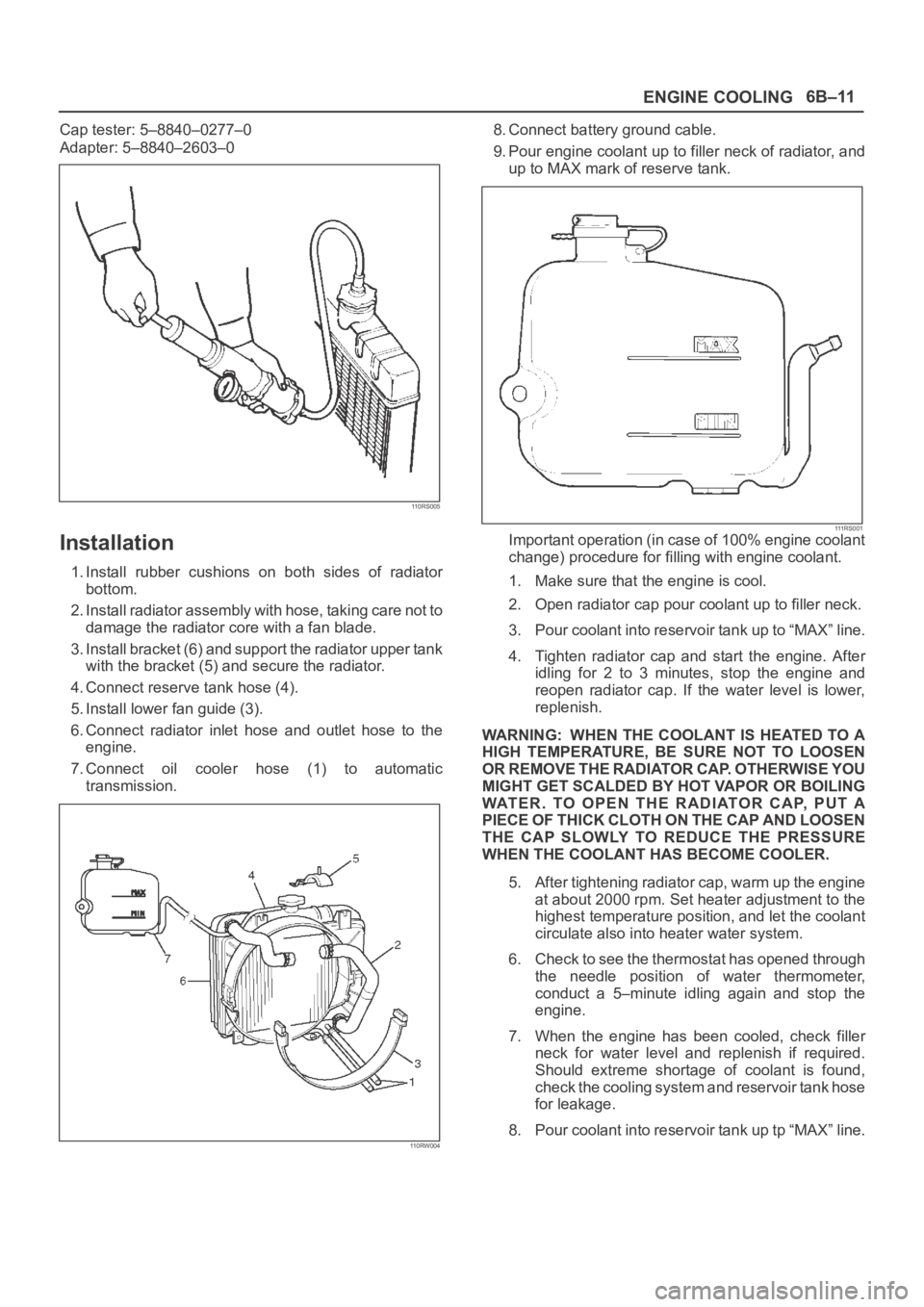
Installation
1. Install rubber cushions on both sides of radiator
bottom.
2. Install radiator assembly with hose, taking care not to
damage the radiator core with a fan blade.
3. Install bracket (6) and support the radiator upper tank
with the bracket (5) and secure the radiator.
4. Connect reserve tank hose (4).
5. Install lower fan guide (3).
6. Connect radiator inlet hose and outlet hose to the
engine.
7. Connect oil cooler hose (1) to automatic
transmission.
110RW004
8. Connect battery ground cable.
9. Pour engine coolant up to filler neck of radiator, and
up to MAX mark of reserve tank.
111 R S 0 0 1Important operation (in case of 100% engine coolant
change) procedure for filling with engine coolant.
1. Make sure that the engine is cool.
2. Open radiator cap pour coolant up to filler neck.
3. Pour coolant into reservoir tank up to “MAX” line.
4. Tighten radiator cap and start the engine. After
idling for 2 to 3 minutes, stop the engine and
reopen radiator cap. If the water level is lower,
replenish.
WARNING: WHEN THE COOLANT IS HEATED TO A
HIGH TEMPERATURE, BE SURE NOT TO LOOSEN
OR REMOVE THE RADIATOR CAP. OTHERWISE YOU
MIGHT GET SCALDED BY HOT VAPOR OR BOILING
WATER. TO OPEN THE RADIATOR CAP, PUT A
PIECE OF THICK CLOTH ON THE CAP AND LOOSEN
THE CAP SLOWLY TO REDUCE THE PRESSURE
WHEN THE COOLANT HAS BECOME COOLER.
5. After tightening radiator cap, warm up the engine
at about 2000 rpm. Set heater adjustment to the
highest temperature position, and let the coolant
circulate also into heater water system.
6. Check to see the thermostat has opened through
the needle position of water thermometer,
conduct a 5–minute idling again and stop the
engine.
7. When the engine has been cooled, check filler
neck for water level and replenish if required.
Should extreme shortage of coolant is found,
check the cooling system and reservoir tank hose
for leakage.
8. Pour coolant into reservoir tank up tp “MAX” line.
Page 4847 of 6000
6E–190
ENGINE DRIVEABILITY AND EMISSIONS
Diagnostic Trouble Code (DTC) P0327 KS Sensor Circuit
D06RW035
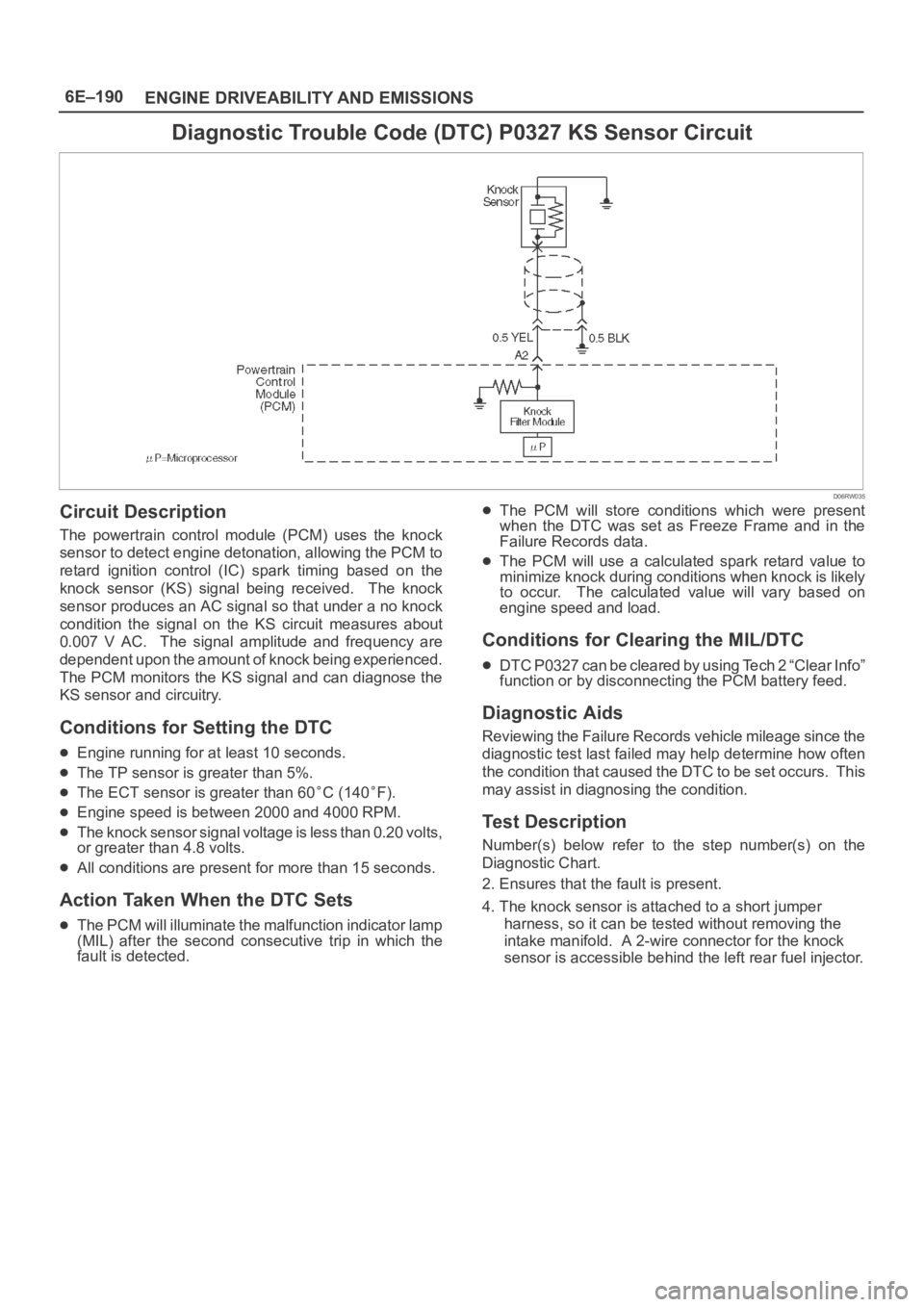
Circuit Description
The powertrain control module (PCM) uses the knock
sensor to detect engine detonation, allowing the PCM to
retard ignition control (IC) spark timing based on the
knock sensor (KS) signal being received. The knock
sensor produces an AC signal so that under a no knock
condition the signal on the KS circuit measures about
0.007 V AC. The signal amplitude and frequency are
dependent upon the amount of knock being experienced.
The PCM monitors the KS signal and can diagnose the
KS sensor and circuitry.
Conditions for Setting the DTC
Engine running for at least 10 seconds.
The TP sensor is greater than 5%.
The ECT sensor is greater than 60C (140F).
Engine speed is between 2000 and 4000 RPM.
The knock sensor signal voltage is less than 0.20 volts,
or greater than 4.8 volts.
All conditions are present for more than 15 seconds.
Action Taken When the DTC Sets
The PCM will illuminate the malfunction indicator lamp
(MIL) after the second consecutive trip in which the
fault is detected.
The PCM will store conditions which were present
when the DTC was set as Freeze Frame and in the
Failure Records data.
The PCM will use a calculated spark retard value to
minimize knock during conditions when knock is likely
to occur. The calculated value will vary based on
engine speed and load.
Conditions for Clearing the MIL/DTC
DTC P0327 can be cleared by using Tech 2 “Clear Info”
function or by disconnecting the PCM battery feed.
Diagnostic Aids
Reviewing the Failure Records vehicle mileage since the
diagnostic test last failed may help determine how often
the condition that caused the DTC to be set occurs. This
may assist in diagnosing the condition.
Test Description
Number(s) below refer to the step number(s) on the
Diagnostic Chart.
2. Ensures that the fault is present.
4. The knock sensor is attached to a short jumper
harness, so it can be tested without removing the
intake manifold. A 2-wire connector for the knock
sensor is accessible behind the left rear fuel injector.
Page 4895 of 6000
6E–238
ENGINE DRIVEABILITY AND EMISSIONS
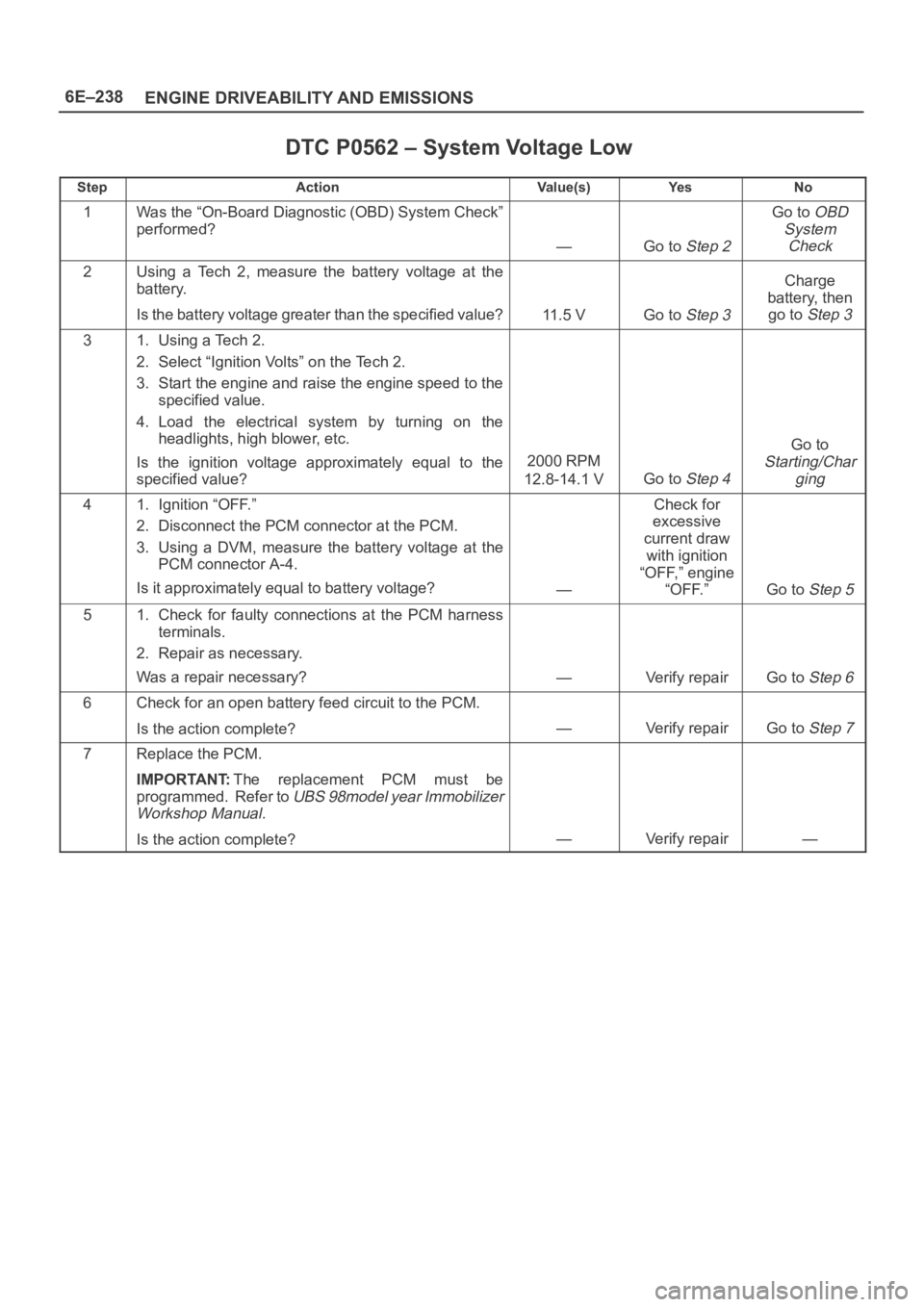
DTC P0562 – System Voltage Low
StepActionVa l u e ( s )Ye sNo
1Was the “On-Board Diagnostic (OBD) System Check”
performed?
—Go to Step 2
Go to OBD
System
Check
2Using a Tech 2, measure the battery voltage at the
battery.
Is the battery voltage greater than the specified value?
11.5 VGo to Step 3
Charge
battery, then
go to
Step 3
31. Using a Tech 2.
2. Select “Ignition Volts” on the Tech 2.
3. Start the engine and raise the engine speed to the
specified value.
4. Load the electrical system by turning on the
headlights, high blower, etc.
Is the ignition voltage approximately equal to the
specified value?
2000 RPM
12.8-14.1 V
Go to Step 4
Go to
Starting/Char
ging
41. Ignition “OFF.”
2. Disconnect the PCM connector at the PCM.
3. Using a DVM, measure the battery voltage at the
PCM connector A-4.
Is it approximately equal to battery voltage?
—
Check for
excessive
current draw
with ignition
“OFF,” engine
“OFF.”
Go to Step 5
51. Check for faulty connections at the PCM harness
terminals.
2. Repair as necessary.
Was a repair necessary?
—Verify repairGo to Step 6
6Check for an open battery feed circuit to the PCM.
Is the action complete?
—Verify repairGo to Step 7
7Replace the PCM.
IMPORTANT:The replacement PCM must be
programmed. Refer to
UBS 98model year Immobilizer
Workshop Manual.
Is the action complete?—Verify repair—
Page 4896 of 6000
6E–239 ENGINE DRIVEABILITY AND EMISSIONS
Diagnostic Trouble Code (DTC) P0563 System Voltage High
Circuit Description
The powertrain control module (PCM) monitors the
system voltage on the ignition feed terminals to the PCM.
A system voltage DTC will set whenever the voltage is
above a calibrated value.
Conditions for Setting the DTC
Ignition “ON.”
System voltage is above 16 volts for 15 minutes.
Action Taken When the DTC Sets
The PCM will not illuminate the malfunction indicator
lamp (MIL).
The PCM will store as Failure Records only conditions
which were present when the DTC was set. This
information will not be stored as Freeze Frame data.
Conditions for Clearing the MIL/DTC
A history DTC P0563 will clear after 40 consecutive
warm-up cycles have occurred without a fault.
DTC P0563 can be cleared by using the Tech 2 “Clear
Info” function or by disconnecting the PCM battery
feed.
Diagnostic Aids
If the DTC sets when an accessory is operated, check for
a poor connection or excessive current draw.
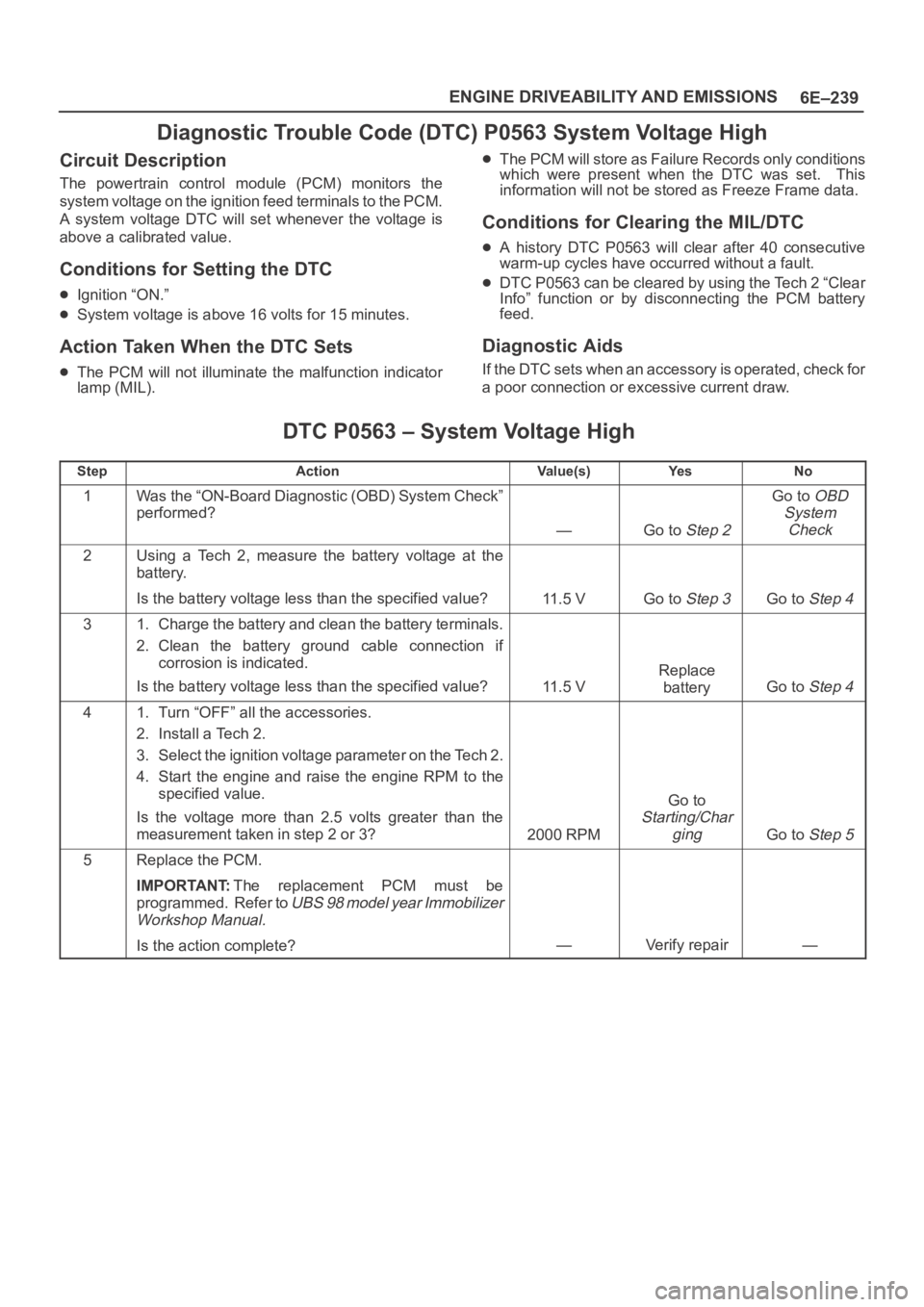
DTC P0563 – System Voltage High
StepActionVa l u e ( s )Ye sNo
1Was the “ON-Board Diagnostic (OBD) System Check”
performed?
—Go to Step 2
Go to OBD
System
Check
2Using a Tech 2, measure the battery voltage at the
battery.
Is the battery voltage less than the specified value?
11 . 5 VGo to Step 3Go to Step 4
31. Charge the battery and clean the battery terminals.
2. Clean the battery ground cable connection if
corrosion is indicated.
Is the battery voltage less than the specified value?
11 . 5 V
Replace
battery
Go to Step 4
41. Turn “OFF” all the accessories.
2. Install a Tech 2.
3. Select the ignition voltage parameter on the Tech 2.
4. Start the engine and raise the engine RPM to the
specified value.
Is the voltage more than 2.5 volts greater than the
measurement taken in step 2 or 3?
2000 RPM
Go to
Starting/Char
ging
Go to Step 5
5Replace the PCM.
IMPORTANT:The replacement PCM must be
programmed. Refer to
UBS 98 model year Immobilizer
Workshop Manual.
Is the action complete?—Verify repair—
Page 5340 of 6000

ENGINE MECHANICAL 6A – 67
12. Immediately install high pressure oil pipe and
tighten to specified torque.
Torque: 80 Nꞏm (8.1 kgꞏm / 57.9 lb ft)
13. Install cylinder head noise insulator cover.
Refer to “Cylinder Head” in this manual.
14. Install intercooler assembly.
Refer to “Intercooler” in this manual.
15. Install air cleaner cover and air duct.
16. Use TECH2 to rewrite injector data to ECM.
For rewriting method refer to section “Data
Programming in Case of ECM Change” of 6E 4JX1
engine driveability and emissions in this manual.
NOTE:
1) On completion of servicing, bleed air from the
engine inside fuel passage by means of the priming
pump. (The priming pump should be operated more
times than in the case of conventional engines.)
2) As air is in the oil rail, it takes more time to start the
engine. Rough idling may occur while the air is
being bled completely after starting the engine, but
it does not indicate trouble.
The air will be bled and normal engine status will be
reached while the vehicle is driven for about 5 km
or engine is operated for about 5 minutes at 1500 to
2000 rpm.
3) The injector spare part will be provided for group
number B1, B2 and B3 only.