Page 3190 of 6000
METER AND GAUGE8E–13
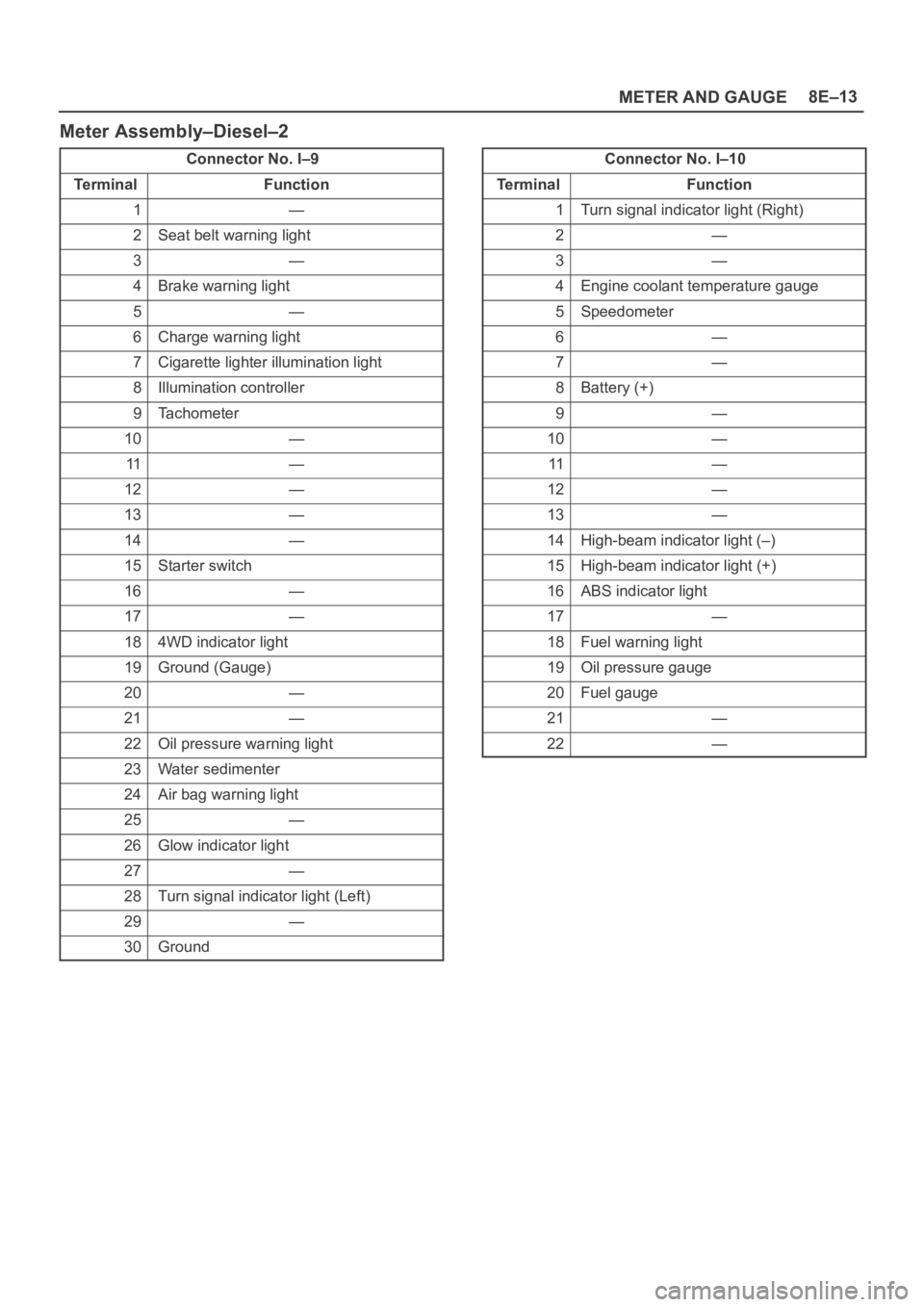
Meter Assembly–Diesel–2
Connector No. I–9
Te r m i n a lFunction
1—
2Seat belt warning light
3—
4Brake warning light
5—
6Charge warning light
7Cigarette lighter illumination light
8Illumination controller
9Tachometer
10—
11—
12—
13—
14—
15Starter switch
16—
17—
184WD indicator light
19Ground (Gauge)
20—
21—
22Oil pressure warning light
23Water sedimenter
24Air bag warning light
25—
26Glow indicator light
27—
28Turn signal indicator light (Left)
29—
30Ground
Connector No. I–10
Te r m i n a lFunction
1Turn signal indicator light (Right)
2—
3—
4Engine coolant temperature gauge
5Speedometer
6—
7—
8Battery (+)
9—
10—
11—
12—
13—
14High-beam indicator light (–)
15High-beam indicator light (+)
16ABS indicator light
17—
18Fuel warning light
19Oil pressure gauge
20Fuel gauge
21—
22—
Page 3292 of 6000
8F–97 BODY STRUCTURE
Use a pair of needle nose pliers to insert the other end
of the piano wire through the adhesive caulking
material at the edge of the windshield glass.
Secure the other end of the piano wire to another
piece of wood.
With the aid of an assistant, carefully move the piano
wire with a sawing motion to cut through the adhesive
caulking material around the entire circumference of
the windshield glass.
Clean the remaining adhesive caulking material from
the area of the body which holds the windshield.
8. Remove windshield upper moulding.
Taking notice of the adhesive tape, and peel the
moulding off the windshield upper portion.
9. Remove moulding clip.
10. Remove spacer.
Installation
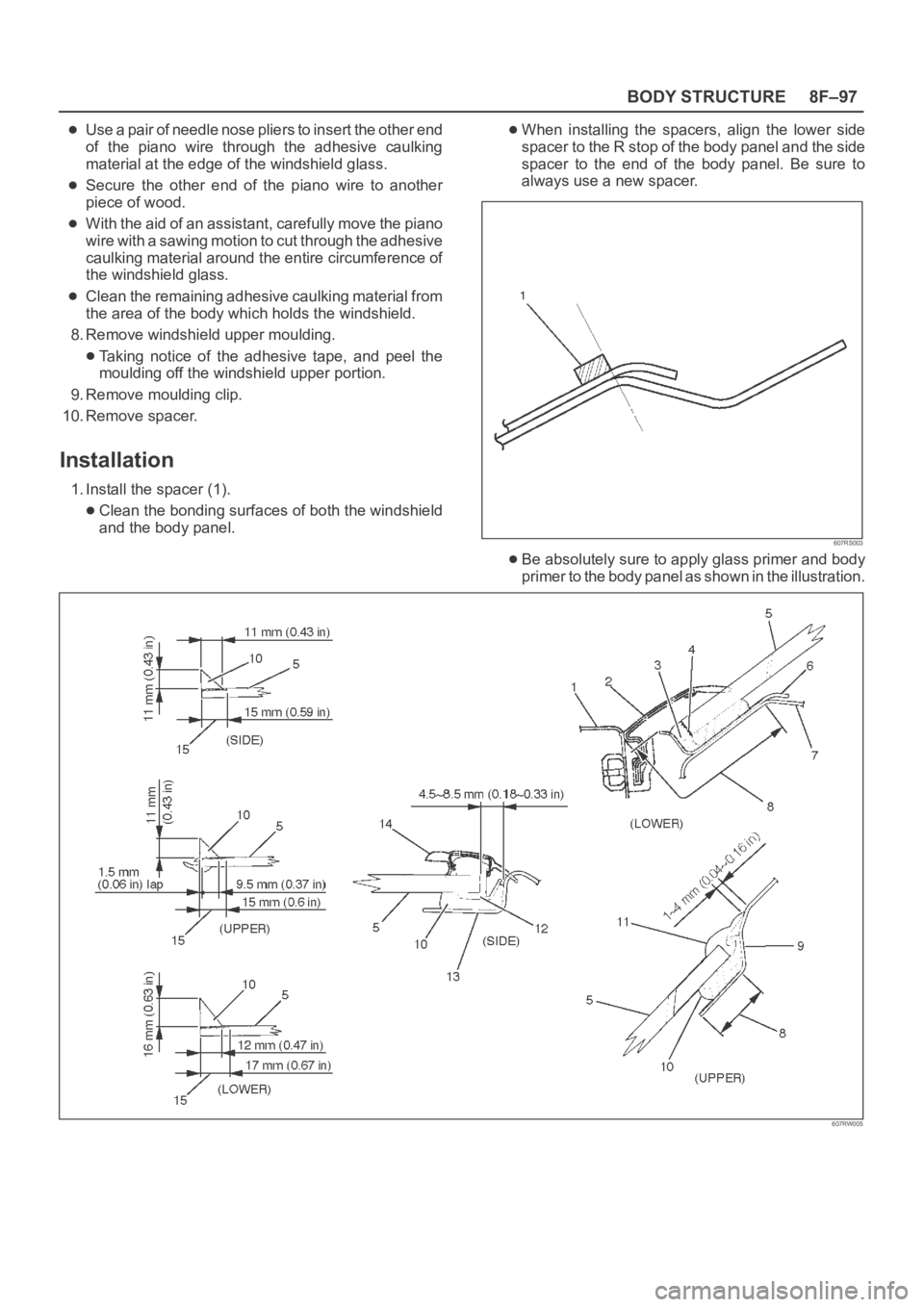
1. Install the spacer (1).
Clean the bonding surfaces of both the windshield
and the body panel.
When installing the spacers, align the lower side
spacer to the R stop of the body panel and the side
spacer to the end of the body panel. Be sure to
always use a new spacer.
607RS003
Be absolutely sure to apply glass primer and body
primer to the body panel as shown in the illustration.
607RW005
Page 3297 of 6000
8F–102BODY STRUCTURE
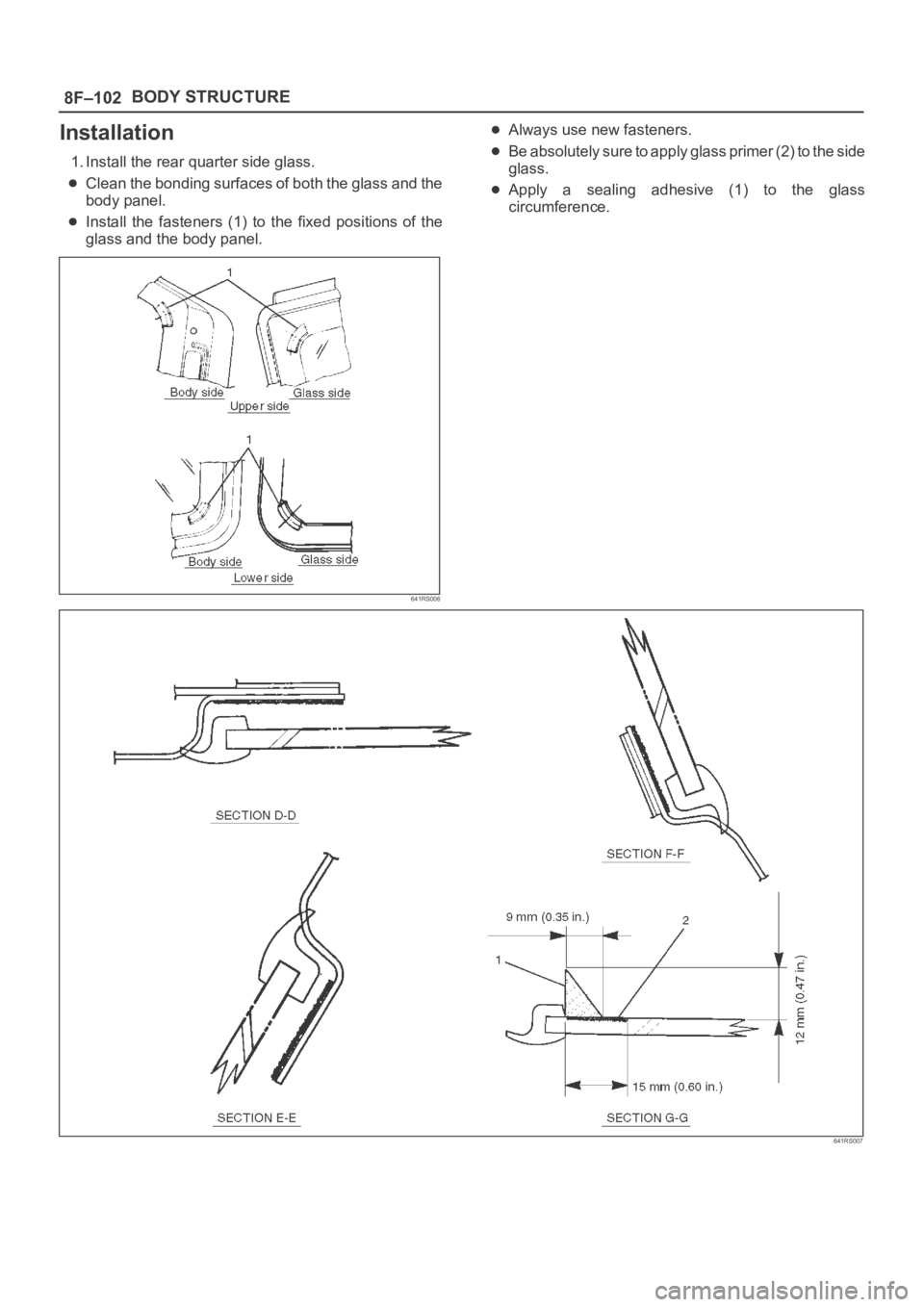
Installation
1. Install the rear quarter side glass.
Clean the bonding surfaces of both the glass and the
body panel.
Install the fasteners (1) to the fixed positions of the
glass and the body panel.
641RS006
Always use new fasteners.
Be absolutely sure to apply glass primer (2) to the side
glass.
Apply a sealing adhesive (1) to the glass
circumference.
641RS007
Page 3300 of 6000
8F–105 BODY STRUCTURE
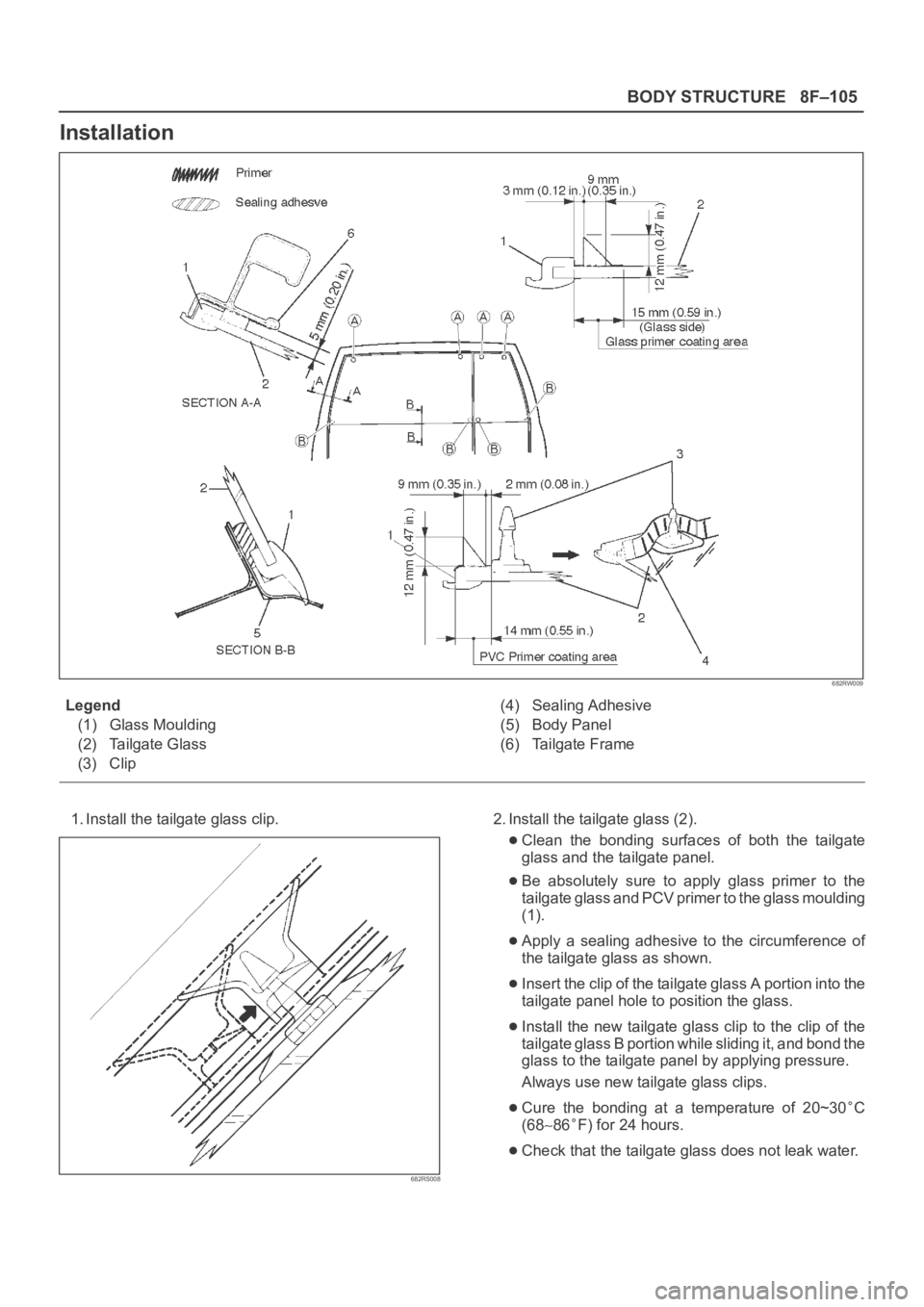
Installation
682RW009
Legend
(1) Glass Moulding
(2) Tailgate Glass
(3) Clip(4) Sealing Adhesive
(5) Body Panel
(6) Tailgate Frame
1. Install the tailgate glass clip.
682RS008
2. Install the tailgate glass (2).
Clean the bonding surfaces of both the tailgate
glass and the tailgate panel.
Be absolutely sure to apply glass primer to the
tailgate glass and PCV primer to the glass moulding
(1).
Apply a sealing adhesive to the circumference of
the tailgate glass as shown.
Insert the clip of the tailgate glass A portion into the
tailgate panel hole to position the glass.
Install the new tailgate glass clip to the clip of the
tailgate glass B portion while sliding it, and bond the
glass to the tailgate panel by applying pressure.
Always use new tailgate glass clips.
Cure the bonding at a temperature of 20~30C
(68
86F) for 24 hours.
Check that the tailgate glass does not leak water.
Page 3439 of 6000
SUPPLEMENTAL RESTRAINT SYSTEM 9J–2
General Description
CAUTION: When fasteners are removed, always
reinstall them at the same location from which they
were removed. If a fastener needs to be replaced, use
the correct part number fastener for that application.
If the correct part number fastener is not available, a
fastener of equal size and strength (or stronger) may
be used. Fasteners that are not reused, and those
requiring thread locking compound will be called
out. The correct torque value must be used when
installing fasteners that require it. If the above
conditions are not followed, parts or system damage
could result.
Restraint Devices
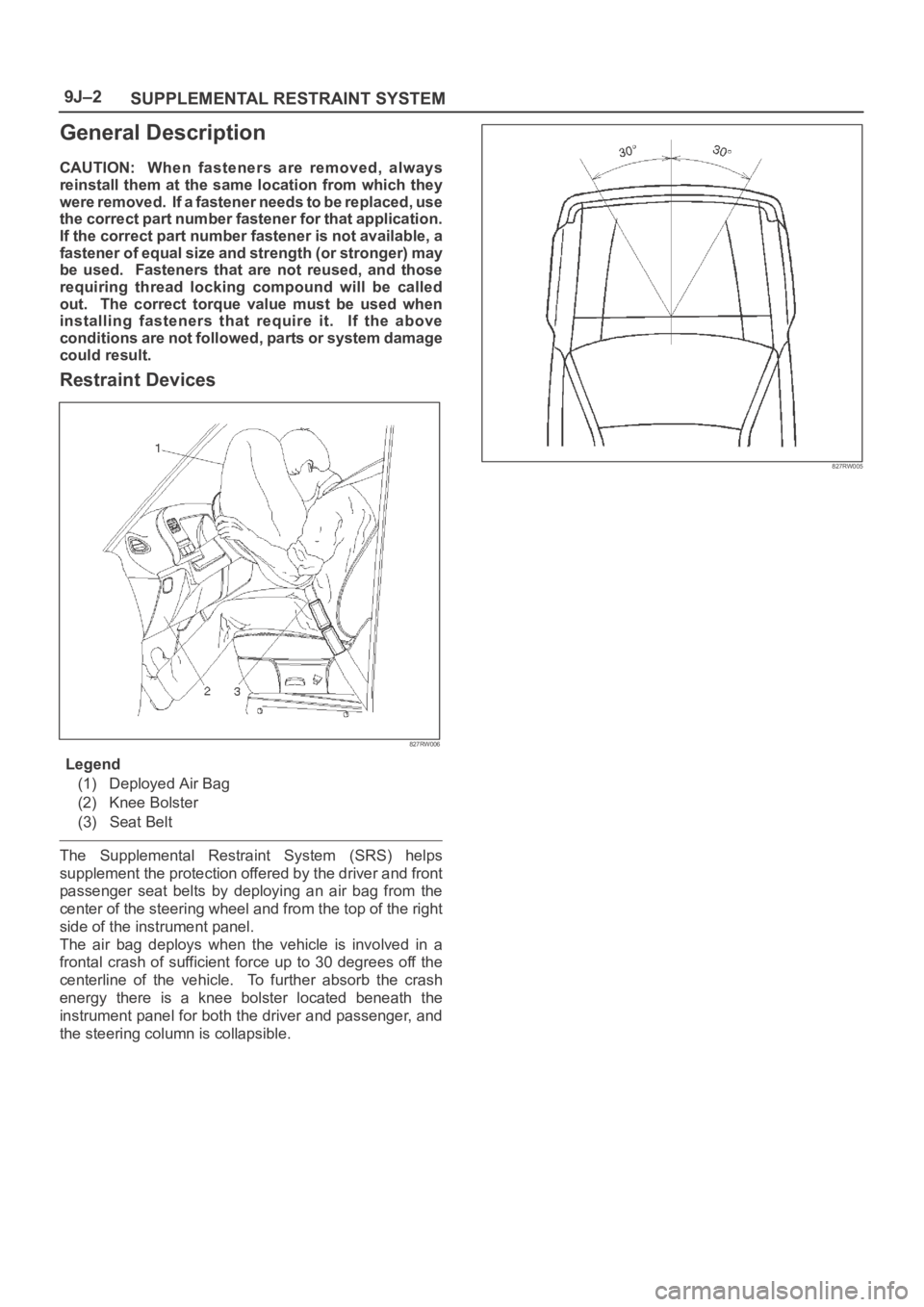
827RW006
Legend
(1) Deployed Air Bag
(2) Knee Bolster
(3) Seat Belt
The Supplemental Restraint System (SRS) helps
supplement the protection offered by the driver and front
passenger seat belts by deploying an air bag from the
center of the steering wheel and from the top of the right
side of the instrument panel.
The air bag deploys when the vehicle is involved in a
frontal crash of sufficient force up to 30 degrees off the
centerline of the vehicle. To further absorb the crash
energy there is a knee bolster located beneath the
instrument panel for both the driver and passenger, and
the steering column is collapsible.
827RW005
Page 3444 of 6000
SUPPLEMENTAL RESTRAINT SYSTEM9J–7
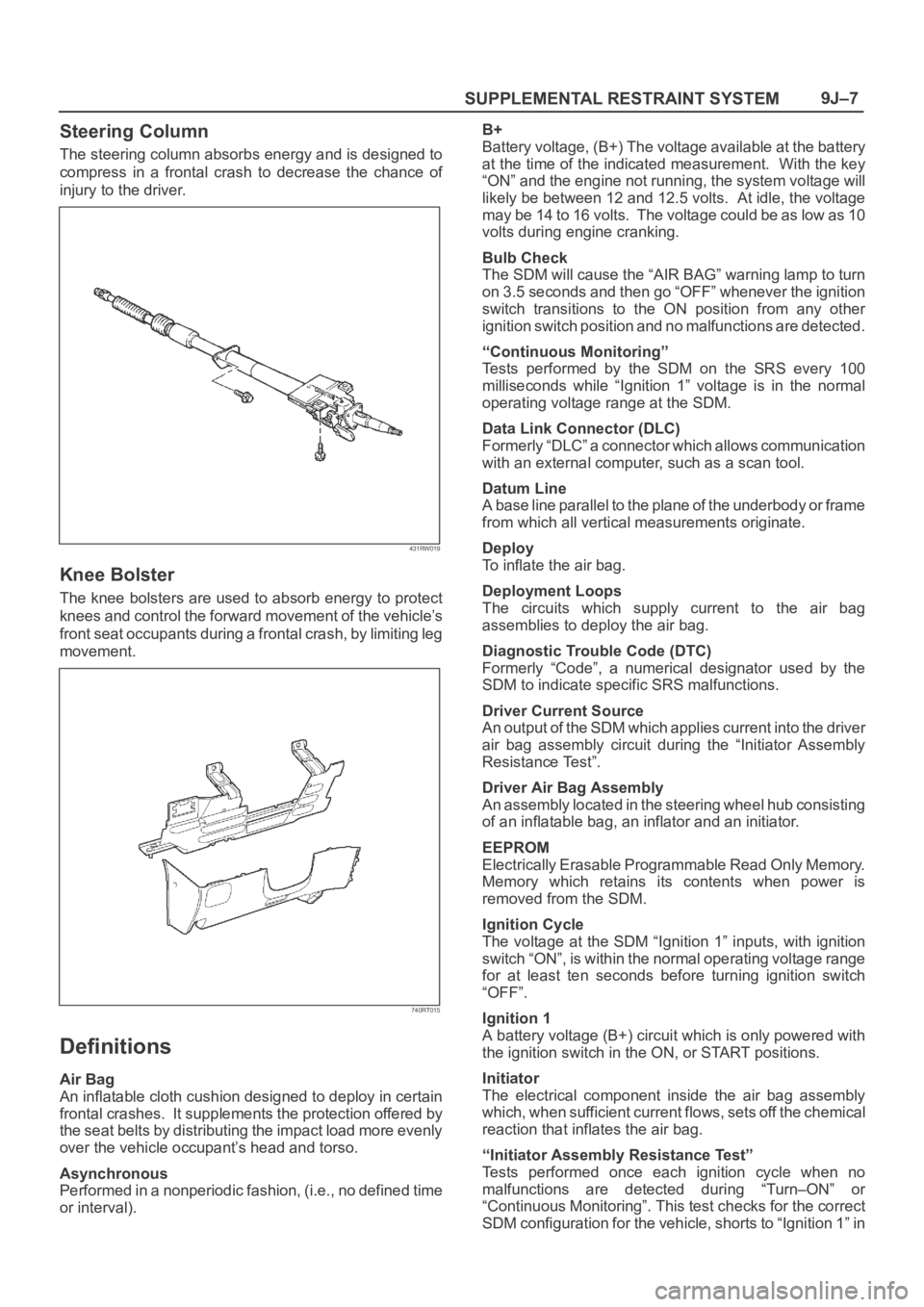
Steering Column
The steering column absorbs energy and is designed to
compress in a frontal crash to decrease the chance of
injury to the driver.
431RW019
Knee Bolster
The knee bolsters are used to absorb energy to protect
knees and control the forward movement of the vehicle’s
front seat occupants during a frontal crash, by limiting leg
movement.
740RT015
Definitions
Air Bag
An inflatable cloth cushion designed to deploy in certain
frontal crashes. It supplements the protection offered by
the seat belts by distributing the impact load more evenly
over the vehicle occupant’s head and torso.
Asynchronous
Performed in a nonperiodic fashion, (i.e., no defined time
or interval).B+
Battery voltage, (B+) The voltage available at the battery
at the time of the indicated measurement. With the key
“ON” and the engine not running, the system voltage will
likely be between 12 and 12.5 volts. At idle, the voltage
may be 14 to 16 volts. The voltage could be as low as 10
volts during engine cranking.
Bulb Check
The SDM will cause the “AIR BAG” warning lamp to turn
on 3.5 seconds and then go “OFF” whenever the ignition
switch transitions to the ON position from any other
ignition switch position and no malfunctions are detected.
“Continuous Monitoring”
Tests performed by the SDM on the SRS every 100
milliseconds while “Ignition 1” voltage is in the normal
operating voltage range at the SDM.
Data Link Connector (DLC)
Formerly “DLC” a connector which allows communication
with an external computer, such as a scan tool.
Datum Line
A base line parallel to the plane of the underbody or frame
from which all vertical measurements originate.
Deploy
To inflate the air bag.
Deployment Loops
The circuits which supply current to the air bag
assemblies to deploy the air bag.
Diagnostic Trouble Code (DTC)
Formerly “Code”, a numerical designator used by the
SDM to indicate specific SRS malfunctions.
Driver Current Source
An output of the SDM which applies current into the driver
air bag assembly circuit during the “Initiator Assembly
Resistance Test”.
Driver Air Bag Assembly
An assembly located in the steering wheel hub consisting
of an inflatable bag, an inflator and an initiator.
EEPROM
Electrically Erasable Programmable Read Only Memory.
Memory which retains its contents when power is
removed from the SDM.
Ignition Cycle
The voltage at the SDM “Ignition 1” inputs, with ignition
switch “ON”, is within the normal operating voltage range
for at least ten seconds before turning ignition switch
“OFF”.
Ignition 1
A battery voltage (B+) circuit which is only powered with
the ignition switch in the ON, or START positions.
Initiator
The electrical component inside the air bag assembly
which, when sufficient current flows, sets off the chemical
reaction that inflates the air bag.
“Initiator Assembly Resistance Test”
Tests performed once each ignition cycle when no
malfunctions are detected during “Turn–ON” or
“Continuous Monitoring”. This test checks for the correct
SDM configuration for the vehicle, shorts to “Ignition 1” in
Page 3473 of 6000
SUPPLEMENTAL RESTRAINT SYSTEM 9J–36
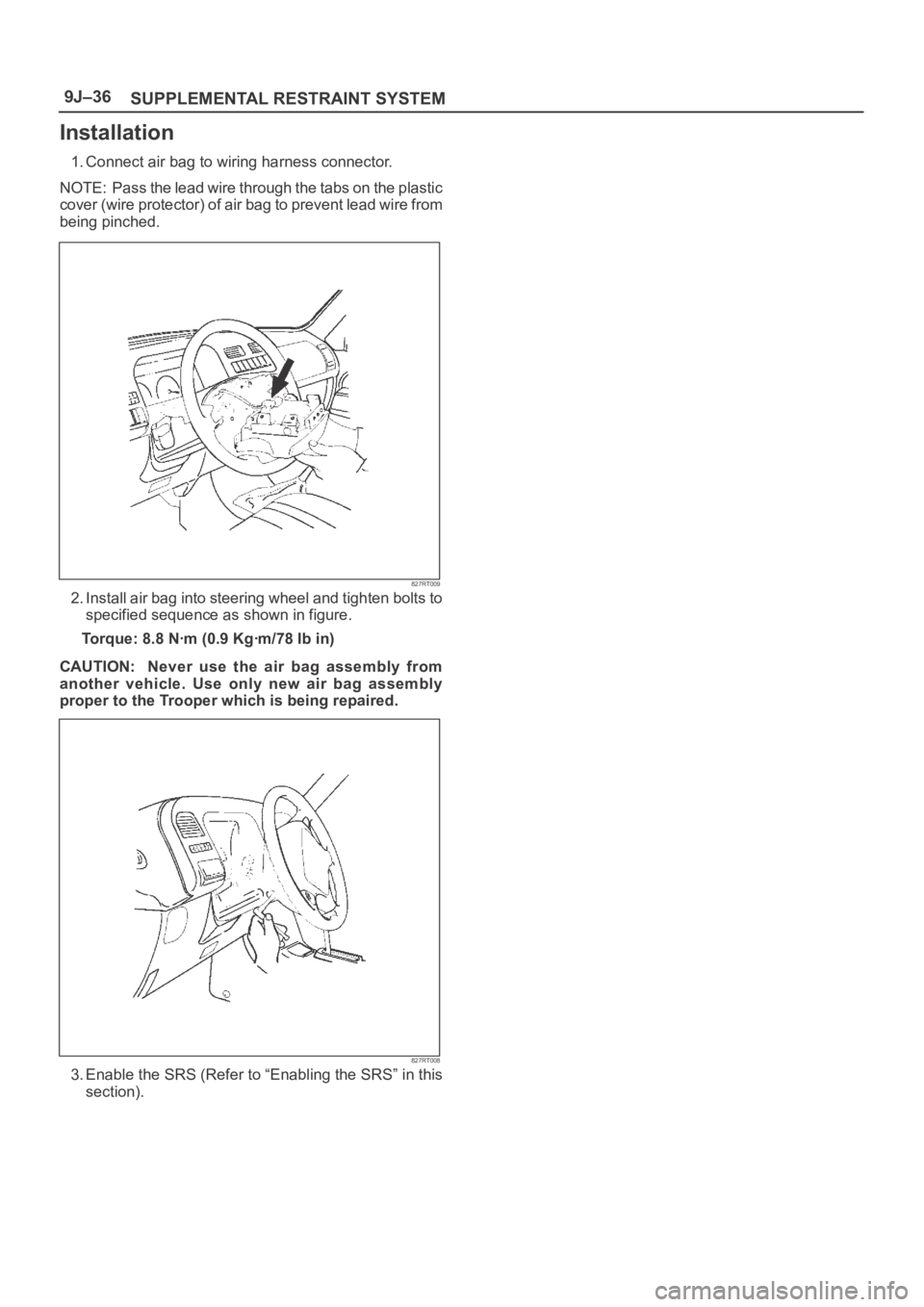
Installation
1. Connect air bag to wiring harness connector.
NOTE: Pass the lead wire through the tabs on the plastic
cover (wire protector) of air bag to prevent lead wire from
being pinched.
827RT009
2. Install air bag into steering wheel and tighten bolts to
specified sequence as shown in figure.
Torque: 8.8 Nꞏm (0.9 Kgꞏm/78 Ib in)
CAUTION: Never use the air bag assembly from
another vehicle. Use only new air bag assembly
proper to the Trooper which is being repaired.
827RT008
3. Enable the SRS (Refer to “Enabling the SRS” in this
section).
Page 3475 of 6000
SUPPLEMENTAL RESTRAINT SYSTEM 9J–38
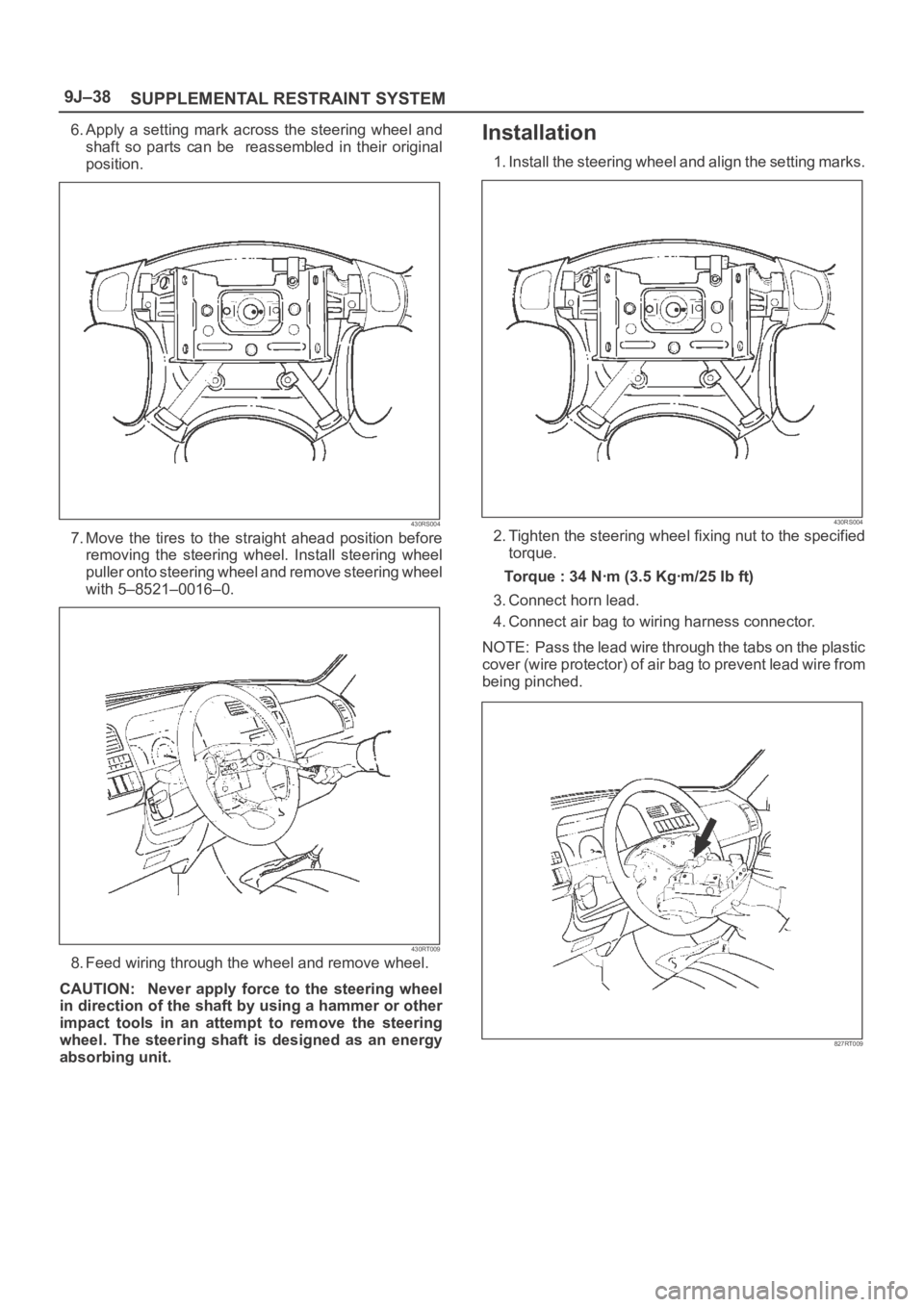
6. Apply a setting mark across the steering wheel and
shaft so parts can be reassembled in their original
position.
430RS004
7. Move the tires to the straight ahead position before
removing the steering wheel. Install steering wheel
puller onto steering wheel and remove steering wheel
with 5–8521–0016–0.
430RT009
8. Feed wiring through the wheel and remove wheel.
CAUTION: Never apply force to the steering wheel
in direction of the shaft by using a hammer or other
impact tools in an attempt to remove the steering
wheel. The steering shaft is designed as an energy
absorbing unit.
Installation
1. Install the steering wheel and align the setting marks.
430RS004
2. Tighten the steering wheel fixing nut to the specified
torque.
Torque : 34 Nꞏm (3.5 Kgꞏm/25 Ib ft)
3. Connect horn lead.
4. Connect air bag to wiring harness connector.
NOTE: Pass the lead wire through the tabs on the plastic
cover (wire protector) of air bag to prevent lead wire from
being pinched.
827RT009