1998 OPEL FRONTERA oil change
[x] Cancel search: oil changePage 5817 of 6000
7A–36 AUTOMATIC TRANSMISSION (AW30-40LE)
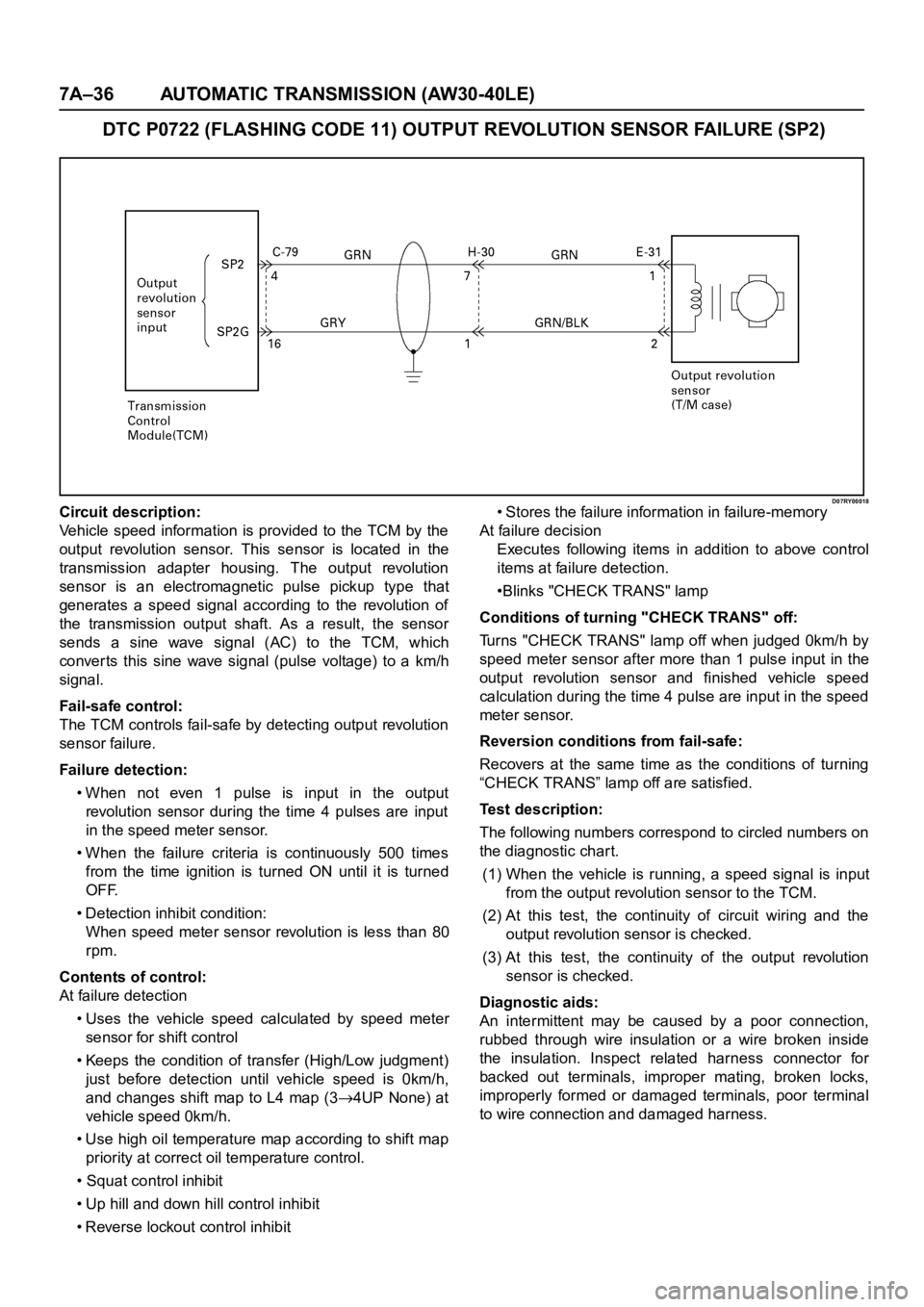
DTC P0722 (FLASHING CODE 11) OUTPUT REVOLUTION SENSOR FAILURE (SP2)
D07RY00018Circuit description:
Vehicle speed information is provided to the TCM by the
output revolution sensor. This sensor is located in the
transmission adapter housing. The output revolution
sensor is an electromagnetic pulse pickup type that
generates a speed signal according to the revolution of
the transmission output shaft. As a result, the sensor
sends a sine wave signal (AC) to the TCM, which
converts this sine wave signal (pulse voltage) to a km/h
signal.
Fail-safe control:
The TCM controls fail-safe by detecting output revolution
sensor failure.
Failure detection:
• When not even 1 pulse is input in the output
revolution sensor during the time 4 pulses are input
in the speed meter sensor.
• When the failure criteria is continuously 500 times
from the time ignition is turned ON until it is turned
OFF.
• Detection inhibit condition:
When speed meter sensor revolution is less than 80
rpm.
Contents of control:
At failure detection
• Uses the vehicle speed calculated by speed meter
sensor for shift control
• Keeps the condition of transfer (High/Low judgment)
just before detection until vehicle speed is 0km/h,
and changes shift map to L4 map (3
4UP None) at
vehicle speed 0km/h.
• Use high oil temperature map according to shift map
priority at correct oil temperature control.
• Squat control inhibit
• Up hill and down hill control inhibit
• Reverse lockout control inhibit• Stores the failure information in failure-memory
At failure decision
Executes following items in addition to above control
items at failure detection.
•Blinks "CHECK TRANS" lamp
Conditions of turning "CHECK TRANS" off:
Turns "CHECK TRANS" lamp off when judged 0km/h by
speed meter sensor after more than 1 pulse input in the
output revolution sensor and finished vehicle speed
calculation during the time 4 pulse are input in the speed
meter sensor.
Reversion conditions from fail-safe:
Recovers at the same time as the conditions of turning
“CHECK TRANS” lamp off are satisfied.
Test description:
The following numbers correspond to circled numbers on
the diagnostic char t.
(1) When the vehicle is running, a speed signal is input
from the output revolution sensor to the TCM.
(2) At this test, the continuity of circuit wiring and the
output revolution sensor is checked.
(3) At this test, the continuity of the output revolution
sensor is checked.
Diagnostic aids:
An intermittent may be caused by a poor connection,
rubbed through wire insulation or a wire broken inside
the insulation. Inspect related harness connector for
backed out terminals, improper mating, broken locks,
improperly formed or damaged terminals, poor terminal
to wire connection and damaged harness.
Page 5826 of 6000

AUTOMATIC TRANSMISSION (AW30-40LE) 7A–45
• Changes solenoid output pattern as following figure
The shift theory at shift solenoid failure
At failure decision
Executes following items in addition to above control
items at failure detection.
•Turns Solenoid power supply OFF
•Blinks "CHECK TRANS" lamp
•Stores the failure information in failure-memory
*Prohibits failure detection of S1, S2, SL, STH,
Selector position switch, and Oil temp. sensor.
Conditions of turning "CHECK TRANS" off:
Turns "CHECK TRANS" lamp off after ignition is turned
ON
OFF ON.
Reversion conditions from fail-safe:
At failure detection
When a normal judgment is obtained by rechecking
during shifting.
At failure decision
Recovers at the same time as the conditions of
turning “CHECK TRANS” lamp off are satisfied.
Test description:
The following numbers correspond to circled numbers on
the diagnostic char t.
(1) With the key "ON", the voltage between the TCM
terminals (C78-4) and (C78-15 or 19) is 8 to 16V.
(2) When the driving wheels revolve with the 3rd speed
gear, the voltage is 1 V or less.
(3) The solenoid resistance is within the range of 11 to
15
.
Diagnostic aids:
In case of faulty connection, open or shor ted circuit to
the TCM terminal (C78-4), DTC P0753 is displayed. A
intermittent failure may be caused by a poor connection,
rubbed through wire insulation or a wire broke inside the
insulation.Shift
lever
Po s i t i o nNormal S1 failure S2 filure S1 and S2 failure
Gear S1 S2 Gear S1 S2 Gear S1 S2 Gear S1 S2
D1
3
1
O/D 2O/D3
O/DO/D
213
1
3 2O/D3
L1313
2O/D
Page 5829 of 6000
7A–48 AUTOMATIC TRANSMISSION (AW30-40LE)
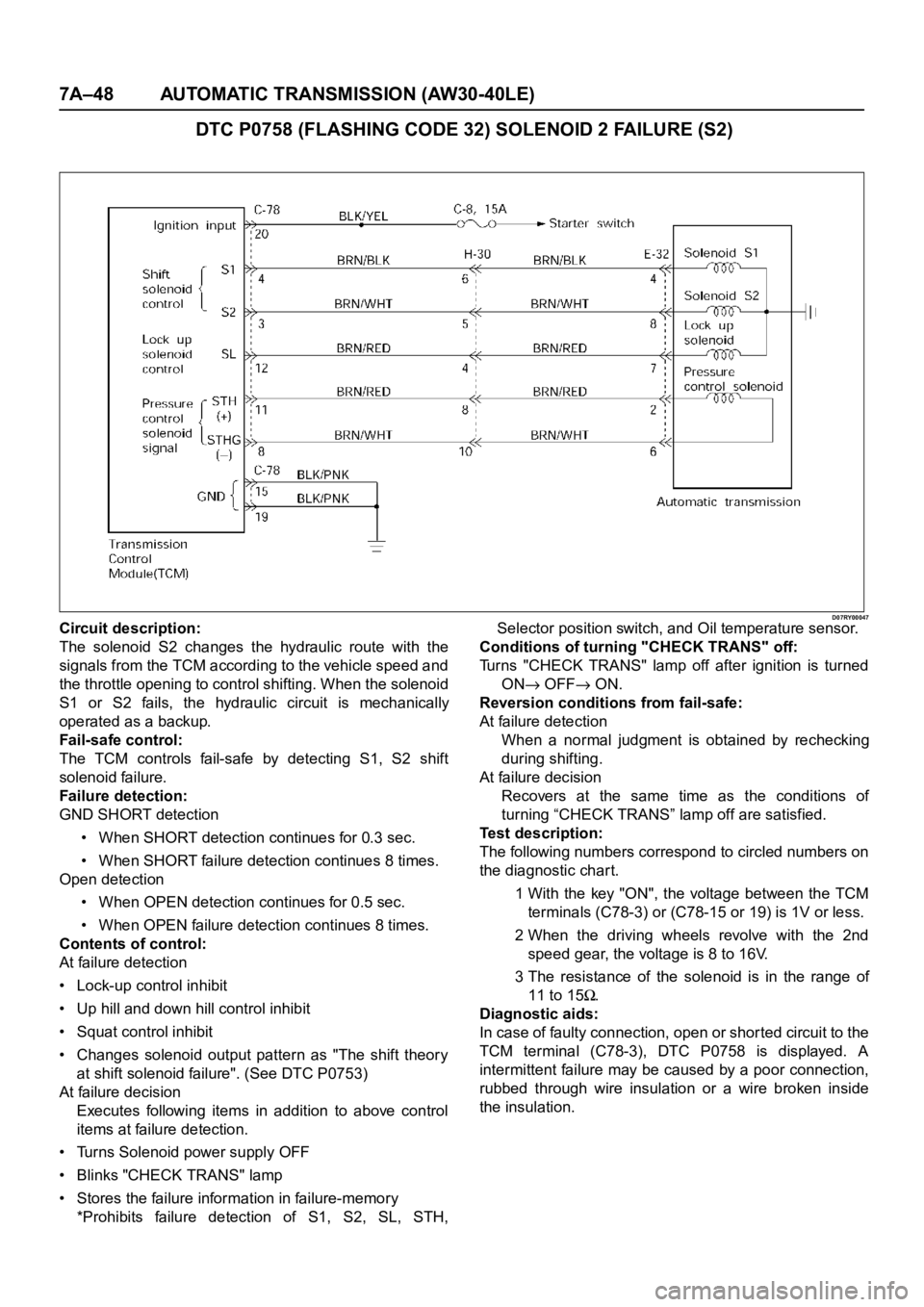
DTC P0758 (FLASHING CODE 32) SOLENOID 2 FAILURE (S2)
D07RY00047Circuit description:
The solenoid S2 changes the hydraulic route with the
signals from the TCM according to the vehicle speed and
the throttle opening to control shifting. When the solenoid
S1 or S2 fails, the hydraulic circuit is mechanically
operated as a backup.
Fail-safe control:
The TCM controls fail-safe by detecting S1, S2 shift
solenoid failure.
Failure detection:
GND SHORT detection
• When SHORT detection continues for 0.3 sec.
• When SHORT failure detection continues 8 times.
Open detection
• When OPEN detection continues for 0.5 sec.
• When OPEN failure detection continues 8 times.
Contents of control:
At failure detection
• Lock-up control inhibit
• Up hill and down hill control inhibit
• Squat control inhibit
• Changes solenoid output pattern as "The shift theory
at shift solenoid failure". (See DTC P0753)
At failure decision
Executes following items in addition to above control
items at failure detection.
• Turns Solenoid power supply OFF
• Blinks "CHECK TRANS" lamp
• Stores the failure information in failure-memory
*Prohibits failure detection of S1, S2, SL, STH,Selector position switch, and Oil temperature sensor.
Conditions of turning "CHECK TRANS" off:
Turns "CHECK TRANS" lamp off after ignition is turned
ON
OFF ON.
Reversion conditions from fail-safe:
At failure detection
When a normal judgment is obtained by rechecking
during shifting.
At failure decision
Recovers at the same time as the conditions of
turning “CHECK TRANS” lamp off are satisfied.
Test description:
The following numbers correspond to circled numbers on
the diagnostic char t.
1 With the key "ON", the voltage between the TCM
terminals (C78-3) or (C78-15 or 19) is 1V or less.
2 When the driving wheels revolve with the 2nd
speed gear, the voltage is 8 to 16V.
3 The resistance of the solenoid is in the range of
11 to 15
.
Diagnostic aids:
In case of faulty connection, open or shor ted circuit to the
TCM terminal (C78-3), DTC P0758 is displayed. A
intermittent failure may be caused by a poor connection,
rubbed through wire insulation or a wire broken inside
the insulation.
Page 5999 of 6000
7A1–6
TRANSMISSION CONTROL SYSTEM (4L30–E)
Shift Control
The transmission gear is shifted according to the shift
pattern selected by the driver. In shifting gears, the gear
ratio is controlled by the ON/ OFF signal using the shift
solenoid A and the shift solenoid B.
Band Apply Control
The band apply is controlled when in the 3–2 downshift
(engine overrun prevention) and the garage shift (shock
control).
The band apply solenoid is controlled by the signal from
the Pulse Width Modulation (PWM) to regulate the flow of
the oil.
Torque Converter Clutch Control
The clutch ON/OFF is controlled by moving the converter
clutch valve through shifting Torque Converter Clutch
(TCC) solenoid using the ON/OFF signal.
Line Pressure Control
The throttle signal allows the current signal to be sent to
the force motor. After receiving the current signal, the
force motor activates the pressure regulator valve to
regulate the line pressure.
On–Board Diagnostic System
Several malfunction displays can be stored in the
Powertrain Control Module (PCM) memory, and read out
of it afterward.The serial data lines, which are required for the testing of
the final assembly and the coupling to other electronic
modules, can be regulated by this function.
Fail Safe Mechanism
If there is a problem in the transmission system, the PCM
will go into a “backup” mode.
The vehicle can still be driven, but the driver must use the
select lever to shift gears.
Torque Management Control
The transmission control side sends the absolute spark
advance signal to the engine control side while the
transmission is being shifted. This controls the engine
spark timing in compliance with the vehicle running
condition to reduce the shocks caused by the change of
speed.
ATF Warning Control
The oil temperature sensor detects the ATF oil
temperature to control the oil temperature warning, TCC,
and the winter mode.
ABS Control (If equipped)
When the select lever is at “L” or “R” range, a signal is sent
to the ABS controller as one of the ABS control
conditions.