Page 99 of 444
Never do this.
Here two children are wearing the same belt. The
belt can't properly spread the impact forces. In a
crash, the two children can be crushed together
and seriously injured.
A belt must be used by
only one person at a time.
Q: What if a child is wearing a lap-shoulder belt,
but the child is
so small that the shoulder belt is
very close to the child's face or neck?
A: Move the child toward the center of the vehicle, but
be sure that the shoulder belt still is on the child's
shoulder, so that in a crash the child's upper body
would have the restraint that belts provide. If the
child is sitting in a rear seat outside position, see
"Rear Safety Belt Comfort Guides" in the Index.
If the child is
so small that the shoulder belt is still
very close to. the child's face or neck, you might
want to place the child in a seat that has a lap belt,
if your vehicle has one.
1-87
ProCarManuals.com
Page 106 of 444
Door Locks
I-
Unlocked doors can be dangerous.
Passengers
-- especially children -- can easily
open the doors and fall out. When a door is
locked, the inside handle won’t open it.
Outsiders can easily enter through an unlocked
door when you slow down
or stop your vehicle.
This may not be
so obvious: You increase the
chance of being thrown out of the vehicle in
a
crash if the doors aren’t locked. Wear safety belts
properly, lock your doors, and you will be far
better
off whenever you drive your vehicle. There
are several ways to lock and unlock your vehicle.
From the outside, use your key or the remote lock
control transmitter (if your vehicle
has this option).
To unlock either front door from the outside with the
key, insert the key and turn it toward the front
of
the vehicle.
You can lock either front door from the outside with
your key by inserting
and turning it toward the rear of
the vehicle.
ProCarManuals.com
Page 116 of 444
Sliding Door
To open the sliding door from outside the vehicle, pull
the handle out and then pull the door toward the rear. If
you slide the door all the way back, the door will rest in
a detent position.
The door must overcome this detent
when closing.
To move the door forward, you must first pull the door
past the open detent position.
If your vehicle is facing downward on a steep
grade
(15 percent or more), the door may not
stay open and could slam shut, possibly injuring
someone.
To make sure the door does not slam
shut, be sure to hold it open until everyone is
clear of the door, and only then allow
it to
slowly close.
Does your vehicle have a sliding door on the driver’s side?
If it does, this door is designed to open only a little if the
fuel door is open.
If this ever happens, don’t try to force
the sliding door. Just close the driver’s side sliding door.\
Then when the
fuel filler door is closed, the driver’s side
sliding door can be opened normally.
Sliding Door Lock
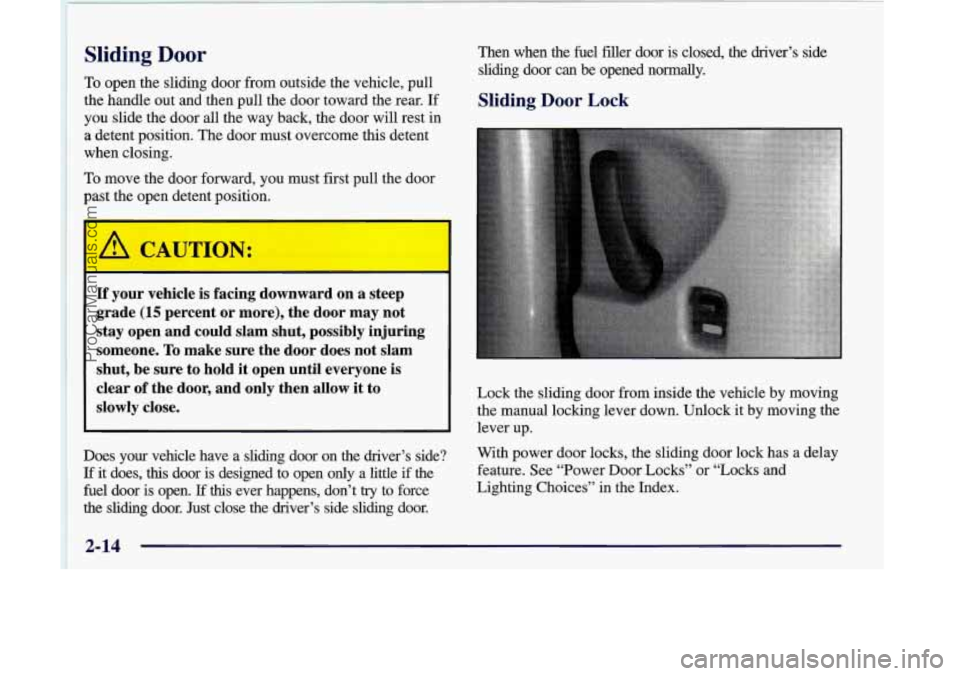
Lock the sliding door from inside the vehicle by moving
the manual locking lever down. Unlock it by moving the
lever up.
With power door locks, the sliding door lock has a delay
feature. See “Power Door Locks” or “Locks and
Lighting Choices” in the Index.
2-14
ProCarManuals.com
Page 120 of 444
A CAUTION:
If your vehicle is facing downward on a steep
grade
(15 percent or more), the door may not
stay open and could slam shut, possibly injuring
someone.
To make sure the door does not slam
shut, turn on the power sliding door feature.
Then
if the door closes, it will close under the
control of the power door system.
To manually close the power sliding door when the
override feature is disabled, pull the inside or outside
handle or the edge of the door. Move the door about
4 inches (10 cm) toward the closed position and release.
The door will close completely and latch for you.
To manually close the power sliding door when the
override feature is enabled, pull the inside or outside
handle and slide the door all the way forward to the
latched position.
ProCarManuals.com
Page 127 of 444
Nuisance Alarms New Vehicle “Break-In”
If you experience nuisance alarms (alarms which are not
caused by the opening of a door or the liftgate and are
not desirable), you may need to reduce the damage
detection sensitivity. Try programming the Content
Theft-Deterrent to Mode
1.
If you continue to experience nuisance alarms, you may
want to try turning
off damage detection by
programming your Content Theft-Deterrent to Mode
2.
If you are still having trouble with nuisance alarms, you
can
turn off the Content Theft-Deterrent system by
programming your Content Theft-Deterrent to Mode
3.
See “Locks and Lighting Choices” in the Index for more
information. See
your retailer or qualified technician
for service.
NOTICE:
Your vehicle doesn’t need an elaborate
“break-in.” But
it will perform better in the long
run
if you follow these guidelines:
0 Don’t drive at any one speed -- fast or
slow
-- for the first 500 miles (805 km).
Don’t make full-throttle starts.
200 miles (322 km) or so. During this time
your new brake linings aren’t yet broken
in. Hard stops with new linings can mean
premature wear and earlier replacement.
Follow
this breaking-in guideline every
time you get new brake linings.
See “Towing
a Trailer’’ in the Index for
more information.
Avoid making hard stops for the first
0 Don’t tow a trailer during break-in.
2-25
ProCarManuals.com
Page 128 of 444

Ignition Positions
With the ignition key in the ignition switch, you can turn
the switch to five positions.
C
ACCESSORY (A): This is an on position in which you
can operate your electrical power accessories. Press in
the ignition switch as you turn the top
of it toward you.
LOCK (B): This is the only position in which you can
remove the key. This locks your steering wheel, ignition
and transaxle.
OFF (C): This position unlocks the steering wheel,
ignition and transaxle, but does not send electrical
power to any accessories. Use this position if your
vehicle must be pushed or towed, but never try to
push-start your vehicle.
A warning chime will sound if
you open the driver’s door when the ignition is off and
the key is in the ignition.
RUN (D): This is an on position to which the switch
returns after you start your engine and release the
switch.
The switch stays in RUN when the engine is
running. But
even when the engine is not running, you
can use RUN to operate your electrical power
accessories, and to display some instrument panel
warning lights.
START (E): This position starts the engine. When the
engine starts, release the key. The ignition switch will
return to RUN for normal driving.
Note that even
if the engine is not running, the positions
ACCESSORY and RUN are positions that allow you to
operate your electrical accessories, such as the radio.
2-26
ProCarManuals.com
Page 130 of 444

2.
3.
If it doesn’t start right away, hold your key in
START. If it doesn’t start in three seconds (or starts
but then stops), push the accelerator pedal about one-quarter
of the way down for 12 more seconds, or
until it starts.
If your engine still won’t start (or starts but then
stops), it could be flooded with too much gasoline.
Try this:
Wait
15 seconds to let the starter motor cool down.
Then push your accelerator pedal all the way to the
floor. Hold it there. Then hold the key
in START.
This clears the extra gasoline from the engine. When
the engine starts, let go
of the key and the accelerator
pedal.
If the engine still doesn’t start, wait another
15 seconds and repeat this step.
NOTICE:
Your engine is designed to work with the
electronics in your vehicle. If you add electrical
parts or accessories, you could change the
way
the engine operates. Before adding electrical
equipment, check with your retailer. If you don’t,
your engine might not perform properly.
If you ever have to have your vehicle towed, see
the part of this manual that tells how to
do it
without damaging your vehicle. See “Towing
Your Vehicle” in the Index.
2-28
ProCarManuals.com
Page 132 of 444

Automatic Transaxle Operation
There are several different positions for your shift lever.
PRND321
PARK (P): This position locks your front wheels. It’s
the best position to use when you start your engine
because your vehicle can’t move easily.
Ensure the shift lever is fully in PARK (P) before
starting the engine.
Your vehicle has Brake-Transaxle
Shift Interlock (BTSI). You must fully
apply your
regular brakes
before you can shift from PARK (P)
when the ignition key is in RUN.
As you step on the
brake pedal, while in PARK (P), you may hear a click
from the solenoid of the BTSI.
This ensures that the
BTSI is operating properly.
I
If you cannot shift out of PARK (P), ease pressure on
the shift lever
-- push the shift lever all the way into
PARK (P) as you maintain brake application. Then
move the shift lever into the gear you wish. See
“Shifting Out of PARK (P)” in this section.
It is dangerous to get out of your vehicle if the
shift lever is not fully in PARK
(P) with the
parking brake firmly set. Your vehicle can roll.
Don’t leave your vehicle when the engine
is
running unless you have to. If you have left the
engine running, the vehicle can move suddenly.
You or others could be injured. To be sure your
vehicle won’t move, even when you’re on
fairly
level ground, always set your parking brake and
move the
shift lever to PARK (P).
See “Shifting Into PARK (P)” in the Index. If
you’re pulling a trailer, see “Towing a Trailer” in
the Index.
ProCarManuals.com


