1998 NISSAN FRONTIER ignition
[x] Cancel search: ignitionPage 14 of 224
This Supplemental Restraint System section
contains important information concerning
the driver and passenger supplemental air
bags. The Supplemental Restraint System
Air Bag can help reduce impact force to the
driver and to the front passenger in certain
frontal collisions. The supplemental air bags
are designed tosupplementthe crash pro-
tection provided by the driver and front pas-
senger seat belts and arenot a substitute
for them. The seat belts should always be
correctly worn and the driver and front pas-
senger seated a suitable distance away from
the steering wheel and instrument panel.
See ``Seat belts'' for instructions and precau-
tions on seat belt usage later in this section.
The supplemental air bags operate only
when the ignition switch is in the ON or
START position.
WARNING
cThe supplemental air bags ordinarily
will not inflate in the event of a side
impact, rear impact, roll over, or
lower severity frontal collision. Al-
ways wear your seat belts to help
reduce the risk or severity of injury
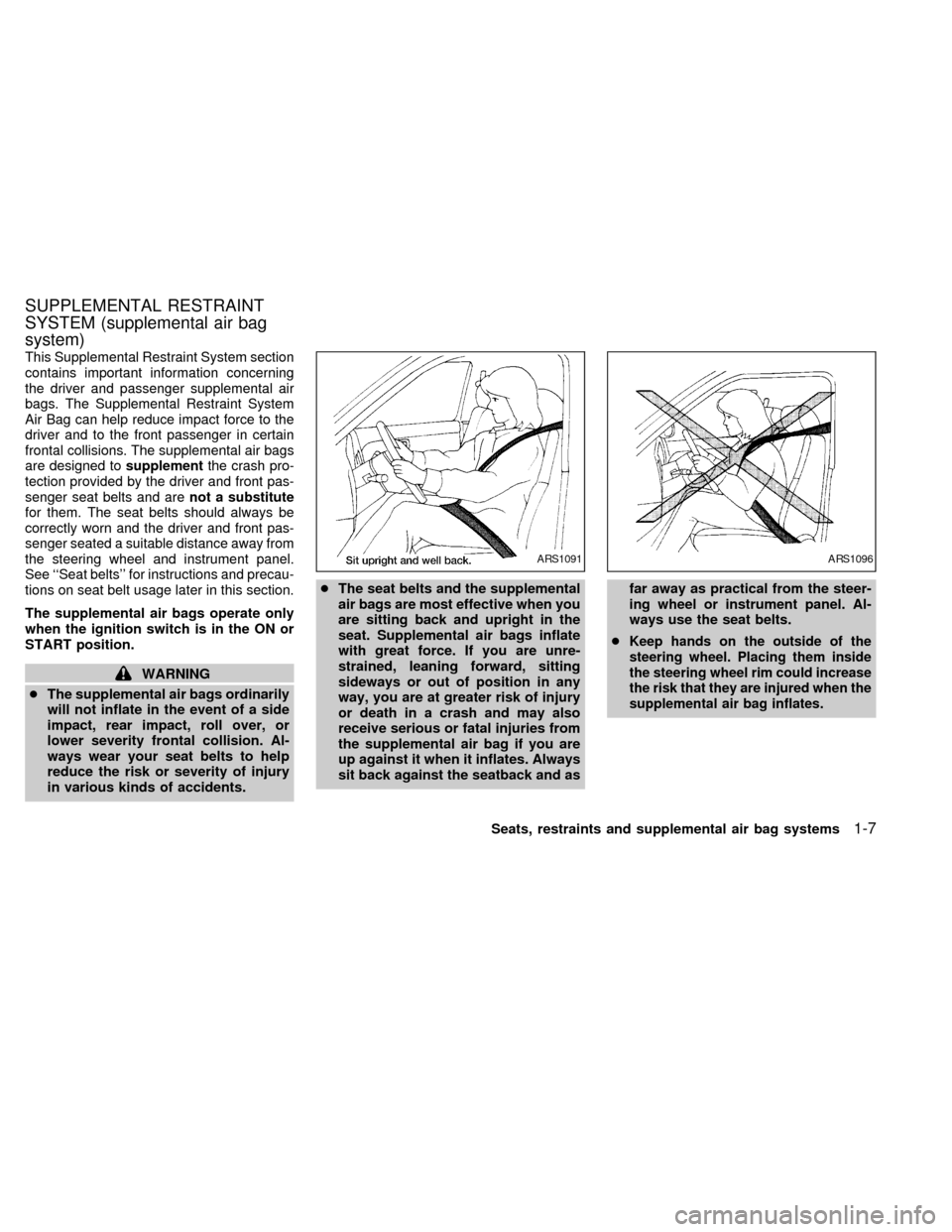
in various kinds of accidents.cThe seat belts and the supplemental
air bags are most effective when you
are sitting back and upright in the
seat. Supplemental air bags inflate
with great force. If you are unre-
strained, leaning forward, sitting
sideways or out of position in any
way, you are at greater risk of injury
or death in a crash and may also
receive serious or fatal injuries from
the supplemental air bag if you are
up against it when it inflates. Always
sit back against the seatback and asfar away as practical from the steer-
ing wheel or instrument panel. Al-
ways use the seat belts.
c
Keep hands on the outside of the
steering wheel. Placing them inside
the steering wheel rim could increase
the risk that they are injured when the
supplemental air bag inflates.
ARS1091ARS1096
SUPPLEMENTAL RESTRAINT
SYSTEM (supplemental air bag
system)
Seats, restraints and supplemental air bag systems1-7
ZX
Page 18 of 224
It can help save lives and reduce serious
injuries. However, an inflating supplemental
air bag may cause facial abrasions or other
injuries. Supplemental air bags do not pro-
vide restraint to the lower body.
Seat belts should be correctly worn and the
driver and passenger seated upright as far
as practical away from the steering wheel or
dashboard. Since the supplemental air bags
inflate quickly in order to help protect the
front occupants, the force of the supplemen-
tal air bag inflating can increase the risk of
injury if the occupant is too close to or
against the supplemental air bag module
during inflation.
The supplemental air bags deflate quickly
after a collision.
The supplemental air bags operate only
when the ignition switch is in the ON or
START position.
WARNING
cDo not attach any objects to the
steering wheel pad or on the instru-
ment panel. Also, do not place any
objects between any occupant and
the steering wheel or on the instru-
ment panel. Such objects maybecome dangerous projectiles and
cause injury if the supplemental air
bag inflates.
cRight after inflation, several supple-
mental air bag system components
will be hot. Do not touch them; you
may severely burn yourself.
c
No unauthorized changes should be
made to any components or wiring of
the supplemental air bag system. This
is to prevent accidental inflation of
the supplemental air bag or damage
to the supplemental air bag system.
cDo not make unauthorized changes to
your vehicle's electrical system, sus-
pension system or front end structure.
This could affect proper operation of
the supplemental air bag system.
cTampering with the supplemental air
bag system may result in serious per-
sonal injury. Tampering includes
changes to the steering wheel and the
instrument panel assembly by placing
material over the steering wheel pad,
above the dashboard, or by installing
additional trim material around the
supplemental air bag system.cWork around and on the supplemen-
tal air bag system should be done by
an authorized NISSAN dealer. Installa-
tion of electrical equipment should
also be done by an authorized NIS-
SAN dealer. The yellow SRS wiring-
should not be modified or discon-
nected. Unauthorized electrical test
equipment and probing devices
should not be used on the supple-
mental air bag system.
cSRS wiring harnesses are covered
with yellow insulation either just be-
fore the harness connectors or over
the complete harness for easy iden-
tification.
When selling your vehicle, we request that
you inform the buyer about the supplemental
air bag system and guide the buyer to the
appropriate sections in this Owner's Manual.
Seats, restraints and supplemental air bag systems1-11
ZX
Page 20 of 224
The ON/OFF switch should ONLYbe used
to turn the passenger supplemental air bag
OFF when the following government criteria
exist:
cInfants (less than 1 year old) in rear
facing child restraints MUST
be placed
in the front passenger seat.
cChildren ages 1-12 years MUST
be
placed in the front passenger seat.
c
The passenger has a medical condition
which, according to a physician, causes
the air bag to pose a special risk and
makes the potential harm from the air
bag greater than the potential harm
from turning off the air bag.
Seat belts and child restraints should al-
ways be properly used. See ªPrecautions
on seat belt usageº and ªChild restraintsº
later in this section for details.
To turn the passenger supplemental air bag
OFF, insert the ignition key in the passenger
supplemental air bag ON/OFF switch and
turn the switch clockwise to the OFF posi-
tion. Then remove the key. When the igni-
tion is turned to the ON or START position
the passenger air bag OFF indicator light
will illuminate to indicate the air bag is OFF.To turn the passenger supplemental air bag
ON, insert the ignition key in the passenger
supplemental air bag ON/OFF switch and
turn the switch counter clockwise to the ON
position. Then remove the key. When the
ignition is turned to the ON or START
position the passenger air bag OFF indica-
tor light will illuminate for 7 seconds to
indicate the system is working properly and
then go out to indicate that the passenger
supplemental air bag is ON.
When the switch is turned to the ON posi-
tion, the passenger supplemental air bag is
enabled and could inflate in a frontal colli-
sion. When the switch is turned to the OFF
position, the passenger supplemental air
bag is disabled and will not inflate in a
frontal collision. The passenger supplemen-
tal air bag OFF indicator light on the instru-
ment panel illuminates when the passenger
supplemental air bag ON/OFF switch is
turned to the OFF position. The driver's side
supplemental air bag always remains en-
abled and is not affected by the passenger
supplemental air bag ON/OFF switch.
The passenger supplemental air bag light,
displaying OFF in the center of the instru-
ment panel, monitors the position of thepassenger supplemental air bag ON/OFF
switch. When the ignition key is in the ON or
START position, the light illuminates for
about 7 seconds and then turns off if the air
bag is ON, or stays on if the air bag is OFF.
WARNING
cDo not switch the air bag OFF unless
you meet the federal government cri-
teria outlined below. This vehicle is
equipped with seat belts with a ``load
limiter'' feature. The seat belts are
designed to work with the air bags to
reduce the risk of injury in a colli-
sion. The seat belts are designed to
release additional belt webbing dur-
ing some collisions to reduce the
concentration of force on the occu-
pant's chest area. In a collision with
the air bag turned OFF, the seat belt
may allow the occupant enough for-
ward movement to incur serious or
fatal injuries.
Seats, restraints and supplemental air bag systems
1-13
ZX
Page 22 of 224

Warning labels about the supplemental air
bag system are placed in the vehicle as
shown in the illustration.The supplemental air bag warning light,
displaying AIR BAG in the instrument panel,
monitors the circuits of the supplemental air
bag. The circuits monitored by the supple-
mental air bag warning light are the diagno-
sis sensor unit, the supplemental air bag
module and all related wiring.
When the ignition key is in the ON or START
position, the supplemental air bag warning
light illuminates for about 7 seconds and
then turns off. This means the system is
operational.
If any of the following conditions occur, the
supplemental air bag needs servicing and
ARS1028ARS1029
WARNING LABELS SUPPLEMENTAL AIR BAG
WARNING LIGHT
Seats, restraints and supplemental air bag systems1-15
ZX
Page 23 of 224
should be taken to your nearest authorized
NISSAN dealer:
1. The supplemental air bag warning light
does not come on and remain on for 7
seconds and then go off as described
above.
2. The supplemental air bag warning light
flashes intermittently or remains on.
3. The supplemental air bag warning light
does not come on at all.
Under these conditions, the Supplemental
Restraint System (supplemental air bag
system) may not function properly. It must
be checked and repaired.
WARNING
If the supplemental air bag warning
light is on, it could mean that the
supplemental air bag system will not
operate in an accident.
Repair and replacement procedure
The supplemental air bag system is de-
signed to inflate on a one-time-only basis.
As a reminder, unless it is damaged, the
supplemental air bag warning light remainsilluminated after inflation has occurred.
Repair and replacement of the supplemen-
tal air bag system should be done only by
an authorized NISSAN dealer.
To ensure long-term functioning, the
system must be inspected 10 years after
the date of manufacture noted on the
certification label located on the driver
side front pillar.
When maintenance work is required on the
vehicle, the supplemental air bag system
and related parts should be pointed out to
the person conducting the maintenance.
The ignition key must always be in the LOCK
position when working under the hood or
inside the vehicle.
WARNING
cOnce the supplemental air bag in-
flates, the supplemental air bag
module will not function again and
should be replaced by an authorized
NISSAN dealer. The supplemental air
bag module cannot be repaired.cThe supplemental air bag system
should be inspected by an autho-
rized NISSAN dealer if there is any
damage to the front end portion of
the vehicle.
cIf you need to dispose of the supple-
mental air bag or scrap the vehicle,
contact an authorized NISSAN
dealer. Correct supplemental air bag
disposal procedures are set forth in
the appropriate NISSAN Service
Manual. Incorrect disposal proce-
dures could cause personal injury.
1-16Seats, restraints and supplemental air bag systems
ZX
Page 25 of 224
cBe sure the seat belt tongue is se-
curely fastened to the proper buckle.
cDo not wear the belt inside out or
twisted. Doing so may reduce its
effectiveness.
cDo not allow more than one person
to use the same belt.
cNever carry more people in the ve-
hicle than there are seat belts.
c
Never allow anyone to ride in the cargo
area or in a slide-in camper or other
type cargo area cover while the vehicle
is in motion. These areas do not con-
tain seat belts. It is not designed for
passengers. They could be injured in
sudden braking or a collision.
cIf the seat belt warning lamp glows
continuously while the ignition is
turned ON with all doors closed and
all seat belts fastened, it may indi-
cate a malfunction in the system.
Have the system checked by an au-
thorized NISSAN dealer.
c
All seat belt assemblies including
retractors and attaching hardware
should be inspected after any colli-
sion at an authorized NISSAN dealer.NISSAN recommends that all seat-
belt assemblies in use during a colli-
sion be replaced unless the collision
was minor and the belts show no
damage and continue to operate
properly. Seat belt assemblies not in
use during a collision should also be
inspected and replaced if either dam-
age or improper operation is noted.
CHILD SAFETY
Children need adults to help protect them.
They need to be properly restrained.
The proper restraint depends on the
child's size. Generally, infants (up to
about 1 year and less than 20 pounds)
should be placed in rear facing child
restraints. Front facing child restraints
are available for children who outgrow
rear facing child restraints.
WARNING
cBe sure to turn the passenger
supplemental air bag ON/OFF switch
OFF when using a rear facing child
restraint in the front passenger seat.
If it is not OFF, the air bag may inflatein a collision. The force of the rapidly
inflating air bag could cause serious
injury or kill the child in the child
restraint.
cDo not install a child restraint in the
jump seats (King Cab model). These
seats are not suitable for child re-
straint installation.
cDo not install a child restraint in the
center position of the front bench
seat. This position is not suitable for
child restraint installation.
c
Infants and children need special pro-
tection. The vehicle's seat belts may
not fit them properly. The shoulder
belt may come too close to the face or
neck. The lap belt may not fit over
their small hip bones. In an accident,
an improperly fitting seat belt could
cause serious or fatal injury. Always
use appropriate child restraints.
All U.S. states and Canadian provinces
require the use of approved child restraints
for infants and small children. See ``Child
restraints'' later in this section for more
information.
In addition, there are many types of child
1-18Seats, restraints and supplemental air bag systems
ZX
Page 47 of 224
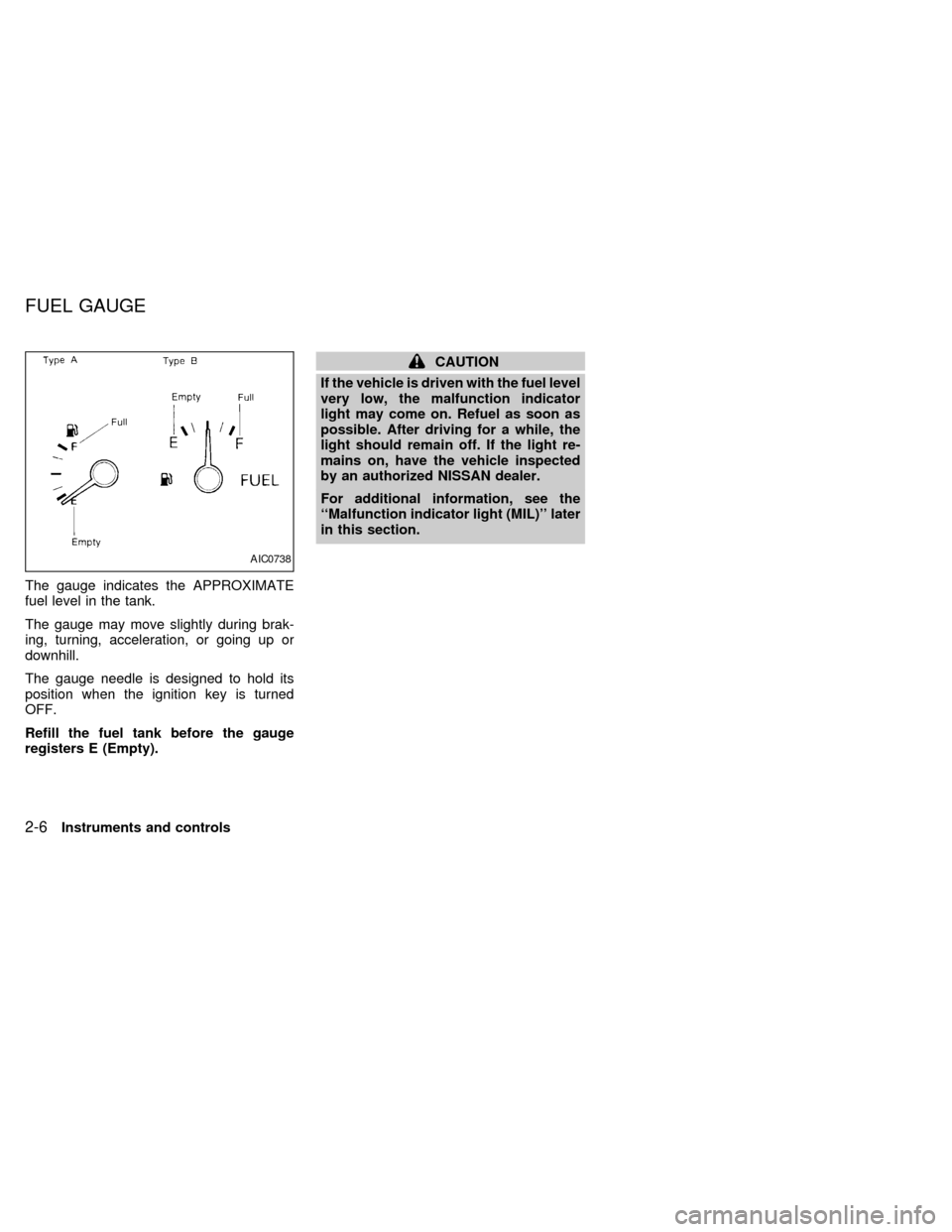
The gauge indicates the APPROXIMATE
fuel level in the tank.
The gauge may move slightly during brak-
ing, turning, acceleration, or going up or
downhill.
The gauge needle is designed to hold its
position when the ignition key is turned
OFF.
Refill the fuel tank before the gauge
registers E (Empty).
CAUTION
If the vehicle is driven with the fuel level
very low, the malfunction indicator
light may come on. Refuel as soon as
possible. After driving for a while, the
light should remain off. If the light re-
mains on, have the vehicle inspected
by an authorized NISSAN dealer.
For additional information, see the
``Malfunction indicator light (MIL)'' later
in this section.
AIC0738
FUEL GAUGE
2-6Instruments and controls
ZX
Page 48 of 224
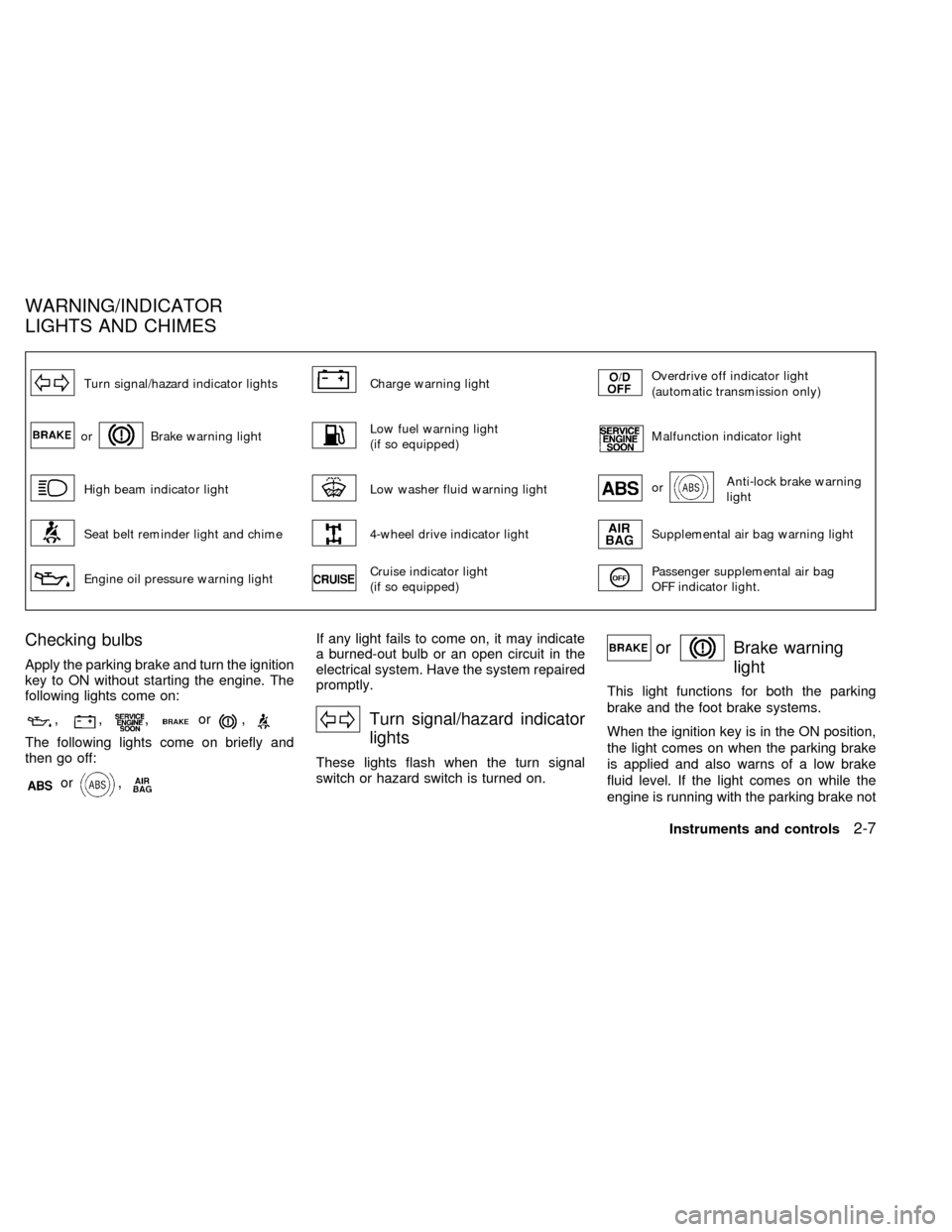
Turn signal/hazard indicator lightsCharge warning lightOverdrive off indicator light
(automatic transmission only)
orBrake warning lightLow fuel warning light
(if so equipped)Malfunction indicator light
High beam indicator lightLow washer fluid warning lightorAnti-lock brake warning
light
Seat belt reminder light and chime4-wheel drive indicator lightSupplemental air bag warning light
Engine oil pressure warning lightCruise indicator light
(if so equipped)Passenger supplemental air bag
OFF indicator light.
Checking bulbs
Apply the parking brake and turn the ignition
key to ON without starting the engine. The
following lights come on:
,,,or,
The following lights come on briefly and
then go off:
or,
If any light fails to come on, it may indicate
a burned-out bulb or an open circuit in the
electrical system. Have the system repaired
promptly.
Turn signal/hazard indicator
lights
These lights flash when the turn signal
switch or hazard switch is turned on.
orBrake warning
light
This light functions for both the parking
brake and the foot brake systems.
When the ignition key is in the ON position,
the light comes on when the parking brake
is applied and also warns of a low brake
fluid level. If the light comes on while the
engine is running with the parking brake not
WARNING/INDICATOR
LIGHTS AND CHIMES
Instruments and controls2-7
ZX