Page 4 of 188
TAPESEEK
TUNE
REW
FFSIDE 1 2
COMP
SHUFF
EJ
RDS
SCAN AUTO
123
4
56
BASS
TREBSELBAL
FADE
MAX
A/CAUTO
FRONT
REAR
SELECTRESET
Climate control
systems
(pg. 26)Clock
(pg. 34) Electronic sound
system; refer to
Audio Guide
(pg. 35)
Passenger side
air bag
(pg. 77)
Traction control
switch*
(pg. 101)
Instrumentation
5
Page 25 of 188
Flash to pass
Pull toward you to activate and
release to deactivate.
CLIMATE CONTROL SYSTEM
Electronic Automatic
Temperature Control (EATC)
system
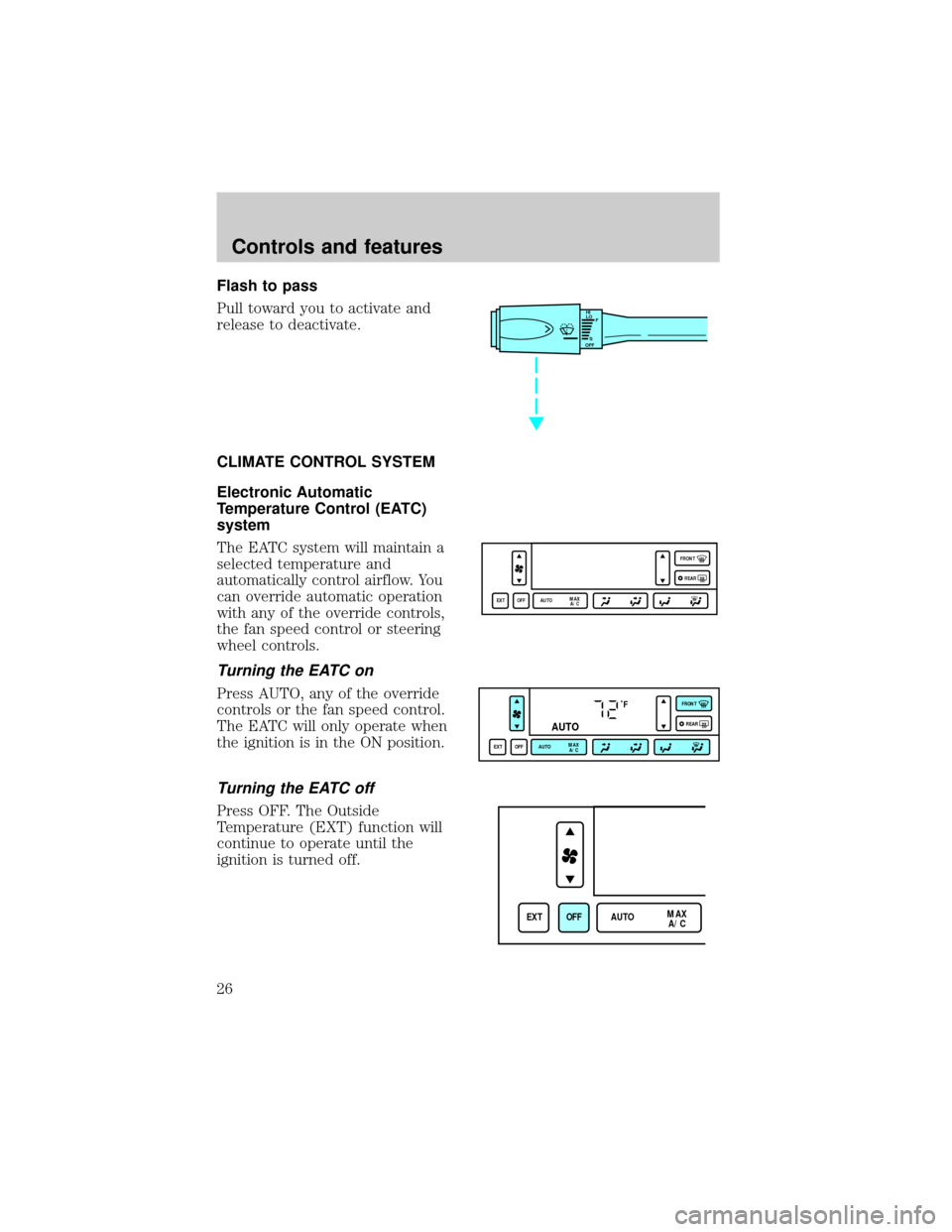
The EATC system will maintain a
selected temperature and
automatically control airflow. You
can override automatic operation
with any of the override controls,
the fan speed control or steering
wheel controls.
Turning the EATC on
Press AUTO, any of the override
controls or the fan speed control.
The EATC will only operate when
the ignition is in the ON position.
Turning the EATC off
Press OFF. The Outside
Temperature (EXT) function will
continue to operate until the
ignition is turned off.
HI
LO
F
S
OFF
EXT OFF AUTOMAX
A/CFRONT
REAR
˚F
AUTO
EXT OFF AUTOMAX
A/CFRONT
REAR
EXT OFF AUTOMAX
A/C
Controls and features
26
Page 29 of 188

clear water drips on the ground
under the air conditioner drain
while the system is working and
even after you have stopped the
vehicle.
Under normal conditions, your
vehicle's climate control system
should be left in any position other
than MAX A/C or OFF when the
vehicle is parked. This allows the
vehicle to ªbreatheº through the
outside air inlet duct.
²MAX A/C-Uses recirculated air
to cool the vehicle. The
temperature display will remain
unchanged and air will be
cooled based on the selected
temperature. To exit, press
AUTO or any other override
controls. MAX A/C is noisier
than normal A/C but more
economical and will cool the
inside of the vehicle faster.
Airflow is from the instrument
panel registers. This mode can
also be used to prevent
undesirable odors from entering
the vehicle.
²
-Distributes outside air
through the instrument panel
registers. However, the air
cannot be cooled below the
outside temperature because the
air conditioning does not
operate in this mode.
²
-Distributes outside air
through the instrument panel
registers and the floor ducts.
Heating and air conditioning
capabilities are provided in this
Controls and features
30
Page 32 of 188
moving. The readings that you get
may not agree with temperatures
given on the radio due to
differences in vehicle and station
locations.
Operating tips
²In humid weather, select FRONT
before driving. This will
prevent your windshield from
fogging. After a few minutes,
select any desired position.
²To prevent humidity buildup
inside the vehicle, don't drive
with the climate control system
in the OFF position.
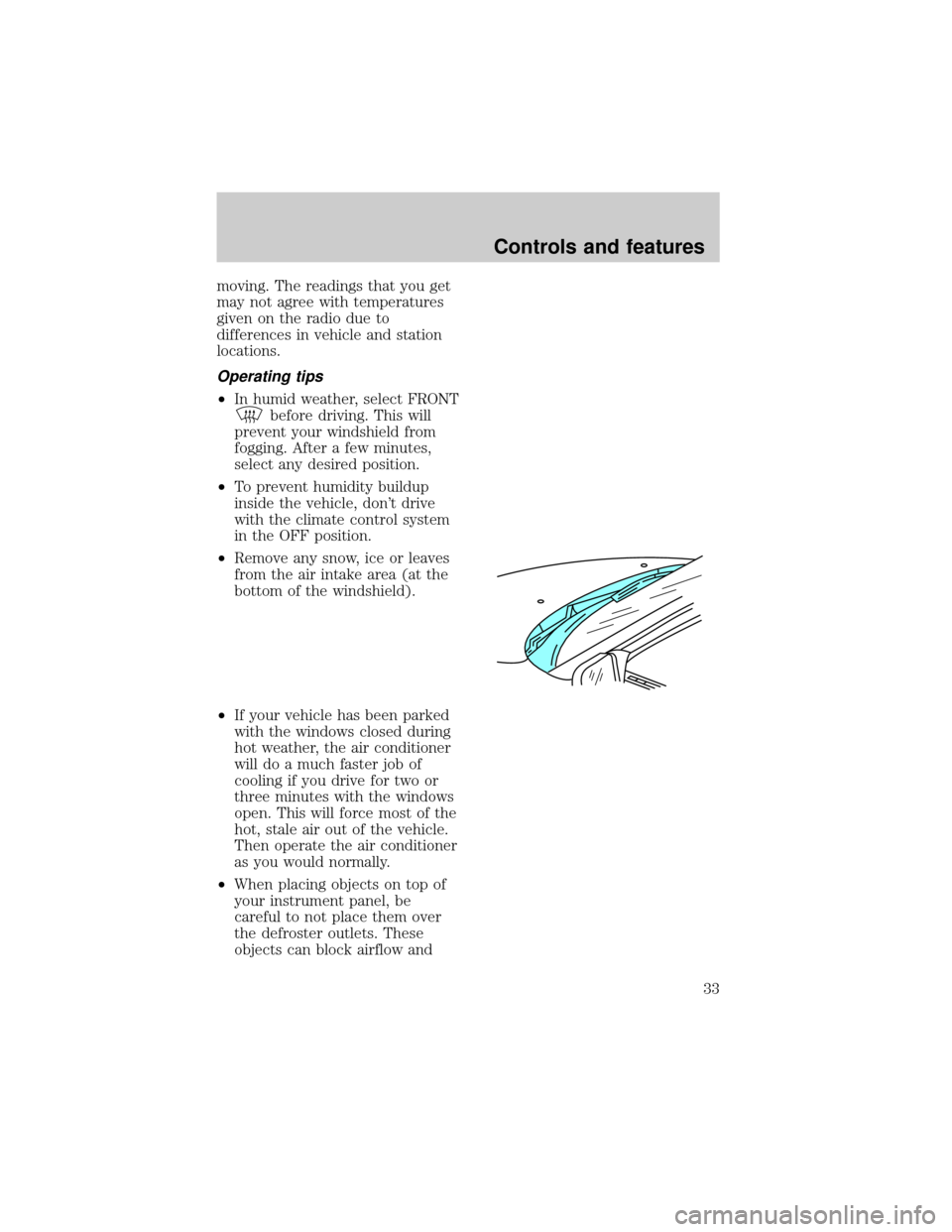
²Remove any snow, ice or leaves
from the air intake area (at the
bottom of the windshield).
²If your vehicle has been parked
with the windows closed during
hot weather, the air conditioner
will do a much faster job of
cooling if you drive for two or
three minutes with the windows
open. This will force most of the
hot, stale air out of the vehicle.
Then operate the air conditioner
as you would normally.
²When placing objects on top of
your instrument panel, be
careful to not place them over
the defroster outlets. These
objects can block airflow and
Controls and features
33
Page 33 of 188
reduce your ability to see
through your windshield. Also,
avoid placing small objects on
top of your instrument panel.
These objects can fall down into
the defroster outlets and block
airflow and possibly damage
your climate control system.
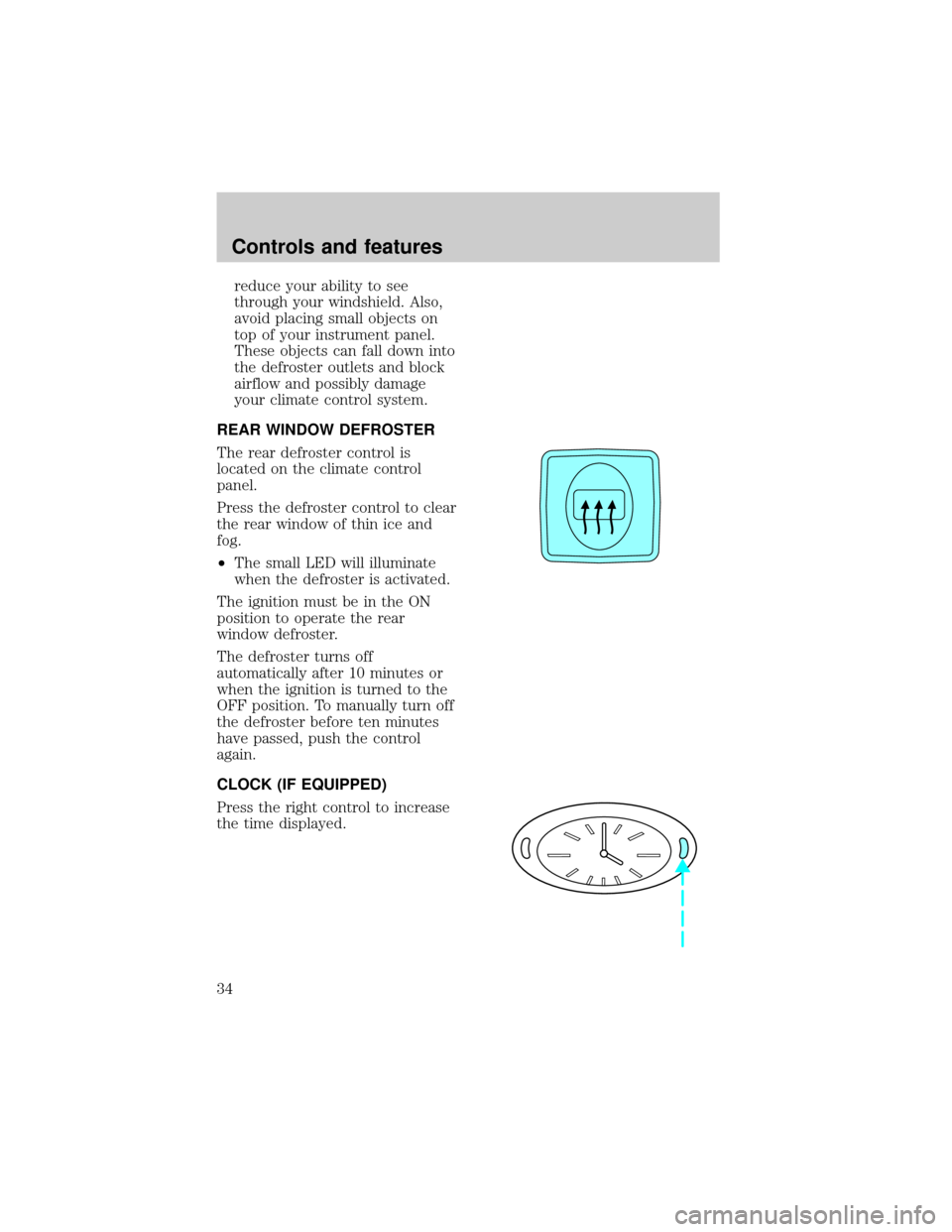
REAR WINDOW DEFROSTER
The rear defroster control is
located on the climate control
panel.
Press the defroster control to clear
the rear window of thin ice and
fog.
²The small LED will illuminate
when the defroster is activated.
The ignition must be in the ON
position to operate the rear
window defroster.
The defroster turns off
automatically after 10 minutes or
when the ignition is turned to the
OFF position. To manually turn off
the defroster before ten minutes
have passed, push the control
again.
CLOCK (IF EQUIPPED)
Press the right control to increase
the time displayed.
Controls and features
34
Page 40 of 188
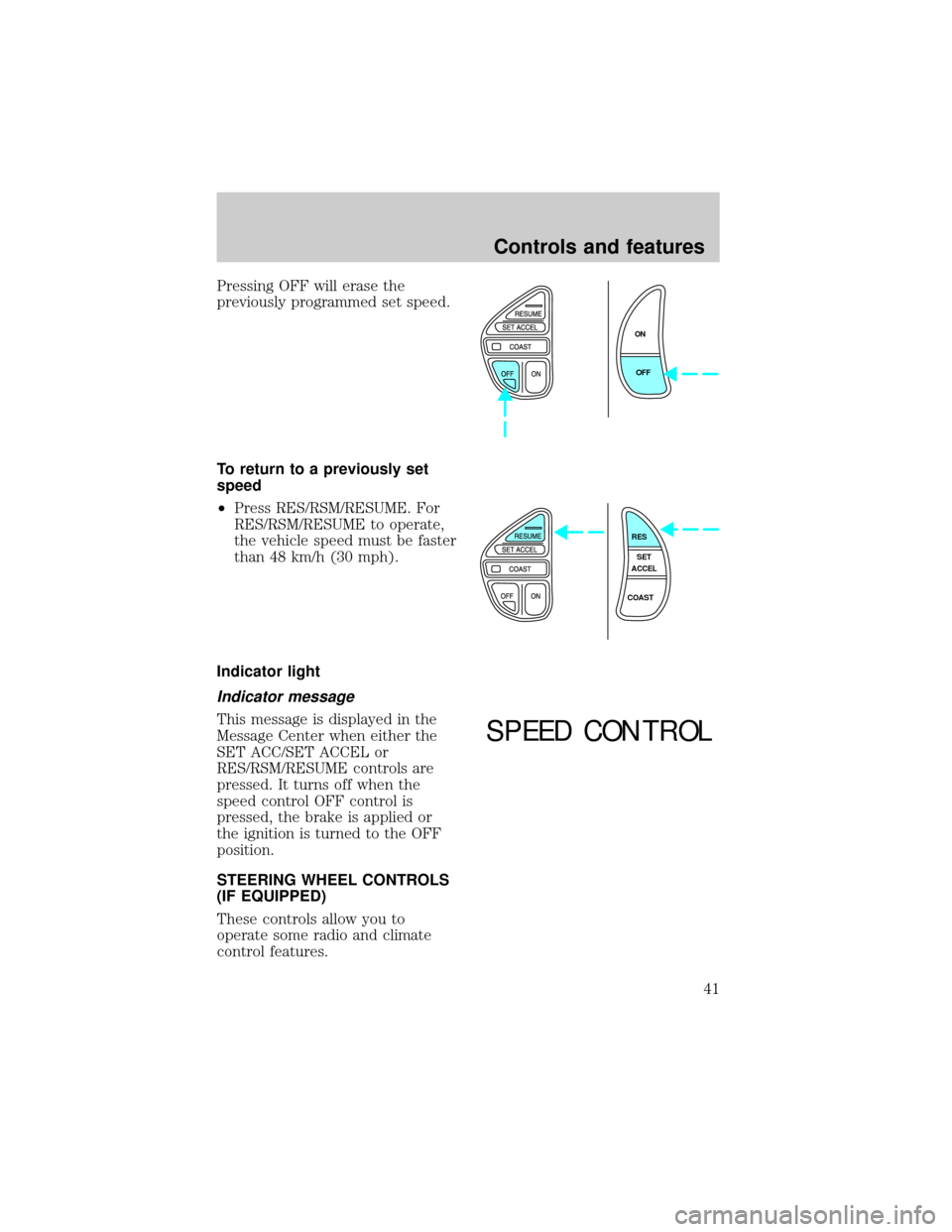
Pressing OFF will erase the
previously programmed set speed.
To return to a previously set
speed
²Press RES/RSM/RESUME. For
RES/RSM/RESUME to operate,
the vehicle speed must be faster
than 48 km/h (30 mph).
Indicator light
Indicator message
This message is displayed in the
Message Center when either the
SET ACC/SET ACCEL or
RES/RSM/RESUME controls are
pressed. It turns off when the
speed control OFF control is
pressed, the brake is applied or
the ignition is turned to the OFF
position.
STEERING WHEEL CONTROLS
(IF EQUIPPED)
These controls allow you to
operate some radio and climate
control features.
ON
OFF
RES
SET
ACCEL
COAST
SPEED CONTROL
Controls and features
41
Page 41 of 188
Radio control features
²Press MEM/NEXT to select a
preset station from memory.
²Press BAND/MODE to select
AM, FM1, FM2, TAPE or CD (if
equipped).
²Press VOL up or down to adjust
the volume.
Climate control features
²Press TEMP up or down to
adjust temperature.
²Press FAN up or down to adjust
fan speed.
HOMELINKTUNIVERSAL
TRANSMITTER (IF EQUIPPED)
The HomeLinktUniversal
Transmitter, located underneath
the driver's visor, provides a
convenient way to replace up to
three hand-held transmitters with
a single built-in device. This
feature will learn the radio
frequency codes of most current
transmitters to operate garage
doors and gates, and can also
control home or office lighting and
security systems (with the
available accessory package).
NEXT
MODE
Controls and features
42
Page 152 of 188

U.S. Department of
Transportation-Tire quality
grades:The U.S. Department of
Transportation requires Ford to
give you the following information
about tire grades exactly as the
government has written it.
Treadwear
The treadwear grade is a
comparative rating based on the
wear rate of the tire when tested
under controlled conditions on a
specified government test course.
For example, a tire grade 150
would wear one and one-half (1
1/2) times as well on the
government course as a tire grade
100. The relative performance of
tires depends upon the actual
conditions of their use, however,
and may depart significantly from
the norm due to variations in
driving habits, service practices,
and differences in road
characteristics and climate.
Traction A B C
The traction grades, from highest
to lowest are A, B, and C, and they
represent the tire's ability to stop
on wet pavement as measured
under test surfaces of asphalt and
concrete. A tire marked C may
have poor traction performance.
Maintenance and care
153