Page 62 of 188

3. Within five seconds of turning
the ignition to OFF, insert the
second previously programmed
SecuriLockykey into the ignition
switch and turn the ignition from
OFF to RUN (maintain ignition in
RUN for at least one second but no
more than 5 seconds).
4. Turn the ignition to OFF and
remove the second SecuriLocky
key from the ignition switch.
5. Within 10 seconds of turning the
ignition to OFF, insert the
unprogrammed SecuriLockykey
(new key) into the ignition switch
and turn the ignition from OFF to
RUN (maintain ignition switch in
RUN for at least one second). This
step will program your new
SecuriLockykey.
6. If it is desired to program
additional SecuriLockykey(s),
repeat this procedure from step 1.
If the programming procedure was
successful, the new SecuriLocky
key(s) will start the vehicle's
engine. The theft indicator (located
on the instrument panel) will light
for three seconds and then go out.
If the programming procedure was
not successful, the new
SecuriLockykey(s) will not
operate the vehicle's engine. The
theft indicator will flash on and off.
Wait at least one minute and then
repeat the procedure from step 1.
If failure repeats, bring your
vehicle to your dealership to have
the spare SecuriLockykey(s)
programmed.
Controls and features
63
Page 74 of 188

belt extension only if the safety
belt is too short for you when fully
extended. Do not use extensions
to change the fit of the shoulder
belt across the torso.
Safety belt warning light and
indicator chime
The seat belt warning light
illuminates in the instrument
cluster and a chime sounds to
remind the occupants to fasten
their safety belts.
Safety belt maintenance
Check the safety belt systems
periodically to make sure they
work properly and are not
damaged. Check the safety belts to
make sure there are no nicks,
wears or cuts. All safety belt
assemblies, including retractors,
buckles, front seat belt buckle
assemblies (slide bar)(if
equipped), shoulder belt height
adjusters (if equipped), child
safety seat tether bracket
assemblies (if equipped), and
attaching hardware, should be
inspected after a collision. Ford
recommends that all safety belt
assemblies used in vehicles
involved in a collision be replaced.
However, if the collision was minor
and a qualified technician finds
that the belts do not show damage
and continue to operate properly,
they do not need to be replaced.
Safety belt assemblies not in use
during a collision should also be
inspected and replaced if either
Seating and safety restraints
75
Page 79 of 188
If the air bag is inflated,
the air bag will not
function again and must be
replaced immediately.Ifthe
air bag is not replaced, the
unrepaired area will increase the
risk of injury in a collision.
The SRS consists of:
²driver and passenger air bag
modules (which include the
inflators and air bags),
²one or more impact and safing
sensors,
²a readiness light and tone
²and the electrical wiring which
connects the components.
The diagnostic module monitors its
own internal circuits and the
supplemental air bag electrical
system warning (including the
impact sensors), the system wiring,
the air bag system readiness light,
the air bag back up power and the
air bag ignitors.
Determining if the system is
operational
The SRS uses a readiness light in
the instrument cluster or a tone to
indicate the condition of the
system. Refer to theAir bag
readinesssection in the
Instrumentationchapter. Routine
maintenance of the air bag is not
required.
Seating and safety restraints
80
Page 80 of 188

A difficulty with the system is
indicated by one or more of the
following:
²The readiness light will either
flash or stay lit.
²The readiness light will not
illuminate immediately after
ignition is turned on.
²A series of five beeps will be
heard. The tone pattern will
repeat periodically until the
problem and light are repaired.
If any of these things happen, even
intermittently, have the SRS
serviced at your dealership or by a
qualified technician immediately.
Unless serviced, the system may
not function properly in the event
of a collision.
Disposal of air bags and air bag
equipped vehicles
For disposal of air bags or air bag
equipped vehicles, see your local
dealership or qualified technician.
Air bags MUST BE disposed of by
qualified personnel.
SAFETY RESTRAINTS FOR
CHILDREN
Important child restraint
precautions
You are required by law to use
safety restraints for children in the
U.S. and Canada. If small children
ride in your vehicle (generally
children who are four years old or
younger and who weigh 18 kg
[40 lbs] or less), you must put
AIR
BAG
Seating and safety restraints
81
Page 92 of 188
Make sure the corresponding lights
illuminate briefly. If a light fails to
illuminate, have the vehicle
serviced.
²If the driver's safety belt is
fastened, the light (
) will not
illuminate.
STARTING THE ENGINE
1. Turn the key to 5 (START)
without pressing the accelerator
pedal and release as soon as the
engine starts. The key will return
to 4 (ON).
2. If the engine does not start
within five seconds, wait ten
seconds and try again.
3. If the engine does not start in
two attempts or if the temperature
is below -12ÉC (10ÉF), depress the
accelerator and start the engine
while holding the accelerator
down. Release the accelerator
when the engine starts.
4. After idling for a few seconds,
apply the brake and release the
parking brake.
Using the engine block heater
(if equipped)
An engine block heater warms the
engine coolant, which improves
starting, warms up the engine
faster and allows the
3
2
1
5
4
Starting
93
Page 96 of 188
shudder while braking, felt mainly
in the steering wheel, the vehicle
most likely needs service.
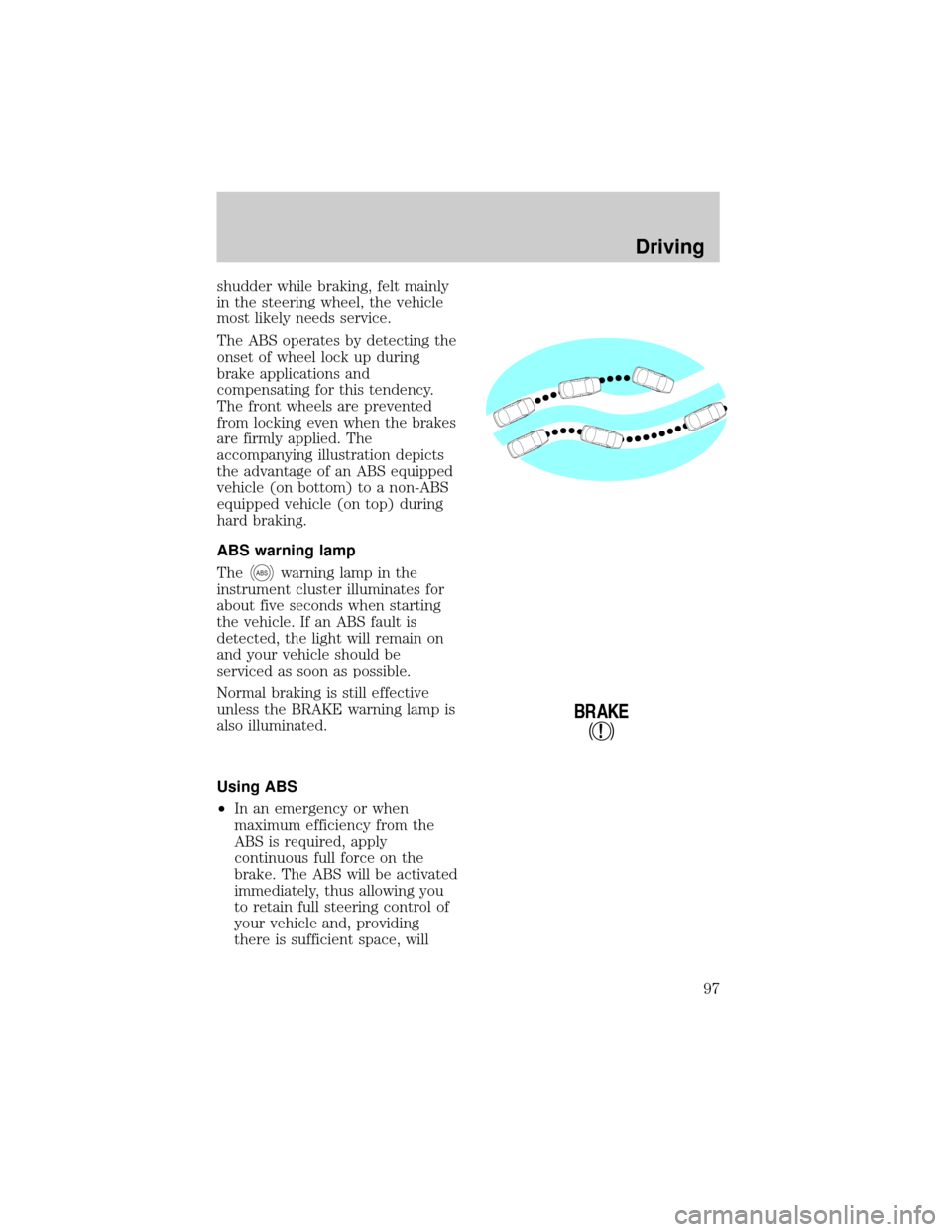
The ABS operates by detecting the
onset of wheel lock up during
brake applications and
compensating for this tendency.
The front wheels are prevented
from locking even when the brakes
are firmly applied. The
accompanying illustration depicts
the advantage of an ABS equipped
vehicle (on bottom) to a non-ABS
equipped vehicle (on top) during
hard braking.
ABS warning lamp
The
ABSwarning lamp in the
instrument cluster illuminates for
about five seconds when starting
the vehicle. If an ABS fault is
detected, the light will remain on
and your vehicle should be
serviced as soon as possible.
Normal braking is still effective
unless the BRAKE warning lamp is
also illuminated.
Using ABS
²In an emergency or when
maximum efficiency from the
ABS is required, apply
continuous full force on the
brake. The ABS will be activated
immediately, thus allowing you
to retain full steering control of
your vehicle and, providing
there is sufficient space, will
!
BRAKE
Driving
97
Page 103 of 188
is possible that a fuse has blown
and the vehicle's brakelamps may
not be operating properly. Refer to
Fuses and relaysin theRoadside
emergencieschapter.
Do not drive your vehicle
until you verify that the
brakelamps are working.
If your vehicle gets stuck in mud
or snow it may be rocked out by
shifting from forward and reverse
gears in a steady pattern. Press
lightly on the accelerator in each
gear.
Do not rock the vehicle for
more than a few minutes. The
transmission and tires may be
damaged or the engine may
overheat.
Always set the parking
brake fully and make sure
the gearshift is latched in P
(Park). Turn off the ignition
whenever you leave your vehicle.
Driving with a 4±speed
automatic transmission
Understanding gearshift
positions
Pull the gearshift lever towards
you and downward to move the
automatic gearshift.
Driving
104
Page 104 of 188
Hold the brake pedal down
while you move the
gearshift lever from position to
position. If you do not hold the
brake pedal down, your vehicle
may move unexpectedly and
injure someone.
P (Park)
Always come to a complete stop
before shifting into P (Park). Make
sure the gearshift is securely
latched in P (Park).
R (Reverse)
With the gearshift in R (Reverse),
the vehicle will move backward.
Always come to a complete stop
before shifting into and out of R
(Reverse).
N (Neutral)
With the gearshift in N (Neutral),
the vehicle can be started and is
free to roll. Hold the brake pedal
down while in this gear.
(Overdrive)
The normal driving position for the
best fuel economy. Transmission
operates in gears one through four.
(Overdrive) can be deactivated
by pressing the transmission
control switch on the end of the
gearshift lever.
The transmission control indicator
light (TCIL) will illuminate in the
instrument cluster.
O/D
ON/OFF
Driving
105