Page 94 of 188
Have the exhaust and body
ventilation systems checked
whenever:
²the vehicle is raised for service.
²the sound of the exhaust system
changes.
²the vehicle has been damaged in
a collision.
Important ventilating
information
If the engine is idling while the
vehicle is stopped in an open area
for long periods of time, open the
windows at least 2.5 cm (one
inch).
Adjust the heating or air
conditioning (if equipped) to bring
in fresh air.
Improve vehicle ventilation by
keeping all air inlet vents clear of
snow, leaves and other debris.
Starting
95
Page 101 of 188
left for more than a few seconds
when the engine is running. This
action could damage the power
steering pump.
Speed sensitive steering
The steering in your vehicle is
speed sensitive. At high speeds,
steering assist will decrease to
improve steering feel. At lower
speeds, maneuverability will be
increased.
If the amount of effort required to
steer your vehicle changes at a
constant vehicle speed, have the
power steering system checked by
your dealer or a qualified service
technician.
AIR SUSPENSION SYSTEM
The air suspension system is
designed to improve ride, handling
and general vehicle performance
during:
²certain road conditions
²steering maneuvers
²braking
²accelerations
This system keeps the rear of your
vehicle at a constant level by
automatically adding air or
releasing air from the springs.
Driving
102
Page 110 of 188

²Anticipate stops and brake
gradually.
Servicing after towing
If you tow a trailer for long
distances, your vehicle will require
more frequent service intervals.
Refer to the Severe Duty Schedule
in your ªService Guideº for more
information.
Trailer towing tips
²Practice turning, stopping and
backing up in an area before
starting on a trip to get the feel
of the vehicle trailer
combination. When turning,
make wider turns so the trailer
wheels will clear curbs and
other obstacles.
²Allow more distance for
stopping with a trailer attached.
²The trailer tongue weight should
be 10±15% of the loaded trailer
weight.
²After you have traveled 80 km
(50 miles), thoroughly check
your hitch, electrical
connections and trailer wheel
lug nuts.
²When stopped in traffic for long
periods of time in hot weather,
place the gearshift in P (Park)
and increase idle speed. This
aids engine cooling and air
conditioner efficiency.
²Vehicles with trailers should not
be parked on a grade. If you
Driving
111
Page 111 of 188

must park on a grade, place
wheel chocks under the trailer's
wheels.
Launching or retrieving a boat
When backing down a ramp during
boat launching or retrieval,
²Do not allow the static water
level to rise above the bottom
edge of the rear bumper and
²Do not allow waves to break
higher than 15 cm (six inches)
above the bottom edge of the
rear bumper.
Exceeding these limits may allow
water to enter critical vehicle
components, adversely affecting
driveability, emissions and
reliability.
If the rear axle is submerged in
water, the rear axle lubricant
should be checked and changed, if
necessary. The rear axle is filled
with a synthetic lubricant and does
not normally require a lubricant
change for the life of the vehicle.
Rear axle lubricant quantities
should not need to be checked
unless a leak is suspected.
DRIVING THROUGH WATER
Do not drive quickly through
standing water, especially if the
depth is unknown. Traction or
brake capability may be limited
and if the ignition system gets wet,
your engine may stall. Water may
also enter your engine's air intake
and severely damage your engine.
Driving
112
Page 113 of 188
HAZARD FLASHER
Use only in an emergency to warn
traffic of vehicle breakdown,
approaching danger, etc. The
hazard flashers can be operated
when the ignition is off.
²Slide the hazard flasher control
to the right to activate the
hazard flashers simultaneously.
²Slide the control to the left to
turn the flashers off.
FUEL PUMP SHUT-OFF SWITCH
If the engine cranks but does not
start after a collision, the fuel
pump shut-off switch may have
been activated. The shut-off switch
is a device intended to stop the
electric fuel pump when your
vehicle has been involved in a
substantial jolt.
1. Turn the ignition switch to the
OFF position.
2. Check the fuel system for leaks.
3. If no fuel leak is apparent, reset
the fuel pump shut-off switch by
pushing in the button on the
switch.
4. Turn the ignition switch to the
ON position. Pause for a few
seconds and return the key to the
OFF position.
5. Make a further check for leaks
in the fuel system.
Roadside emergencies
114
Page 126 of 188
4. Check all battery terminals and
remove any excessive corrosion
before you attach the battery
cables.
5. Turn the heater fan on in both
vehicles to protect any electrical
surges. Turn all other accessories
off.
Connecting the jumper cables
1. Position the vehicles so that
they do not touch one another.
2. Switch off the engine. Switch off
any unnecessary electrical
equipment.
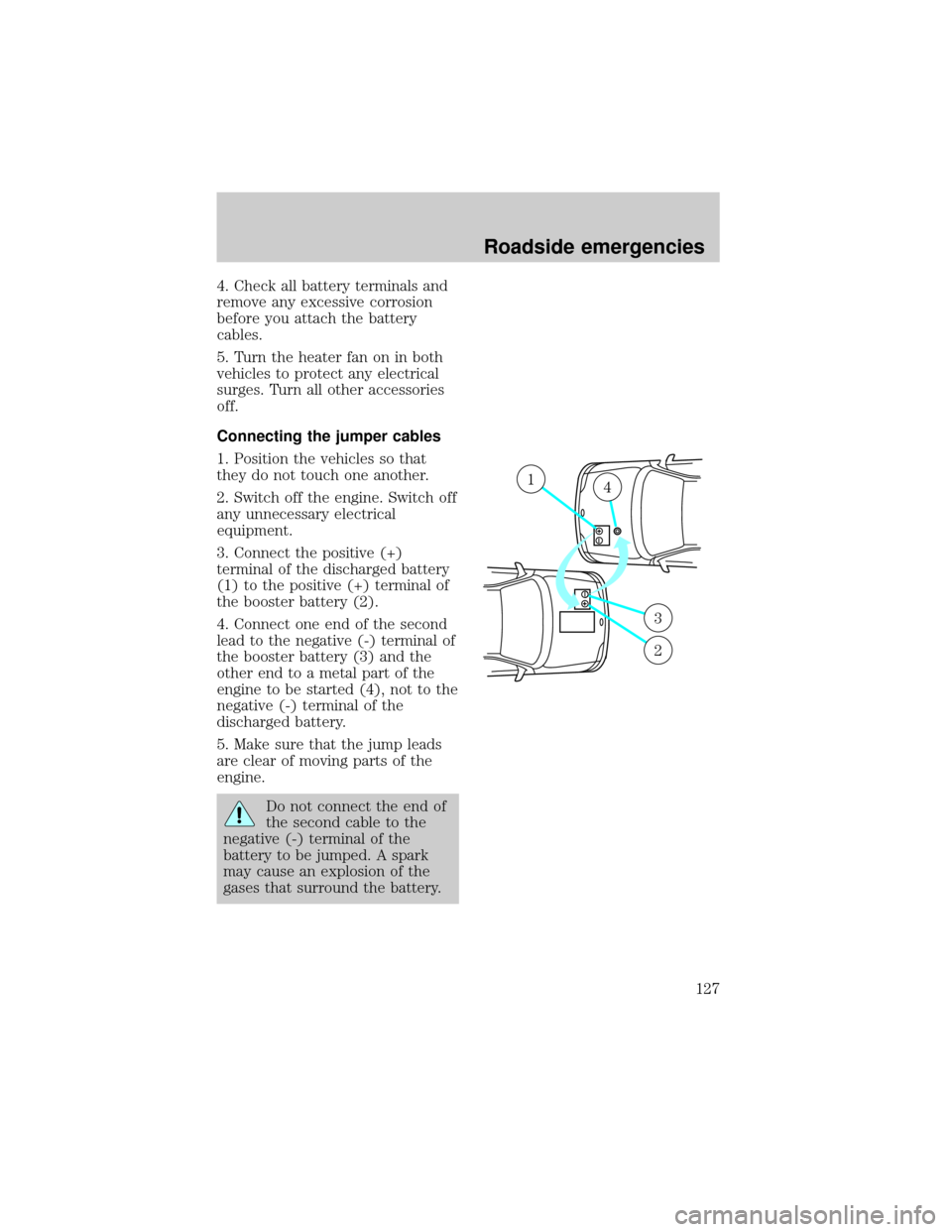
3. Connect the positive (+)
terminal of the discharged battery
(1) to the positive (+) terminal of
the booster battery (2).
4. Connect one end of the second
lead to the negative (-) terminal of
the booster battery (3) and the
other end to a metal part of the
engine to be started (4), not to the
negative (-) terminal of the
discharged battery.
5. Make sure that the jump leads
are clear of moving parts of the
engine.
Do not connect the end of
the second cable to the
negative (-) terminal of the
battery to be jumped. A spark
may cause an explosion of the
gases that surround the battery.
+–
+–
14
3
2
Roadside emergencies
127
Page 130 of 188

SERVICE RECOMMENDATIONS
To help you service your vehicle:
²We highlight do-it-yourself items
in the engine compartment for
easy location.
²We provide a ªService Guideº
which makes tracking routine
service easy.
If your vehicle requires
professional service, your
dealership can provide necessary
parts and service. Check your
ªWarranty Guideº to find out which
parts and services are covered.
Use only recommended fuels,
lubricants, fluids and service parts
conforming to specifications.
Motorcraft parts are designed and
built to provide the best
performance in your vehicle.
PRECAUTIONS WHEN
SERVICING YOUR VEHICLE
Be especially careful when
inspecting or servicing your
vehicle.
²Do not work on a hot engine.
The cooling fan is
automatic and may come
on at any time. Always
disconnect the negative terminal
of the battery before working
near the fan.
²When the engine is running,
avoid wearing loose clothing,
jewelry or long hair that could
get caught up in moving parts.
Maintenance and care
131
Page 134 of 188
ENGINE OIL
Checking the engine oil
Check the engine oil each time you
fuel your vehicle.
1. Make sure the vehicle is on level
ground.
2. Turn the engine off and wait a
few minutes for the oil to drain
into the oil pan.
3. Set the parking brake and
ensure the gearshift is securely
latched in P (Park).
4. Open the hood. Protect yourself
from engine heat.
5. Locate and carefully remove the
engine oil level indicator
(dipstick).
6. Wipe the indicator clean. Insert
the indicator fully, then remove it
again.
MAX MIN
Maintenance and care
135