Page 135 of 188
²If the oil level isbetween the
MIN and MAX marks, the oil
level is acceptable.DO NOT
ADD OIL.
²If the oil level is below the MIN
mark, add enough oil to raise
the level within the MIN-MAX
range.
²Oil levels above the MAX mark
may cause engine damage. Some
oil must be removed from the
engine by a service technician.
7. Put the indicator back in and
ensure it is fully seated.
Adding engine oil
1. Check the engine oil. For
instructions, refer toChecking the
engine oilin this chapter.
2. If the fluid level is not within
the normal range, add only
certified engine oil of the preferred
viscosity. Add engine oil through
the oil filler cap. Remove the filler
cap and use a funnel to pour oil in
the opening.
3. Recheck the oil level. Make sure
the oil level is not above the MAX
mark on the dipstick.
Maintenance and care
136
Page 137 of 188
Ford production and aftermarket
(Motorcraft) oil filters are designed
for added engine protection and
long life. If a replacement oil filter
is used that does not meet Ford
material and design specifications,
startup engine noises or knock
may be experienced.
It is recommended you use the
appropriate Motorcraft oil filter (or
another brand meeting Ford
specifications) for your engine
application.
BRAKE FLUID
Checking and adding brake
fluid
Brake fluid should be checked and
refilled as needed at least once
each year:
1. Clean the reservoir cap before
removal to prevent dirt or water
from entering the reservoir.
2. Visually inspect the fluid level.
3. If necessary, add brake fluid
until the level reaches MAX. Do
not fill above this line.
4. Use only a DOT 3 brake fluid
certified to meet Ford
specifications. Refer toLubricant
specificationsin theCapacities
and specificationschapter.
MAX
MIN
Maintenance and care
138
Page 138 of 188
Brake fluid is toxic.
If you use a brake fluid
that is not DOT 3, you will
cause permanent damage to your
brakes.
Do not let the reservoir for
the master cylinder run
dry. This may cause the brakes
to fail.
CHECKING AND ADDING
WASHER FLUID
Check the washer fluid whenever
you stop for fuel.
If the level is low, add enough fluid
to fill the reservoir. In very cold
weather, do not fill the reservoir all
the way.
Do not put engine coolant
in the container for the
windshield washer fluid.
Maintenance and care
139
Page 139 of 188
ENGINE COOLANT
Check the level of the coolant in
the reservoir at least once a
month. Be sure to read and
understandPrecautions when
servicing your vehiclein this
chapter.
If the engine coolant has not been
checked for a long period of time,
the engine coolant reservoir may
eventually empty. If this occurs,
add engine coolant to the coolant
reservoir. For more information on
engine coolant maintenance, refer
toAdding engine coolantin this
chapter.
Automotive fluids are not
interchangeable; do not use engine
coolant, antifreeze or windshield
washer fluid outside of its specified
function and vehicle location.
Adding engine coolant
Do not put engine coolant
in the container for the
windshield washer fluid.
If sprayed on the windshield,
engine coolant could make it
difficult to see through the
windshield.
When the engine is cool, add a
50/50 mixture of engine coolant
and water to the engine coolant
Maintenance and care
140
Page 140 of 188
recovery reservoir-DO NOT ADD
DIRECTLY TO THE RADIATOR.
Add straight water only in an
emergency, but you should replace
it with a 50/50 mixture of coolant
and distilled water as soon as
possible.
Check the coolant level in the
coolant recovery reservoir the next
few times you drive the vehicle. If
necessary, add enough of a 50/50
mixture of coolant and water to
bring the liquid level to the fill line
on the reservoir.
Never remove the coolant
recovery cap while the
engine is running or hot.
If you must remove the coolant
recovery cap, follow these steps to
avoid personal injury:
1. Before you remove the cap, turn
the engine off and let it cool.
2. When the engine is cool, wrap a
thick cloth around the cap. Slowly
turn cap counterclockwise until
pressure begins to release.
3. Step back while the pressure
releases.
4. When you are sure that all the
pressure has been released, use
the cloth to turn it
counterclockwise and remove the
cap.
Use Ford Premium Cooling System
Fluid E2FZ-19549±AA (in Canada,
Motorcraft CXC-8±B) or an
equivalent premium engine coolant
Maintenance and care
141
Page 142 of 188

refer toRefill capacitiesin the
Capacities and specifications
chapter.
Have your dealer check the engine
cooling system for leaks if you
have to add more than a liter
(quart) of engine coolant per
month.
Severe winter climate
If you drive in extremely cold
climates (less than ±36ÉC [±34ÉF]),
it may be necessary to increase the
coolant concentration above 50%.
Refer to the chart on the coolant
container to ensure the coolant
concentration in your vehicle is
such that the coolant will not
freeze at the temperature level in
which you drive during winter
months. Never increase the engine
coolant concentration above 60%.
Leave a 50/50 mixture of engine
coolant and water in your vehicle
year-round in non-extreme
climates.
What you should know about
fail-safe cooling
If the engine coolant supply is
depleted, this feature allows the
vehicle to be driven temporarily
before incremental component
damage is incurred. The ªfail safeº
distance depends on ambient
temperatures, vehicle load and
terrain.
Maintenance and care
143
Page 144 of 188
²Immediately turn the engine off
to prevent severe engine
damage.
²Wait for the engine to cool.
²Check the coolant level.
CHECKING AND ADDING
POWER STEERING FLUID
Check the power steering fluid at
least twice a year. If adding fluid is
necessary, use only MERCONt
ATF power steering fluid.
1. Start the engine and let it run
until it reaches normal operating
temperature (the engine coolant
temperature gauge will be near the
center of the NORMAL band).
2. While the engine idles, turn the
steering wheel left and right
several times.
3. Turn the engine off.
4. Check the fluid level in the
reservoir. It should be between the
MIN and MAX lines. Do not add
fluid if the level is in this range.
Maintenance and care
145
Page 146 of 188
notice some sign of fluid leakage.
Transmission fluid should be
checked at normal operating
temperatures 66ÉC-77ÉC
(150ÉF-170ÉF) on a level surface.
The normal operating temperature
can be reached after approximately
32 km (20 miles) of driving.
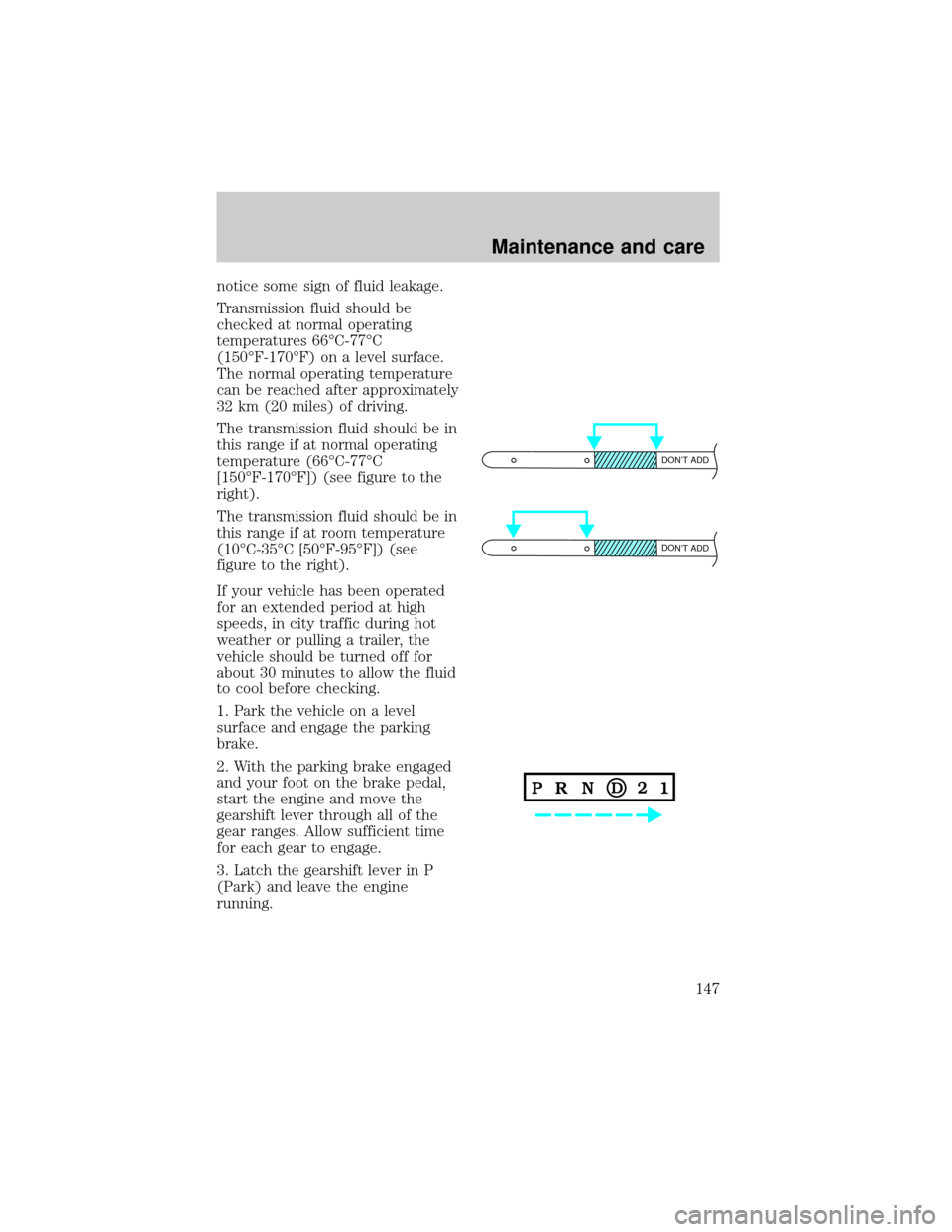
The transmission fluid should be in
this range if at normal operating
temperature (66ÉC-77ÉC
[150ÉF-170ÉF]) (see figure to the
right).
The transmission fluid should be in
this range if at room temperature
(10ÉC-35ÉC [50ÉF-95ÉF]) (see
figure to the right).
If your vehicle has been operated
for an extended period at high
speeds, in city traffic during hot
weather or pulling a trailer, the
vehicle should be turned off for
about 30 minutes to allow the fluid
to cool before checking.
1. Park the vehicle on a level
surface and engage the parking
brake.
2. With the parking brake engaged
and your foot on the brake pedal,
start the engine and move the
gearshift lever through all of the
gear ranges. Allow sufficient time
for each gear to engage.
3. Latch the gearshift lever in P
(Park) and leave the engine
running.
DON’T ADD
DON’T ADD
Maintenance and care
147


