1998 JAGUAR X308 egr
[x] Cancel search: egrPage 278 of 2490
Vehicle Dynamic Suspension - Vehicle Dynamic Suspension
Diagn
osis and Testing
Refer to the PDU User Guide for details of diagnosing and testing the Adaptive Damping System. The PDU interrogates the
ADCM directly via the K and L lines to the J1962 diagnostic socket.
The PDU will give an indication of the integrity of each electron ic and electrical component. It will indicate, for example, that
the accelerometers are not broken, but not that they functionin g correctly when the vehicle is in motion. However, it is
exceptional for an accelero meter to function incorrectly in its dynamic mode if it is proved to be functioning when static.
Basic Checks
The accele
rometers have the following ch
aracteristics. At 0g (no movement of the body) each vertical accelerometer
outputs approximately 2.5V steady voltage; the lateral acce lerometer outputs approximately 1.5V. The voltage output due
to body movement is proportional to acceleration in the acceleration axis, up to approximately 4.5V and down to
approximately 0.5V.
Before changing any component, refer to the circuit diagrams and check the cont inuity of relevant harness circuits; in some
instances, the PDU will not different iate between a faulty component an d a damaged connection or wiring.
Check the following fuses:
En
gine compartment fuse
box, fuse F5 (10A).
Engine m
anagement fuse
box, fuse F1 (20A).
Check the following ADCM input/output lines:
Sy stem erro
r output from the ADCM
to the instrument cluster.
Vehicl
e speed output from the inst
rument cluster to the ADCM.
Foo
tbrake signal to the ADCM.
Check any relevant connections to confirm that the connection is electrically sound and that a terminal pin has not been
pushed back into the connector shell, ie. not ma king a connection to its mating pin or socket.
Page 285 of 2490

R
ear Drive Axle/Differential - Rear Drive Axle and Differential
Description an
d Operation
Loca
tion
The differential
unit
is mounted between the wide mount ing bracket, pendulum assembly and the wishbone tie assembly.
Two tie rods are fitted between top rear of the final dr ive casing and the front of the wide mounting bracket.
Parts List
Description
The
type 14 HU final drive assembly is a hypoid unit with th
e pinion arranged on the cross-car centerline. The driveshaft
coupling utilizes a cassette type pinion oil seal, which is an in tegral part of the pinion flange. This type of seal cannot be
separated from the pinion fl ange and therefore may only be renewed as a complete seal / flange assembly
The axle shafts are driven by the output flanges which rotate on sealed bearings , these assemblies being retained in the
final drive unit by circlips.
Pinion Drive Flange / Seal Detail
• NOTE: The component parts are shown in an exploded view for clarity, this is NOT the fitted condition
It
em
Par
t Number
De
scription
1—F
inal Drive Unit
2—W
ide Mounting Bracket
3—Pen
dulum Assembly
4—Wi
shbone Tie Assembly
5—'A'
Frame
Page 431 of 2490
The brake
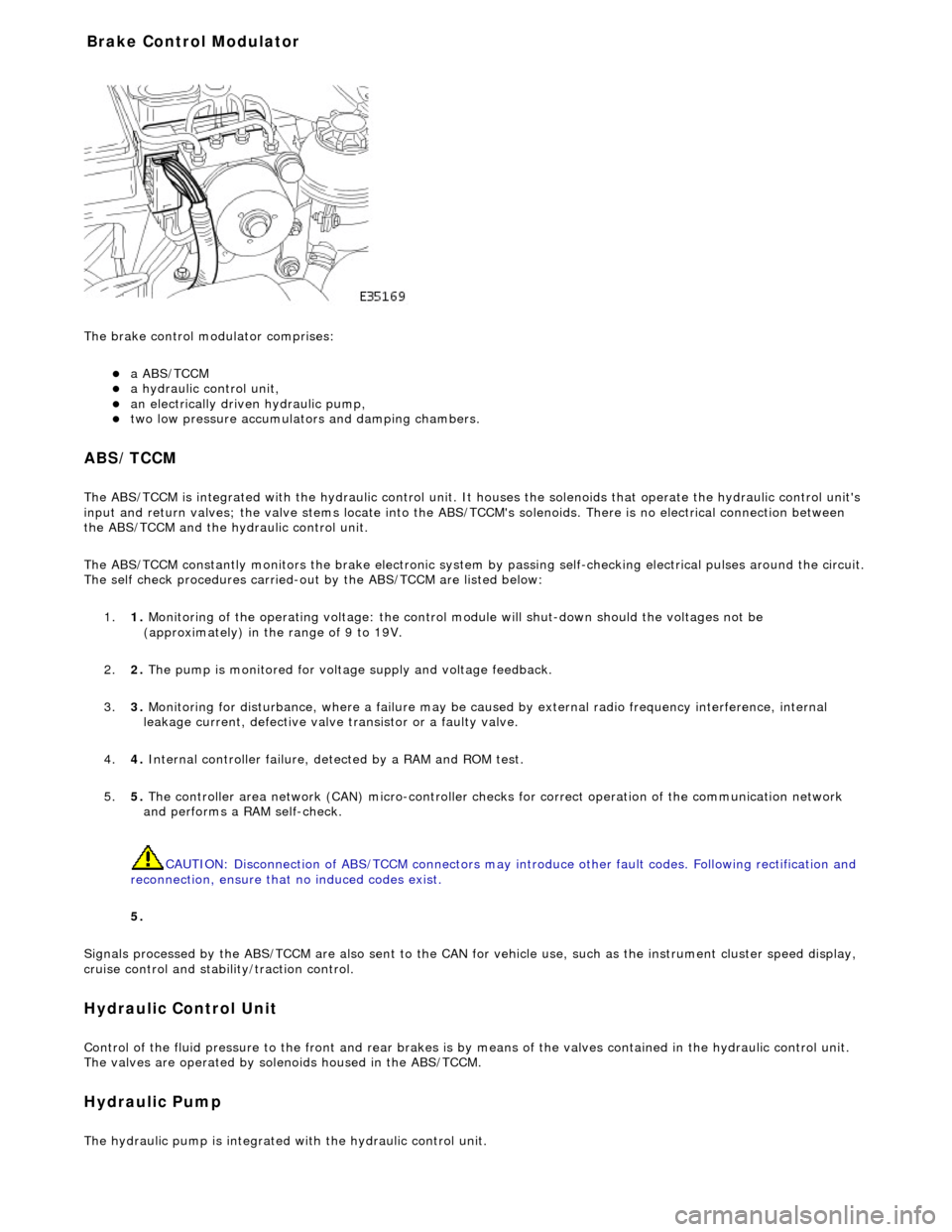
control modulator comprises:
a A
BS/TCCM
a h
ydraulic control unit,
an electrically driven hydrau
lic pump,
two low pressure accumulato
rs and damping chambers.
ABS/TCCM
The AB
S/TCCM is integrated with the hydrau
lic control unit. It houses the solenoids that operate the hydraulic control unit's
input and return valves; the valve stems locate into the ABS/TCCM's solenoids. There is no electrical connection between
the ABS/TCCM and the hydraulic control unit.
The ABS/TCCM constantly monitors the brake electronic system by passing self-checking electrical pulses around the circuit.
The self check procedures carried-out by the ABS/TCCM are listed below:
1. 1. Monitoring of the operating voltage: the control mo dule will shut-down should the voltages not be
(approximately) in the range of 9 to 19V.
2. 2. The pump is monitored for volt age supply and voltage feedback.
3. 3. Monitoring for disturbance, where a failure may be caus ed by external radio frequency interference, internal
leakage current, defective valve transistor or a faulty valve.
4. 4. Internal controller failure, de tected by a RAM and ROM test.
5. 5. The controller area network (CAN) micr o-controller checks for correct operation of the communication network
and performs a RAM self-check.
CAUTION: Disconnection of ABS/TCCM connectors may introduce other fault codes. Following rectification and
reconnection, ensure that no induced codes exist.
5.
Signals processed by the ABS/TCCM are also sent to the CAN for vehicle use, such as the instrument cluster speed display,
cruise control and stability/traction control.
Hydraulic Control Unit
Control of
the fluid pressure to
the front and rear brakes is by means of the valves contained in the hydraulic control unit.
The valves are operated by solenoids housed in the ABS/TCCM.
Hydraulic Pump
The
hydraulic pump is integrated
with the hydraulic control unit.
Bra
ke Control Modulator
Page 439 of 2490

Spin
the wheel by hand and check the meter display.
3
Doe
s the sensor generate a voltage?
Yes GO to E2
.
No
If the WSS ring is in good condition, install a new WSS.
REFER to: Rear Wheel Speed Sensor
(20
6-09 Anti-Lock Control, Removal and Installation).
E2
: CHECK THE WSS SIGNAL CIRCUIT CONTINUITY
Make sure the ignition is off. 1
Di
sconnect the ABS module connector, LF27.
2
Meas
ure the resistance between LF27
, pin 21 (U) and LA02, pin 01 (U).
3
I
s the resistance less than 5 ohms?
Yes GO to E3
.
No
Repair the high resistance circui t. This circuit includes intermediate connector, LA02. Refer to the
electrical guides. Clear the DTC, check for normal operation.
E3
: CHECK THE WSS RETURN CIRCUIT CONTINUITY
Meas
ure the resistance between LF27
, pin 22 (U) and LA02, pin 02 (U).
1
I
s the resistance less than 5 ohms?
Yes The WSS and circuits are OK. Check for DTCs indicating a possible module failure.
No Repair the high resistance circui t. This circuit includes intermediate connector, CA29. Refer to the
electrical guides. Clear the DTC, check for normal operation.
P
INPOINT TEST F : CONT
ROLLER AREA NETWORK (CAN) INTEGRITY TEST
TE
ST
CONDITIONS
D
ETAILS/RESULTS/ACTIONS
F
1: CHECK THE NETWORK INTEGRITY
FROM THE DIAGNOSTIC SOCKET
M
easure the resistance between pins 06 (Y) and 14 (G) of the diagnostic socket.
1
I
s the resistance 60 ohms?
Yes The CAN system is OK. Check for DTCs indicating a fault elsewhere.
No Check the CAN system for open an d short circuits. Refer to the electrical guides. Clear the DTC,
check for normal operation.
Page 480 of 2490

The steering rack assembly :
Is mounted on the
rear face of the
front suspension crossbeam by two forg ed mounting brackets with resilient
bushes. The bushes are handed (pinion side and non-pinion side) and are orientated according to the vehicle range
application.
Convert s
the rotary motion of the steering wheel, via the steering gear pinion, to the lateral motion of the rack.
F
e
atures a variable ratio steering
rack with integral hydraulic po wer steering cylinder and piston.
Has a hydrauli
c control valve with Servotronic co
ntrol and positive center feel torsion bar.
The basic steering rack assembly is not serviceable. The following components are serviceable items:
Transfer pipework
.
Servotronic valve. Cent
ralizing cap.
O
u
ter ball joint.
Rac
k
gaiter.
Clips and
fittings.
Steering Rack Components
It e
m
Par
t
Number
De
scr
iption
1—Front
su
spension crossbeam
2—Steeri
ng rack housi
ng
3—Hydraulic
control valve housing
4—Moun
ting bracke
t
5—Gait
er
6—Tie
rod
7—O
u
ter ball joint
Steering R
a
ck Assembly
Page 483 of 2490

P
arts List
The positive center-feel torsion bar improves the straight ahead feel of the steering in the region where very small amounts
of hydraulic pressure, and hence re action pressure, are generated.
The torsion bar assembly forms part of the hydraulic control valve assembly , and includes an axially pre-loaded metal
bellows spring, which is arranged co-axially with the torsion bar. The torsion bar is positively connected between the end
piece and the input shaft. One end of the bellows spring is attached to the input shaft, while the other end is attached to a
centering device. The centering device has two prism-shaped recesses with ca ged, guided, ball bearings arranged between
the recesses, and determines the zero-torsion position of the bellows spring.
On turning the steering wheel from the straight ahead position, the spring fo rces of the torsion bar assembly must be
overcome. Initially, the bellows spring produces substantial additional torsional resistance. However, after an angular
movement of approximately 0.2 degrees the torsional rigidity decreases and becomes similar to a conventional torsion bar.
It
em
Par
t Number
De
scription
1—End piece
2—Torsio
n bar
3—Caged ball bearing
s
4—Centering device
5—Bel
lows spring
6—In
put shaft
Positive Center-Feel Torsion Bar
Torsio
n Bar Components
Page 485 of 2490

The fluid reservo
ir:
Is lo
cated in the engine compartment, mounted on the engine compartment fuse box bracket.
Incorporates
a 10 micron, li
fetime, integral filter.
Has a cap
acity of 0.4 liter.
Has a dipsti
ck incorporated into the filler cap for checking the fluid level.
A new reservoir must be fitted if the steering rack, pump or fluid cooler are renewed.
Fluid C
ooler
P
arts List
The fluid cooler:
Is
resiliently mounted on th
e front body cross member.
Coo
ls the fluid before it is
returned to the reservoir.
Is
of the wire-bound tube type.
Has i
ntegral hoses.
Supply and Return Hoses a
nd Pipework
The supply and return h
oses and
pipework deliver fluid at high pressure from the pump to th e steering rack assembly. The
fluid is then returned to th e reservoir through the cooler tube. The high pressure supply hose contains two cable-type
attenuators, one at each end, to reduce nois e. The return pipe is clipped to the steering rack housing by a resilient
mounting.
It
em
Par
t Number
De
scription
1—Fl
uid reservoir
2—Supply line
3—R
eturn line
4—Fi
ller cap
It
em
Par
t Number
De
scription
1—Front body cross member
2—F
luid cooler
3—Inte
gral hoses
4—Cooler m
ounting
P
arts List
Page 503 of 2490

Steering
Linkage - Steering Linkage
Descriptio
n and Operation
Parts List
The left- and right-hand tie rod assemblies:
T
ransmit steering forces from the steering rack to the st
eering arms which are integral with the vertical links.
Comprise the tie rod, inner
ball joint,
outer tie rod end and outer ball joint.
P
rovide front road wheel toe setting by adju
stment of the threaded outer tie rod ends.
• NOTE: Steering geometry adjustments must only be carried out wi th the vehicle on turn plates to allow the wheels to move
during adjustment.
The left- and right-hand steering rack gaiters:
Are
installed between the steering rack and the tie bars.
Are
of the concertina type.
R
etain lubricant and prevent th
e ingress of foreign matter.
P
ermit movement of the steering rack and tie rods.
ItemPa
rt Number
Descript
ion
1—St
eering rack assembly
2—St
eering rack gaiter
3—I
nner ball joint
4—Tie
rod
5—O
uter tie rod end
6—Lo
ck-nut
7—Oute
r ball joint
8—O
uter ball joint nut