1998 ISUZU TROOPER engine
[x] Cancel search: enginePage 890 of 3573
5C – 12 POWER ASSISTED BRAKE SYSTEM
27. Depress the brake pedal to check if you feel
“sponginess” after the air has been removed from
all wheel cylinders and calipers. If the pedal feels
“spongy”, the entire bleeding procedure must be
repeated.
28. After the bleeding operation is completed on each
individual wheel, check the level of brake fluid in
the reservoir and replenish up to the “MAX” level if
necessary.
29. Attach the reservoir cap.
•If the diaphragm inside the cap is deformed,
reform it and install.
30. Stop the engine.
FLUSHING BRAKE HYDRAULIC SYSTEM
It is recommended that the entire hydraulic system be
thoroughly flushed with clean brake fluid whenever
new parts are installed in the hydraluic system.
Approximately one quart of fluid is required to flush
the hydraulic system.
The system must be flushed if there is any doubt as to
the grade of fluid in the system or if fluid has been
used which contains the slightest trace of mineral oil.
All rubber parts that have been subjected to a
contaminated fluid must be replaced.
BRAKE PIPES AND HOSES
The hydraulic brake system components are
interconnected by special steel piping and flexible
hoses. Flexible hoses are used between the frame and
the front calipers, the frame and rear axle case and the
rear axle and the rear calipers.
When the hydraulic pipes have been disconnected for
any reason, the brake system must be bled after
reconnecting the pipe; refer to “Bleeding Brake
Hydraulic System” in this section.
BRAKE HOSE INSPECTION
The brake hoses should be inspected at least twice a
year. The brake hose assembly should be checked for
road hazard, cracks and chafing of the outer cover,
and for leaks and blisters. Inspect for proper routing
and mounting of the hose. A brake hose that rubs on
suspension components will wear and eventually fail.
A light and mirror may be needed for an adequate
inspection. If any of the above conditions are
observed on the brake hose, adjust or replace the
hose as necessary.
CAUTION:
Never allow brake components such as calipers to
hang from the brake hoses, as damage to the hoses
may occur.
Page 891 of 3573
POWER ASSISTED BRAKE SYSTEM 5C – 13
CHECKING BRAKE PEDAL HEIGHT
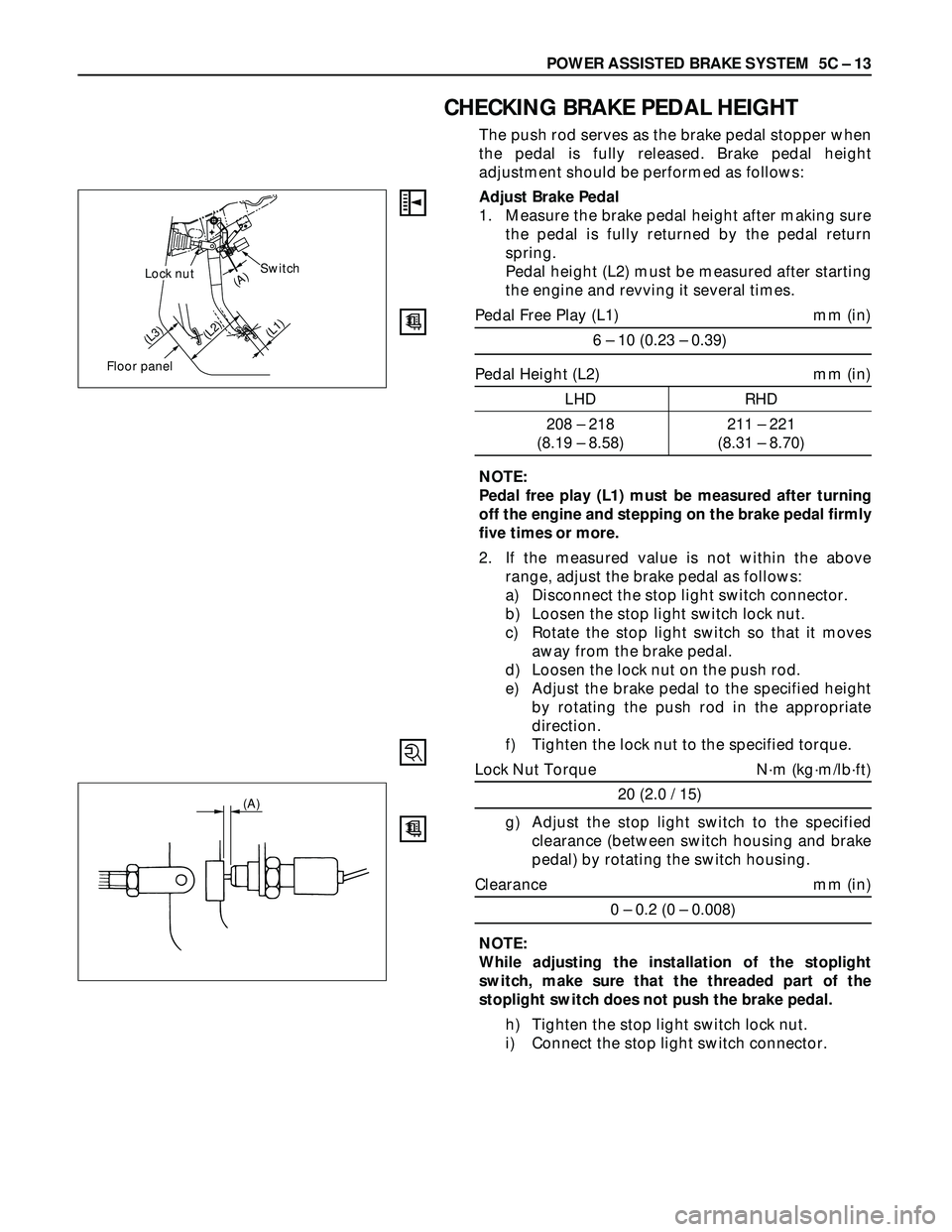
The push rod serves as the brake pedal stopper when
the pedal is fully released. Brake pedal height
adjustment should be performed as follows:
Adjust Brake Pedal
1. Measure the brake pedal height after making sure
the pedal is fully returned by the pedal return
spring.
Pedal height (L2) must be measured after starting
the engine and revving it several times.
Pedal Free Play (L1) mm (in)
6 – 10 (0.23 – 0.39)
Pedal Height (L2) mm (in)
LHD RHD
208 – 218 211 – 221
(8.19 – 8.58) (8.31 – 8.70)
NOTE:
Pedal free play (L1) must be measured after turning
off the engine and stepping on the brake pedal firmly
five times or more.
2. If the measured value is not within the above
range, adjust the brake pedal as follows:
a) Disconnect the stop light switch connector.
b) Loosen the stop light switch lock nut.
c) Rotate the stop light switch so that it moves
away from the brake pedal.
d) Loosen the lock nut on the push rod.
e) Adjust the brake pedal to the specified height
by rotating the push rod in the appropriate
direction.
f) Tighten the lock nut to the specified torque.
Lock Nut Torque N·m (kg·m/lb·ft)
20 (2.0 / 15)
g) Adjust the stop light switch to the specified
clearance (between switch housing and brake
pedal) by rotating the switch housing.
Clearance mm (in)
0 – 0.2 (0 – 0.008)
NOTE:
While adjusting the installation of the stoplight
switch, make sure that the threaded part of the
stoplight switch does not push the brake pedal.
h) Tighten the stop light switch lock nut.
i) Connect the stop light switch connector.
Switch
Floor panel
(L3)
(A)
(L2)(L1)
Lock nut
(A)
Page 892 of 3573
5C – 14 POWER ASSISTED BRAKE SYSTEM
CHECKING BRAKE PEDAL TRAVEL
1. Pedal height (L3) must be measured after starting
the engine and removing it several times to apply
vacuum to the vacuum booster fully.
NOTE:
Pedal height (L3) must be 100 mm (3.9 in)/85 mm (3.5
in) (LHD/RHD) or more when about 50 kg (110.25 lb)
of stepping force is applied.
2. If the measured value is lower than the above
range, air existing in the hydrauic system is
suspected and perform bleeding procedure.
FRONT AND REAR DISC BRAKE PADS
INSPECTION
Check the outer pad by looking at each caliper from
above. Check the thickness on the inner pad by
looking down through the inspection hole in the top of
the caliper. Whenever the pad is worn to about the
thickness of the pad base, the pad should be removed
for further measurements. The pad should be
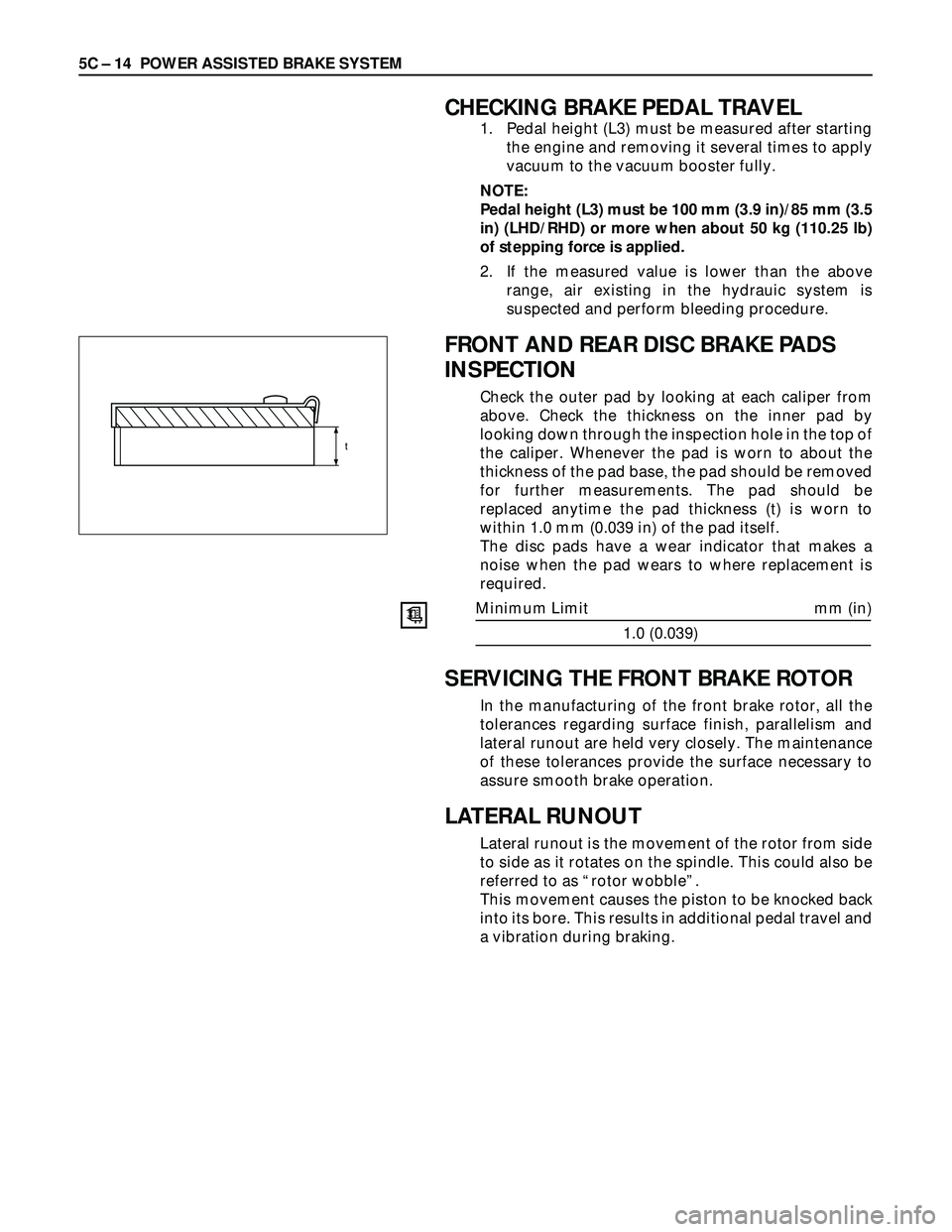
replaced anytime the pad thickness (t) is worn to
within 1.0 mm (0.039 in) of the pad itself.
The disc pads have a wear indicator that makes a
noise when the pad wears to where replacement is
required.
Minimum Limit mm (in)
1.0 (0.039)
SERVICING THE FRONT BRAKE ROTOR
In the manufacturing of the front brake rotor, all the
tolerances regarding surface finish, parallelism and
lateral runout are held very closely. The maintenance
of these tolerances provide the surface necessary to
assure smooth brake operation.
LATERAL RUNOUT
Lateral runout is the movement of the rotor from side
to side as it rotates on the spindle. This could also be
referred to as “rotor wobble”.
This movement causes the piston to be knocked back
into its bore. This results in additional pedal travel and
a vibration during braking.
t
Page 901 of 3573

POWER ASSISTED BRAKE SYSTEM 5C – 23
VACUUM BOOSTER
This booster is a tandem vacuum unit with a diaphragm effective diameter 205 mm + 230 mm (gasoline
engine model) / 180 mm + 205 mm (diesel engine model). In normal operating mode, with the service
brakes in the released position, the tandem vacuum booster operates with vacuum on both sides of its
diaphragms. When the brakes are applied, air at atmospheric pressure is admitted to one side of each
diaphragm to provide the power assist. When the service brake is released, the atmospheric air is shut
off from the one side of each diaphragm. The air is then drawn from the booster through the vacuum
check valve to the vacuum source.
CAUTION:
1) If any hydraulic component is removed or disconnected, it may be necessary to bleed all or part of
the brake system.
2) The torque values specified are for dry, unlubricated fasteners.
3) The vacuum booster is not repairable and must be replaced as complete assembly.
Page 920 of 3573
5C – 42 POWER ASSISTED BRAKE SYSTEM
REMOVAL
•Before removing the vacuum booster assembly,
disconnect and remove brake pipes.
1. Master Cylinder
•Refer to Master Cylinder Assembly in this Section.
CAUTION:
When removing master cylinder from vacuum booster,
be sure to get rid of the internal negative pressure of
the vacuum booster (by, for instance, disconnecting
vacuum hose) in advance.
If any negative pressure remains in the vacuum
booster, the piston may possibly come out when the
master cylinder is being removed, letting the brake
fluid run out.
While removing master cylinder, further, do not hold
the piston as it can be easily pulled out.
Outside surface of the piston is the surface on which
seals are to slide. Care should be taken to keep the
surface free of cuts and dents.
2. Vacuum Hose
3. Yoke Clevis
•Disconnect the yoke clevis from the brake pedal.
4. Vacuum Booster Fixing Nut
5. Vacuum Booster
INSPECTION AND REPAIR
Vacuum Hose
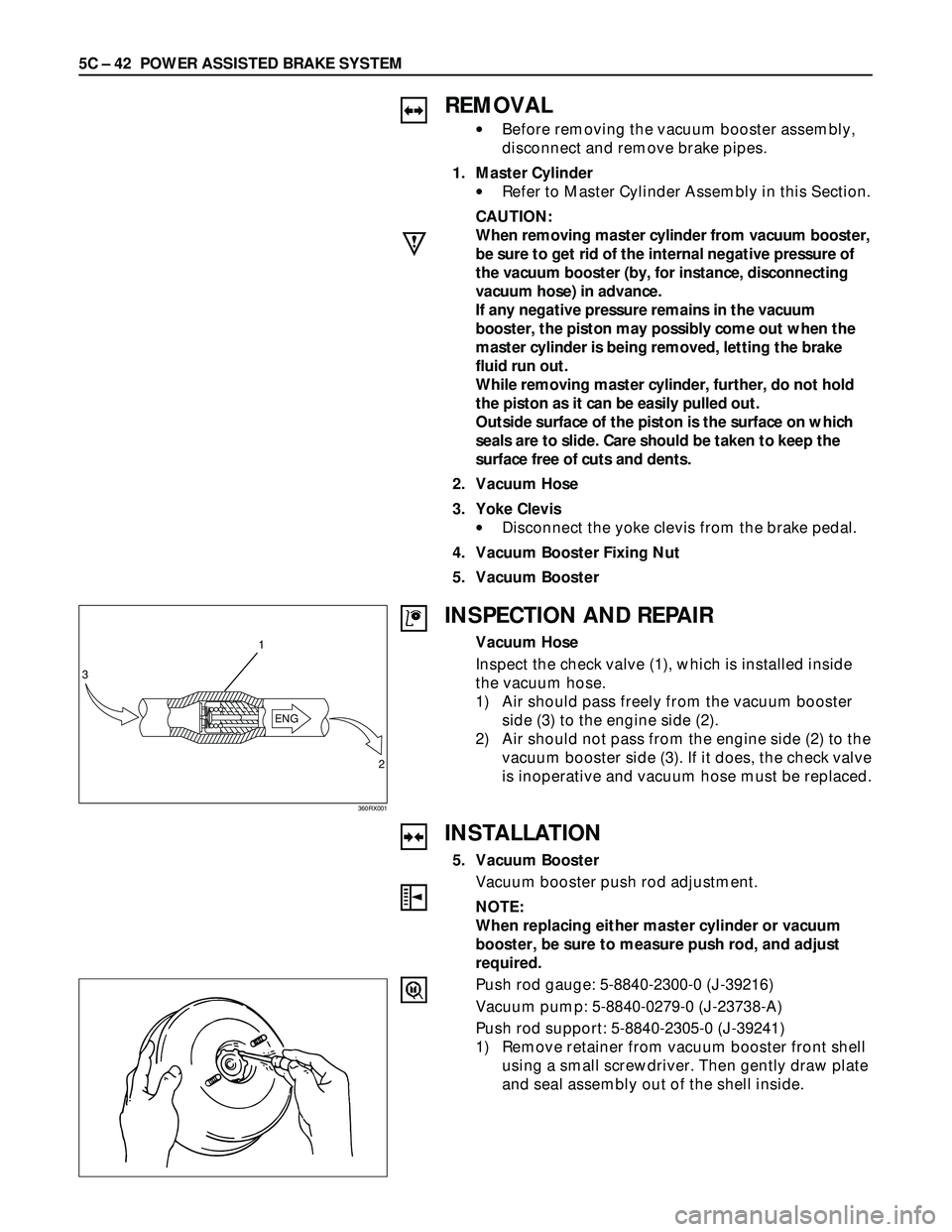
Inspect the check valve (1), which is installed inside
the vacuum hose.
1) Air should pass freely from the vacuum booster
side (3) to the engine side (2).
2) Air should not pass from the engine side (2) to the
vacuum booster side (3). If it does, the check valve
is inoperative and vacuum hose must be replaced.
INSTALLATION
5. Vacuum Booster
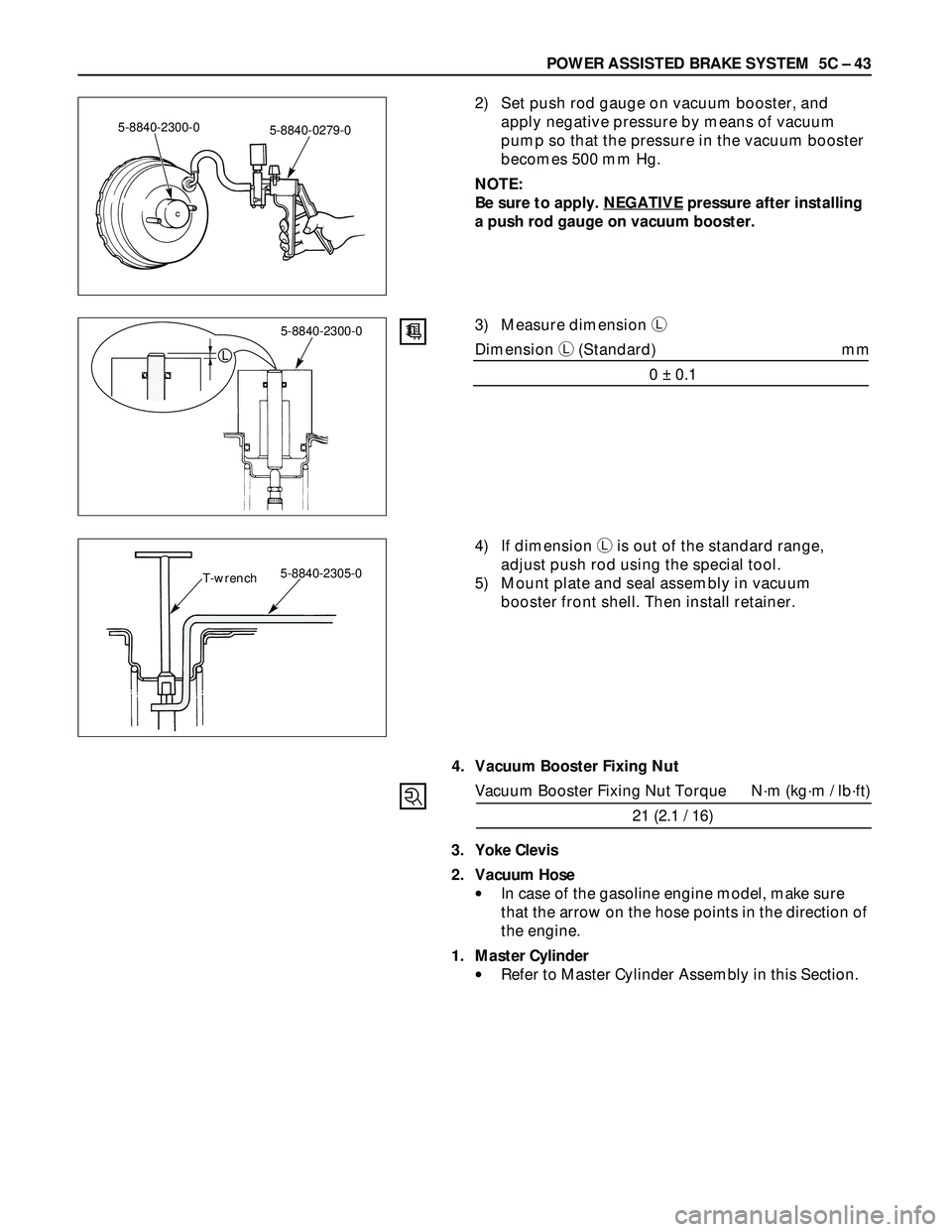
Vacuum booster push rod adjustment.
NOTE:
When replacing either master cylinder or vacuum
booster, be sure to measure push rod, and adjust
required.
Push rod gauge: 5-8840-2300-0 (J-39216)
Vacuum pump: 5-8840-0279-0 (J-23738-A)
Push rod support: 5-8840-2305-0 (J-39241)
1) Remove retainer from vacuum booster front shell
using a small screwdriver. Then gently draw plate
and seal assembly out of the shell inside.
ENG
1
2 3
360RX001
Page 921 of 3573
POWER ASSISTED BRAKE SYSTEM 5C – 43
2) Set push rod gauge on vacuum booster, and
apply negative pressure by means of vacuum
pump so that the pressure in the vacuum booster
becomes 500 mm Hg.
NOTE:
Be sure to apply. NEGATIVE
pressure after installing
a push rod gauge on vacuum booster.
3) Measure dimension L
Dimension L(Standard) mm
0 ± 0.1
5-8840-0279-05-8840-2300-0
L
5-8840-2300-0
4) If dimension Lis out of the standard range,
adjust push rod using the special tool.
5) Mount plate and seal assembly in vacuum
booster front shell. Then install retainer.
4. Vacuum Booster Fixing Nut
Vacuum Booster Fixing Nut Torque N·m (kg·m / lb·ft)
21 (2.1 / 16)
3. Yoke Clevis
2. Vacuum Hose
•In case of the gasoline engine model, make sure
that the arrow on the hose points in the direction of
the engine.
1. Master Cylinder
•Refer to Master Cylinder Assembly in this Section.
5-8840-2305-0 T-wrench
Page 957 of 3573

6A±1
ENGINE MECHANICAL
ENGINE
CONTENTS
Engine Mechanical 6A. . . . . . . . . . . . . . . . . . . . . .
Engine Cooling 6B. . . . . . . . . . . . . . . . . . . . . . . . .
Engine Fuel 6C. . . . . . . . . . . . . . . . . . . . . . . . . . . .
Engine Electrical 6D1. . . . . . . . . . . . . . . . . . . . . . . .
Ignition System 6D2. . . . . . . . . . . . . . . . . . . . . . . . .
Starting and Charging System 6D3. . . . . . . . . . . . Driveability and Emissions 6E. . . . . . . . . . . . . . . .
Engine Exhaust 6F. . . . . . . . . . . . . . . . . . . . . . . . .
Engine Lubrication 6G. . . . . . . . . . . . . . . . . . . . . .
Engine Speed Control System 6H. . . . . . . . . . . .
Inducton 6J. . . . . . . . . . . . . . . . . . . . . . . . . . . . . . .
ENGINE MECHANICAL
CONTENTS
Service Precaution 6A±2. . . . . . . . . . . . . . . . . . . . . .
General Description 6A±3. . . . . . . . . . . . . . . . . . . . .
Engine Diagnosis 6A±4. . . . . . . . . . . . . . . . . . . . . . .
Cylinder Head Cover LH 6A±18. . . . . . . . . . . . . . . . .
Removal 6A±18. . . . . . . . . . . . . . . . . . . . . . . . . . . . .
Installation 6A±19. . . . . . . . . . . . . . . . . . . . . . . . . . . .
Cylinder Head Cover RH 6A±21. . . . . . . . . . . . . . . . .
Removal 6A±21. . . . . . . . . . . . . . . . . . . . . . . . . . . . .
Installation 6A±22. . . . . . . . . . . . . . . . . . . . . . . . . . . .
Common Chamber 6A±24. . . . . . . . . . . . . . . . . . . . . .
Removal 6A±24. . . . . . . . . . . . . . . . . . . . . . . . . . . . .
Installation 6A±24. . . . . . . . . . . . . . . . . . . . . . . . . . . .
Exhaust Manifold LH 6A±26. . . . . . . . . . . . . . . . . . . . .
Removal 6A±26. . . . . . . . . . . . . . . . . . . . . . . . . . . . .
Installation 6A±26. . . . . . . . . . . . . . . . . . . . . . . . . . . .
Exhaust Manifold RH 6A±27. . . . . . . . . . . . . . . . . . . .
Removal 6A±27. . . . . . . . . . . . . . . . . . . . . . . . . . . . .
Installation 6A±27. . . . . . . . . . . . . . . . . . . . . . . . . . . .
Crankshaft Pulley 6A±28. . . . . . . . . . . . . . . . . . . . . . .
Removal 6A±28. . . . . . . . . . . . . . . . . . . . . . . . . . . . .
Installation 6A±28. . . . . . . . . . . . . . . . . . . . . . . . . . . .
Timing Belt 6A±29. . . . . . . . . . . . . . . . . . . . . . . . . . . . .
Removal 6A±29. . . . . . . . . . . . . . . . . . . . . . . . . . . . .
Installation 6A±30. . . . . . . . . . . . . . . . . . . . . . . . . . . .
Camshaft 6A±33. . . . . . . . . . . . . . . . . . . . . . . . . . . . . .
Removal 6A±33. . . . . . . . . . . . . . . . . . . . . . . . . . . . .
Installation 6A±33. . . . . . . . . . . . . . . . . . . . . . . . . . . .
Cylinder Head 6A±37. . . . . . . . . . . . . . . . . . . . . . . . . .
Removal 6A±37. . . . . . . . . . . . . . . . . . . . . . . . . . . . .
Installation 6A±37. . . . . . . . . . . . . . . . . . . . . . . . . . . .
Valve Stem Oil Controller , Valve Spring and
Valve Guide 6A±39. . . . . . . . . . . . . . . . . . . . . . . . . . . .
Removal 6A±39. . . . . . . . . . . . . . . . . . . . . . . . . . . . .
Installation 6A±39. . . . . . . . . . . . . . . . . . . . . . . . . . . .
Piston, Piston Ring and Connecting Rod 6A±40. . . Removal 6A±40. . . . . . . . . . . . . . . . . . . . . . . . . . . . .
Installation 6A±41. . . . . . . . . . . . . . . . . . . . . . . . . . . .
Crankshaft and Main Bearings 6A±42. . . . . . . . . . . .
Removal 6A±42. . . . . . . . . . . . . . . . . . . . . . . . . . . . .
Installation 6A±43. . . . . . . . . . . . . . . . . . . . . . . . . . . .
Rear Oil Seal 6A±47. . . . . . . . . . . . . . . . . . . . . . . . . . .
Removal 6A±47. . . . . . . . . . . . . . . . . . . . . . . . . . . . .
Installation 6A±47. . . . . . . . . . . . . . . . . . . . . . . . . . . .
Engine Assembly 6A±48. . . . . . . . . . . . . . . . . . . . . . . .
Removal 6A±48. . . . . . . . . . . . . . . . . . . . . . . . . . . . .
Installation 6A±48. . . . . . . . . . . . . . . . . . . . . . . . . . . .
Cylinder Head 6A±52. . . . . . . . . . . . . . . . . . . . . . . . . .
Cylinder Head and Associated Parts 6A±52. . . . .
Disassembly 6A±52. . . . . . . . . . . . . . . . . . . . . . . . . .
Clean 6A±53. . . . . . . . . . . . . . . . . . . . . . . . . . . . . . . .
Inspection and Repair 6A±53. . . . . . . . . . . . . . . . . .
Reassembly 6A±53. . . . . . . . . . . . . . . . . . . . . . . . . .
Valve Spring, Oil Controller, Valve,
Valve Guide 6A±56. . . . . . . . . . . . . . . . . . . . . . . . . . . .
Valve Spring, Oil Controller, Valve,
Valve Guide and Associated Parts 6A±56. . . . . . .
Disassembly 6A±56. . . . . . . . . . . . . . . . . . . . . . . . . .
Inspection and Repair 6A±57. . . . . . . . . . . . . . . . . .
Reassembly 6A±60. . . . . . . . . . . . . . . . . . . . . . . . . .
Valve Clearance Adjustments 6A±61. . . . . . . . . . . . .
Camshaft 6A±63. . . . . . . . . . . . . . . . . . . . . . . . . . . . . .
Camshaft and Associated Parts 6A±63. . . . . . . . .
Disassembly 6A±63. . . . . . . . . . . . . . . . . . . . . . . . . .
Inspection and Repair 6A±64. . . . . . . . . . . . . . . . . .
Reassembly 6A±66. . . . . . . . . . . . . . . . . . . . . . . . . .
Crankshaft 6A±69. . . . . . . . . . . . . . . . . . . . . . . . . . . . .
Crankshaft and Associated Parts 6A±69. . . . . . . .
Disassembly 6A±69. . . . . . . . . . . . . . . . . . . . . . . . . .
Inspection and Repair 6A±70. . . . . . . . . . . . . . . . . .
Inspection and Repair 6A±71. . . . . . . . . . . . . . . . . .
Reassembly 6A±73. . . . . . . . . . . . . . . . . . . . . . . . . .
Page 958 of 3573

6A±2
ENGINE MECHANICAL
Piston and Connecting Rod 6A±77. . . . . . . . . . . . . . .
Piston, Connecting Rod and Associate
Parts 6A±77. . . . . . . . . . . . . . . . . . . . . . . . . . . . . . . .
Disassembly 6A±77. . . . . . . . . . . . . . . . . . . . . . . . . .
Inspection and Repair 6A±78. . . . . . . . . . . . . . . . . .
Reassembly 6A±82. . . . . . . . . . . . . . . . . . . . . . . . . .
Cylinder Block 6A±85. . . . . . . . . . . . . . . . . . . . . . . . . .
Cylinder Block and Associated Parts 6A±85. . . . .
Disassembly 6A±85. . . . . . . . . . . . . . . . . . . . . . . . . .
Inspection and Repair 6A±86. . . . . . . . . . . . . . . . . .
Reassembly 6A±87. . . . . . . . . . . . . . . . . . . . . . . . . .
Main Data and Specification 6A±90. . . . . . . . . . . . . .
Special Tool 6A±96. . . . . . . . . . . . . . . . . . . . . . . . . . . .
Service Precaution
WARNING: I F S O E Q U IPPED WITH A
SUPPLEMENTAL RESTRAINT SYSTEM (SRS),
REFER TO THE SRS COMPONENT AND WIRING
LOCATION VIEW IN ORDER TO DETERMINE
WHETHER YOU ARE PERFORMING SERVICE ON OR
NEAR THE SRS COMPONENTS OR THE SRS
WIRING. WHEN YOU ARE PERFORMING SERVICE
ON OR NEAR THE SRS COMPONENTS OR THE SRS
WIRING, REFER TO THE SRS SERVICE
INFORMATION. FAILURE TO FOLLOW WARNINGS
COULD RESULT IN POSSIBLE AIR BAG
DEPLOYMENT, PERSONAL INJURY, OR
OTHERWISE UNNEEDED SRS SYSTEM REPAIRS.
CAUTION: Always use the correct fastener in the
proper location. When you replace a fastener, use
ONLY the exact part number for that application.
ISUZU will call out those fasteners that require a
replacement after removal. ISUZU will also call out
the fasteners that require thread lockers or thread
sealant. UNLESS OTHERWISE SPECIFIED, do not
use supplemental coatings (Paints, greases, or other
corrosion inhibitors) on threaded fasteners or
fastener joint interfaces. Generally, such coatings
adversely affect the fastener torque and the joint
clamping force, and may damage the fastener. When
you install fasteners, use the correct tightening
sequence and specifications. Following these
instructions can help you avoid damage to parts and
systems.