Page 207 of 272
Lights
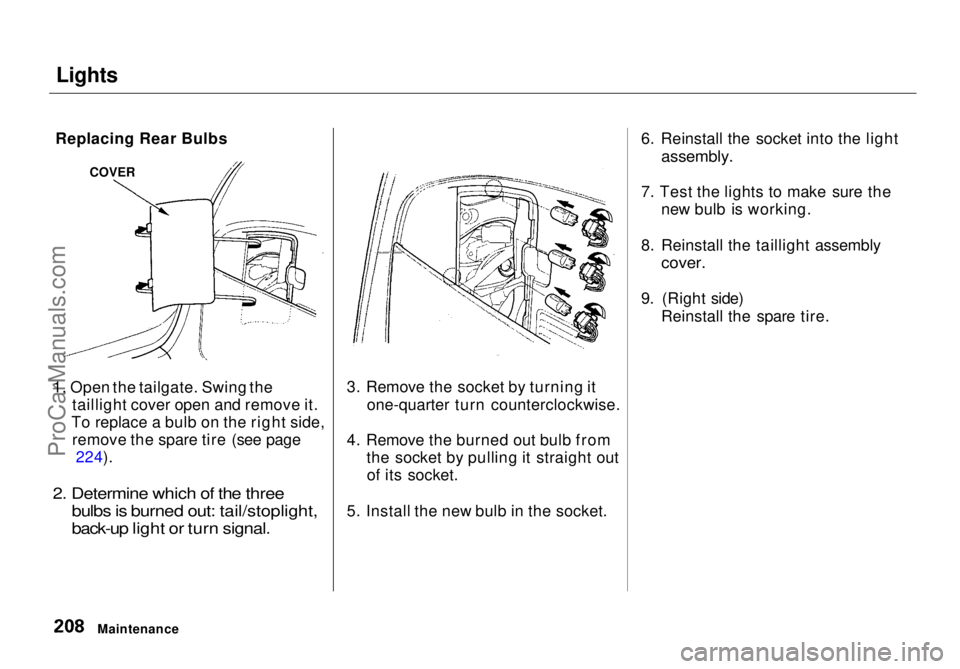
1. Open the tailgate. Swing the taillight cover open and remove it.
To replace a bulb on the right side, remove the spare tire (see page 224).
2. Determine which of the three bulbs is burned out: tail/stoplight,
back-up light or turn signal.
3. Remove the socket by turning it
one-quarter turn counterclockwise.
4. Remove the burned out bulb from the socket by pulling it straight outof its socket.
5. Install the new bulb in the socket. 6. Reinstall the socket into the light
assembly.
7. Test the lights to make sure the new bulb is working.
8. Reinstall the taillight assembly
cover.
9. (Right side) Reinstall the spare tire.
Maintenance
COVER
Replacing Rear BulbsProCarManuals.comMain Menu Table of Contents s t
Page 208 of 272
Lights
Replacing a Rear License Bulb
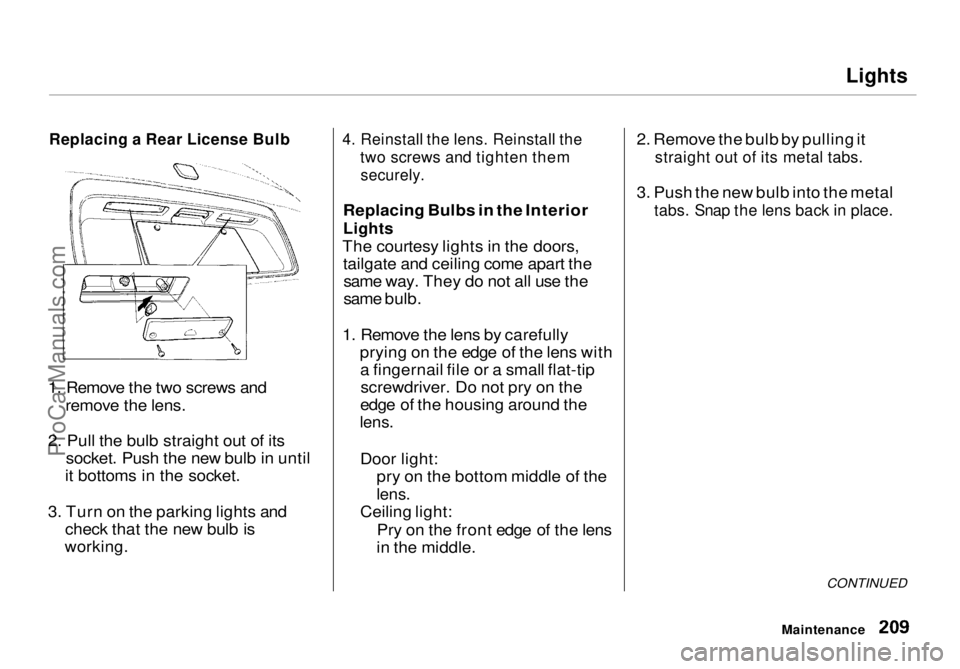
1. Remove the two screws and remove the lens.
2. Pull the bulb straight out of its socket. Push the new bulb in until
it bottoms in the socket.
3. Turn on the parking lights and check that the new bulb is
working.
4. Reinstall the lens. Reinstall the
two screws and tighten them
securely.
Replacing Bulbs in the Interior
Lights
The courtesy lights in the doors, tailgate and ceiling come apart thesame way. They do not all use the
same bulb.
1. Remove the lens by carefully prying on the edge of the lens witha fingernail file or a small flat-tipscrewdriver. Do not pry on the
edge of the housing around the
lens.
Door light: pry on the bottom middle of the
lens.
Ceiling light:
Pry on the front edge of the lens
in the middle. 2. Remove the bulb by pulling it
straight out of its metal tabs.
3. Push the new bulb into the metal
tabs. Snap the lens back in place.
CONTINUED
MaintenanceProCarManuals.comMain Menu Table of Contents s t
Page 209 of 272
Lights
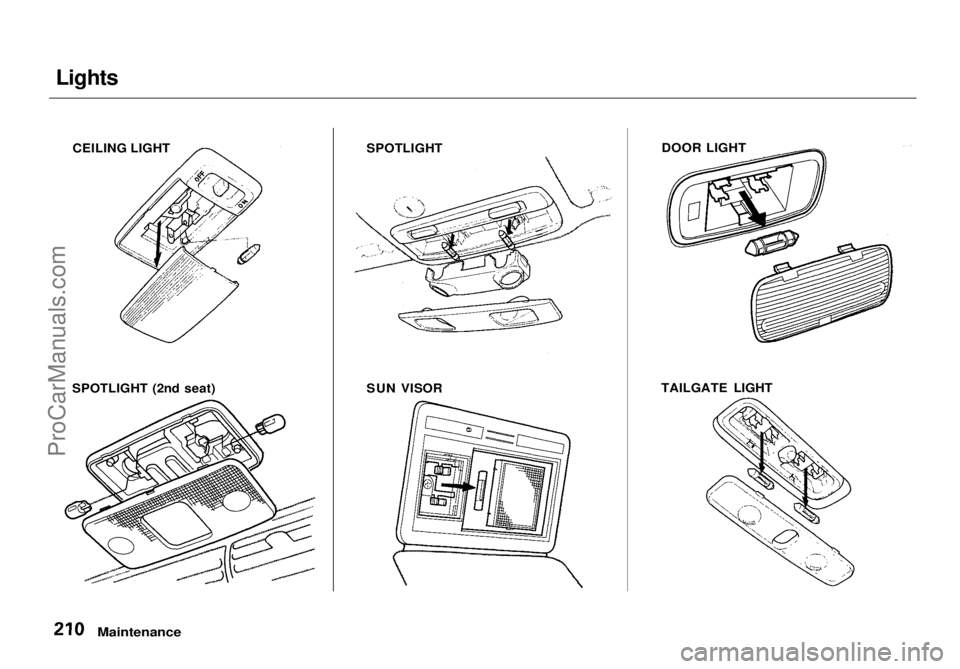
CEILING LIGHT
SPOTLIGHT (2nd seat) SPOTLIGHT
SUN VISOR DOOR LIGHT
TAILGATE LIGHT
MaintenanceProCarManuals.comMain Menu Table of Contents s t
Page 220 of 272
Changing a Flat Tire
If you have a flat tire while driving,
stop in a safe place to change it.
Stopping in traffic or on the shoulder of a busy road is dangerous. Drive
slowly along the shoulder until you
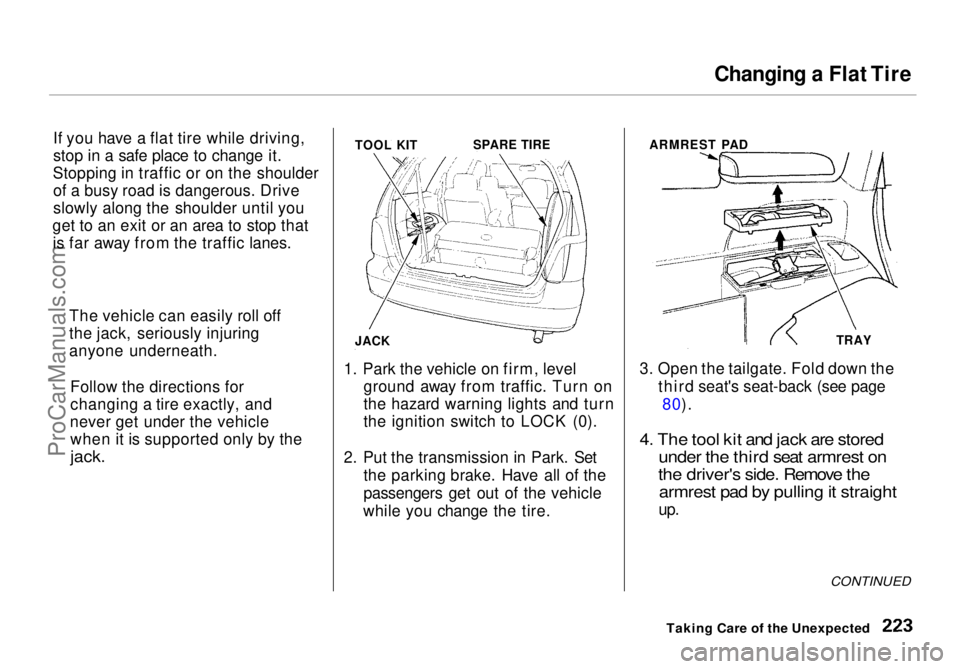
get to an exit or an area to stop that is far away from the traffic lanes. TOOL KIT
SPARE TIRE
JACK
1. Park the vehicle on firm, level ground away from traffic. Turn on
the hazard warning lights and turn
the ignition
switch to LOCK (0).
2. Put the transmission in Park. Set the parking brake. Have all of the
passengers get out of the vehicle
while you change the tire. ARMREST PAD
TRAY
3. Open the tailgate. Fold down the third seat's seat-back (see page80).
4. The tool kit and jack are stored under the third seat armrest on
the driver's side. Remove the armrest pad by pulling it straight
up.
CONTINUED
Taking Care of the Unexpected
The vehicle can easily roll off
the jack, seriously injuring
anyone underneath.
Follow the directions for
changing a tire exactly, and
never get under the vehicle when it is supported only by the
jack.ProCarManuals.comMain Menu Table of Contents s t
Page 226 of 272
If Your Engine Won't Start
Diagnosing why your engine won't start falls into two areas, depending
on what you hear when you turn the
key to START (III):
You hear nothing, or almostnothing. The engine's starter
motor does not operate at all, or
operates very slowly.
You can hear the starter motor operating normally, or the starter
motor sounds like it is spinning
faster than normal, but the engine does not start up and run.
Nothing Happens or the Starter
Motor Operates Very Slowly
When you turn the ignition switch to START (III), you do not hear the
normal noise of the engine trying tostart. You may hear a clicking sound
or series of clicks, or nothing at all.
Check these things: Your vehicle has the Immobilizer
System. You should use a
properly-coded master or valet key
to start the engine (see page 67).
A key that is not properly coded will cause the immobilizer systemindicator in the dash panel to blink
rapidly.
Check the transmission interlock.
The transmission must be in Park or Neutral or the starter will not
operate.
Turn the ignition switch to ON (II).
Turn on the headlights and check their brightness. If the headlightsare very dim or don't light at all,
the battery is discharged. See
Jump Starting on page 230.
Turn the ignition switch to START
(III). If the headlights do not dim,
check the condition of the fuses. If
the fuses are OK, there is proba-
bly something wrong with the electrical circuit for the ignitionswitch or starter motor. You will
need a qualified technician to determine the problem. (See
Towing on page 244.)
If the headlights dim noticeably or
go out when you try to start theengine, either the battery is dis-
charged or the connections are
corroded. Check the condition of
the battery and terminal connec-
tions (see page 189). You can
then try jump starting the vehicle
from a booster battery (see page
231).
Taking Care of the UnexpectedProCarManuals.comMain Menu Table of Contents s t
Page 227 of 272
If Your Engine Won't Start, Jump Starting
The Starter
Operates Normally
In this case, the starter motor's
speed sounds normal, or even faster
than normal, when you turn the
ignition switch to START (III), but
the engine does not run. Are you using the proper startingprocedure? Refer to Starting the
Engine on page 141.
Do you have fuel? Turn the
ignition switch to ON (II) for a
minute and watch the fuel gauge.
The low fuel level warning light may not be working, so you were
not reminded to fill the tank.
There may be an electrical problem, such as no power to the
fuel pump. Check all the fuses (see page 242).
If you find nothing wrong, you will
need a qualified technician to find
the problem. See Towing on page
244.
Jump Starting
If your vehicle's battery has rundown, you may be able to start the
engine by using a booster battery.
Although this seems like a simple procedure, you should take several
precautions.
You cannot start a Honda by pushing or pulling it. To jump start your vehicle, follow
these directions closely:
1. Open the hood and check the physical condition of the battery(see page 189 ). In very cold
weather, check the condition of the electrolyte. If it seems slushyor like ice, do not try jump starting
until it thaws.
If a battery sits in extreme cold, the electrolyte inside can freeze.
Attempting to jump start with a frozen battery can cause it to rupture.
2. Turn off all the electrical acces- sories: heater, A/C, stereo system,
lights, etc.
Put the transmission in Neutral or
Park and set the parking brake.
Taking Care of the Unexpected
A battery can explode if you do
not follow the correct procedure,
seriously injuring anyone nearby.
Keep all sparks, open flames,
and smoking materials away
from the battery.
NOTICEProCarManuals.comMain Menu Table of Contents s t
Page 237 of 272
Fuses
ABS FUSE BOX
The ABS fuse box is in the engine
compartment on the right side.
Checking and Replacing Fuses
If something electrical in your
vehicle stops working, the first thing
you should check for is a blown fuse. Determine from the chart on pages 242 and 243 , or the diagram on the
fuse box lid, which fuse or fuses control that component. Check those
fuses first, but check all the fuses
before deciding that a blown fuse is not the cause. Replace any blown
fuses and check the component's
operation.
1. Turn the ignition switch to LOCK (0). Make sure the headlights and
all other accessories are off.
2. Remove the cover from the fuse box. 3. Check each of the large fuses in
the under-hood fuse box by
looking through the top at the wireinside. Removing these fuses
requires a Phillips-head screw-driver.
Taking Care of the Unexpected
BLOWNProCarManuals.comMain Menu Table of Contents s t
Page 264 of 272

Index
Brakes Anti-lock System (ABS)............ 148
Break-in, New Linings .............. 128
Fluid............................................ 183
Light, Burned-out...................... 196
Parking.......................................... 85
System Indicator.......................... 52
Wear Indicators......................... 147
Brakes, ABS Operation.................................... 148
System Indicator.................. 53, 149
Braking System.............................. 147
Break-in, New Car......................... 128
Brightness Control, Instruments... 59
Brights, Headlights......................... 58
Bulb Replacement Back-up Lights........................... 208
Brake Lights............................... 208
Ceiling Light............................... 210
Front Parking Lights................. 207
Front Side Marker Lights......... 207
Headlights.................................. 206
License Plate Lights.................. 209
Specifications............................. 249
Turn Signal Lights..................... 207
Bulbs, Halogen............................... 206 Cables, Jump Starting With.......... 231
Capacities Chart............................. 248
Carbon Monoxide Hazard.............. 47
Carrying Cargo.............................. 137
Cassette Player Care............................................. 121
Operation............................ 107, 119
CAUTION, Explanation of............... ii
CD Player ............................... 110, 122
Center Pocket.................................. 88
Certification Label......................... 246
Chains............................................. 201
Change Oil
How to......................................... 175
When to....................................... 164
Changing a Flat Tire..................... 223
Changing Engine Coolant............. 179
Charging System Indicator.... 52, 235
Checking Automatic Transmission
Fluid........................................ 182
Battery Condition...................... 189
Brake Fluid................................. 183
Drive Belts.................................. 195
Engine Coolant........................... 132
Engine Oil................................... 131
Fuses........................................... 240
Power Steering Fluid................. 184
Checklist, Before Driving............. 140
Childproof Door Locks................... 72
Cigarette Lighter............................. 89
Cleaner, Air.................................... 185
Cleaning
Aluminum Wheels..................... 215
Carpeting.................................... 216
Exterior....................................... 214
Fabric.......................................... 216
Interior........................................ 216
Seat Belts.................................... 217
Vinyl............................................ 216
Window....................................... 217
CLEAN Light................................. 121
Clock, Setting the ............................ 86
CO in the Exhaust......................... 255
Cold Weather, Starting in............. 141
Compact Spare............................... 222
Consumer Information*................ 260
Controls, Instruments and.............. 49ProCarManuals.comMain Menu s t