1998 HONDA CIVIC COUPE Timing
[x] Cancel search: TimingPage 142 of 251
Maintenance
This section explains why it is important to keep your vehicle well
maintained and to follow basic
maintenance safety precautions.
This section also includes Maintenance Schedules for normaldriving and severe driving conditions,
a Maintenance Record, and instruc-
tions for simple maintenance tasks
you may want to take care of yourself.
If you have the skills and tools to per-
form more complex maintenance tasks on your Honda, you may want
to purchase the Service Manual. See
page 219 for information on how to obtain a copy, or see your Honda
dealer.
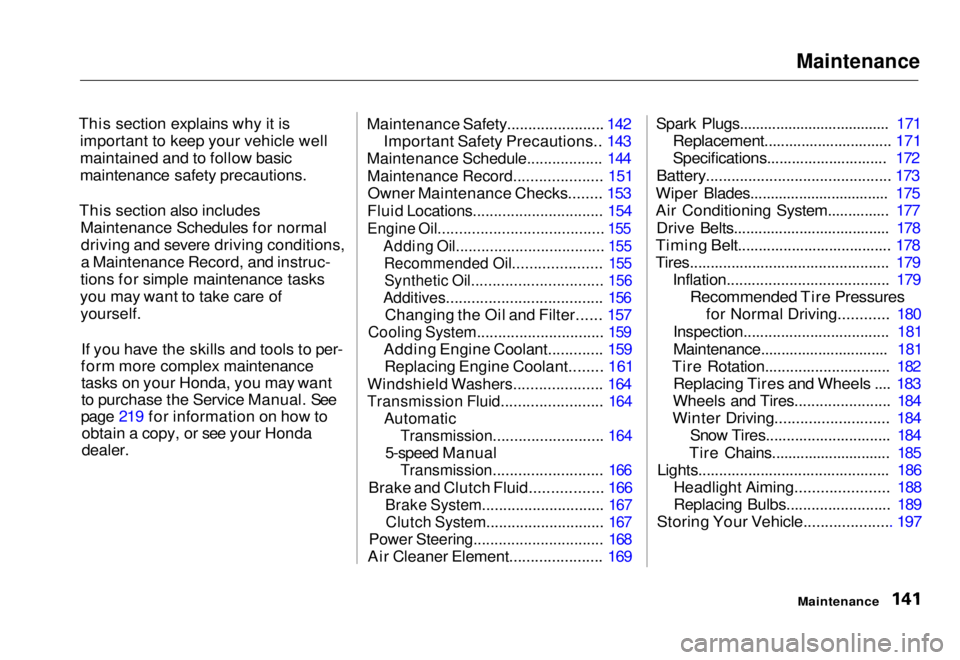
Maintenance Safety....................... 142
Important Safety Precautions.. 143
Maintenance Schedule.................. 144
Maintenance Record..................... 151
Owner Maintenance Checks........ 153
Fluid Locations............................... 154
Engine Oil....................................... 155 Adding Oil................................... 155Recommended Oil..................... 155Synthetic Oil............................... 156
Additives..................................... 156
Changing the Oil and Filter...... 157
Cooling System.............................. 159
Adding Engine Coolant............. 159Replacing Engine Coolant........ 161
Windshield Washers..................... 164
Transmission Fluid........................ 164
Automatic
Transmission.......................... 164
5-speed Manual
Transmission.......................... 166
Brake and Clutch Fluid................. 166
Brake System............................. 167Clutch System............................ 167
Power Steering............................... 168
Air Cleaner Element...................... 169 Spark Plugs..................................... 171
Replacement............................... 171
Specifications............................. 172
Battery............................................ 173
Wiper Blades.................................. 175
Air Conditioning System............... 177 Drive Belts...................................... 178
Timing Belt..................................... 178
Tires................................................ 179 Inflation....................................... 179
Recommended Tire Pressures
for Normal Driving............ 180
Inspection................................... 181
Maintenance............................... 181
Tire Rotation.............................. 182
Replacing Tires and Wheels ....
183
Wheels an d
Tires....................... 184
Winter Driving........................... 184 Snow Tires.............................. 184
Tire Chains............................. 185
Lights.............................................. 186 Headlight Aiming...................... 188
Replacing Bulbs......................... 189
Storing Your Vehicle..................... 197
MaintenanceMain Menu s t
Page 148 of 251
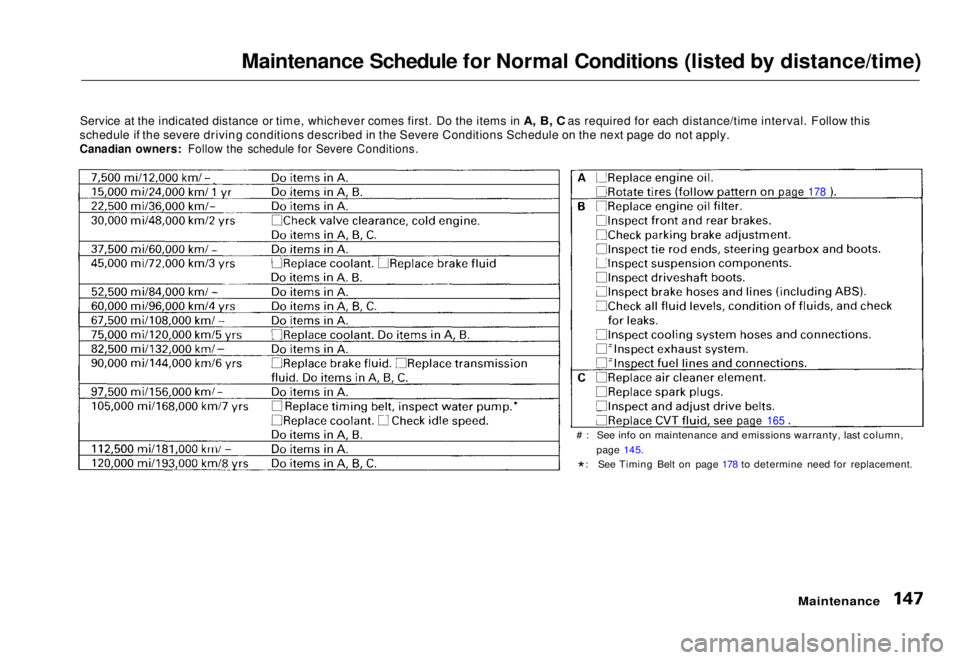
Maintenance Schedule for Normal Conditions (listed by distance/time)
Service at the indicated distance or time, whichever comes first. Do the items in A, B, C as required for each distance/time interval. Follow this
schedule if
the severe driving conditions described in the Severe Conditions Schedule on the next page do not apply.
Canadian owners: Follow the schedule for Severe Conditions.
Maintenance
page 178
page 165
# : See info on maintenance and emissions warranty, last column,
page 145.
* : See Timing Belt on page 178 to determine need for replacement.Main Menu Table of Contents s t
Page 151 of 251
Maintenance
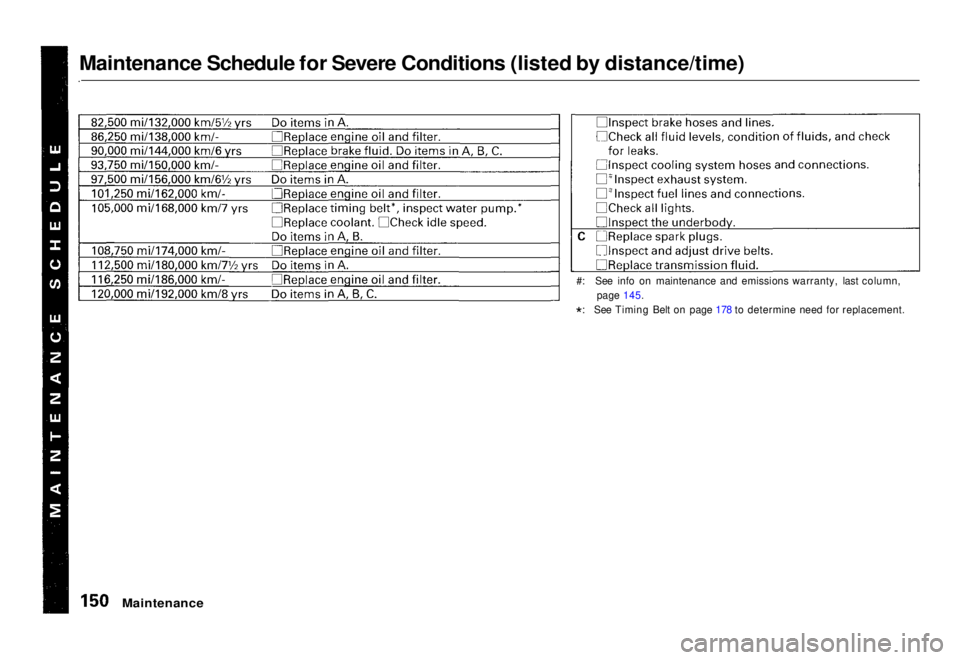
Maintenance Schedule for Severe Conditions (listed by distance/time)
#: See info on maintenance and emissions warranty, last column,page 145.
* : See Timing Belt on page 178 to determine need for replacement.Main Menu Table of Contents s t
Page 179 of 251
Drive Belts, Timing Belt
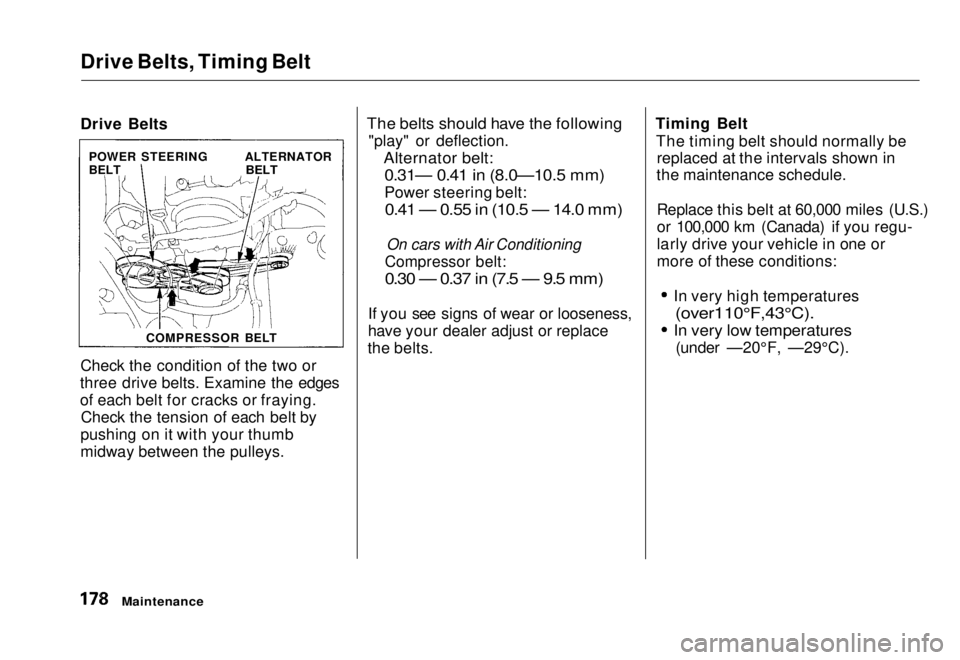
Drive Belts
Check the condition of the two or
three drive belts. Examine the edges
of each belt for cracks or fraying. Check the tension of each belt by
pushing on it with your thumb
midway between the pulleys.
The belts should have the following
"play" or deflection.
Alternator belt:
0.31— 0.41 in (8.0—10.5 mm)
Power steering belt:
0.41 — 0.55 in (10.5 — 14.0 mm)
On cars with Air Conditioning
Compressor belt:
0.30 — 0.37 in (7.5 — 9.5 mm)
If you see signs of wear or looseness,
have your dealer adjust or replace
the belts. Timing Belt
The timing belt should normally be replaced at the intervals shown in
the maintenance schedule.
Replace this belt at 60,000 miles (U.S.)
or 100,000 km (Canada) if you regu-
larly drive your vehicle in one or
more of these conditions: In very high temperatures
(over110°F,43°C).
In very low temperatures
(under —20°F, —29°C).
Maintenance
POWER STEERING
BELT
ALTERNATOR
BELT
COMPRESSOR BELTMain Menu Table of Contents s t
Page 229 of 251
Technical Information
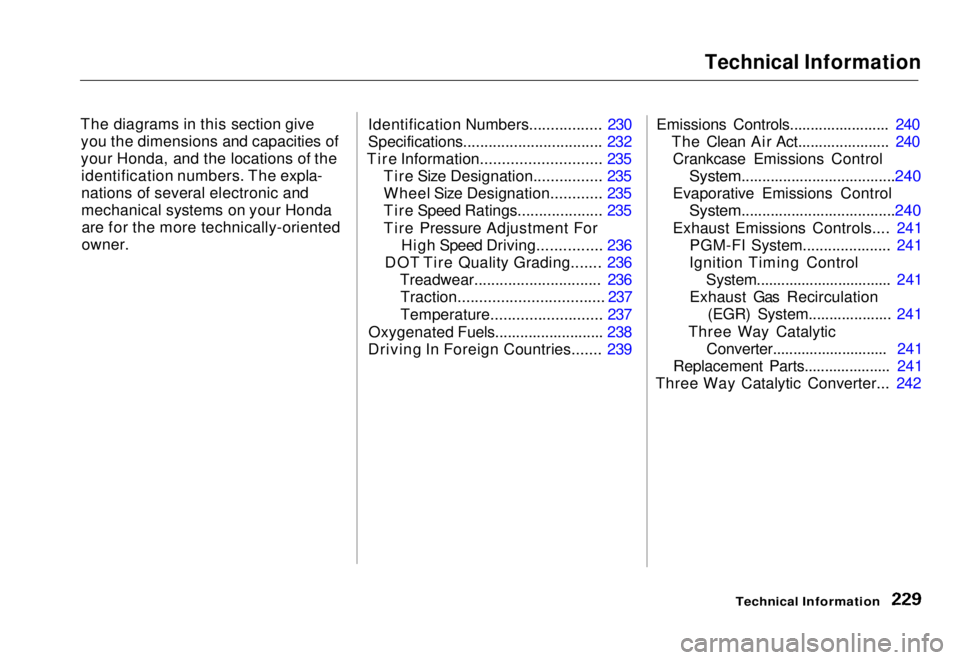
The diagrams in this section give you the dimensions and capacities of
your Honda, and the locations of theidentification numbers. The expla-
nations of several electronic and
mechanical systems on your Hondaare for the more technically-oriented
owner. Identification Numbers................. 230
Specifications................................. 232
Tire Information............................ 235 Tire Size Designation................ 235
Wheel Size Designation............ 235
Tire Speed Ratings.................... 235
Tire Pressure Adjustment For High Speed Driving............... 236
DOT Tire Quality Grading....... 236 Treadwear.............................. 236Traction.................................. 237
Temperature.......................... 237
Oxygenated Fuels.......................... 238
Driving In Foreign Countries....... 239 Emissions Controls........................ 240
The Clean Air Act...................... 240Crankcase Emissions Control
System.....................................240
Evaporative Emissions Control
System.....................................240
Exhaust Emissions Controls.... 241 PGM-FI System..................... 241
Ignition Timing Control System................................. 241
Exhaust Gas Recirculation (EGR) System.................... 241
Three Way Catalytic Converter............................ 241
Replacement Parts..................... 241
Three Way Catalytic Converter... 242
Technical InformationMain Menu s t
Page 241 of 251
Emissions Controls
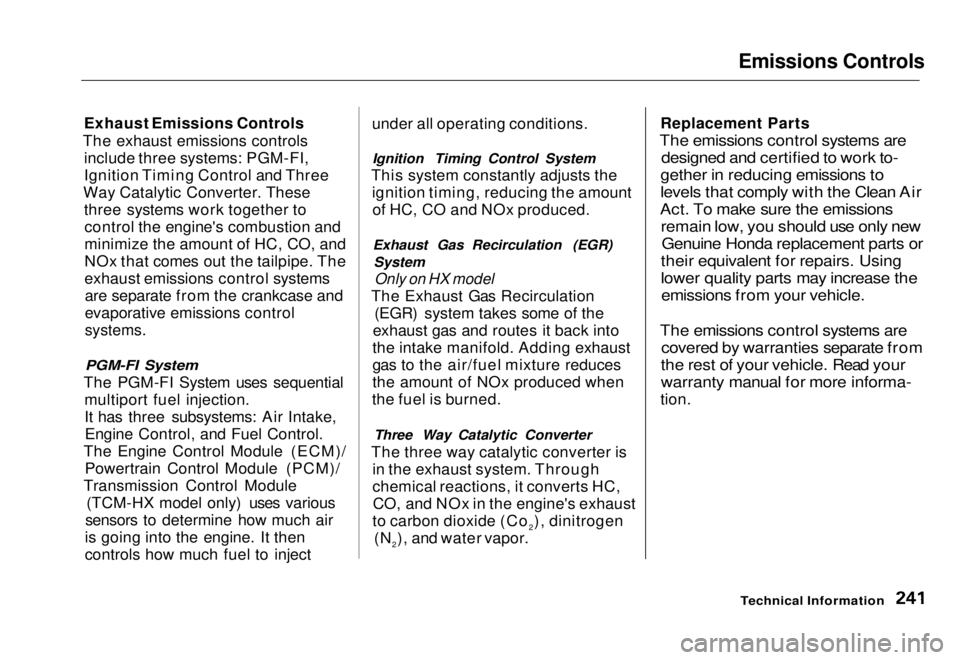
Exhaust Emissions Controls
The exhaust emissions controls include three systems: PGM-FI,
Ignition Timing Control and Three
Way Catalytic Converter. These three systems work together tocontrol the engine's combustion and
minimize the amount of HC, CO, and
NOx that comes out the tailpipe. The
exhaust emissions control systemsare separate from the crankcase and
evaporative emissions control
systems.
PGM-FI System
The PGM-FI System uses sequential multiport fuel injection.
It has three subsystems: Air Intake,Engine Control, and Fuel Control.
The Engine Control Module (ECM)/ Powertrain Control Module (PCM)/
Transmission Control Module (TCM-HX model only) uses various
sensors to determine how much air
is going into the engine. It then
controls how much fuel to inject under all operating conditions.
Ignition Timing Control System
This system constantly adjusts the ignition timing, reducing the amountof HC, CO and NOx produced.
Exhaust Gas Recirculation (EGR)
System
Only on HX model
The Exhaust Gas Recirculation (EGR) system takes some of the
exhaust gas and routes it back into
the intake manifold. Adding exhaust
gas to the air/fuel mixture reduces
the amount of NOx produced when
the fuel is burned.
Three Way Catalytic Converter
The three way catalytic converter is in the exhaust system. Through
chemical reactions, it converts HC,CO, and NOx in the engine's exhaust
to carbon dioxide (Co2), dinitrogen (N2), and water vapor. Replacement Parts
The emissions control systems are designed and certified to work to-
gether in reducing emissions to
levels that comply with the Clean Air
Act. To make sure the emissions remain low, you should use only newGenuine Honda replacement parts or
their equivalent for repairs. Using
lower quality parts may increase the
emissions from your vehicle.
The emissions control systems are covered by warranties separate from
the rest of your vehicle. Read your
warranty manual for more informa-
tion.
Technical InformationMain Menu Table of Contents s t
Page 251 of 251
Index
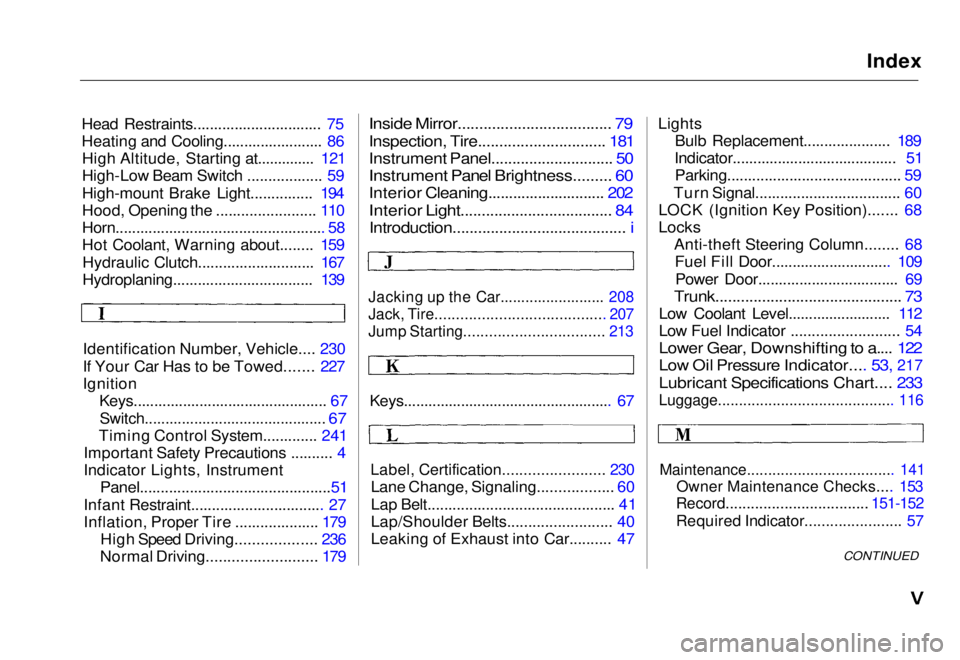
Head Restraints............................... 75
Heating and Cooling........................ 86 High Altitude, Starting at.............. 121
High-Low Beam Switch .................. 59
High-mount Brake Light............... 194
Hood, Opening the ........................ 110
Horn................................................... 58
Hot Coolant, Warning about........ 159
Hydraulic Clutch............................ 167
Hydroplaning.................................. 139
Identification Number, Vehicle.... 230
If Your Car Has to be Towed....... 227
Ignition
Keys............................................... 67
Switch............................................ 67
Timing Contro l
System............. 241
Important Safety Precautions .......... 4
Indicator Lights, Instrument
Panel..............................................51
Infant Restraint................................ 27
Inflation, Proper Tire .................... 179 High Speed Driving................... 236
Normal Driving.......................... 179
Inside Mirror.................................... 79
Inspection, Tire.............................. 181
Instrument Panel............................. 50
Instrument Panel Brightness......... 60
Interior Cleaning............................ 202
Interior Light.................................... 84
Introduction......................................... i
Jacking up the Car......................... 208
Jack, Tire........................................ 207
Jump Starting................................. 213
Keys................................................... 67
Label, Certification........................ 230
Lane Change, Signaling.................. 60
Lap Belt............................................. 41
Lap/Shoulder Belts......................... 40
Leaking of Exhaust into Car.......... 47 Lights
Bulb Replacement..................... 189
Indicator........................................ 51 Parking.......................................... 59
Turn Signal................................... 60
LOCK (Ignition Key Position)....... 68
Locks
Anti-theft Steering Column........ 68Fuel Fill Door............................. 109
Power Door.................................. 69
Trunk............................................ 73
Low Coolant Level......................... 112
Low Fuel Indicator .......................... 54
Lower Gear, Downshifting to a.... 122
Low Oil Pressure Indicator.... 53,
217
Lubricant Specification s
Chart.... 233
Luggage.......................................... 116
Maintenance................................... 141
Owner Maintenance Checks.... 153
Record.................................. 151-152
Required Indicator....................... 57
CONTINUEDMain Menu s t