Page 157 of 251
Engine Oil
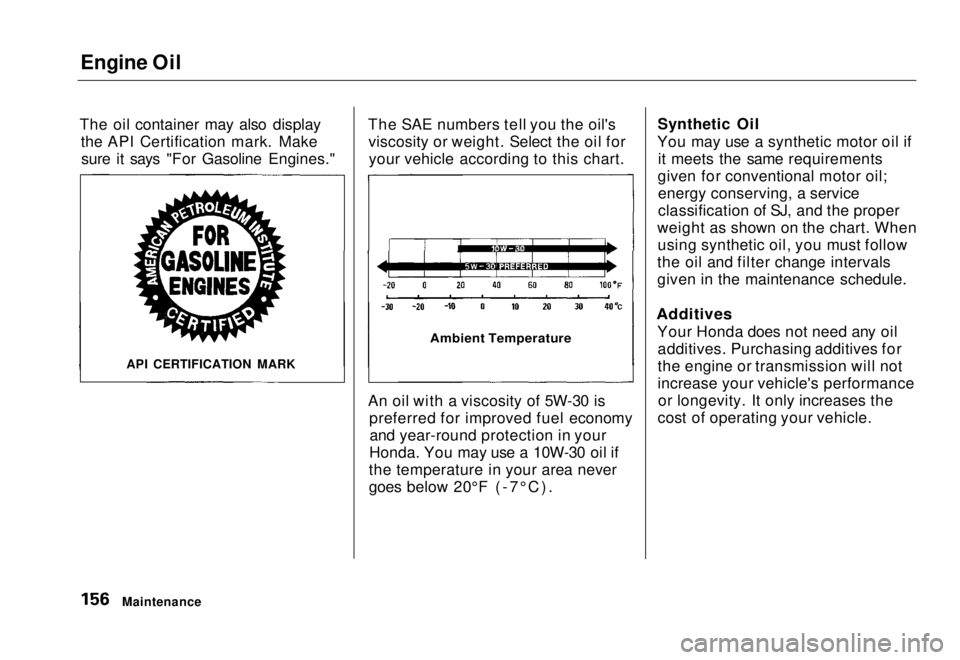
The oil container may also display the API Certification mark. Makesure it says "For Gasoline Engines." The SAE numbers tell you the oil's
viscosity or weight. Select the oil foryour vehicle according to this chart.
An oil with a viscosity of 5W-30 is preferred for improved fuel economyand year-round protection in your
Honda. You may use a 10W-30 oil if
the temperature in your area never
goes below 20°F (-7°C). Synthetic Oil
You may use a synthetic motor oil if it meets the same requirements
given for conventional motor oil; energy conserving, a service
classification of SJ, and the proper
weight as shown on the chart. When using synthetic oil, you must follow
the oil and filter change intervals
given in the maintenance schedule.
Additives
Your Honda does not need any oiladditives. Purchasing additives for
the engine or transmission will not
increase your vehicle's performanceor longevity. It only increases the
cost of operating your vehicle.
Maintenance API CERTIFICATION MARK
Ambient TemperatureMain Menu Table of Contents s t
Page 158 of 251
Engine Oil
Changing the Oil and Filter
Always change the oil and filter according to the time and distance (miles/kilometers) recommenda-
tions in the maintenance schedule.
The oil and filter collect contami- nants that can damage your engine if
they are not removed regularly.
Changing the oil and filter requires
special tools and access from
underneath the vehicle. The vehicle should be raised on a service station-
type hydraulic lift for this service.
Unless you have the knowledge and
proper equipment, you should have
this maintenance done by a skilled
mechanic.
1. Run the engine until it reaches
normal operating temperature,
then shut it off.
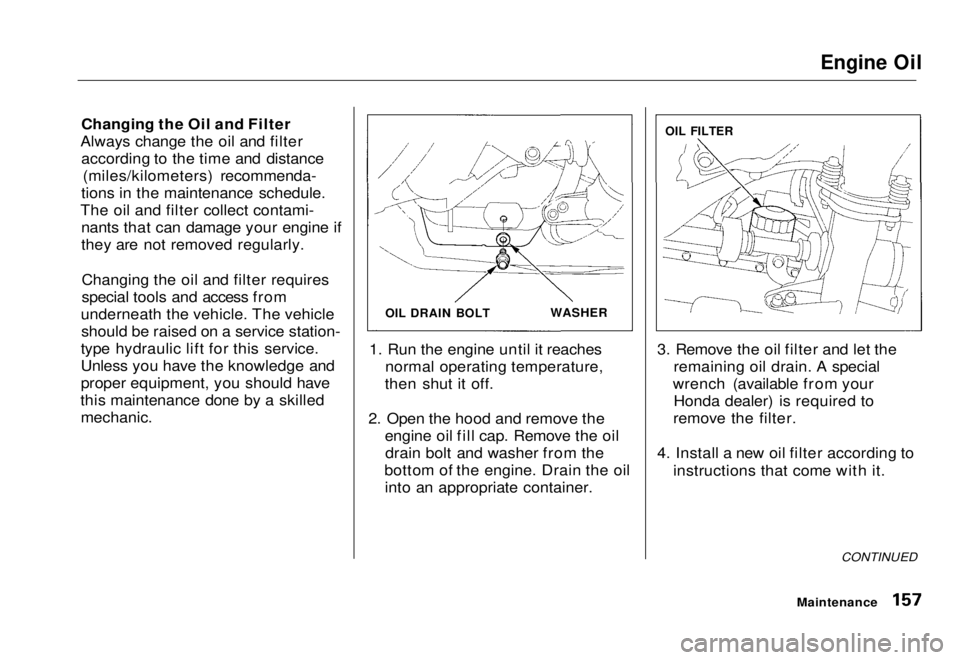
2. Open the hood and remove the engine oil fill cap. Remove the oildrain bolt and washer from the
bottom of the engine. Drain the oil into an appropriate container. 3. Remove the oil filter and let the
remaining oil drain. A special
wrench (available from your Honda dealer) is required to
remove the filter.
4. Install a new oil filter according to instructions that come with it.
CONTINUED
Maintenance
OIL DRAIN BOLT
WASHER
OIL FILTERMain Menu Table of Contents s t
Page 159 of 251
Engine Oil
5. Put a new washer on the drain bolt,
then reinstall the drain bolt.
Tighten it to:
(DX)
33 lbf.ft (44 N.m, 4.5 kgf.m)
(U.S.: HX, EX, Canada: Si)
29 Ibf.ft (39 N.m , 4.0 kgf.m)
6. Refill the engine with the recom-
mended oil.
Engine oil change capacity
(including filter):
(DX)
3.8 US qt (3.6 ,3.2 Imp qt)
(U.S.: HX, EX, Canada: Si)
3.5 US qt (3.3 ,2.9 Imp qt) 7. Replace the engine oil fill cap.
Start the engine. The oil pressure
indicator light should go out within
five seconds. If it does not, turn off the engine and reinspect your
work.
8. Let the engine run for several minutes and check the drain bolt
and oil filter for leaks.
9. Turn off the engine, let it sit for several minutes, then check the oil
level. If necessary, add oil to bring
the level to the upper mark on the
dipstick.
Improper disposal of engine oil can be
harmful to the environment. If you
change your own oil, please dispose of
the used oil properly. Put it in a sealed
container and take it to a recycling
center. Do not discard it in a trash bin
or dump it on the ground.
Maintenance
NOTICEMain Menu Table of Contents s t
Page 160 of 251
Cooling System
Adding Engine Coolant
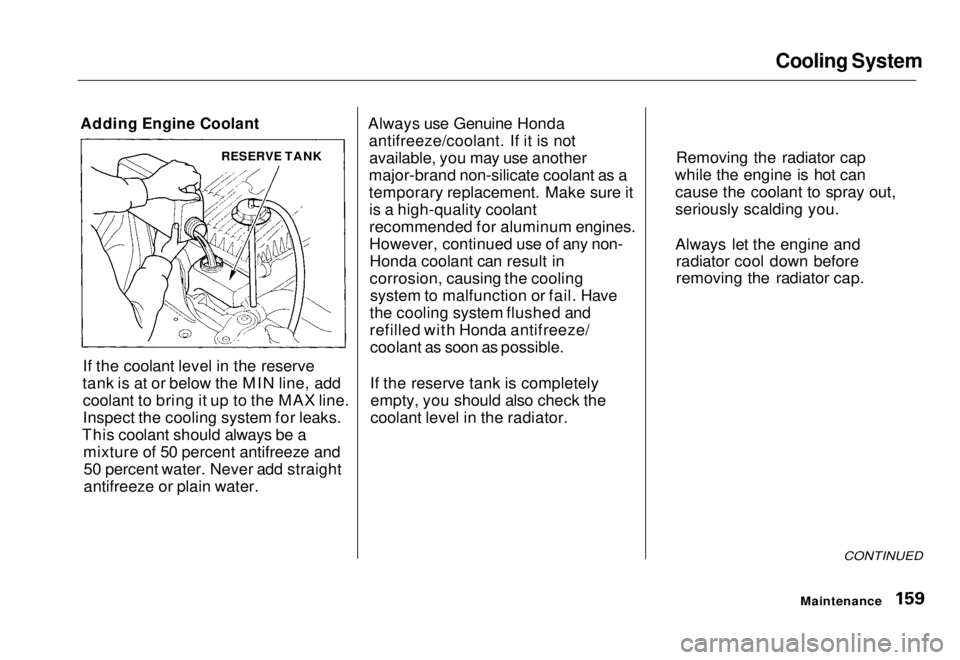
If the coolant level in the reserve
tank is at or below the MIN line, add coolant to bring it up to the MAX line.
Inspect the cooling system for leaks.
This coolant should always be a mixture of 50 percent antifreeze and50 percent water. Never add straight
antifreeze or plain water. Always use Genuine Honda
antifreeze/coolant. If it is notavailable, you may use another
major-brand non-silicate coolant as a
temporary replacement. Make sure it is a high-quality coolant
recommended for aluminum engines.
However, continued use of any non-Honda coolant can result in
corrosion, causing the coolingsystem to malfunction or fail. Have
the cooling system flushed and
refilled with Honda antifreeze/ coolant as soon as possible.
If the reserve tank is completelyempty, you should also check the
coolant level in the radiator.
CONTINUED
RESERVE TANK
Maintenance
Removing the radiator cap
while the engine is hot can cause the coolant to spray out,
seriously scalding you.
Always let the engine and radiator cool down before
removing the radiator cap.Main Menu Table of Contents s t
Page 161 of 251
Cooling System
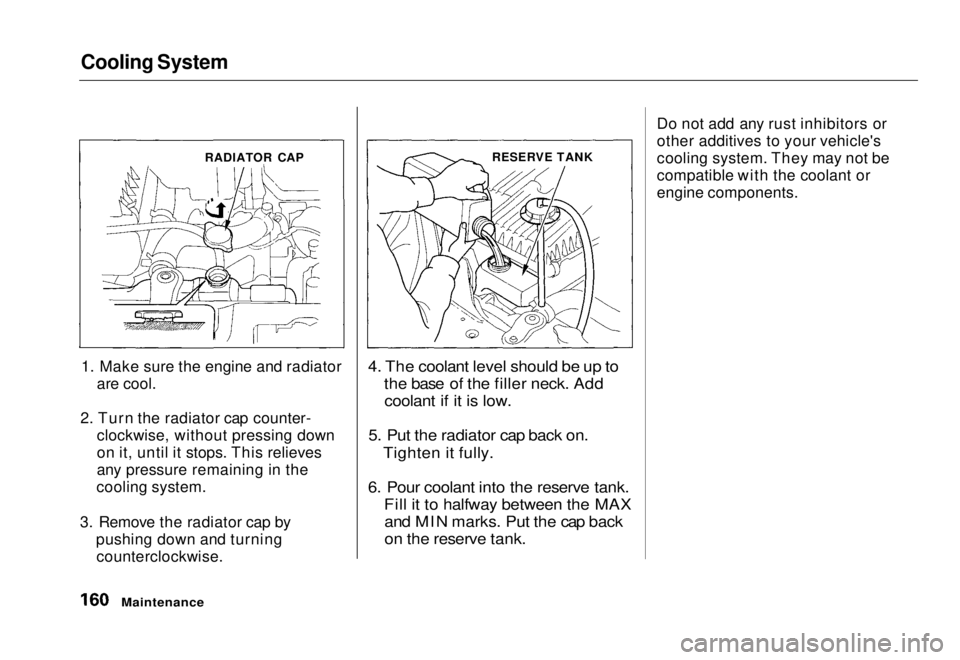
1. Make sure the engine and radiator are cool.
2. Turn the radiator cap counter- clockwise, without pressing down
on it, until it stops. This relieves
any pressure remaining in the
cooling system.
3. Remove the radiator cap by pushing down and turningcounterclockwise.
4. The coolant level should be up to
the base of the filler neck. Addcoolant if it is low.
5. Put the radiator cap back on. Tighten it fully.
6. Pour coolant into the reserve tank. Fill it to halfway between the MAXand MIN marks. Put the cap back
on the reserve tank.
Do not add any rust inhibitors or
other additives to your vehicle's
cooling system. They may not be
compatible with the coolant or
engine components.
Maintenance
RADIATOR CAP
RESERVE TANKMain Menu Table of Contents s t
Page 162 of 251
Cooling System
Replacing Engine Coolant
The cooling system should be completely drained and refilled with
new coolant according to the time and distance recommendations in
the maintenance schedule. Only use Genuine Honda antifreeze/coolant.
Draining the coolant requires access
to the underside of the vehicle. Unless you have the tools and
knowledge, you should have this maintenance done by a skilled
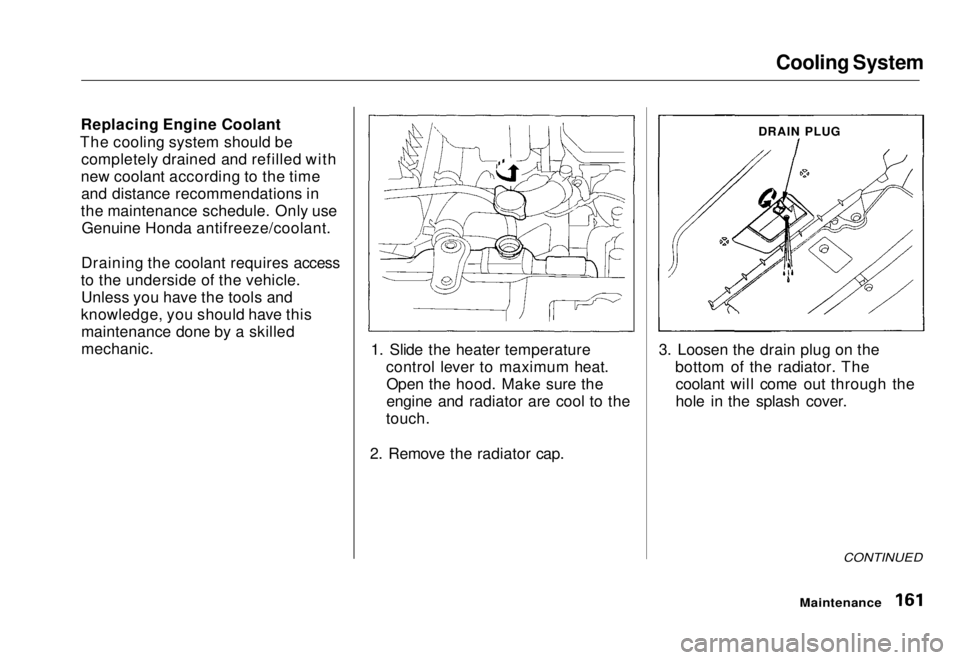
mechanic. 1. Slide the heater temperature
control lever to maximum heat.Open the hood. Make sure the
engine and radiator are cool to the
touch.
2. Remove the radiator cap. 3. Loosen the drain plug on the
bottom of the radiator. Thecoolant will come out through the
hole in the splash cover.
CONTINUED
Maintenance
DRAIN PLUGMain Menu Table of Contents s t
Page 164 of 251
Cooling System
8. Start the engine and let it run until it warms up (the radiator cooling
fan comes on at least twice).
9. Turn off the engine. Check the level in the radiator, add coolant ifneeded. Install the radiator cap,
and tighten it fully.
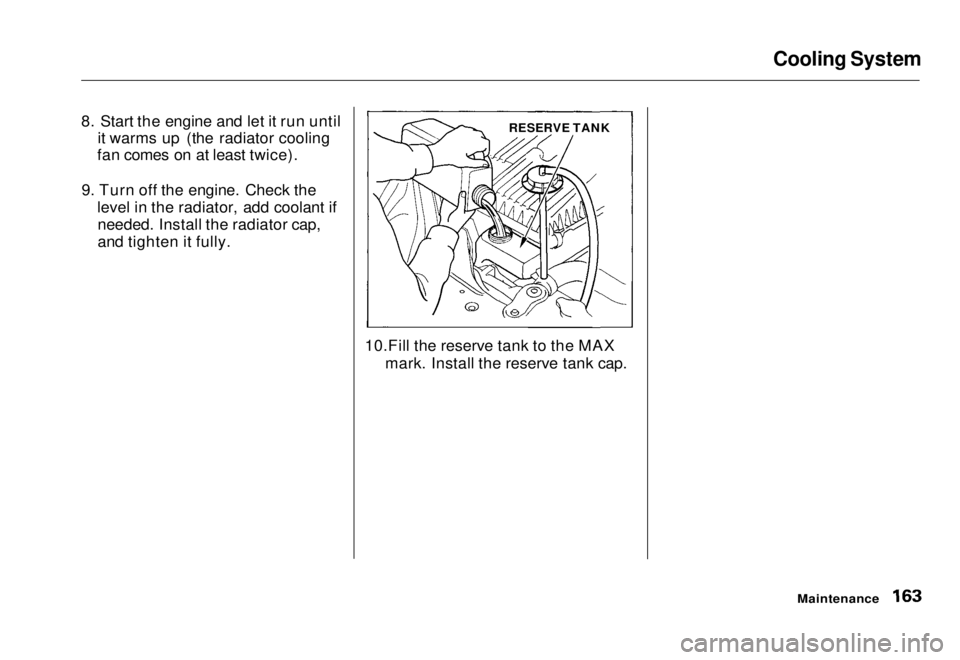
10.Fill the reserve tank to the MAXmark. Install the reserve tank cap.
Maintenance
RESERVE TANKMain Menu Table of Contents s t
Page 165 of 251
Windshield Washers, Transmission Fluid
Check the level in the windshield
washer reservoir at least monthly during normal usage. In bad weather,
when you use the washers often, check the level every time you stop
for fuel.
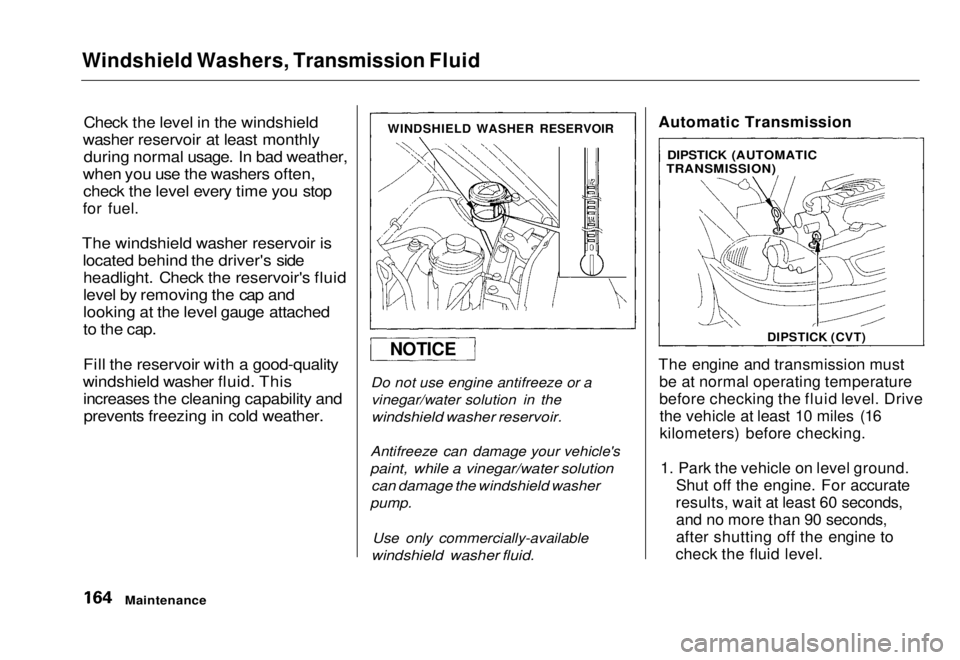
The windshield washer reservoir is located behind the driver's sideheadlight. Check the reservoir's fluid
level by removing the cap and
looking at the level gauge attached
to the cap.
Fill the reservoir with a good-quality
windshield washer fluid. This increases the cleaning capability andprevents freezing in cold weather. Do not use engine antifreeze or a
vinegar/water solution in the
windshield washer reservoir.
Antifreeze can damage your vehicle's
paint, while a vinegar/water solution
can damage the windshield washer
pump.
Use only commercially-available
windshield washer fluid.
Automatic Transmission
The engine and transmission must
be at normal operating temperature
before checking the fluid level. Drivethe vehicle at least 10 miles (16
kilometers) before checking.
1. Park the vehicle on level ground. Shut off the engine. For accurate
results, wait at least 60 seconds, and no more than 90 seconds,
after shutting off the engine to
check the fluid level.
Maintenance
WINDSHIELD WASHER RESERVOIR
NOTICE
DIPSTICK (AUTOMATIC
TRANSMISSION)
DIPSTICK (CVT)Main Menu Table of Contents s t